Category Archives: quatrains

Jerome Betts, ‘Lines On A Lady In Bronze’

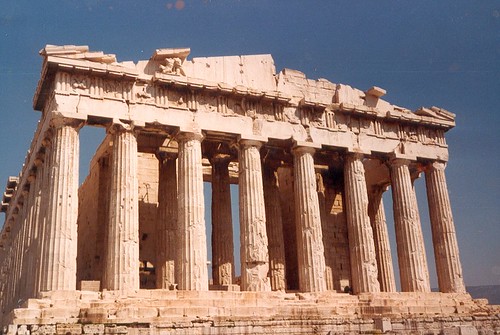
(The statue of Boadicea and her Daughters by Thomas Thornycroft was erected in 1902 near Westminster Bridge London.)

Set up, the civic skyline Shardless,
A proxy late Victoria then,
She charges, rein-free, grim, regardless,
Towards the Gothic giant, Big Ben.

Just what is known about this fiery
And long ago wronged ruler’s life?
Such fields for scholarly enquiry
Are now churned up by toxic strife.

For some, her Roman power rejection
Makes for a memory well kept green,
While others mock as myth-confection
Their proto-Brexit British queen.

Remainers, Leavers, play Have at you!
That chariot and rearing pair
Of  horses make a super statue.
Whoever wins, she’ll still be there.

*****

Jerome Betts writes: “I find statues fascinating with their largely unchanging nature as the people and scenes around them change and they make an obvious target for revolutionaries, rowdies and rhymers. Boadicea, unveiled without ceremony in 1902 because of Edward the 7th’s appendicitis, strikes me as a splendid piece of slightly unhistorical sculpture and useful landmark for visitors. Amusement at her lack of reins and apparent charge towards the Palace of Westminster blended with the Brexit debate when the piece was published in Better Than Starbucks. Whether this dooms the last two stanzas to the archives remains to be seen.”

Jerome Betts lives in Devon, England, where he edits the quarterly Lighten Up Online. Pushcart-nominated twice, his verse has appeared in a wide variety of UK publications and in anthologies such as Love Affairs At The Villa NelleLimerick Nation, The Potcake Chapbooks 1, 2 and 12, and Beth Houston’s three Extreme collections. British, European, and North American web venues include Amsterdam QuarterlyBetter Than StarbucksLightThe Asses of ParnassusThe HypertextsThe New Verse News, and Snakeskin.

Photo: “Boadicea Statuary Group” by Rafesmar is licensed under CC BY-SA 3.0.

Shamik Banerjee, ‘Memories of a Flood’

For one full week, the sun was dead,
     unloosening the gray,
wild clouds that swamped each paddy bed—
     the plowman’s great dismay.

The regal night sky, once agleam,
     was purloined of its stars.
Each lane became a water stream.
     Dinghies replaced the cars.

Mazdoors, waist-hidden, waded to
     their distant factory sites.
The Tongas‘ (since they were a few)
     demand reached greater heights.

But our town did what it does best—
     it kept the hoo-ha going.
In every church and temple’s chest,
     hope’s candles were still glowing.

On the roadside estaminets,
     sports went with malt whisky,
and there were pleasant tête-à-têtes
     on every balcony.


Mazdoor: an unskilled labourer
Tonga: a light horse-drawn two-wheeled vehicle
‘Memories of a Flood’ was first published in the San Antonio Review..

Shamik Banerjee is a poet from Assam, India. Some of his recent publications include Spelt, Ink Sweat & Tears, St. Austin Review, Modern Reformation, San Antonio Review, The Society of Classical Poets, Third Wednesday, California Quarterly, and Amethyst Review, among others.

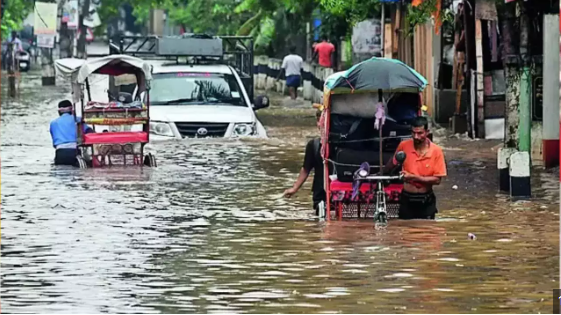
Photo: Times of India, July 5, 2024

Weekend read: Cherokee myth: “Nursery Rhyme for Lazy Children” by Jennifer Reeser

They live at bottom of the deep
In ocean waters or in fresh.
They feed with greed on human flesh.
They kill the ones who oversleep.

You never will be fully grown.
They shoot with arrows while you dream,
Then drag you down like cod or bream,
But first replace you with a clone.

They leave it sleeping in your tent.
It has your eyes. It has your cheeks.
It wakes up early and it speaks.
The tribe won’t wonder where you went.

It does your chores and may amaze.
Like you, it plays and even thinks
But very soon, your double shrinks
And it will die in seven days.

Your people will not ever know.
You’ll never love. You’ll never marry.
Your twin’s the one that they will bury
For you’ve gone where the fish bones go.

But if you listen you will thrive:
Get out of bed and brush your hair.
The hunter’s coming. Be aware
Lest you be swallowed up, alive.

*****

Jennifer Reeser’s ‘Nursery Rhyme for Lazy Children’ was first published in New Verse Review. She cites the following Cherokee myth, ‘The Water Cannibals‘:

Besides the friendly Nûñnë’hï of the streams and mountains there is a race of cannibal spirits, who stay at the bottom of the deep rivers and live upon human flesh, especially that of little children. They come out just after daybreak and go about unseen from house to house until they find some one still asleep, when they shoot him with their invisible arrows and carry the dead body down under the water to feast upon it. That no one may know what has happened they leave in place of the body a shade or image of the dead man or little child, that wakes up and talks and goes about just as he did, but there is no life in it, and in seven days it withers and dies, and the people bury it and think they are burying their dead friend. It was a long time before the people found out about this, but now they always try to be awake at daylight and wake up the children, telling them “The hunters are among you.”

This is the way they first knew about the water cannibals: There was a man in Tïkwäli’tsï town who became sick and grew worse until the doctors said he could not live, and then his friends went away from the house and left him alone to die, They were not so kind to each other in the old times as they are now, because they were afraid of the witches that came to torment dying people.

He was alone several days, not able to rise from his bed, when one morning an old woman came in at the door. She looked just like the other women of the settlement, but he did not know her. She came over to the bed and said, “You are very sick and your friends seem to have left you. Come with me and I will make you well.” The man was so near death that he could not move, but now her words made him feel stronger at once, and he asked her where she wanted him to go. “We live close by; come with me and I will show you,” said the woman, so he got up from his bed and she led the way down to the water. When she came to the water she stepped in and he followed, and there was a road under the water, and another country there just like that above.

They went on until they came to a settlement with a great many houses, and women going about their work and children playing. They met a party of hunters coming in from a hunt, but instead of deer or bear quarters hanging from their shoulders they carried the bodies of dead men and children, and several of the bodies the man knew for those of his own friends in Tïkwäli’tsï. They came to a house and the woman said “This is where I live,” and took him in and fixed a bed for him and made him comfortable.

By this time he was very hungry, but the woman knew his thoughts and said, “We must get him something to eat. She took one of the bodies that the hunters had just brought in and cut off a slice to roast. The man was terribly frightened, but she read his thoughts again and said, “I see you can not eat our food.” Then she turned away from him and held her hands before her stomach–so–and when she turned around again she had them full of bread and beans such as he used to have at home.

So it was every day, until soon he was well and strong again. Then she told him he might go home now, but he must be sure not to speak to anyone for seven days, and if any of his friends should question him he must make signs as if his throat were sore and keep silent. She went with him along the same trail to the water’s edge, and the water closed over her and he went back alone to Tïkwäli’tsï. When he came there his friends were surprised, because they thought he had wandered off and died in the woods. They asked him where he had been, but he only pointed to his throat and said nothing, so they thought he was not yet well and let him alone until the seven days were past, when he began to talk again and told the whole story.

*****

Jennifer Reeser is the author of seven books of poetry. She is an author with Penguin Random House, London’s “Everyman’s Library” series, and Able Muse. Her poems, translations, essays and critical reviews have appeared internationally in POETRY, The Hudson Review, RATTLE, and elsewhere, with new work forthcoming in Nimrod from the University of Tulsa. She divides her time between her Gulf Coast estate and home on the Cherokee reservation in Indian Country, Oklahoma.

It’s too late to take up ‘sleeping in’ kid, time for school 🙂” by Brent Halstead is licensed under CC BY-NC 2.0.
Using form: Quatrains with refrain: Jerome Betts, ‘Plus ça change. . .’

If, as a child, he had a spreading rash,
The squitters, then, far worse, was constipated,
Or boasted big blue bruise and graze and gash,
A doctor murmured, “Yes, it’s age-related.”

When, in mid-life, and seeking novel thrills,
He got a dose of something best not stated
So had to suffer jabs and bitter pills,
A doctor murmured, “Yes, it’s age-related.”

Come his declining years, which tax most brains,
His wits would wander, now grown antiquated,
And while he rambled down his memory’s lanes
A doctor murmured, “Yes, it’s age-related.”

Until, one day of flowers and muffled peals,
Cause of demise at last certificated,
As up the aisle he rolled, worm-food on wheels,
A doctor murmured, “Yes, it’s age-related.”

*****

Jerome Betts writes: “Hearing a phrase new to you can start some process in the brain leading toa piece of verse. Here it was my GP saying of some minor ailment It’s age-related. It stuck in my mind, and I think triggered a recollection of a Thomas Hood poem, The Doctor, its seven stanzas all ending with the refrain Yes, yes, said the Doctor, / I meant it for that!, the dodgy physician’s unvarying response to reports of the disastrous effects, even death, of his prescriptions. Not long after, the sight of a hearse on wheels rather than on bearers’ shoulders entering a Devon church provided the idea for the last stanza of this essay in black humour which appeared in Snakeskin.

Jerome Betts lives in Devon, England, where he edits the quarterly Lighten Up Online. Pushcart-nominated twice, his verse has appeared in a wide variety of UK publications and in anthologies such as Love Affairs At The Villa NelleLimerick Nation, The Potcake Chapbooks 1, 2 and 12, and Beth Houston’s three Extreme collections. British, European, and North American web venues include Amsterdam QuarterlyBetter Than StarbucksLightThe Asses of ParnassusThe HypertextsThe New Verse News, and  Snakeskin.

Illustration: “Great Grandfather and Child” by Melissa Flores is licensed under CC BY-NC-ND 2.0.

Melissa Balmain: ‘A Super-Subtle Metaphor’

(For my son)

Dear Unruly Backyard Maple:
I’ve been clipping you for years,
convinced that efforts to reshape’ll
pay for one who perseveres.

But now I get it, stubborn maple –
though I’ve trained your docile peers,
my double-bladed snip and scrape’ll
never give you classic tiers.

And I am seeing, steadfast maple,
how your tousled crown endears:
you shelter birds; come spring, your drape’ll
glow just like a chandelier’s.

So please forgive me, patient maple,
if it’s not too late, for here’s
my blessing, solemn as the papal.
Grow your way.
                        Love, Pruning Shears

*****

Melissa Balmain writes: “Looking back at poems I’ve written for and about my family, I realize many are metaphorical. I suspect that metaphor–like rhyme and meter–helps steer me toward interesting thoughts and away from over-sentimentality. (Whether my son agrees has yet to be seen!)”

‘A Super-Subtle Metaphor’ is the lead poem in the current issue of Lighten Up Online.

Melissa Balmain’s third poetry collection, Satan Talks to His Therapist, is available from Paul Dry Books (and from all the usual retail empires). Balmain is the editor-in-chief of Light, America’s longest-running journal of light verse, and has been a member of the University of Rochester’s English Department since 2010. She is a recovering mime.  

Photo: “Red Maple Tree” by Stanley Zimny (Thank You for 52 Million views) is licensed under CC BY-NC 2.0.

Richard Fleming, ‘Sunset’

At sunset he ascends the crooked hill
to ruminate on times past and to weep
for friends long dead and lost friends living still.
Each time he climbs this hill it grows more steep.

A day’s end is somehow akin to death
as time bleeds out and cannot be revived.
He stands on the hill’s summit, out of breath
and wonders how on earth he has contrived

to be the last survivor of his peers,
avoided heart attack or foul disease.
The red sky is a bonfire of his years.
Pure luck, the answer whispers in the breeze.

*****

Richard Fleming is an Irish-born poet (and humorist) currently living in Guernsey, a small island midway between Britain and France. His work has appeared in various magazines, most recently Snakeskin, Bewildering Stories, Lighten Up Online, the Taj Mahal Review and the Potcake Chapbook ‘Lost Love’, and has been broadcast on BBC radio. He has performed at several literary festivals and his latest collection of verse, Stone Witness, features the titular poem commissioned by the BBC for National Poetry Day. He writes in various genres and can be found at www.redhandwriter.blogspot.com or Facebook https://www.facebook.com/richard.fleming.92102564/

Photo: Richard Fleming post

Weekend read: Parody poem: Marcus Bales, ‘Slash Wednesday’

I
Because I do not do the limerick line
Because I do not do
Because I do not do the limerick
Desiring this man’s schtick or that man’s joke
I will stick to knocking out free verse
(If here and there a rhyme so much the worse)
In mournful moans
Presented ragged-right upon the page.

II
There once was a Lady with three
White leopards, a juniper tree,
And a bag full of bones
That sang their sad moans
Of what they had once hoped to be.

III
At every turning of the turning stair,
Your breathing hard, your eyesight edged with dark,
You see the face of hope and of despair.

You breathe the vapor of the fetid air
And toil as if some atmospheric shark
At every turning of the turning stair

Was hunting through the gathering darkness there,
While back and forth across the narrative arc
You see the face of hope and of despair.

At every turning there’s a window where
You contemplate a drop that’s still more stark
At every turning of the turning stair.

Instead you circle upward as you swear
Like you are looking for a place to park.
You see the face of hope and of despair.

You can’t endure the future’s dismal dare
Nor drag yourself to put out your own spark
At every turning of the turning stair.

You’re learning how to care and not to care
And whether you will make or be a mark.
You see the face of hope and of despair
At every turning of the turning stair.

IV
Higgledy piggledy
Here we are all of us
Trudging along where some
Billions have trod

Smelling the flowers and
Trusting religionists’
Tergiversational
Rodomontade.

V
If the word that is lost isn’t lost,
And the word that is spent isn’t spent
Then silence is actually speaking,
And meaning is something unmeant.

If the meaning is what is unheard
And the word is the thing that’s unspoken
Then how do you hear if a word
Has a meaning that hasn’t been broken.

If the unspoken word must be still
And the unheard is what it’s about
To have heard the unhearable meaning
The inside has got to be out.

If the unheard were out of this world
And the light shone in darkness were dark
Then the unlit unheard would be meaning
If the snuffer provided the spark.

If the yadda can yadda its yadda
And the pocus was what hocus took
Then gobble must surely be gobble
Though dee separates it from gook.

VI
Awake! Your hope to turn or not to turn
Is wasting time – but go ahead and yearn
To see the light or hear the word to know
A heaven human beings can’t discern.

There’s nothing there for such as you and me;
We make our meaning up from what we see
And hear and touch and taste and smell and think —
But all there is is fragments and debris.

The steps are just the steps, the stairs the stairs,
The rest is merely human hopes and prayers
That do no more than hopes and prayers can do,
And nothing’s chasing you except your heirs.

No unmoved mover writes upon some slate
That mortals may abate or not abate;
No hope and no despairing of that hope
Reveals what nothing states, or doesn’t state.

Whatever happens happens because of us
We get a muss when we don’t make a fuss
Demanding right from wrong not mere convenience:
We’re all complicit underneath this bus.

Awake! Don’t hope to turn or not to turn,
Don’t pray that this is none of your concern.
Awake! What will it take for you to learn
That if it all burns down you, too, will burn?

*****

Marcus Bales has produced this wonderful set of parodies of the long T.S. Eliot poem ‘Ash Wednesday‘, beginning with a piece in the poem’s style for Part I,
Because I do not hope to turn again
Because I do not hope
Because I do not hope to turn
Desiring this man’s gift and that man’s scope

but then moving into a limerick for Part II’s
Lady, three white leopards sat under a juniper-tree

and a 22-line villanelle for Part III’s
At the first turning of the second stair

and a double dactyl for Part IV’s
Who walked between the violet and the violet

and quatrains for Part V’s
If the lost word is lost, if the spent word is spent
If the unheard, unspoken
Word is unspoken, unheard;

and finally rubaiyat with a strong flavour of FitzGerald’s Omar Khayyam for Part VI’s
Although I do not hope to turn again
Although I do not hope
Although I do not hope to turn

Ash Wednesday‘ has proved one of Eliot’s best-known and most quoted poems, with its signature mixture of Christian mysticism, personal emotion, loose form and scattered rhyme, rich imagery and memorable wordplay. Bales’ ‘Slash Wednesday‘ is an appropriate tour de force of a back-handed homage, mocking Eliot’s ragged rambling with a sampling of forms that could have been used (inappropriately) instead.

Not much is known about Marcus Bales except that he lives and works in Cleveland, Ohio, and that his work has not been published in Poetry or The New Yorker. However his ’51 Poems’ is available from Amazon. He has been published in several of the Potcake Chapbooks (‘form in formless times’).

This is being posted a couple of days late for Ash Wednesday, but as it’s for the already late T.S. Eliot that shouldn’t matter too much…

Photo: “File:T S Eliot Simon Fieldhouse.jpg” by Simon Fieldhouse is licensed under CC BY-SA 3.0.

Quatrains: Fergus Cullen, ‘Wisdom of Working Men’

“One thing you must accept,”
Said the butcher—”and I don’t intend this meanly:
To live is to get divided up
And to live well is to divide up cleanly.”

“One thought that made sense of things,”
Said the baker—“perhaps even solved life’s riddle:
To live is to harden in the heat
And to live well is to stay soft in the middle.”

“One principle strikes me as ultimate,”
Said the candlestick-maker—“if not downright holy:
To live is to burn down
And to live well is to burn down slowly.”

*****

Fergus Cullen writes: “These stanzas are about that state in which work comes to occupy one’s mind so utterly that one begins to see the rest of life through it. They do not make any statement on the subject: we just hear from some personalities living in this condition.I wanted contrast. On the one hand, the form is so light as to be barely there (speech rhythms in long lines, stanzas only pulled together by trite rhymes); and the characters originate in the world of nursery rhyme. On the other, these characters take on the biggest subject; and what they say may sound rueful, even bitter. It was certainly written that way; though, returning to it after some time, I see that it need not be read that way. This is one of two versions of the poem and was published in The Borough. I hope the other, rather different, shall appear soonish.”

Fergus Cullen is a postgraduate researcher in history at Queen Mary, University of London, and an occasional writer and translator of prose and verse.

https://x.com/FairGoose
https://ferguscullen.blogspot.com/p/about.html

Photo: “Rub-a-dub-dub Three Men in a Tub” by DJOtaku is licensed under CC BY-NC-SA 2.0.

Quatrains: Susan McLean, ‘Pain Management’

The management has gauged how much you’ll take
before you buckle or walk out. They care
about your health—at least until you break,
use up your sick leave, or require repair.

The management endorses your retiring
early. They will help you out the door,
so that they can economize by hiring
fresh blood for half of what they paid before.

The management can’t monetize your gain
in knowledge or experience. They doubt
that anything you’d do if you remain
could beat their savings if you’re shunted out.

They needn’t lay you off, just raise your stress
through higher workloads and adverse conditions,
until exhaustion, strain, and hopelessness
force you to leave, fulfilling their ambitions.

*****

Susan McLean writes: “In my lifetime, I’ve worked in private businesses, government agencies, and academia; most of them abused or exploited workers at some level, which is not surprising when power relations are one-sided. However, I was most shocked by what happened when the business model was applied to education. Education suffers when students are treated as products to be turned out as cheaply as possible, and when teachers are treated as easily replaceable cogs in a machine. But the mistreatment of workers to increase profitability is widespread across many forms of employment, so I did not want to limit the poem’s relevance to the academic world.

“Over the thirty years that I taught at a state university, states reduced the amount they paid for public higher education, shifting the economic burden more and more to the students, and creating budget crises for the universities. In response, university administrators reduced their hiring of professors, often increasing class sizes dramatically, shifting teaching of many classes to ridiculously underpaid grad students or adjunct instructors with no job security, and shutting down departments in order to lay off tenured professors. Students were paying more and getting less; professors were overworked and fearful of losing their jobs at ages at which no one else would be likely to hire them; recent PhDs were unable to find teaching jobs with a livable wage or any prospect of long-term employment. Meanwhile, administrative jobs were burgeoning, adding more deans and assistant deans to bolster the status and shoulder the duties of those in charge.

“The stress and overwork that many professors experienced under the business model of higher education took a physical toll on many, with some disciplines suffering more than others. Those who had to spend endless hours at computers or grading papers tended to develop back pain and a host of other ailments common to sedentary jobs. When administrators offered incentives for them to accept early retirement, so that the university could save money by replacing them with lower-paid workers, many retired. I was one of them.

“This poem got its start when I noticed that “pain management” (usually associated with using analgesics or other methods to reduce pain) could also mean “management by means of pain.” It was published in New Verse Review.”

Susan McLean has two books of poetry, The Best Disguise and The Whetstone Misses the Knife, and one book of translations of Martial, Selected Epigrams. Her poems have appeared in Light, Lighten Up Online, Measure, Able Muse, and elsewhere. She lives in Iowa City, Iowa.
https://www.pw.org/content/susan_mclean

Photo: “Stress” by topgold is licensed under CC BY 2.0.

Barbara Loots, ‘Love Song’

You are the butterfly whose wings
stir up a rainfall in Peru.
The tropic fern unfurled that brings
an earthquake in Tibet is you.

The cry bursting from blackbirds’ throats
that turns the tide on Iceland’s shore
is you, and Sahara’s dusty motes
rosing the sunset in Lahore.

Who is the breath of an infant’s sigh
that sparks the heart of a unicorn?
The rock streaking the moonless sky
that wafts a feather around Cape Horn?

You, the invisible silver thread
between Zanzibar and Amsterdam.
Even by thought unlimited,
whatever the you may be, I am.

*****

Barbara Loots writes: “On my way to copy out the poem I meant to send you, I ran across this one. It has appeared only once in print, so I decided to give it another chance at immortality. Love is too small a word to contain the energy field of creation, evolution, and eternity. But this little verse (published in my second collection Windshift, from Kelsay Books, 2018) helps connect me with ‘whatever the you may be‘ right here and now.”

Barbara Loots resides with her husband, Bill Dickinson, and their boss Bob the Cat in the historic Hyde Park neighborhood of Kansas City, Missouri. Her poems have appeared in literary magazines, anthologies, and textbooks since the 1970s. She is a frequent contributor to lightpoetrymagazine.com. Her three collections are Road Trip (2014), Windshift (2018), and The Beekeeper and other love poems (2020), at Kelsay Books or Amazon. More bio and blog at barbaraloots.com

Photo: “September 1st 2008 – They’re Back” by Stephen Poff is licensed under CC BY-NC-ND 2.0.