Blessed now be Arius, although condemned as odd: his Jesus was created and was thus distinct from God.
Blessed be Pelagius who held there was no Fall. Blessed be the Mormons polygamy and all.
Blessed be the Adamites, who (being free from sin) went naked into churches, dressed only in their skin.
Blessed too be Origen, of mind so well behaved he liked to think that in the end the Devil would be saved.
Blessed be all doctrines held in Christendom’s dominions, and blessed be the Lord God who varies men’s opinions.
*****
Gail White writes: “I wrote this the other day while attempting to put my own irreverent thoughts on theology in the form of a Jewish prayer.”
Gail White is a widely published Formalist poet and a contributing editor to Light. She won the Rhina P. Espaillat Poetry Award from Plough magazine for 2025, and her latest chapbook, Paper Cuts, is out on Amazon or from Kelsay Books. She lives in Breaux Bridge, Louisiana, with her husband and cats.
By now you shall have counted out my fears on many fingers, and I count them, too, because I know I am already you remembering myself from your old years.
How loved you were: your hands, your heavy breasts, your laughter, and the secret talk of eyes, the vivid mouth, the spreading lap of thighs (beloved woman, warm and fully blessed
whose laughter lined our face with troughs for tears!) I write this down in order to prepare a kind of perfume for your sallow hair, a kiss, a love song for your wrinkled ears.
*****
Barbara Loots writes: “Following a form of Yeats (“When you are old and gray and full of sleep…”) I wrote this note to myself in my 30s. Now closing in on my 80s, I feel not in the least wistful or decrepit, still waiting for that imagined “old age”. With the perspective of some fifty years, I can say that old age is not at all as dismal as this poem would suggest. For one thing, my hair turned a rather dazzling white. And love faileth not.”
After decades of publishing her poems, Barbara Loots has laurels to rest on, but keeps climbing. The recent gathering at Poetry by the Sea in Connecticut inspired fresh enthusiasm. Residing in Kansas City, Missouri, Barbara and her husband Bill Dickinson are pleased to welcome into the household a charming tuxedo kitty named Miss Jane Austen, in honor of the 250th birthday year of that immortal. She has new work coming in The Lyric, in the anthology The Shining Years II, and elsewhere. She serves as the Review editor for Light Poetry Magazine (see the Guidelines at lightpoetrymagazine.com)
Melissa Balmain’s third poetry collection, Satan Talks to His Therapist, is available from Paul Dry Books (and from all the usual retail empires). Balmain is the editor-in-chief of Light, America’s longest-running journal of comic verse, and has been a member of the University of Rochester’s English Department since 2010.
No bitterness and no recriminations, no flesh hacked off in gladiatorial sport, no claims for unpaid debts, no scornful laughter to mock experience so dearly bought.
But differences all gently papered over, cracks filled and memory’s cobwebbed cupboards cleared. Receipts for all the good times carbon copied our life divides more simply than we’d feared,
with dogs and books and vinyl all apportioned, all ledgers balanced with forgiveness sought and paid for with a parting smile. For this had once been love – or so we’d thought.
*****
Martin Parker writes: “Sadly I can offer no significant thoughts about its background. I simply wrote it then left it in a drawer for about ten years as it did not seem to fit with anything I was writing at the time. But I do remember hoping that I had written something gentler and more civilised and sympathetic than much of what was appearing on the net at the time. And my ancient hope seems to have been justified in the light of recent reactions to the poem.
“My website at www.martinparker-verse.co.uk gives details and excerpts from my two hopefully humorous and only occasionally wrily depressing books in which parody, pastiche, satire, farce and poetic irreverence should appeal to all but the most po-faced of poetry fans.”
‘Fifty Ways to Leave a Lover. No. 51’ was originally published in Snakeskin.
Martin Parker is a writer of mainly light and humorous verse much of which has appeared in national publications including The Spectator, The Oldie and The Literary Review. In 2008 Martin founded the quarterly light verse webzine, Lighten Up Online at www.lightenup-online.co.uk, now edited by Jerome Betts.
“This was Mr Heaney’s room. The peat’s From off his boots. It got into the rug And won’t be Hoovered out. Likewise the sheets And pillow case.” Solemn, I nod and shrug,
Expecting little better, as I note The sad brace of dried heads, the shards of flint, The coprolites and drafts that Heaney wrote Lying untidied here. “He liked his pint,
Did Mr Heaney, but you know the Irish. That and a roasted spud. He didn’t pay The last two weeks and more. You know the Irish.” And so it is I lie where Heaney lay
And watch the twilight dripping with the murk Lurking beyond short curtains. Left alone, I ponder what she’d said: “He’d often work My bit of bogland like it was his own–
He liked the muck and suck. But then one day He got some kind of letter from the Swedes, Got all excited and he went away. Now the whole plot is given over to weeds.”
Such cause for wonderment: Did Heaney ask No better than a spade or pen or hoe To kill his time? Nothing to ease the task– Girls, say? Or hurling pools? I just don’t know.
*****
R.S. (Sam) Gwynn writes: “It just came out of the similarity between the two names. With Heaney I always think of him out digging in a peat bog, etc.”
*****
The poem plays off Philip Larkin‘s description of himself moving into a boarding house, renting a room formerly lived in by ‘Mr Bleaney‘:
‘This was Mr Bleaney’s room. He stayed The whole time he was at the Bodies, till They moved him.’ Flowered curtains, thin and frayed, Fall to within five inches of the sill,
Whose window shows a strip of building land, Tussocky, littered. ‘Mr Bleaney took My bit of garden properly in hand.’ (…)
(But if) at his age having no more to show Than one hired box should make him pretty sure He warranted no better, I don’t know.
What happened to Bleaney? He stayed there “till they moved him”. As for Heaney, he got that letter from the Swedes and went off to collect his Nobel Prize. – Editor
*****
R. S. (Sam) Gwynn was born in Leaksville (now Eden), North Carolina, in 1948. After attending Davidson College, he entered the graduate program at the University of Arkansas, where he earned his M. F. A. From 1976, he taught at Lamar University, where he was Poet-in-Residence and University Professor of English. He retired in 2016. His first two collections were chapbooks, Bearing & Distance (1977) and The Narcissiad (1980). These were followed by The Drive-In (1986) and No Word of Farewell: New and Selected Poems 1970-2000. His latest collection is Dogwatch(2014) from Measure Press (which includes this poem). His criticism appeared regularly in the Hudson Review and other publications, and he was editor of the Pocket Anthology Series from Pearson-Longman. He lives in Beaumont, Texas, with his wife, Donna. They have three sons and seven grandchildren.
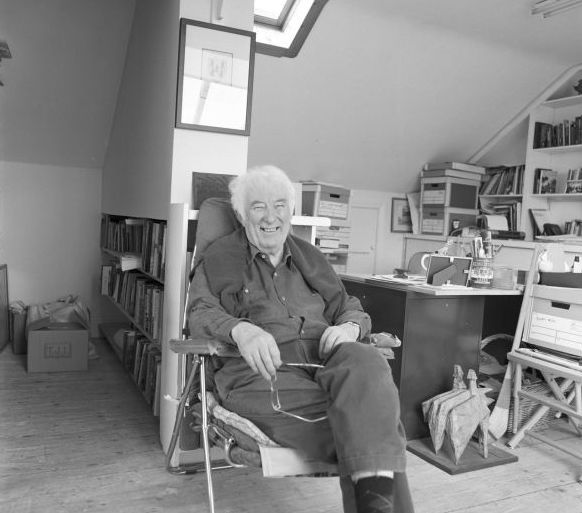
Photo with thanks to the Bobbie Hanvey Photographic Archive/Boston College.
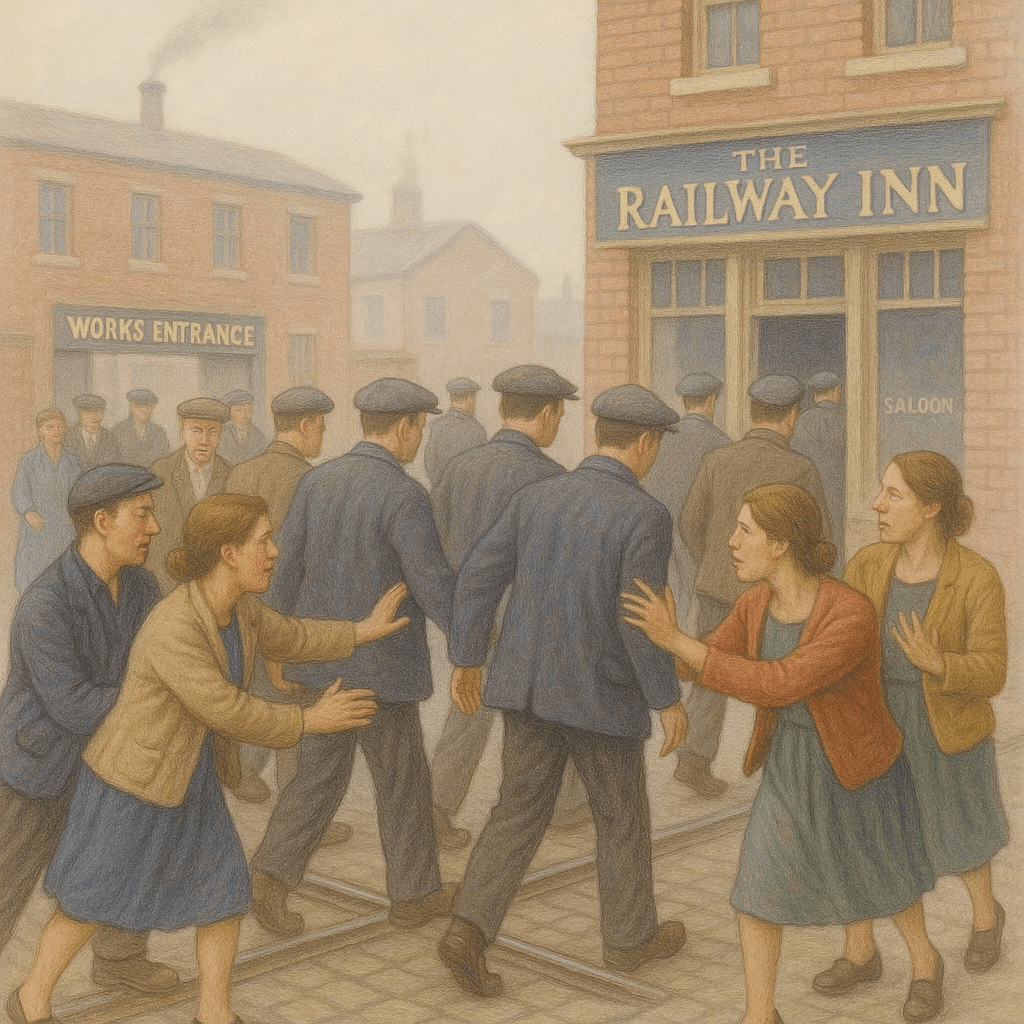
My dad’s plant was across the railroad tracks from half a dozen shot and chaser bars, and on paydays the bars were visited and stocked with stacks of bills by armored cars,
and women waited at the gates and tracks at shift changes, to try to intercept their thirsty husbands in the passing throng before they cashed and drank up half their check.
At the time, I didn’t think about how desperate those women must have been to go out on a crowded public street and chase after their irresponsible men;
I guess I found it droll. But if I’d been more aware, what could I have done or said? When people’s lives are going off the rails strangers only frown and shake their heads.
*****
David Stephenson writes: “When I was in high school, my dad worked at John Deere Plow-Planter—now called Seeding and Cylinder—in Moline, Illinois. This was before direct deposit, so the workers got paper paychecks. As with many factories, there were several taverns nearby, any of which would happily cash a paycheck. If I borrowed Dad’s car, I would have to pick him up and drop him off, so I was sometimes there during shift changes. On paydays you would see armored cars outside the bars, and at the end of the afternoon shift you would see women waiting on the railroad tracks, as described in the poem. It didn’t really register with me at the time, but later on I realized it was quite sad. I wrote the first two stanzas of the poem four or five years ago, but was stuck as to how to proceed, since I didn’t know what to say about the scene. What can you say? I finally came up with the current ending, which says there isn’t anything to say, but says it well.”
David Stephenson is a retired manufacturing engineer from Detroit, and the editor of Pulsebeat Poetry Journal. His most recent collection is Wall of Sound (Kelsay Books, 2022).
A starter British passport, now with a French one too, I can vote in both and put down roots in either, and stroll through
eGates and customs checks head high, as one of us, legitimately pukkah, blessed by birth/life/luck, and thus
with paperwork in order should copper or gendarme ask me who on earth I am: I smile and keep my calm
and my right to an annual break upon a sunlit beach where seas digesting some who yearned my paradise to reach
lap peacefully as though the summer days could last as far into the future as they failed to in the past . . .
*****
Tom Vaughan writes: “The older I get, the more I ask myself the question: ‘Where would we be without our (double) standards?’.”
‘One of Us’ was first published in Snakeskin.
Tom Vaughan is not the real name of a poet whose previous publications include a novel and three poetry pamphlets (A Sampler, 2010, and Envoy, 2013, both published by HappenStance; and Just a Minute, 2024, from Cyberwit). His poems have been published in a range of poetry magazines, including several of the Potcake Chapbooks and frequently in Snakeskin and Lighten Up Online. He currently lives in Brittany. https://tomvaughan.website
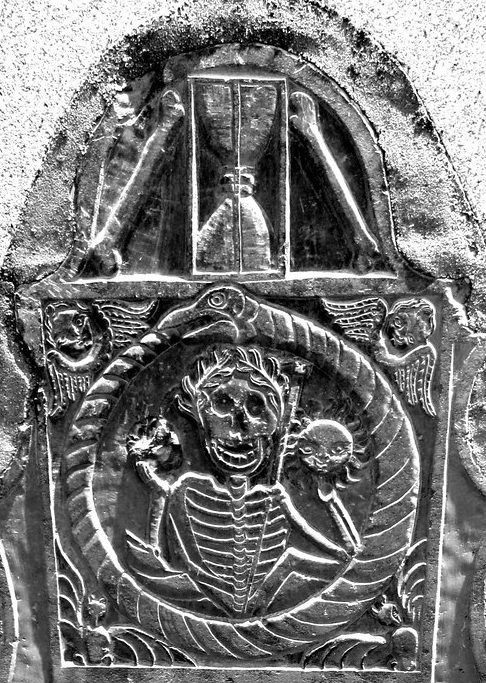
If you’re dead, an’ ya’ ain’t on a mantle, Then ya’ go in a hole in the groun’. From a slab to a coffin, ya’ don’t move very often. When you’re dead you’re jus’ lyin’ aroun’.
If you’re dead, an’ you’re hauled to a graveyard, A few fam’ly ‘n’ friends might arrive, An’ the buzzards ‘ll buzz up above ya’ because When you’re dead you’re no longer alive.
If you’re dead, there’ll be those who hol’ Judgment— Say your Soul is in Heaven or Hell; But Whatever is True (an’ regardless o’ you) When you’re dead, that’s their story to tell.
If you’re dead . . . well, ain’t none o’ that matters. It’s the livin’ who toss in the dirt. What remains goes to rot. An’ though like it or not When you’re dead ya’ don’t feel any hurt.
*****
Johnny writes: “Inspired—in part, at least—by my interest in gravestones of the Colonial era, ‘Epitaph’ utilizes a second person voice. A tip of the hat, if you will, to the ‘As I am now, so you must be’ subgenre of epitaph, wherein the dead address the living to forewarn of Death’s inevitability. Seven stanzas too long at one point, I chopped it down to four. Reason being, the three stanzas I rather begrudgingly removed were written in a confessional mode that conflicted not just with the second person voice, but also with the Everyman vibe that I began sensing the Muse actually desired from me, along with greater brevity. Having made such cuts, I shelved the piece, thinking I’d revisit it in the future with a fresh(er) set of eyes. But then, a recent, troubling news event and its subsequent media fallout brought ‘Epitaph’ to the forefront of my mind. So, on a whim, I posted the abridged version on Facebook. To my pleasant surprise, that led to Robin querying me about its availability, and ultimately, its appearance here at Form in Formless Times.”
Johnny Longfellow is a poet from Massachusetts. His work has appeared in The Five-Two, The Literary Hatchet, Misery Tourism, Punk Noir, and other fine literary venues. You can learn more about both him and his work at Heeeeeeere’s Johnny . . . Longfellow, that is.
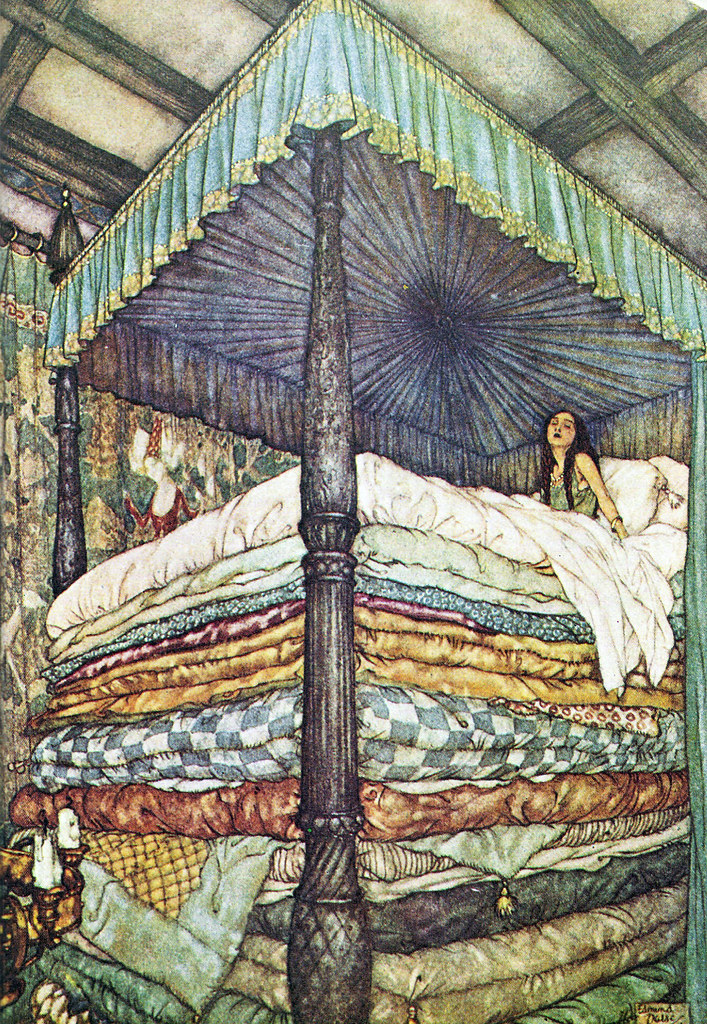
Once a devious queen lodged just one tiny pea Under twenty soft mattresses, wanting to see Out of many young princesses which was the one Who deserved to be matched with the prince, her fine son.
For she knew a true princess was dainty and fine, And that little legume underneath the frail spine Would prevent her enjoying the tiniest rest, And by this all would know she had passed the queen’s test.
But you see, a true princess is also polite, So when, bleary-eyed after a long, sleepless night, Each was asked how she’d slept by the queen the next day, She replied, “Very well,” and was sent on her way,
Till one morning a girl hollered, “What is this lump? Do you call this a bed? Who can sleep in this dump?” So the queen said okay. The prince married her straight. And the moral is: don’t let your mom choose your mate.
*****
Max Gutmann writes: “It always frustrated me that the fairy tale couldn’t seem to see the flaw in the queen’s thinking.”
Max Gutmann has contributed to New Statesman, Able Muse, Cricket, and other publications. His plays have appeared throughout the U.S. (see maxgutmann.com). His book There Was a Young Girl from Verona sold several copies.
Illustration: ‘The Princess and the Pea’ by Edmund Dulac. Dulac illustrated several of H.C. Andersen’s fairy tales, many of which include sarcastic social commentary on pretentiousness.
She drinks a bit more she loves a bit less she no longer fits in her wedding dress.
She’s given up trying, accepted her fate, feels herself thinning while she stacks on the hate.
Doesn’t feel like his partner his mate or his wife, all she feels is as hard and as sharp as a knife.
She reels her mind back but can’t seem to recall, what she ever saw in him, why she married at all.
It’s a dead man’s float, face down on the bed, they sleep separate, unsound in their queen sized dread.
So she’ll tread bitter water as she has done for years, not so much married to him as she is to her fears.
*****
Lindsay McLeod writes: “‘She’ was written in my head, wearing ear protection in a factory. It was about my (then) partner who had recently escaped a toxic relationship.” The poem was originally published in Fine Flu.
Lindsay McLeod is an Australian writer who lives quietly on the coast of the great southern penal colony with (yet another ferocious Aussie animal) his cattle dog, Mary. Lindsay still drives a forklift to support his poetry habit.