Category Archives: Robin Helweg-Larsen

Poem: ‘His Mad Skull’s Like’

His mad skull’s like
a motorcycle cage of death,
the engines roaring over and beneath:
conflicting paths, crashless machinery –
the crowd roars, hoping for catastrophe.

an alchemist’s laboratory,
he strives through Universal symmetry
alone to conquer nature, friendlessly,
transmuting hopeless to hope endlessly.

a planet with its atmosphere,
blossoming gaudy after starting drear;
from grand extinctions and tectonic faults
life reaches out to loot galactic vaults.

a plant with taproot down the spine
side-nerve extractors reaching out to mine
the Universe’s minerals of sense,
make sense, and raise to Mind the mind’s pretense.

This poem along with four others of mine has just been published in The Brazen Head in the UK. I came across the magazine through Marcus Bales who published three sonnets in it in October 2021. The magazine is an idiosyncratic quarterly blog with a diversified structure and a wealth of unexpected ideas in poetry and prose. My poem felt quite at home. I will post the other poems in the next little while–a couple of them have even more unusual forms; the five make a nice set.

Sonnet: ‘Voyage’

Some watch the widening, receding wake
On life’s long voyage. Others at the bow
Scan ahead, wondering what route we take.
(But Past and Future point to one end, Now.)
When disembarked, what will your story be?
“I looked back, couldn’t tell where we’d begun…”
“I tried to look ahead, but couldn’t see…”
“I read lots.” “Slept.” “I made friends.” “I made none.”
“Sunsets were nice.” “The food was just so-so.”
“I helped someone.” “I tried, but got in fights.”
What’s next?
Aboard Earth round the sun all go,
Each spinning whirl hundreds of days and nights,
Through scores of rounds. How’d we get here? Don’t know.
Then each, some unknown -day and -where, alights.

This poem was originally accepted for Contemporary Sonnet but, as far as I understand, when Charlie Southerland took over from the previous editor all the online passwords had been lost, and the magazine folded. So the poem went to Verse-Virtual instead. Given that its subject matter is the unpredictability of life, such changes for the poem’s own voyage are quite in keeping.

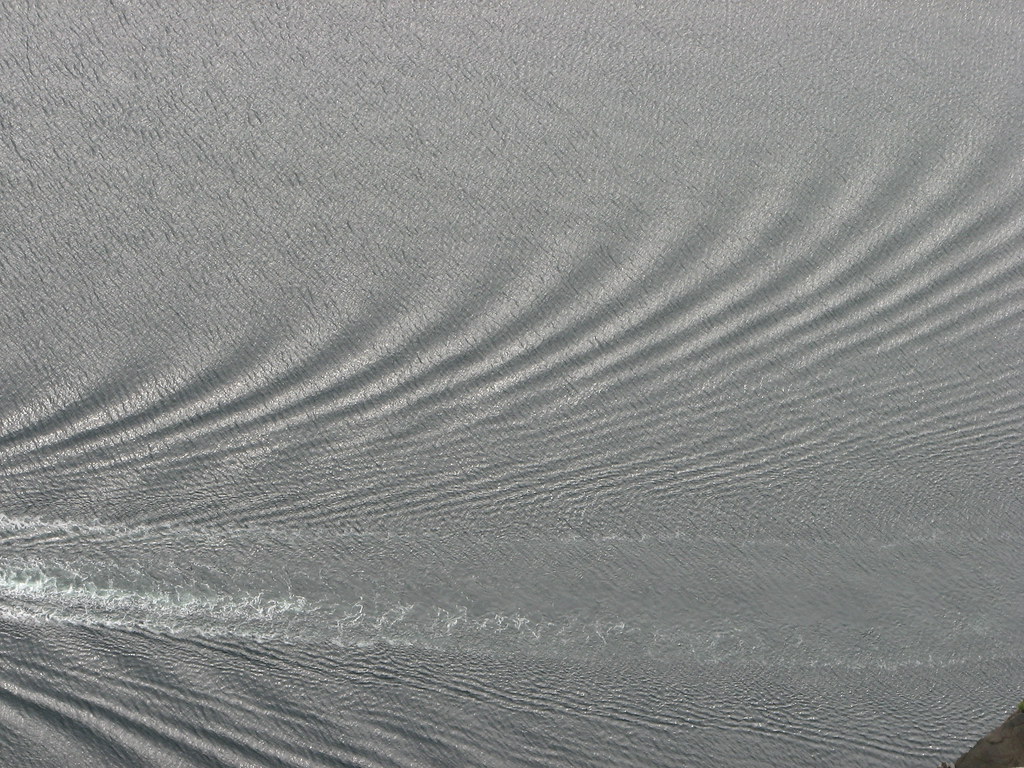
Ship’s wake” by Dany_Sternfeld is marked with CC BY-NC-ND 2.0.

Sonnet: ‘Thunderclouds’

Lightning connecting heavens to the Earth
When heat, humidity grow thunderclouds–
Blackening, building to torrential floods–
Is how the Singularity will birth.
Then our new thunderous AI gods appear,
Growing and killing, Shiva-like, their wards.
(I, for one, welcome our new Overlords…)
Their lightning flashes blind, freighted with fear.
From rising mists and steams of consciousness
Poetry stormclouds, too, flash and connect.
When humans by our own AI are wrecked–
Our own connected selves and selflessness–
The Jovian bolts of electricity
Will be posthuman–and pure poetry.

No, this doesn’t have anything to do with Vlad the Bad‘s invasion of Ukraine. It is just part of my decades-long fascination with the way that technology is laying the foundations for AI that will be more powerful than humans, and for brain-to-brain communication that will move us to a Borg-like condition. And then what? It’s unknowable, but it will be the end of the world as we know it. And I feel fine. Nature is in a permanent state of change and replacement and development, and humans are not exempt from being obsoleted. Not this year or next. But in 100 years, who knows what transitions will be happening?

This sonnet was first published in the Shot Glass Journal.

“Thunderhead” by Nicholas_T is licensed under WordPress Creative Commons

Poem: ‘Advances in Personal Care’

1700 BCE
A length of fibre to extract a tooth –
a flint to decorate yourself with scars –
a large, strong thorn to make holes for tattoos –
an oyster shell to scrape off excess hair…
so health’s improved and beauty is accented.

1700 CE
High heels and wig show stature, vigour, youth;
a monocle improves both look and looking.
How we’ve advanced, compared to ancient times!
Some say there’ll be advances still to come,
but how, when all’s already been invented?

This poem is a riff on a 19th century joke. Charles H. Duell, the Commissioner of US Patent Office in the late 1890s, is widely quoted as having stated that the patent office would soon shrink in size, and eventually close, because “Everything that can be invented has been invented.” (In fact Duell said in 1902: “In my opinion, all previous advances in the various lines of invention will appear totally insignificant when compared with those which the present century will witness. I almost wish that I might live my life over again to see the wonders which are at the threshold.”) But the joke appears to have had earlier incarnations in the 19th century in Punch magazine and elsewhere, presumably as the world was adapting to the reality of life changing more and more rapidly.

The poem is in iambic pentameter, but the only rhymes are between the two verses: the first lines of each and the last lines of each. But I feel that produces enough echo to make it sound adequate. My thanks to Bill Thompson for including it in the Alabama Literary Review – ALR 2021.

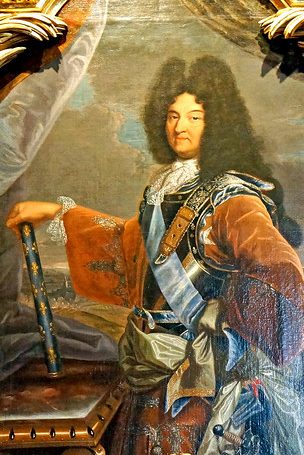
Photo: “France-001560 – Louis XIV” by archer10 (Dennis) is licensed under CC BY-NC 2.0

Poem: ‘The Entertainer’s Servant’

See the violinist
blocking, enchanting passing crowds with his bowing
and watch some ragged child, the very thinnest,
with held-out cap through those crowds coming and going.

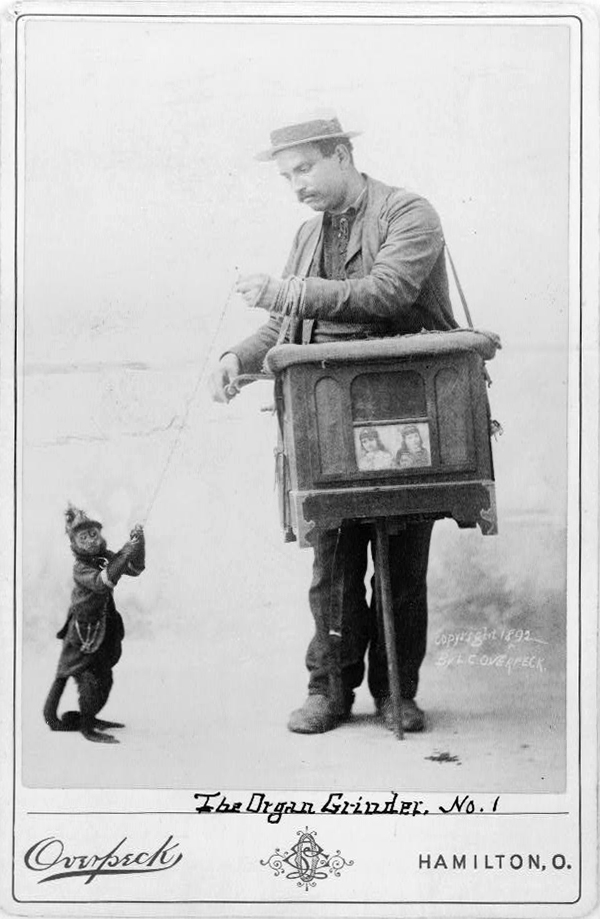
Or the organ grinder
haunting the emotions and memories of all,
his songs life’s bittersweetness’s reminder….
but it’s his well-dressed monkey makes the coins fall.

And more: the child’s home work handed in
though mostly done by mummy;
and more: the wisecracks bandied in,
seemingly by the ventriloquist’s dummy…

This is the poet’s story:
somewhere some unseen Maker
wrings from a wild wand
magnificence, sadness, glory…
while the mere poet capers,
postures, and holds out a hand.

All of which is merely a complicated rumination on not knowing where poetry comes from. It feels like the initial impulse and the key words come from outside, from some muse or god of poetry… and the poet is merely a puppet: observed, apparently autonomous, but not the true artist.

This poem was published in The Road Not Taken: The Journal of Formal Poetry. It may not be as formal as you would expect, but it has a steady structure complete with rhymes. I make no apologies for its inadequacies – the poem itself allows me to blame the unknown puppeteer.

Short poem: ‘The Inevitable Future’

Now that I’ve got Windows 10,
11 comes; and then, and then…
Next: self-driving flying cars,
Trump in jail and Musk on Mars.

Certain things appear inevitable in the businessman’s crystal ball… Well, we’ll see. This short poem was published in the ever-succinct Asses of Parnassus – thanks, Brooke Clark!

Poem on poetry: ‘Diatribe Against Unversed Poets’

Ignoring clockwork towns and fertile farms
Tied to the sun-swing as the seas to moon,
They searched for verse in deserts without rhyme,
Lifted erratic rocks nonrhythmically
In search of poetry, then through the slough
Of their emotions hunted for a trail:

“The scent is cold. Its Spirit must have fled;
The body of its work, though dead,
Has been translated to some higher plane.
Look how the world’s translated verse
Comes to us plain—why can’t we emulate?
Then if the words themselves are unimportant,
If poetry in essence is idea,
And song is wrong,
Rhyme a superfluous flamboyance
(Like colour in Van Gogh),
Rhythm a distraction to the memoring mind,
Then we determine poetry’s true form is mime!”

While in the air the deafening blare
Confounds their silence everywhere:
Before our hearts began to beat
We were conceived in rhythmic heat;
So, billions strong, we sing along
For all the time, in time, our time, the song
Goes rocking on in rhythmic rhyme. Rock on!

“Unversed” means “not experienced, skilled, or knowledgeable”. Poetry takes different forms in different languages, but the forms all have the same desirable outcome: to make it easier to memorise and recite word-for-word. Alliteration, assonance, rhyme, metre – these are all useful tools for achieving this, along with less tangible tools such as fresh or startling imagery. Metre/beat/rhythm is viscerally important to us, because the mother’s heartbeat is the background to sensory development in the womb, and our own heartbeat and breathing rhythms continue throughout life. As humans we drum, we dance, we sing, just as we walk and run rhythmically, tap our fingers rhythmically when we are bored, teach small children to clap and sing, teach older children clapping and skipping games. Rhythm is built into us from before birth.

Rhythmic poetry didn’t die when it almost stopped being publishable. It just went into folk songs, blues, rock, country-and-western, musicals, rap, hip hop… Popular music let teenagers and adults continue to thrive with what they were not given by schools: rhythm and rhyme. This drive to make words memorable and recitable is part of who we humans are. So schools do best when they leaven “creative self-expression” with getting kids to learn things by heart, and getting them to pay attention to the qualities that make it easy to memorise and recite.

Photo: “Lost in desert” by Rojs Rozentāls is licensed under CC BY-SA 2.0

Sonnet: ‘Portraits’

Easy enough, the people in the park,
A subway addict, or some screaming child:
Knock off five lines from some chance-heard remark,
A tic observed, or mood or clothes gone wild.

A longer piece for loves, coworkers, friends,
People you’ve bonded with, played some life game;
Can’t be so flip – unless the portrait bends,
Fictionalizing thoughts in formal frame.

And closer to you than your own bed mate
Is, tougher yet, perspective and full view
Of parents, more than threaded through your fate,
They’re warp and weft, the loom, the weavers too.

So, last of all, the golden trophy shelf:
That great and grand grotesquery, yourself.

… which is merely to say that writing about people has difficulties that increase as the subjects are closer to you. Technically, a Shakespearean sonnet (iambic pentameter, rhyming ABAB CDCD EFEF GG), though without a volta, that delightful twist that reverses the mood or imagery or argument. Oh well.

Originally published in The Poetry Porch, edited by Joyce Wilson.

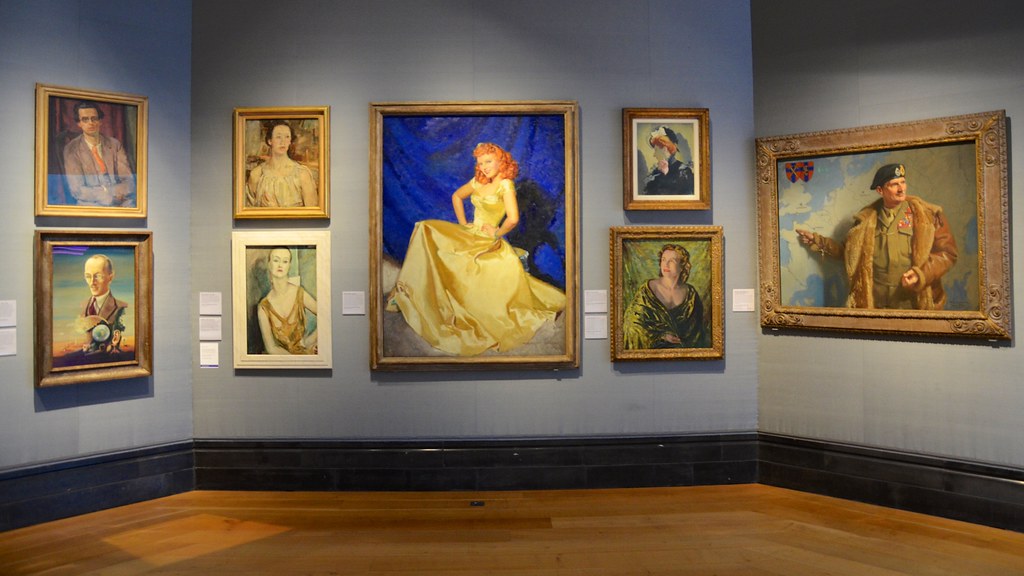
Photo: “National Portrait Gallery” by Joe Shlabotnik is licensed under CC BY-NC-SA 2.0

My own favourites: ‘To Myself In 50 Years Time’

Old fool! You really think yourself the same
As I who write to you, aged 22?
Ha! All we’ve got in common is my name:
I’ll wear it out, throw it away,
You’ll pick it up some other day….
But who are you?

My life’s before me; can you say the same?
I choose its how and why and when and who.
I’ll choose the rules by which we play the game;
I may choose wrong, it’s not denied,
But by my choice you must abide….
What choice have you?

If, bored, I think one day to see the world
I pack that day and fly out on the next.
My choice to wander, or to sit home-curled;
Each place has friends, good fun, good food,
But you sit toothless, silent, rude….
And undersexed!

Cares and regrets of loss can go to hell:
You sort them out with Reason’s time-worn tool.
Today’s superb; tomorrow looks as well:
The word “tomorrow” is a thrill,
I’ll make of mine just what I will….
What’s yours, old fool?

This poem, first published in Snakeskin No. 147, September 2008 and recently reprinted in the Extreme Formal Poems Contemporary Poets anthology edited by Beth Houston, is symptomatic of my constant concern with mortality. It was also a way to be provocative: under the guise of insulting myself, I got to insult all older generations. And it was also an exercise in poetic structure: each stanza presents an aspect of the superiority of present youth over future age. (Premise and conclusion aren’t necessarily made as statements, many times rhetorical questions are used instead.) The structure of each stanza is to begin with pentameters for a sense of reasonableness in the first three lines, pick up the pace for the next two lines, and end with a short punchline. Aggressive and effective.

Yes, I wrote it when I was 22. I don’t know if I will be able to concoct a suitably terse and dismissive answer when I’m 72. But it’s a favourite poem of mine, and I owe it a response.

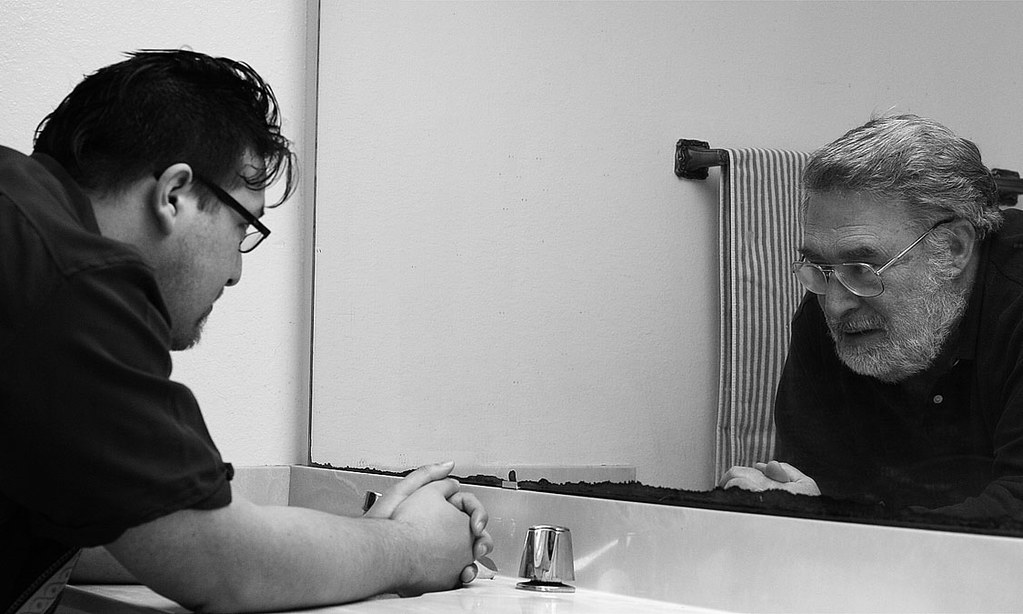
Photo: “Day 005: The child is father to the man.” by JesseMenn is licensed under CC BY-NC-ND 2.0

Sonnet (?): ‘Sleep is Like’

Sleep is like heading to the locker room at halftime
Sleep is like stepping into the wings between acts
Sleep is like going outside for a cigarette.

And then you go back to work
Back to the performance
Back to the game.

The game that may go thirty thousand rounds;
But who you really are is when you’re on break;
The rest is just your job, performance, game, not you.

And when at last it ends, and you go home,
Back to where you came from,
Who are you? and where do you go?

Perhaps you know this while you’re deep
Asleep…

This poem–if it is a poem–on (one of) the mysteries of the universe was just published in Snakeskin. I suppose you could call it a sonnet if you want… it has 14 lines. With four thoughts in four sets of three lines and a concluding sort of rhymed couplet, it has an organised form. Sonnetish. But it’s not elegant, it’s coarse–like life and death, consciousness and sleep.

It has no regular beat, let alone formal metre. And it’s not reasonable to claim that ABC DEF GHI JKL MM is a rhyme scheme. The piece simply doesn’t have the carefully balanced exposition of a sonnet, the flow of rhythm, the inevitability of rhyme.

If I put together a collection of my sonnets, I wouldn’t include it.

Probably.

“Smoking outside London Bar” by macabrephotographer is licensed under CC BY-SA 2.0