Category Archives: Robin Helweg-Larsen

Semi-formal poem: ‘Gulf Airport’

The men in suits, the men in African robes,
The men in jeans and sports shirts,
The local men in headdresses and thobes,
None look out of place.
The women in abayas, saris, or long skirts,
The women in slacks and blouses
(Some with, some without headscarves, depends on race)
None look out of place.
But the anonymous silent women faceless in veils,
And the noisy drunk in-your-face blatant females
In shorts that barely cover their barelys,
They look alien even in a Gulf airport.
The extremes have to be more extreme here to stand out–
Either private as houses,
Or provocative past any “careless”–
But it can be done, with thought.

*****

I wish I had been able to find a photo showing the wonderful range of clothing styles that you encounter in the truly global airports of the Middle East, where travellers on the long-haul carriers change planes en route to Sydney, Tokyo, Mumbai, Johannesburg, Paris, Houston… Your clothing and behaviour has to be extremely extreme if it is to stand out.

This poem was written in Bahrain’s Manama Airport in 2015, published in Snakeskin a year later. It’s not really “formal” verse, is it? 😦

3am, Dubai Airport” by joiseyshowaa is licensed under CC BY-SA 2.0.

Short poem: ‘First Contact’

And when we leave this planet, even leave
corporeal necessity behind,
launch in new realms of space, new states of matter,
encapsuled and encoded, searching blind,
who will we find, as we have always found,
those others there before us, unconfined?
How will we meet them, how will we relate,
them settled formlessly, we coming late?

*****

Perhaps I owe an explanation to non-readers of science fiction. The premise of the poem is that we humans will continue to tinker with not just our bodies but our DNA, as we have always experimented with everything. We will produce ever more bizarre manifestations as posthumans, especially useful in off-planet environments (I recommend the short stories of John Varley), ultimately finding ways to exist with intelligence and control without being tied to physical bodies. (Try Vernor Vinge.) But as always, wherever and however we voyage in exploration, we will always find someone (some thing) is there before us. And then there will be all the usual situations that occur with first contact… confusion, lack of communication, miscommunication, trust and distrust, treachery, violence, accommodation, mutual benefit, all the things that social species engage in.

Appropriately this short poem was first published in Bewildering Stories (thanks, Don Webb!), an excellent weekly magazine of speculative stories both short and serialized, and speculative poetry and art. This eight-line poem is structurally pretty basic: it’s in iambic pentameter with the second, fourth and sixth lines rhyming and with a final couplet.

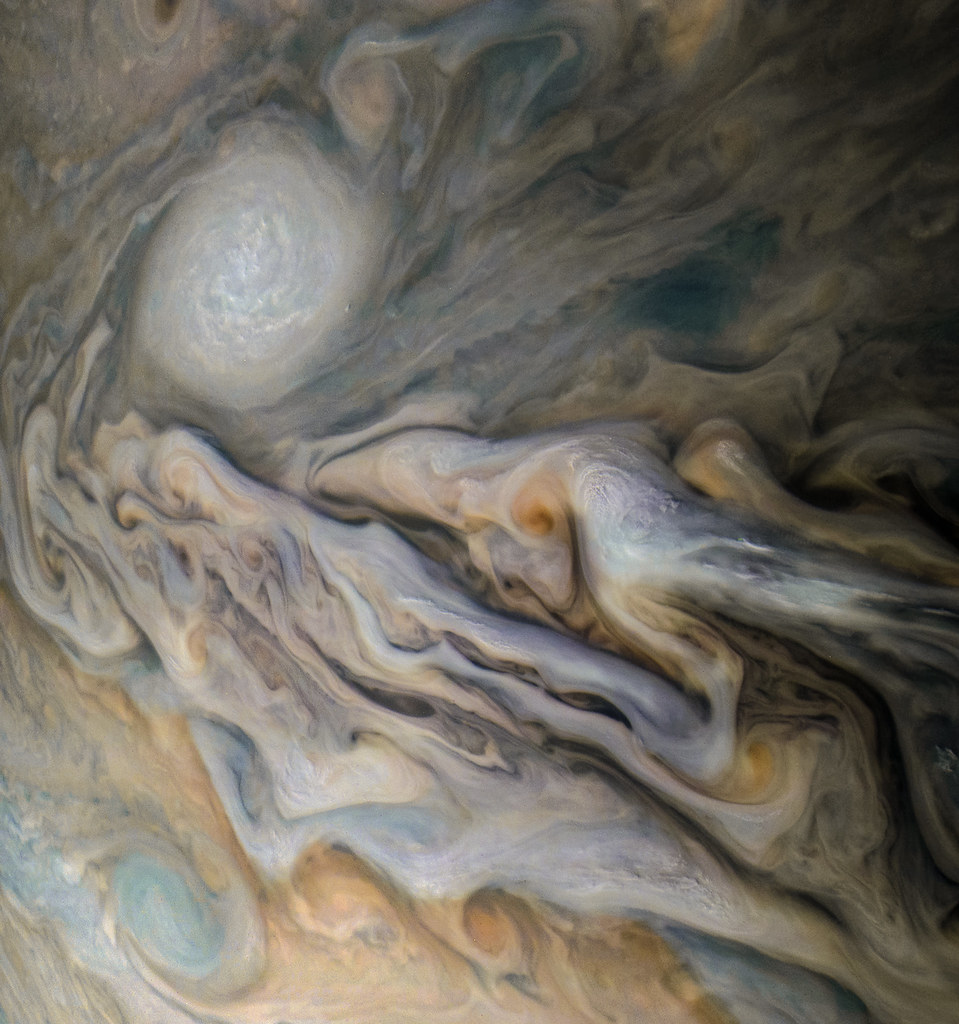
Jupiter – PJ16-13” by Kevin M. Gill is licensed under CC BY 2.0.

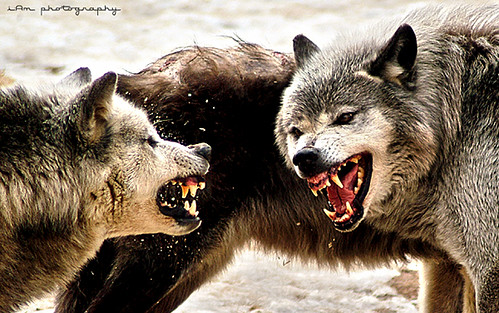
Sonnet: ‘Zombies and Wolves’

Women I’ve failed or wronged or left behind
Approach my thoughts like zombies for the kill;
I’ve literary walled defences – still,
Given the chance, they’ll eat my brains, my mind.
Through forest, orchard, farmyard in decay,
A shadow of a wolf slips greyly in,
My thoughts of death, grim, wasted, ill, rib-thin,
Tracking my weak resolve, hungry to slay.

Mountaintops blown apart, forests clear-cut,
Where’s there to hide? Nature doesn’t exist;
Her landscapes crushed in patriarchal fist.
This former farmland hides my ruined hut.
Impotent, I still write, thus giving birth
To future wolves and zombies of the earth.

*****

What on earth triggered this sonnet 15 years ago? I have no idea. What’s it really about? Well, it seems the volta between the octave and the sestet moves the narrative from purely personal regrets to our current planetary destruction. More than that, I can’t say. Your suggestions are welcome!

Anyway, the poem was published in that now-defunct British beacon of formal verse, Candelabrum.

Photo: “Wolves in Action” by iam_photography is licensed under CC BY-NC-SA 2.0.Copy text

Short poem: ‘Into the Cryonics Dewar’

We had no destination ever, from birth,
save into the ultimate ocean, or ultimate fire, or ultimate earth.
Now we have not quite so ultimate ice.
For now, it will have to suffice.

The chance of reanimation from cryonic suspension may be small, but still greater than the chance of reanimation after cremation or burial in land or at sea. And I guess we now have a fifth option – ending up off-planet, adrift in space. But in effect that will be a variant on “not-quite-so-ultimate ice”. In space you’d end up near Absolute Zero, as with cryonics – but whereas with cryonics there is the miniscule hope of eventual reanimation, in space your ultimate fate would be that of all space debris: drifting for millions of years until burning up into a star or planet, or getting sucked into a black hole.

Life, death, quite fascinating. Not many options for changing the outcome, though various billionaires are throwing some of their money at the search for immortality, as people have done since at least the time of the pharaohs and early Chinese emperors. And why not? think it’s “just science fiction”? For thousands of years we used to dream we could fly to the moon, and that happened eventually…

This poem was originally published in Snakeskin #274, July 2020. Thanks, George Simmers!

Photo: cryonics.org

Sonnet: “What Will You Be When You Grow Up?”

Historically, this never was a thing.
You did what you were born to do, were told,
Fitting yourself into your parent’s mold,
A farmer’s son a farmer, king’s son a king,
A girl to be a mother and a wife.
But then came education, travel, choice,
Awareness of the wishes you could voice,
Countries, careers, sex partners — it’s your life!
And though just who you are you cannot know,
Nor what you want, yet all is your decision.
You’ll make mistakes, find failures and derision,
But life is long: so have another go . . .
Retry, and then try something else; take; give.
Do what you love. You die, regardless. Live!

This sonnet is a mirror of the short poem I posted most recently – and I’m happy to see that my outlook has a certain consistency, even over a 50 year period.

The sonnet has just been published in the formal verse section of the current Better Than Starbucks – thanks, Vera Ignatowitsch!

Photo: “career choices” by Jerome T is marked with CC BY-NC-ND 2.0.

Short poem: ‘Remember’

Remember the whole world’s in your range,
When all your strength is gone.
If you can’t accept, then rearrange;
Can’t rearrange, move on.

I wrote this little poem when I was a very unsettled and directionless 20-year-old, and I lived by its tenets for several years, constantly changing jobs, countries and relationships. Eventually I slowed down, only changing jobs, countries and relationships once every few decades. But I still hold to the principle that you have no obligation to stay in an unsatisfactory situation, that you should actively try to identify what makes you happiest at the deepest level and then change your life in that direction. And sometimes random change is an appropriate if temporary solution.

This poem was finally published, decades later, in The Asses of Parnassus.

Photo: “File:Banksy Hitchhiker to Anywhere Archway 2005.jpg” by User:Justinc is marked with CC BY-SA 2.0.

Epigram: ‘Bit with Bite’

I think I’ve blinked
At what you write:
Edgy, succinct–
A bit with bite.

This is in the spirit of a homage to The Asses of Parnassus, in which the poem found a home. Editor Brooke Clark has created a tumblr account that for the past few years has been posting “Short, witty, formal poems” on an occasional (i.e. erratic) basis, much in the spirit of Latin and Greek epigrams (and often translations of them, or modern retellings).

This poem itself is not particularly noteworthy – but I enjoyed rhyming ‘blinked’ with ‘succinct’, as well as the ‘think/blink’ and ‘bit/bite’ pairings. Wordplay is at the heart of poetry, from Anglo-Saxon alliteration to modern rap, from nursery rhymes to Shakespearean sonnets. Wordplay is memorable, and sharpens the pain of an epigrammatic jab. Use it, if you want your barbs to be effective.

Kyrielle: ‘Desire is the Last Domino to Fall’

Religion starts as trying to explain,
Progresses to high priests’ financial gain.
I’ve tried religions, and seen through them all;
Desire is the last domino to fall.

Explore the world – well, fifty lands’ enough;
Novelty fades; folks are just folks; stuff’s stuff.
I’ve seen both rich and poor round this blue ball;
Desire is the last domino to fall.

And I’ve gone barefoot, and I’ve gone first class:
The trinkets pall beside bare feet on grass.
Markets go up and down and they too pall;
Desire is the last domino to fall.

The fearful right, the overtrusting left:
Politics, history, both of sense bereft.
Reagan’s road leads to Trump and hits a wall;
Desire is the last domino to fall.

My arts expression’s been in writing verse–
The arse end, clearly, of the universe.
There’s rarely silver in the nets I haul;
Desire is the last domino to fall.

I’ve had my fill of sex – but when I see
A vibrant youth, my thoughts are freshly free.
I want, though why I want I mayn’t recall…
Desire is the last domino to fall.

This poem, published by George Simmers in April’s Snakeskin, flowed straight out of a comment by Jackson Browne in a Guardian article on his latest album, ‘Downhill From Everywhere’. My thanks go to Mindy Watson, creator of poems in every form she hears of, for identifying this one as a kyrielle. I hadn’t set out to write within a specific form, I merely wrote a poem that used a repeating last line of the stanza. And this highlights one of the things about form: form follows function, in poetry as in architecture. Metre, rhyme scheme, line length, all these are chosen for their appropriateness for the mood and content of the poem. Ballads, sonnets, couplets, villanelles, each type finds its best use in a different situation, each evolved to provide a good expression of a different mood, each became popular as its expressive strength was demonstrated.

A kyrielle seems to me a natural poetic construct for an expression of prayer or despair or wherever all avenues of thought lead back obsessively to the same essential fact or wish. It was formalised in the time of the troubadours, and its name derives from the Late Latin phrase “kyrie eleison“, “Lord, have mercy”. Very appropriate.

Photo: “Where It All Began” by mckinney75402 is marked with CC BY 2.0.

Experimental Poem: ‘Pumpkins’

I said: “Look at the little kids playing Tag round the pumpkins – you can be that age again, if you close your eyes and remember pumpkins almost as big as you, too big to move – the massive newness, strangeness of them, never seen before, so big, but obviously to sight and touch a vegetable – you can reexperience the never before experienced, a world in which everything new absorbs your mind, and every minute you experience something new – playing Tag is a sensory delight, of running-and-not-falling (wobbly) in the half-dark (strange light) around pumpkins (absorbing color and texture) with an older sibling (touch and clutch) across strewn hay (a new but not difficult surface) and sometimes wooden pallets (a new and bizarre and impossible-to-run-on surface) but mostly the joy of running in the dark as a physical delight and not falling over – and then you stop and sit and throw straw in the air, and it doesn’t hurt (unlike gravel) and it doesn’t make a mess (unlike mud) and it doesn’t really get in your hair and eyes (unlike sand) and it also doesn’t really go anywhere no matter how hard you throw it (unlike any of them) and you laugh; you can remember all that if you can remember/imagine all the pumpkins three times as big, nearly as tall as you, too big to move – and adults become a different species, they go “Wa-wa-wa-wa-wa-wa-wa-wa” and make no sense, so you only really talk with other kids until finally an adult breaks into your world and tags your mind, and makes you hear with threats of violent pain, makes you give up your soul in self-defence,
Leaves you a narrow life of yes’m, no’m.”
She said: “You don’t make any sense.
Go write a poem.”

This is the last of five poems recently published in The Brazen Head. Technically it might be a quatrain… but unmetered, and with a very long first line. Neither this post nor The Brazen Head manage the format that I wanted, which is to have the bulk of the poem (everything that overflows the first printed line) inset half an inch from the left margin where the four lines start. This is designed to make that body of text look somewhat pumpkiny. Here I’ve settled for bolding the first words of each line.

The poem itself tries to recapture the flood of sensation that a child experiences in a new environment. A coffee shop in a wooded suburban area of Carrboro, North Carolina, had a large outdoor area of pallets, hay bales and enormous pumpkins in the run-up to Halloween, and small children were running riot in it as the evening drew in. For a moment I felt able to recapture the massive novelty of childhood experience.

Photo: “Pumpkin Patch Kid” by mountain_doo2 is marked with CC BY-NC-ND 2.0.

Poem: ‘Poems Like Motes of Dust’

Like tiny midges, poems in the air
were unseen all my life, presence unclear,
occasionally one would land, bite, sting…
I’d be aware
a poem had come, was singing by my ear.
Now everything, literally every thing,

is a poem: a car, a dog, a glass,
a chair, a seagull, every blade of grass,
all people and each thing they pass.
Now I see swarms, millions of flies,
or like light’s dots of darkness thickening as day dies,

the poems are visible in the air around,
a pointillist canvas, every dot
a poem in itself, an image, word, rhyme, thought,
or like neutrinos streaming from the sun,
billions a second passing with no sound
unseen, unfelt, through everyone,
the poetry of existence, raw, untaught.

The Universe: a cloud of dust that hangs and floats,
dust like a drive of cattle on the range,
or when you fill a barn with dusty motes
by sudden action, and a sunbeam’s slice;
or as Sumerian gods convene, converse,
swarming like flies around burnt sacrifice,

summoned by smell of sacrificial meal…
was it my sacrifices made this change,
made poems visible like motes of dust?
Is this the Universe’s thrust?
Hide them, and then reveal?
For all the poems make one UniVerse.

This is the fourth of a series of five poems recently published in The Brazen Head. It is semi-formal: written in iambics with lines of uneven length, fully rhymed but not to any pattern. My model for this style of verse is Matthew Arnold’s ‘A Summer Night‘, a poem that I have loved and recited since high school. (We can leave for another time the debate about whether his poem should have stopped as originally at the final question mark, or whether the years-later addition of the subsequent lines is an improvement.)

Smoky Dusty Light Rays Texture” by Sprogz is marked with CC BY-NC 2.0.