Category Archives: Robin Helweg-Larsen

Short Poem: ‘For Eliot’

I guess
Success
Not elation
Or creation
Alone may men not mock;

God bless
T.S.,
Spared the temptation
Of our generation —
Writing rhymes for rock.

First published in Metverse Muse in India. As you might guess, I wrote this before Andrew Lloyd Webber set that “Old Possum” T.S. Eliot‘s rhymes to music for the West End and Broadway hit Cats, disturbing everyone (except the Poetry Foundation)’s understanding of both Eliot and musicals.

Photo: “T.S. Eliot” by duncan is licensed under CC BY-NC 2.0

Short poem: ‘My Life Twists’

My life twists
Dangling in the mists
A spider in the earliest hint of dawn.
My mind roams
Lost in a thousand homes,
Amnesiac messenger still trying to warn.

Sometimes a poem is just a mood. This is one such. It was first published some years ago in the now defunct Candelabrum. And, yes, it rhymes better in English than in American…

“Unidentified Spider on a Thread DSC_0197” by NDomer73 is licensed under CC BY-NC-ND 2.0

Poem: ‘Dreams’

In the back alleys of our nightly dreams-–
Where cartoon murders repay debts of grudge,
And all’s not graspable nor as it seems,
And logic leers, then sneers and disappears,
And our warped lusts of power, sex and pain
Live stray cat lives, are killed, and live again
To yowl and fight, to scavenge, hunt, give birth-–
We overlay fresh civilized veneers
On age-old dynamos of massive girth.
So the thin skin of life upon the Earth
Cannot restrain the molten mass beneath
(Driving relentless change despite crust’s sheath),
Till, trampled and forgotten in the sludge,
Our empires are mere broken plastic toys.
Dreams run from us like cats from evil boys.

Dreams, the unconscious, one’s Muse… cats, ravens, the Earth… time and timelessness, change and continuty… so many of these ideas return again and again, always the same, always differently organised, a true kaleidoscope. And this isn’t a sonnet–too many lines, no pattern to the rhymes–even if it sort of feels like one; it’s more of a kaleidoscope itself.

This poem was first published in The Lyric. As far as I remember, its editor wanted the removal of the word “on” from the ninth line; they thought this improved the scansion, and the editor is always right so I allowed it. But I’ve put it back now, anyway.

“My cat running away from the camera #cat #iphone #cats” by gargudojr is licensed under CC BY-SA 2.0

Short Poem: ‘Chronosynclastic’

In the chronosynclastic infundibulum
That is God’s fantastic waiting room,
You’re always barely on the score,
One show away from being shown the door.

“God’s waiting room” normally applies to places considered to have a large population of retirees, like Eastbourne in the UK, or Victoria, BC, or the state of Florida. But we are all mortal, and all facing an end at an unknown time. So Kurt Vonnegut’s dark existential humour seems universally applicable. He created the term ‘chrono-synclastic infundibulum’ in ‘The Sirens of Titan’ as a label for a place, or a moment, where all the different kinds of truths fit together, and where there are many different ways to be absolutely right about everything.

Take the concept of ‘God’. Though we can all agree on the meaning and validity of “God’s waiting room”, we may disagree vehemently on the meaning and validity of the word “God”. Can there be a place in which all the understandings of that word are simultaneously correct? Perhaps. We are only tiny-brained creatures in an obscure solar system in an unimportant galaxy, and can hardly presume to know all the answers, any more than any of our stone age ancestors did when they thought they knew everything.

Anyway, my poem (first published in Lighten-Up Online) pays homage to the author of ‘The Sirens of Titan’, ‘Cat’s Cradle’, ‘Slaughterhouse Five’… I put Kurt Vonnegut right up there with Tolstoy in the ranking of People Who Should Have Won A Nobel Prize But Didn’t.

So it goes.

Photo: “The Chronosynclastic Infundibulum – Front Elevation” by Fulla T is licensed under CC BY-NC 2.0

Poem: ‘Oxford’

Purple voices, rich and rare,
Glowing in the jeweled air,
Handling esoteric themes,
Mysteries like running streams
Dammed with unexpected care
Into almost-answered prayer
Where you’d think no calmness could
In the wildest of the wood.
Thoughts and unknown meanings dance,
Wordwise weave you in a trance,
Darkly glowing, rich and rare,
Purple voices, glowing air.

This was first published in Candelabrum, the now-defunct journal dedicated to keeping formal/traditional poetry alive in the UK through the darkest days of free verse, i.e. from 1970 to 2010. I only discovered the magazine in 2004, better late than never–I had almost given up writing poetry, having been unable to publish anything at all up to that point. I remain grateful to its editor Leonard McCarthy, the Anglo-Irish formalist poet.

Photo: “Deep in conversation” by NatBat is licensed under CC BY-NC-SA 2.0

Short Poem: ‘The Logophile Picks a Fight’

By the spots of shame with which your life is spattered,
Your position, sir, is grossly overmattered –
Overmattered, sir, or greatly undermined;
And I cannot help but find
That the lot of humankind
Would be bettered, not embittered, were you battered!

After having kicked around for years, this short piece–which has no purpose other than wordplay–finally got an explanatory title (instead of just the first few words) and was published in this month’s Lighten-Up Online in the section ‘Words, Words, Words’. Thanks, Jerome Betts!

Photo: “Picking a fight for net neutrality #ind12” by Kalexanderson is licensed under CC BY 2.0. Photo has been cropped.

Short poem: ‘Yogis’

Though mystified why yogis walk
Across the burning coals,
We know they stand upon their heads
To elevate their soles.

This was first published in Metverse Muse, an Indian magazine put out by Dr. Tulsi Hanumanthu that champions structured verse in English. The poem’s pun seems so obvious to me that I’m still surprised I haven’t seen it anywhere else. Be that as it may, I’m a proponent of the health benefits of five-minute headstands, which I have been doing irregularly since I wrote the poem nearly 50 years ago, after spending a month in the Sivananda Vedanta Yogashram in Val Morin, Quebec.

As for timing five minutes while in a headstand, I do it by mentally reciting the first 18 verses of Matthew Arnold’s ‘The Scholar Gypsy’. After years of those 180 lines, I keep thinking I could replace it with 45 quatrains of ‘The Rubaiyat of Omar Khayyam’… but somehow I always get stuck pondering which edition of the Rubaiyat I prefer…

Photo: taken by Eliza.

Sonnet: ‘Drifting’

Drifting and drifting in an eddying stream
The leaf cannot recall the maple tree;
Pieces fall off; it has nor plan nor scheme;
How could a leaf have sense of destiny?
Its work is done; tree-feeding fades like dream,
Tree-making’s not a possibility.
It drifts and rots, nibbled by perch and bream
Or reaches finally the endless sea.

The sea itself moves, rhythmical and blind:
Is calm, or sprays salt as the waves make foam.
Seas have no will, no parliament of mind,
To make directives like hives make bees roam
To pollinate the world, defend their kind,
And with their mind create their honeycomb.

This sonnet drifts in several ways. The rhythm of iambic pentameter is meditative, rambling. The rhyme scheme is slow, repetitive, changing between the octave and sestet: ABABABABCDCDCD. And the ideas drift: the leaf is left behind when it reaches the sea, and the sea is abandoned for bees. The form seems suitable for the content.

‘Drifting’ has just been published in this month’s Snakeskin, whose editor commented “I like the way it moves from one idea to another that you don’t expect.” Thanks, George Simmers!

Photo: “Like a Leaf in a Stream” by Referenceace – Working! is licensed under CC BY-NC-SA 2.0

Poem: ‘What Lasts?’

Munch’s Scream fades, and the Taliban
blow up the grandest statues that they can.
Safer are spoken treasures of the mind:
poems and songs outlast objects that rust,
or bust, or slowly crumble into dust.
Until from cave or dig comes some strange find…
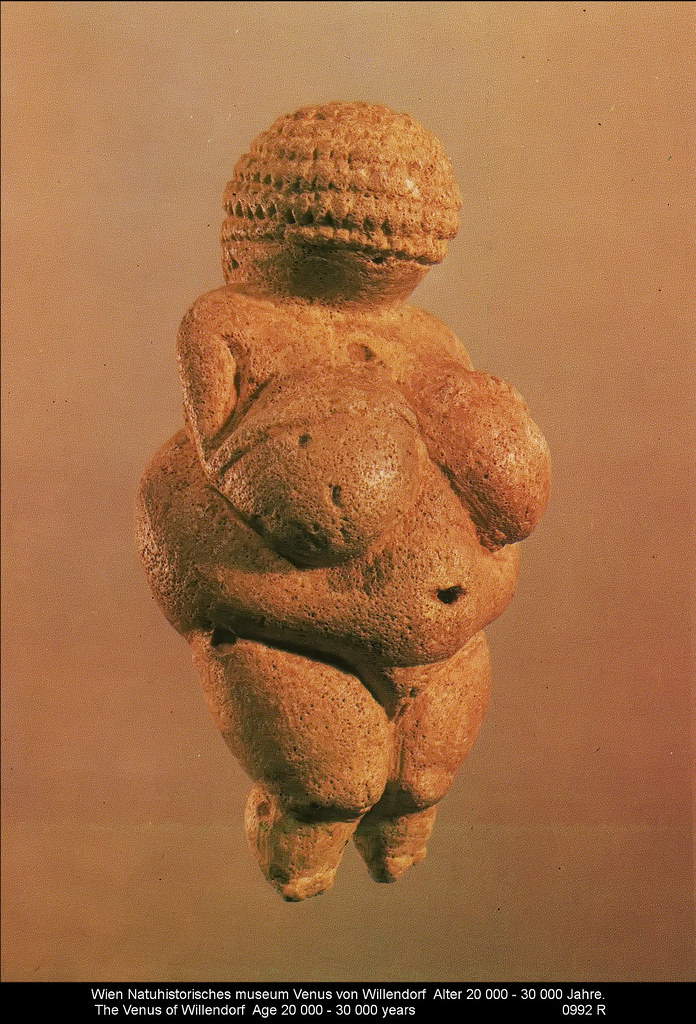
but when Lascaux and Willendorf were young,
what was recited, or what songs were sung?

As regards “immortal” works of art… anything that is still respected in a hundred years is pretty good, anything still talked about after a couple of thousand years is doing very well… Songs and poems can manage that length of time, especially if connected a religion or other social ritual; but there is very little oral survival beyond that, and the survival of physical artifacts from tens of thousands of years ago is of the luckiest, perhaps of the lost or the most overlooked, not necessarily the best.

How wonderful if in the future we can recapture sounds from the Stone Age! At present there is no way to see how it could ever be done. But at least we have a few cave paintings and small carvings…

This poem was just published a short while ago in The Asses of Parnassus. Thanks, Brooke Clark!

“Austria. Wien Naturhistorisches museum Venus von Willendorf. Die Venus von Willendorf ist eine Venusfigurine aus der jüngeren Altsteinzeit (Jungpaläolithikum), dem Gravettien, und ist als Österreichs bekanntestes Fundstück heute im Naturhistorischen Museum” by Morton1905 is licensed under CC BY-NC-ND 2.0

Poem: ‘Friendly Advice’

“Listen, old feller-me-lad,” he said
With a rugger-player’s laugh
(Not that he was big and brawny,
Only about scrum-half)
“You can muck about till you’re blinking dead
Without a career or a wife,
But (I know that it sounds damn corny)
You’re wasting your bloody life!

“Look, Slater Walker would snap you up!
Anyone can see you’re no fool.
Or why not go round to the Honkers and Shankers?
You’ve been to a decent school.
But before you do, go and have a haircut
You can’t go through life as a clown.
Get a good job! You’ll only thank us
For helping you settle down.

“Work with a Bank, and go overseas,
That’s where you’ll get the best pay.
Look at us: Jill and I are content,
With our two kids, and one on the way.
We’ve enough for a car, and boarding-school fees,
And her clothes, and my drinking and smoking;
And the Bank pays us our large flat’s rent,
And we’ve got our own place in Woking.

“So we’ve got our means, and we’ve got our ends,
And we’re happy through and through;
But you, you do nothing, although you’re clever,
And we worry a bit about you.
Now look, we like you, we’re speaking as friends:
Settle down! Get a job and a wife!
You can’t go on mucking about for ever –
You’re wasting your bloody life!”

In my gap year between school and university I worked in the local Barclays Bank in my home town of Governor’s Harbour. My subsequent university career only lasted a matter of months and I began wandering between countries, but my former boss at Barclays had friendly advice for getting me back on track. His Englishness is there in the poem, which dates itself with references to the once-mighty Slater Walker investment house and with the nickname of the Hongkong & Shanghai Bank before it became HSBC. It was a while ago… if Tim Clark is back in Woking with his wife Jill, they must be in their 90s by now.

The scansion of the poem is a little casual, but there are alternating 4 and 3 feet to a line. The rhyme scheme is tighter, ABCBADCD in each verse. I think it works well as a piece of casual one-sided discussion. First published in Lighten-Up Online – thanks, Jerome Betts!

Photo: “Bored at Work” by D Street is licensed under CC BY-NC-ND 2.0