Category Archives: short poems

Unforgettable nonsense: Christopher Isherwood, ‘The Common Cormorant or Shag’

The common cormorant (or shag)
Lays eggs inside a paper bag,
The reason you will see no doubt,
Is to keep the lightning out.
But what these unobservant birds
Have never noticed is that herds
Of wandering bears may come with buns
And steal the bags to hold the crumbs.

*****

There are a couple of anomalies about this poem. First, some people doubt that it is by Christopher Isherwood, because the poem had been circulating anonymously since 1938 but didn’t appear under his name until 1982 in his nonsense-animals collection ‘People One Ought To Know’. But he had actually written the collection as early as 1928, as I gather here. Secondly, cormorants and shags are similar but different birds of the same family, at least in current terminology; however as Wikipedia says, ‘No consistent distinction exists between cormorants and shags. The names “cormorant” and “shag” were originally the common names of the two species of the family found in Great Britain.’ And anyway, it’s a nonsense poem, so who really cares? It is amusing, and easy to memorise because it is in verse.

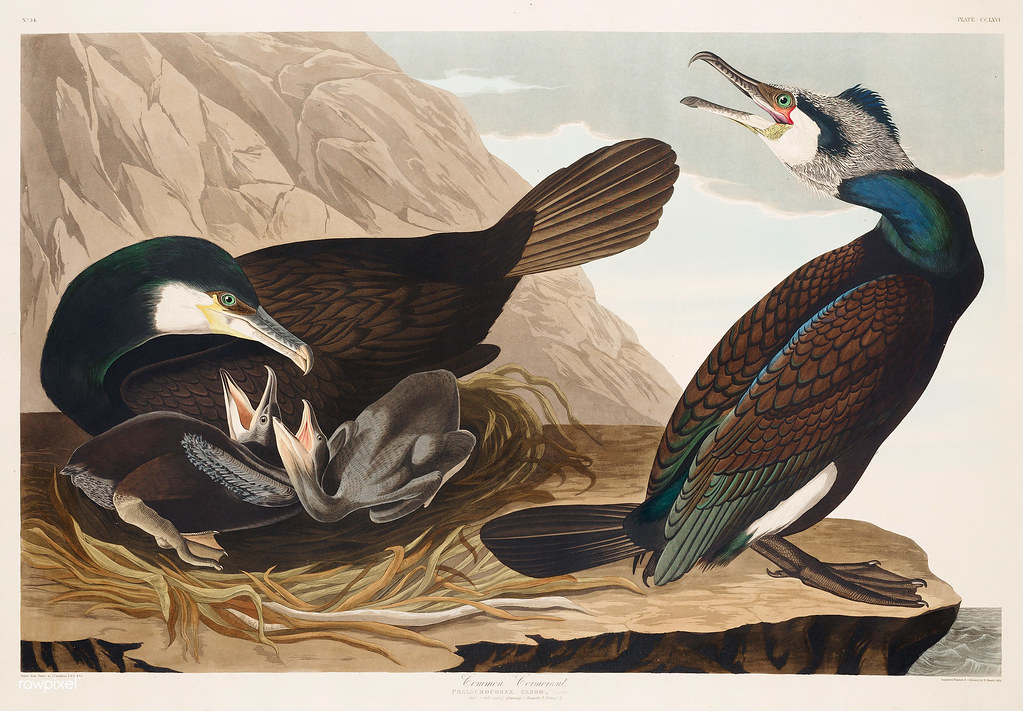
Illustration: “Common Cormorant from Birds of America (1827) by John James Audubon (1785 – 1851), etched by Robert Havell (1793 – 1878). The original Birds of America is the most expensive printed book in the world and a truly awe-inspiring classic.” by Free Public Domain Illustrations by rawpixel is licensed under CC BY 2.0.

Short poem: RHL, ‘Coat’

Sew, sew, sew your coat
Gently down the seam;
Threadily, threadily, threadily, threadily,
Joseph wants a dream.

*****

A throwaway poem. For anyone unfamiliar with the references, it blends what is often sung as a round:
Row, row, row your boat
Gently down the stream;
Merrily, merrily, merrily, merrily,
Life is but a dream

with the idea behind the Andrew Lloyd Webber / Tim Rice musical Joseph and the Amazing Technicolour Dreamcoat.

The poem was published in Lighten Up Online (aka LUPO). Thanks, Jerome Betts!

Photo: “Benjamin School District 25 production of ‘Joseph and the Amazing Technicolor Dream Coat’. March 9th, 2013.” by old06cphotos is licensed under CC BY-NC-ND 2.0.

Short poem: RHL, ‘Sassy, Classy’

Easy to be young and sassy;
add experience, and it’s classy.

*****

I have absolutely no idea what inspired this couplet. Be that as it may, it was published in The Asses of Parnassus in October – thanks, Brooke Clark!

Photo: “Cece 220223 (1)” by ceciliajaner is licensed under CC BY-SA 2.0.

RHL, ‘Boy With Scab’

The boy he’s always been still takes delight
In testing scabs on elbows, knees,
To see if fingernails can assert their right
To lift with satisfying ease
The lid from off the mystery healing box
And see the flesh beneath the skin
Where the wise body-mind slowly unlocks
Corpuscles and white pus within.
The hint of pain, like some itch that you scratch,
Is fun alongside look-and-see.
What does the boy do with that useless patch,
The scab? Easy: autophagy.

*****

Curiosity is a useful aspect of intelligence. This poem first published in Lighten Up Online (aka LUPO). Thanks, Jerome Betts!

Photo: “War Stories” by Noël Zia Lee is licensed under CC BY 2.0.

Unforgettable nonsense: Anon, ‘I Eat My Peas With Honey’

I eat my peas with honey;
I’ve done it all my life.
It makes the peas taste funny,
But it keeps them on the knife.

*****

The staying power of well-turned nonsense rhymes is testament to the value of rhythm and rhyme for keeping something intact, perfectly remembered. The poem’s joke is well done, with a good punchline; but the word-for-word memorability comes from the magic of verse.

The Poetry Foundation recognises this poem as having been recited in the American comedy/quiz show ‘It Pays to Be Ignorant‘ on 2nd February 1944 (or more likely 7th February 1944), you can hear Harry McNaughton read it here, and my guess is that he (or another of the show’s writers) was the author. Apparently some people have thought it was written by Shel Silverstein (1930-1999), but this is denied by his Estate and its archivists. Others in the US have stated it is by Ogden Nash. In the UK it has been labeled as Spike Milligan’s. It is an object lesson in optimistic (i.e. false) attribution. But even in Arnold Silcock’s collection ‘Verse and Worse’ (Faber & Faber, 1952) it is only credited to Anonymous… whose birth was a long time ago, and whose death is not expected any time soon.

Photo: “I eat peas with honey – Day 101 of Project 365” by purplemattfish is licensed under CC BY-NC-ND 2.0.

Unforgettable nonsense: Samuel Wilberforce, ‘If I Were a Cassowary’

If I were a cassowary
On the plains of Timbuctoo
I would eat a missionary,
Cassock, bands, and hymn-book too.

*****

Yes, cassowaries are from Australia and New Guinea, and Timbuktu is in Africa… but so what? The rhymes are too good to ignore. ‘Bands’, btw, refers to the pseudo-necktie thingies that priest-types and lawyer-types affect in some countries – little cloth flaps, plural because you wear two of them.

The probable author is Bishop Samuel “Soapy Sam” Wilberforce, best known nowadays for debating  Thomas Henry Huxley on evolution in 1860. Huxley (Aldous Huxley’s grandfather) was commonly referred to as ‘Darwin’s bulldog’. Wilberforce is remembered for his question as to whether it was through his grandmother or his grandfather that Huxley considered himself descended from a monkey. Huxley is said to have replied that he would not be ashamed to have a monkey for his ancestor, but he would be ashamed to be connected with a man who used his great gifts to obscure the truth.  Apparently everyone enjoyed the debate, and they all went off happily to dinner together afterwards.

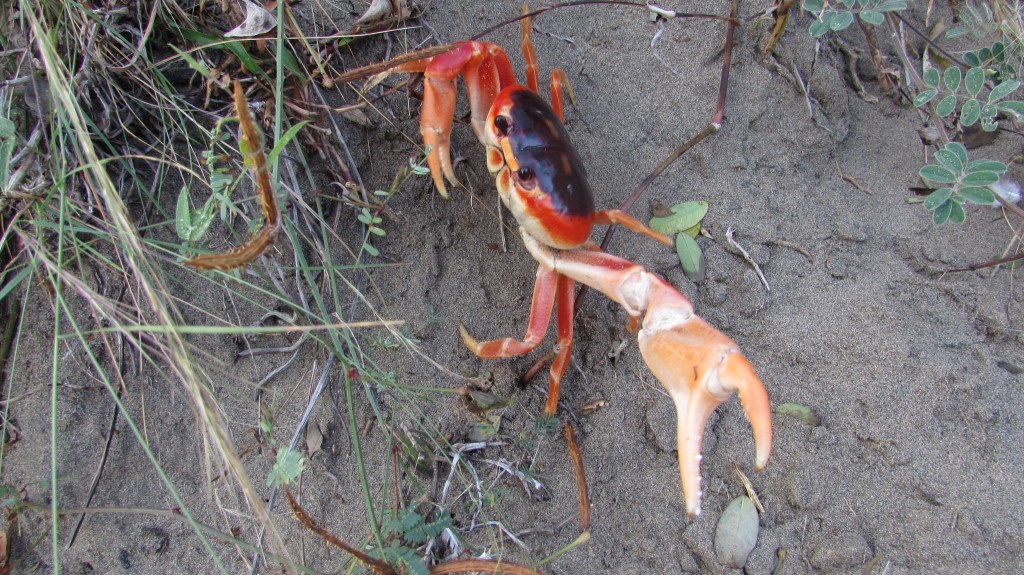
Cassowaries are more formidable than either Wilberforce or Huxley. Standing over six feet tall, capable of running at 30 mph (and good swimmers in rivers and sea), and able to leap and strike chest-high with razor-sharp 5-inch talons, they are omnivores not to be confronted. Yes, they might well eat a missionary. Also, the cassowary’s bands are more impressive.

Photo: “Cassowary at the Budapest zoo” by brenkee is marked with CC0 1.0.

Short poem: Amit Majmudar, ‘Charmed Life’

Destiny blessed me. Kismet kissed me.
Accident aimed, but the meteor missed me.
Fate did me favors. Luck had my back
For a leisurely picnic between the tracks.
Joy was a contract I printed and inked.
How could I know
In the mountaintop snow
Nemesis tiptoed behind me and winked?

*****

‘Charmed Life’ appeared in Literary Matters, and also in The Best American Poetry 2024, selected by Mary Jo Salter. That BAP volume carries Amit Majmudar’s statement on the poem in the back matter:

“Count no man lucky until he is dead,” said Solon, a lawgiver in ancient Greece. You never know when a friendly universe might turn on you: The monthlong dry cough that turns out to be a lung mass, the backache that turns out to be a bone met; a quick trip in the car to get bread and bananas that takes a left at the light into lifelong quadriplegia. Just days before that catastrophe: A wedding, or a book deal, or a Disney trip with the kids…. It’s not a tightly enforced law, but things do tend to cancel out when it comes to good luck and bad luck, good times and bad times. (At least that holds for those of us who crowd the middle of the luck distribution; certainly some people at either extreme have only one sort of luck in abundance.)

This dashed-off charm of a poem, ‘Charmed Life,’ reflects that sense of yin and yang, of scooping slop and caviar with the same spoon. The speaker plays life on easy mode until that turn at the end, but the first word of the last line embeds the idea. “Nemesis” comes from the Greek for giving someone what they deserve, and before that, from the Indo-European root *nem-, which means “distribute.” Everyone deserves hell yeah and oh no in roughly equal measures. And for the most part, that is what we get.

*****

Amit Majmudar is a poet, novelist, essayist, and translator. He works as a diagnostic nuclear radiologist in Westerville, Ohio, where he lives with his wife and three children. Recent books include Twin A: A Memoir (Slant Books, 2023), The Great Game: Essays on Poetics (Acre Books, 2024), and the hybrid work Three Metamorphoses (Orison Books, 2025). More information at www.amitmajmudar.com

Photo: “Nemesis Roman goddess of retribution Marble 150 CE” by mharrsch is licensed under CC BY 2.0.


Short poem: RHL, ‘Tease’

I feel good that you want it;
you know it’s under there;
it makes me feel important
but I don’t like your stare.

I wear enough to hide it
though all around is bare;
it’s treasure, ’cos you want it;
who you are, I don’t care.

*****

This poem was first published in Rat’s Ass Review (as are many politically incorrect poems), Fall/Winter 2024 – thanks, Roderick Bates!

Photo: “Lustful model teasing on a boat in a bikini.” by @yakobusan Jakob Montrasio is licensed under CC BY 2.0.

Short poem: RHL, ‘Neanderthals’

Watch how the status of the poor
Neanderthals will rise
when we admit we thank them for
red hair, white skin, blue eyes.

*****

“All non-Africans today may have a roughly equal proportion of Neanderthal DNA, but some of the most visible physical traits appear to have been inherited especially by modern Europeans, and northern Europeans in particular. Here is a list of traits that distinguished Neanderthals from Homo sapiens, but that you could also have inherited if you are of European or Western Eurasian descent.

  • Rufosity : i.e. having red hair, or brown hair with red pigments, or natural freckles.
  • Fair skin, hair and eyes : Neanderthals are believed to have had blue or green eyes, as well as fair skin and light hair. Having spent 300,000 years in northern latitudes, five times longer than Homo sapiens, it is only natural that Neanderthals should have developed these adaptive traits first.”

I skipped 11 traits to get to these two. If you want the whole list, they’re at https://www.eupedia.com/europe/neanderthal_facts_and_myths.shtml

I’m just amused, of course, by the chance to label famously red-white-and-blue flag-waving countries as Neanderthals: the US, UK, France, Netherlands, and Russia… (as well as many other less historically aggressive countries around the world).

This poem was first published in Rat’s Ass Review (as are many politically incorrect poems), Fall/Winter 2024 – thanks, Roderick Bates!

Image: ChatGPT from RHL prompt

Short poem: RHL, ‘The Self-Aware’

Most insecure are those, the self-aware:
for all their acts are pointless and they know it,
scurrying like ants on an eclair…
the universe, indifferent, looks askance.

This insecure mode breeds defensiveness
and therefore arrogance, not least in poets
who know their work especially valueless…
even to other ants.

*****

I think we poets, who can be so rude about other people, need to be rude about ourselves occasionally. Not that the universe cares one way or the other.

This poem was originally published in The Road Not Taken – A Journal of Formal Poetry – in Fall 2016. Thanks, Dr. Kathryn Jacobs!

Photo: “Ant picnic” by dmcneil is licensed under CC BY-NC-ND 2.0.