Category Archives: Poetics

Using form: sonnet variation: Amit Majmudar, ‘A Pedestrian’

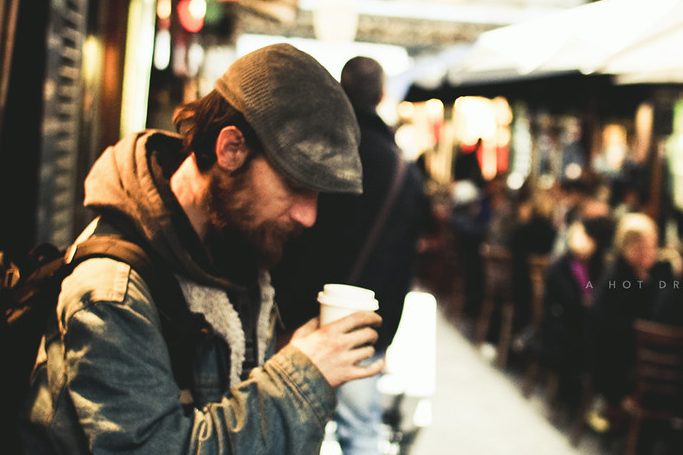
He window shops. He yawns. He checks his watch.
He sips his Starbucks through a spillproof lid.
No one knows who he is or what he did
except a black van loitering down the block.
He buys a pack of gum. Briefly he stops
to crouch and read the headlines of the Times
before continuing up 12th and Vine.
His neck prickles. He slows. The coffee drops

and before it has landed he’s off like a hound at the races
he is hurdling strollers and ducking a chilidog raised
to the mouth checkered taxis grow fists as he cuts
into oncoming traffic our cellular phones snap shut
in amazement look billowing trenchcoats give chase
fleshcolored earpieces dangling a flush to their faces

*****

Amit Majmudar writes: “The actor Alfred Molina recorded ‘A Pedestrian‘ for the Poetry Foundation many years ago: https://www.wnyc.org/story/52133-poetry-off-the-shelf-amit-majmudar/ . It’s an excellent rendition. I remember feeling, when I heard that recording back in 2006 (at the tender age of 27), that I had finally “arrived” as a poet—after all, the guy from the opening sequence of Raiders of the Lost Ark had spoken my words! I don’t often write sonnets, but ‘A Pedestrian‘, with its metrical shift from walking to running at the volta (dovetailing with the idea of metrical “feet”), was a fun poem to write.”

Amit Majmudar is a poet, novelist, essayist, translator, and the former first Poet Laureate of Ohio. He works as a diagnostic and nuclear radiologist and lives in Westerville, Ohio, with his wife and three children. 
      Majmudar’s poetry collections include 0’, 0’ (Northwestern, 2009), shortlisted for the Norma Faber First Book Award, and Heaven and Earth (2011, Storyline Press), which won the Donald Justice Prize, selected by A. E. Stallings. These volumes were followed by Dothead (Knopf, 2016) and What He Did in Solitary (Knopf, 2020). His poems have won the Pushcart Prize and have appeared in the Norton Introduction to Literature, The New Yorker, and numerous Best American Poetry anthologies as well as journals and magazines across the United States, UK, India, and Australia. Majmudar also edited, at Knopf’s invitation, a political poetry anthology entitled Resistance, Rebellion, Life: 50 Poems Now. 
      Majmudar’s essays have appeared in The Best American Essays 2018, the New York Times, and the Times of India, among several other publications. His forthcoming collection of essays, focusing on Indian religious philosophy, history, and mythology, is Black Avatar and Other Essays (Acre Books, 2023). Twin A: A Life (Slant Books, 2023) is the title of a forthcoming memoir, in prose and verse, about his son’s struggle with congenital heart disease. 
      Majmudar’s work as a novelist includes two works of historical fiction centered around the 1947 Partition of India, Partitions (Holt/Metropolitan, 2011) and The Map and the Scissors (HarperCollins India, 2022). His first children’s book also focuses on Indian history and is entitled Heroes the Colour of Dust (Puffin India, 2022). Majmudar has also penned a tragicomic, magical realist fable of Indian soldiers during World War I, Soar (Penguin India, 2020). The Abundance (Holt/Metropolitan, 2013), by contrast, is a work of contemporary realism exploring Indian-American life. Majmudar’s long-form fiction has garnered rave reviews from NPR’s All Things Considered, the Wall Street Journal, Good Housekeeping, and The Economist, as well as starred reviews from Kirkus and Booklist; his short fiction won a 2017 O. Henry Prize.   
      Majmudar’s work in Hindu mythology includes a polyphonic Ramayana retelling, Sitayana (Penguin India, 2019), and The Mahabharata Trilogy (Penguin India, 2023). His work as a translator includes Godsong: A Verse Translation of the Bhagavad-Gita, with Commentary (Knopf, 2018).

Photo: “a hot drink” by [ embr ] is licensed under CC BY-NC-SA 2.0.
Using form: Couplets: Maryann Corbett, ‘Fugue in October’

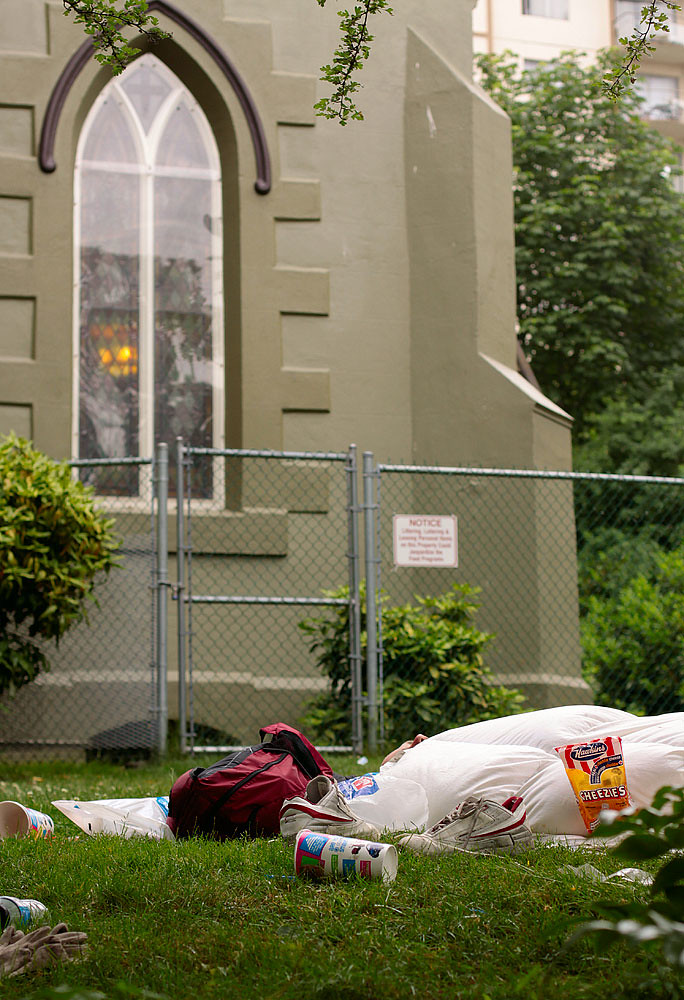
Baroque chamber ensemble and homeless encampment, Saint Paul

Perfect: the singers, strings, and keyboards. Perfect
Bruised sky above the tents of the squatters’ district
the little jewel-box church, its bright acoustic
calm in the year’s last mildness, the only music
softened a little in the candles’ lighting,
the mumbling underpass. The wind. No fighting
for this is God’s mind, woven of harmonies
for once. Tonight, for once, no one ODs—
and our souls thread through the flame of the vigil lamp
someone got lucky at the entrance ramp
as we hold, hold to Monteverdi’s line
(panhandling, on this warm day, with a sign)
and stop our breath until the last string dies
and parcels out his manna of salty fries
in the last great chord of his Beatus vir
while sirens wail some sorrow, far from here.

*****

Editor’s comments: “In case it isn’t clear from whatever device you are reading this on, each couplet here is comprised of a line about a musical ensemble in a church followed by a line about a homeless encampment under a highway. You can read it straight through as a soft-voiced line followed by a harsher one; or you can read every other line in one voice and the remaining lines in a different voice; either way, you are blending two very different aspects of city life into a larger, richer picture of community sharing, whether in glamour or squalor. This is an unusual and remarkably effective use of rhymed couplets of iambic pentameter.
The contrast built into the poem, and the skill with which it was done, made it a natural poem for inclusion in the ‘City! Oh City!‘ Potcake chapbook. It first appeared in Measure Review; and is included in the collection In Code.

Maryann Corbett writes: “Events that trigger a poem need not be as simultaneous as the poem makes them seem. The choral concert in this poem took place on a subzero night during the Christmas season; the rise of homeless encampments occurred at a warmer time of year–but both could be happening in my city at any time, and they probably still are.”

Maryann Corbett earned a doctorate in English from the University of Minnesota in 1981 and expected to be teaching Beowulf and Chaucer and the history of the English language. Instead, she spent almost thirty-five years working for the Office of the Revisor of Statutes of the Minnesota Legislature, helping attorneys to write in plain English and coordinating the creating of finding aids for the law. She returned to writing poetry after thirty years away from the craft in 2005 and is now the author of two chapbooks, five full-length collections already published, and a forthcoming book. Her fifth book, In Code, contains the poems about her years with the Revisor’s Office. Her work has won the Willis Barnstone Translation Prize, has appeared in many journals on both sides of the Atlantic, and is included in anthologies like Measure for Measure: An Anthology of Poetic Meters and The Best American Poetry 2018.

Her web page: http://maryanncorbett.com

Photo: “sleeping on the rock of ages” by waferboard is licensed under CC BY 2.0.

Using form: nonce form; John Beaton, ‘Wolves’

I’m wakened, drawn towards the ice-thin window,
to witness scenes as faint and still as death.
How bleak the moon; how bare the trees and meadows;
sky’s pale maw overhangs
Earth bleached beneath star fangs.
Night’s curled lip sneers on shadows
of mountains set like teeth.

Two bow waves shear the median of the valley,
iced hayfield yields as feral muscles glide–
hoarfrost disturbed by wakes of live torpedoes.
Grey shoulders breach and lope,
implode and telescope,
impelled by ruthless credos
of chilled and vicious pride.

The wolves tear savage furrows down the nightscape;
their eyes are shined with blood, their mission clear.
Grass springs back shocked to green behind their passage–
twin tracks traverse the vales,
cold comets trailing tails
leave scarred in frost their message:
the wolves, the wolves passed here.

*****

John Beaton writes: “This describes a real incident on our acreage when I woke in the middle of a frosty night for no apparent reason and looked out the window. I was struck by the grace, power, and sense of danger the wolves evoked.
“The first three lines are pentameter and the endings alternate—feminine, masculine, feminine. The next four lines contract to trimeter to give a sense of speed and acceleration. Lines two and seven have a masculine rhyme that closes the stanza and ties its parts together. The overall rhyme-scheme is xabccba. My intent was to convey the power and motion of the wolves running and I built in alliteration and internal rhyme to help with this.”

John Beaton’s metrical poetry has been widely published and has won numerous awards. He recites from memory as a spoken word performer and is author of Leaving Camustianavaig published by Word Galaxy Press. Raised in the Scottish Highlands, John lives in Qualicum Beach on Vancouver Island.
https://www.john-beaton.com/

Photo: “Wolves With Northern Lights (Color Corrected)” by edenpictures is licensed under CC BY 2.0.

Using form: alliterative verse: A.M. Juster, ‘Three Visitors’

Mist on moonspill as midnight nears.
Adrift but not dreaming our drowsy son
is covered and kissed. At the kitchen door
our old basset is barking; coyotes out back
are standing like statues down by the dogwoods.
Across the crystal of crusted snow,
they search for stragglers to startle and chase.
Their vigil reveals no victims this night.

Trash would be trouble; they trot away
unbothered by bloodthroated growling and baying.
No star distracts their stealthy march.
As the highway hums they howl through the calm,
then savor new scents that spice their path
in this world awash in wonder and wrath.

*****

Editor’s comments: “Alliterative verse is a form found across the old Germanic language family including Old English, Middle English, Old Norse, Old High German and Old Saxon. It relies on a chant-like use of stressed syllables and does not count all syllables in the way that Romance poetry tends to; and it relies on alliteration rather than rhyme as its key memory-aid for recitation. Although there are many regional variations in the structure, most include these key points:
each line is divided into two halves by a heavy caesura;
each half has two heavily stressed syllables (“lifts”) as well as some unstressed ones (“dips”);
the two lifts of the first half alliterate with the first lift of the second half, but not with the second.
There is a good article on alliterative verse in Wikipedia which goes into more detail and also quotes or references a range of modern poets who have experimented with the form: Tolkien, C.S. Lewis, Auden, Richard Wilbur, Ezra Pound, Heaney… and Alaric Watts for his alliterative abecedarian ‘Siege of Belgrade‘. Alliterative verse can work smoothly and powerfully in English.”

A.M. Juster writes: “After translating the anonymous long Old English poem ‘The Phoenix‘ for a stalled book, I became interested in the possibilities for original alliterative verse—this poem is the first of those poems. A reader should also be able to detect the ghost of a sonnet in it due to the length of the stanzas, the turn, and the closing rhymed couplet.
“The poem started in my mind with the real invasion of coyotes in our suburban Boston neighborhood, but as I struggled with the poem it seemed to be situated in a beautiful place I have never seen—a fusion of our house and the house my bride’s parents used to have in Vermont (where I set an experimental sonnet in my first book).
“Although I think the religious undercurrents are fairly subtle, Micah Mattix & Sally Thomas did include the poem in their recent Paraclete Press anthology of Christian Poetry in America since 1940.”

A.M. Juster’s poems and translations have appeared in Poetry, The Paris Review, The Hudson Review and other journals. His tenth book is Wonder and Wrath (Paul Dry Books 2020) and his next book will be a translation of Petrarch’s Canzoniere, which W.W. Norton will release in early 2024. He also overtweets about formal poetry @amjuster.

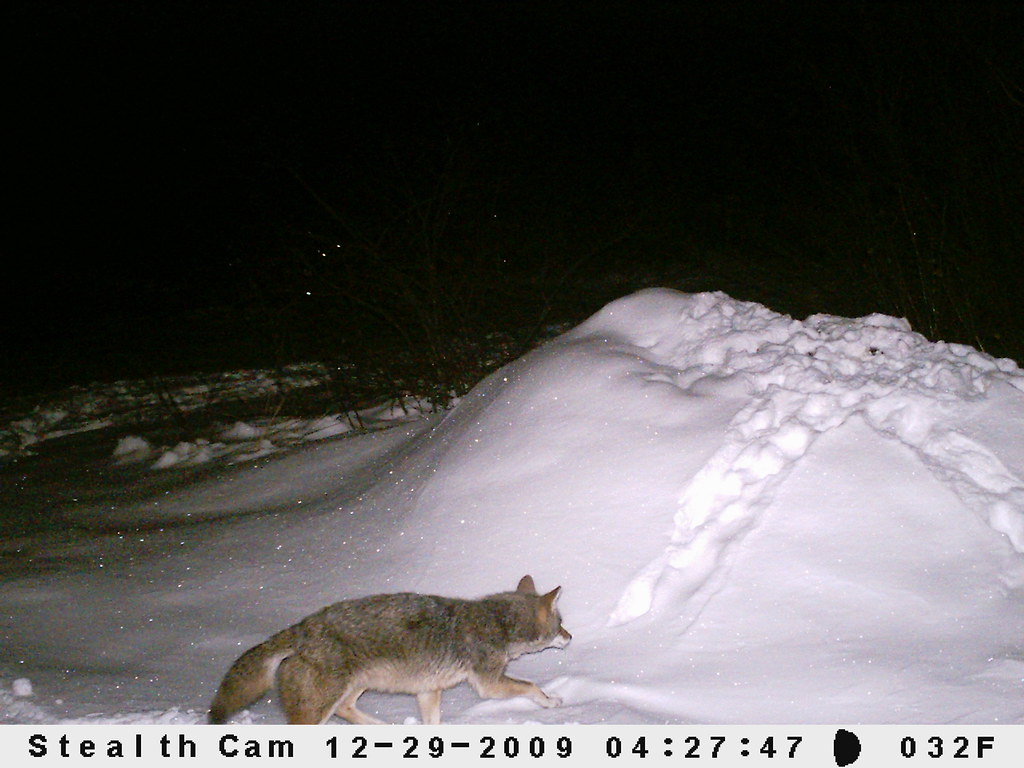
Photo: “LZGC coyote” by animaltourism.com is licensed under CC BY-NC-ND 2.0.

Calling the Poem: 13. ‘Crafting the Verse’

We stand on two banks of the river that’s flowing between us.
I’ll bridge my new thoughts out to you with a verse.
First I form key ideas – they need clarity, cleanness –
The bridge forms an outline, takes shape in my head.
Now that bridge must be built,
Built regardless of canyons, or mud flats and silt.

The pillars are images placed first for more of the bridge to traverse,
With my strongest words buttressing them so they’re not washed away.
Their positions are set by the distance and shores,
While the force of the water, the shape of the bed,
And the landscape and soil on my side and yours,
The allowance for possible earthquake or storm,
The demands of the load that the bridge will convey…
These determine the structure, materials, form:
For the best bridge will meet site demands
With both strength and matched style.
So the poet needs meter and rhyme, every trick he commands,
Or the verses won’t carry their burden, will fail to beguile.

Though you see stone or steel in the bridge, for the most part it’s air,
Rhythmic arches of unspoken airy allusion, illusion,
Outlined in hard words and designed to be elegant, spare.
So this poem’s a book, that’s reduced to an essay, reduced more compactly
To two hundred lines, sacrificing precision
To memory’s need for concision, elision.
Two hundred exactly?
No, not exactly. (Exactly!)

From the sweep, pattern, length,
To its delicate strength,
Whether old Roman aqueduct, young Golden Gate,
Whether flowing with water or people and freight,
Its clean shape was constrained by the structural needs and efficiencies,
Driving its strength and position and duty.
All unstructured words in the river are wasted deficiencies.
Poems will last quite as long as an old Roman aqueduct,
Bridging the banks, bearing brightly in rhythms of beauty,
If all ostentation and ornamentation
Support the key functions in what you construct.
Raise your sights to the Space Elevator, that cable,
That modern-day Tower of Babel,
To not just bridge over
A strait or the Severn
But up! to bridge up! at the same time, to heaven.

Cloaked gods were invoked,
And the tiger broke cover,
Your poem connects river banks.
Now give thanks.

*****

When I moved to Denmark in my early 20s I was intrigued to hear that engineering students at a local university began their studies, not with lectures on a variety of key subjects, but by being placed in teams and told to design a bridge that would meet the demands for specific use at a specified site. Materials, geology, weather, load, cost, elegance and everything else that goes into bridge design all had to be researched and included in the project. When students had completed a whole series of projects, they had earned their degree. It was a very different approach from the lecture-based university courses that I had dropped out of in the UK.

How does this relate to writing poetry? Well, it brings to mind Heinlein’s ‘first law of writing’: “You must write.” Also the old story of the would-be concert-goer lost in New York City, asking a man with a violin case how to get to Carnegie Hall and being told “Practice, practice, practice.” There are a lot of factors involved in writing verse – some are common across all cultures and languages while others are language-specific. They all involve ideas (and their mysterious origin), images and their expression in words; but making those words so effective that they evoke an appropriate response in the reader or listener, so effective that they can be remembered and recited, requires the use of a whole range of language-specific factors that are mastered by doing.

By the way, the “two hundred lines” mentioned above refers to the length of the entire ‘Calling the Poem’ e-chapbook that this is part of. This chapbook is a single work, though constructed of various formal and semi-formal pieces.

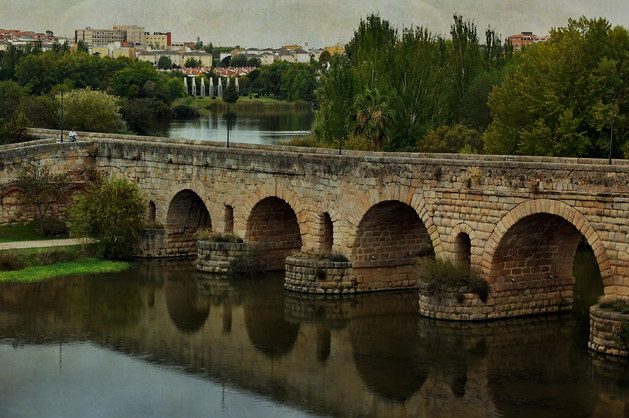
Photo: “Roman Bridge, Merida” by Jocelyn777 Love Europe is licensed under CC BY-SA 2.0.

Calling the Poem: 12. ‘Memorableness’

That* for an idea, for an idea’s transmission.
But that isn’t poetry. Poetry’s mission
is memory – every quick trick of the tongue
to give ear-to-mouth memory,
words sung and strung
from an ear to an ear,
bearing clear repetition,
not just the idea,
but the idea’s expression,
silk wrapping the emery –
rhythm and rhyme,
form, pattern, compression,
feet, movements, beat, time,
iter-, reiter- and alliteration,
sense, nonsense and assonance, insinuation,
barbs and allusions,
hooks, jokes and confusions,
directions, inflections, creating connections…
So memory favours your chanting, reciting,
enchanting beyond all mere reading and writing –
and magicking into the mind of forever.
You’ve taken control of poetic endeavour.

*****

*The first word, “That”, is referring back to the previous poem in the e-chapbook’s sequence, dealing with the process of obtaining the thoughts and ideas for a poem. This poem shifts the focus to the wordsmithing that makes a poem word-for-word memorable, memorisable, repeatable, recitable.

Consider the pieces of verse that are easiest for you, personally, to recite… nursery rhymes, passages of Shakespeare, bits of Tennyson’s ‘Charge of the Light Brigade’, quatrains from FitzGerald’s ‘Rubaiyat of Omar Khayyam’, an Emily Dickinson or Edward Lear poem?

Then consider how many prose passages of similar length you can recite – perhaps a Bible passage or part of Lincoln’s ‘Gettysburg Address‘? There will be some, prose passages you have heard many, many times. But poetry is going to win out over prose by number of pieces, length of pieces, and accuracy, because poetry is deliberately uses a variety of tricks that make memorisation as easy as possible.

Poetry is not just the idea but also, essentially, the idea’s expression.

Photo: “Maori Chant” by pietroizzo is licensed under CC BY-NC-SA 2.0.

Potcake Poet’s Choice: Marcus Bales, ‘Cleveland Krater’

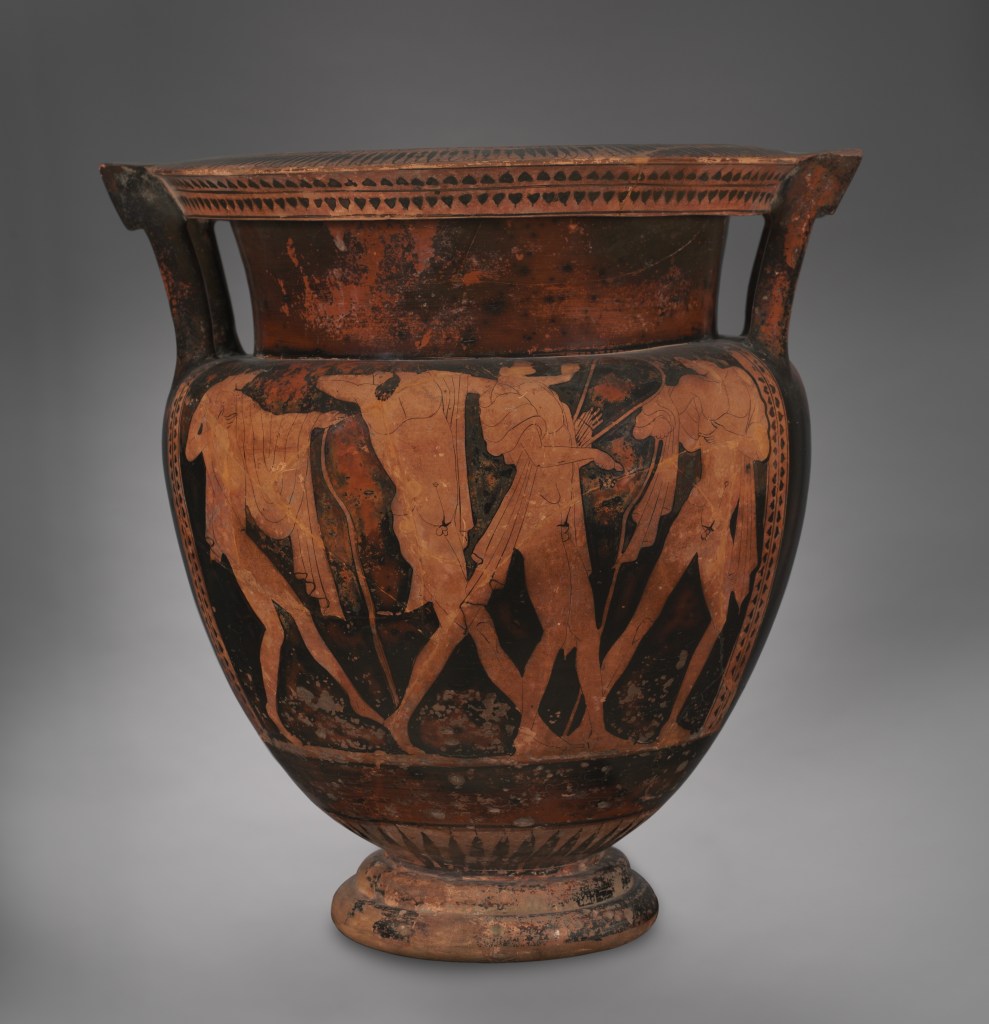
This column krater once held watered wine,
Its figures, red on black, an illustration
Of how it served the daily and divine.
On one side Hera offers a libation
With Artemis, Apollo, and their mother,
While three nude athletes and a bearded man
Are drunk with more than liquor on the other.
I stare through all four panes of glass that ban
All but my eyes from learning every curve,
And I can only dream that luck and nerve
And my own art may earn a chance to feel,
As one of few who cares to understand
That ancient try to make one ideal real,
To feel it push through time with my own hand.

*****

Marcus Bales writes: “A poem is language in meter that evokes emotion in the reader. Those who write to express themselves are doing something other than writing poetry. No reader accomplished enough to be engaged in reading poems is in it for the writer’s blurt. It may be that the writer is trying to evoke the same emotion in the reader that the writer felt in the poem’s circumstances, but the goal remains to evoke that emotion in the reader, not merely recount the writer’s emotion.

Poems that fail to evoke emotion in the reader are failed poems and, alas, every poet has several. They wait patiently like the mythic swordsman in fairytales to keep the protagonist from going through the door behind them. Our hero or heroine arrives in the room, the swordsman puts down Kant’s ‘Critique of Pure Reason’ – in the original German – and smiles, drawing a sword. The writer, however already wounded or tired from the effort of getting there, engages and soon enough, after an elaborate exploration of the waiting swordsman’s skills, is disarmed. The swordsman bows, kicks the writer’s sword back to him, sheathes his own, picks up his book, and sits down again, angles it to the light from the only window, nods goodbye, and resumes his perusal. The writer picks up the disgraced weapon, and trudges back out the way they came in. That poem still does not do what the writer intended to do: evoke emotion in the reader; all it remains as is an account of his or her own emotion.

It is the strength of that felt emotion that keeps the writer coming back to the failed poem, ever hopeful that it is an exception to the unyielding rule that the poem is for the reader, not the poet. Some poets make careers out of performing such things, their agents guaranteeing that the poet will cry during the performance, sure that the promoters are only interested in the performance, not in its effects on the audience. And there are audiences for whom watching the performer fail in their presentation is the point. No one involved in that scenario is there for poetry.

Unfortunately, this poem, ‘Cleveland Krater’ is one of those failed poems. Absent the actual krater, I have finally come to realize, the reader is not going to experience the emotion I did. I have come back and back to this piece, always after having visited the krater again, examining it closely through its Plexiglas box, looking for the clues that moved me and still move me, to try to shove them into words that will bring that impact I felt to the reader. Maybe if I just admit my failure I will get free of the draw of its blade when I arrive at it, again, hoping that this time I’ll do better than the dismissive kick of my sword clattering across the stone floor.”

Not much is known about Marcus Bales except that he lives and works in Cleveland, Ohio, and that his work has not been published in Poetry or The New Yorker. However his ’51 Poems’ is available from Amazon. He has been published in several of the Potcake Chapbooks (‘form in formless times’).

An extensive review of the Cleveland Krater and its creator can be found at https://www.academia.edu/12708103/The_Cleveland_Painter. You don’t need to log in or register, you can simply scroll down to read the entire pdf.

Photo: provided by the Cleveland Museum of Art https://www.clevelandart.org/art/1930.104#

Epigram: ‘Bit with Bite’

I think I’ve blinked
At what you write:
Edgy, succinct–
A bit with bite.

This is in the spirit of a homage to The Asses of Parnassus, in which the poem found a home. Editor Brooke Clark has created a tumblr account that for the past few years has been posting “Short, witty, formal poems” on an occasional (i.e. erratic) basis, much in the spirit of Latin and Greek epigrams (and often translations of them, or modern retellings).

This poem itself is not particularly noteworthy – but I enjoyed rhyming ‘blinked’ with ‘succinct’, as well as the ‘think/blink’ and ‘bit/bite’ pairings. Wordplay is at the heart of poetry, from Anglo-Saxon alliteration to modern rap, from nursery rhymes to Shakespearean sonnets. Wordplay is memorable, and sharpens the pain of an epigrammatic jab. Use it, if you want your barbs to be effective.

Kyrielle: ‘Desire is the Last Domino to Fall’

Religion starts as trying to explain,
Progresses to high priests’ financial gain.
I’ve tried religions, and seen through them all;
Desire is the last domino to fall.

Explore the world – well, fifty lands’ enough;
Novelty fades; folks are just folks; stuff’s stuff.
I’ve seen both rich and poor round this blue ball;
Desire is the last domino to fall.

And I’ve gone barefoot, and I’ve gone first class:
The trinkets pall beside bare feet on grass.
Markets go up and down and they too pall;
Desire is the last domino to fall.

The fearful right, the overtrusting left:
Politics, history, both of sense bereft.
Reagan’s road leads to Trump and hits a wall;
Desire is the last domino to fall.

My arts expression’s been in writing verse–
The arse end, clearly, of the universe.
There’s rarely silver in the nets I haul;
Desire is the last domino to fall.

I’ve had my fill of sex – but when I see
A vibrant youth, my thoughts are freshly free.
I want, though why I want I mayn’t recall…
Desire is the last domino to fall.

This poem, published by George Simmers in April’s Snakeskin, flowed straight out of a comment by Jackson Browne in a Guardian article on his latest album, ‘Downhill From Everywhere’. My thanks go to Mindy Watson, creator of poems in every form she hears of, for identifying this one as a kyrielle. I hadn’t set out to write within a specific form, I merely wrote a poem that used a repeating last line of the stanza. And this highlights one of the things about form: form follows function, in poetry as in architecture. Metre, rhyme scheme, line length, all these are chosen for their appropriateness for the mood and content of the poem. Ballads, sonnets, couplets, villanelles, each type finds its best use in a different situation, each evolved to provide a good expression of a different mood, each became popular as its expressive strength was demonstrated.

A kyrielle seems to me a natural poetic construct for an expression of prayer or despair or wherever all avenues of thought lead back obsessively to the same essential fact or wish. It was formalised in the time of the troubadours, and its name derives from the Late Latin phrase “kyrie eleison“, “Lord, have mercy”. Very appropriate.

Photo: “Where It All Began” by mckinney75402 is marked with CC BY 2.0.

Epigram: ‘The Gods Compete’

The gods compete; some harvest verse, some tears,
Some deaths in battle, some vague hopes and fears.

This epigram is nondenominational–in the sense that I don’t have any preference for how people view, or are attracted to, some particular god.

More challenging is the punctuation. Good punctuation definitely helps guide the reader through the meanings of the passage, but what is ‘good’ varies by culture. Many Americans loathe the semicolon beloved by writers of convoluted passages. Many people argue for or against comma placements. In this piece, a 17-word sentence, the first line seems clearer than the second. “Some deaths in battle” might in this case be better written as “Some, deaths in battle” but that would suggest following it with “some, vague hopes and fears.” Then it might be preferable to separate those two parts of the line with a semicolon… but then perhaps the previous line should end in a semicolon too… but then what about the semicolon after “The gods compete”? Replace it with a colon.

I can’t help thinking of the remark often attributed to Oscar Wilde, or, as David Galef pointed out in the New York Times, Gustave Flaubert: “I spent the morning putting in a comma. In the afternoon I removed it.”

The poem was originally published in The Asses of Parnassus–thanks, Brooke Clark!

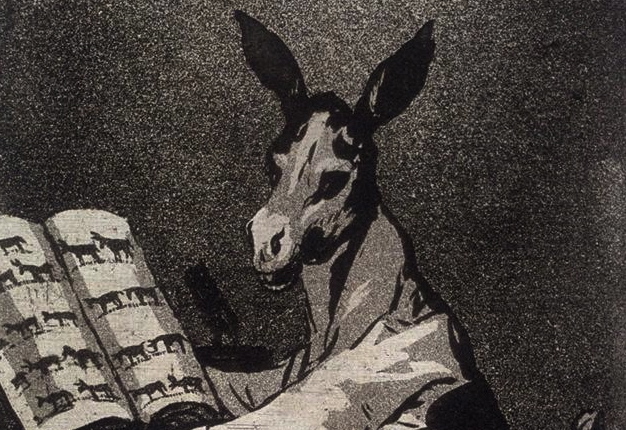
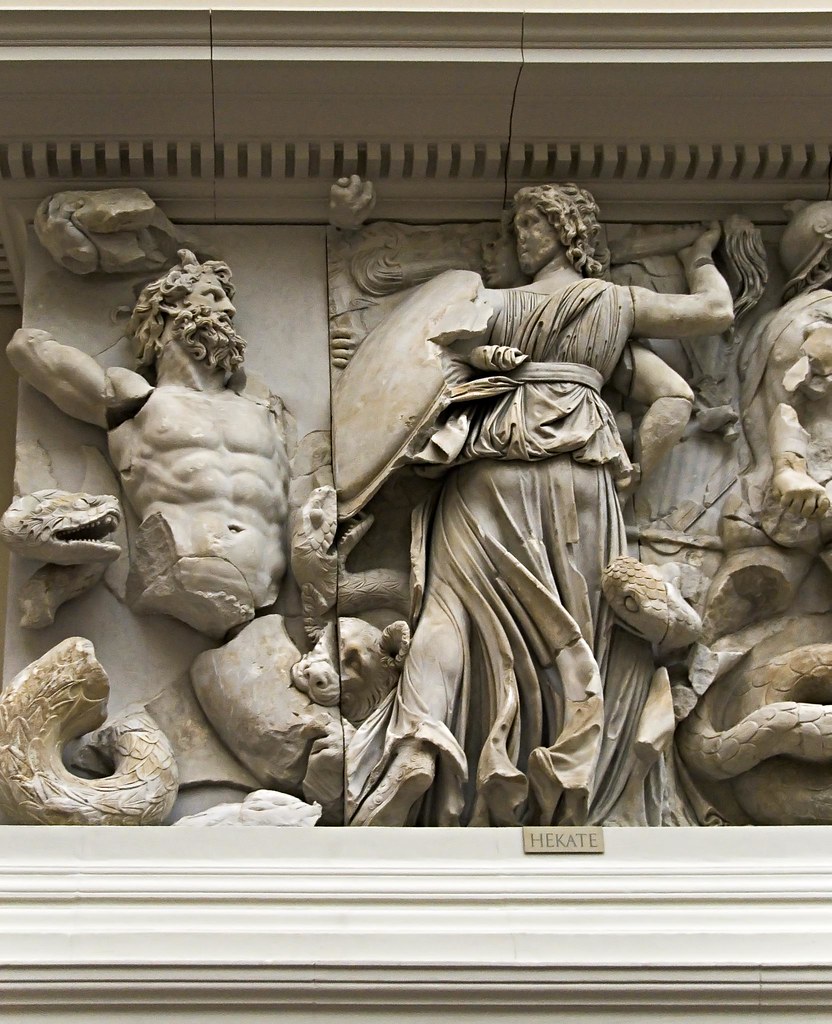
Photo: “Pergamon Museum _DSC17798” by youngrobv is marked with CC BY-NC 2.0.