Tag Archives: age

Sonnet: Helena Nelson, ‘Dream’

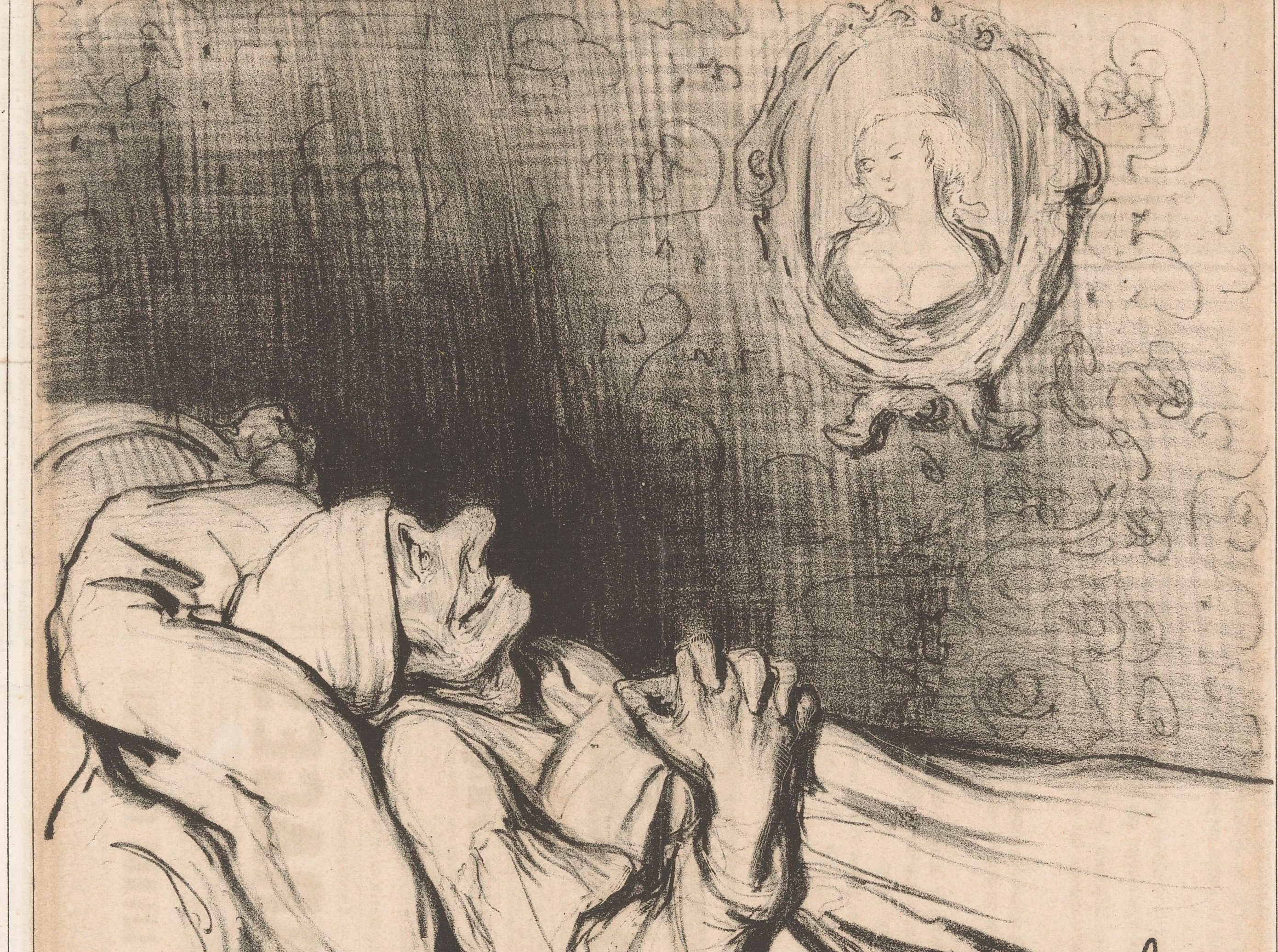
I found myself in bed with an old man.
His beard was silvery, his scrawny chest
a rack of ribs, his loose-lipped mouth open
and toothless as a baby. There he was,
there in our bed, as if he owned the place.
He snored and grunted like some ancient king
asleep after a banquet. But what feast
had led, dear heart, to this? What partying?
He turned his head to me. I saw his face—
a travesty. Some metamorphosis
had happened in our sleep, my love replaced
by a bag of windy bones. I need a piss,
he muttered, and got up. O then I knew
what age had done to us, and who was who.

*****

Helena Nelson writes: “Everyone experiences it eventually. You glance at your own reflection in the mirror and get a shock at how old you look. So that’s one of inspirations for this poem. The other spur to write this was a dream I had one night, though in the poem it’s intentionally unclear whether the experience is or isn’t real. I started with near rhymes in the octet and moved towards perfect rhyme at the end to convey the shock. I do hope the reader feels that shock at the end.” 

‘Dream’ was originally published in The Dark Horse.

Helena Nelson runs HappenStance Press (now winding down) and also writes poems, one of which appears in the Potcake Chapbook, ‘Lost Love’. Her most recent collection is Pearls (The Complete Mr and Mrs Philpott Poems). She reviews widely and is Consulting Editor for The Friday Poem.

Short verse: Susan McLean, ‘Jeopardy’

The first thing she requests post-surgery,
awake but drifting in the morphine glow,
is that my sister turn on the TV
so that the two can watch her favorite show.
Weak but alive, unsure if she has cancer,
my mother turns to questions she can answer.

*****

Susan McLean writes: “I wrote this poem while I was over a thousand miles away from the scene it describes, based on my sister’s phone account of what happened. The irony of the show’s title under the circumstances was the first stimulus for the poem, but also I almost laughed when I thought of how characteristic my mother’s action was. Given that she was in her eighties when she had major surgery, my mother’s jeopardy was very real, and I wrote the poem while we still didn’t know whether she had cancer. She did not. There is another irony, in that the game show Jeopardy! provides answers for which the contestants have to supply the appropriate questions. Yet, in context, those questions are answers.
The hardest challenge when writing about an emotional situation is to focus on the facts and let the emotions emerge by suggestion. A hint of humor acts as a counterweight to unspoken anxieties. The poem was first published in Measure and later appeared in my second poetry book, The Whetstone Misses the Knife.”

Susan McLean has two books of poetry, The Best Disguise and The Whetstone Misses the Knife, and one book of translations of Martial, Selected Epigrams. Her poems have appeared in Light, Lighten Up Online, Measure, Able Muse, and elsewhere. She lives in Iowa City, Iowa.

Susan McLean has two books of poetry, The Best Disguise and The Whetstone Misses the Knife, and one book of translations of Martial, Selected Epigrams. Her poems have appeared in Light, Lighten Up Online, Measure, Able Muse, and elsewhere. She lives in Iowa City, Iowa.
https://www.pw.org/content/susan_mclean

Photo: “Filming Jeopardy!” by jurvetson is licensed under CC BY 2.0.

Brian Gavin, ‘Death Watch at the Nursing Home’

Two rows of heads puffed white for show
are turned to watch the gurney go
parade-like down the hall and through
the double doors, and out of view.

They linger, as the swinging doors
are gazed to stillness, and intercourse
is but the mingling of silhouettes.
Beyond the tumults of regret

and wonder, they are elsewhere, all
their architecture of recall
connecting lives to family plots,
or maybe – further back – in what

may be a keepsake memory – light
parade, perhaps – a child’s delight
in clowns and cotton candy, high
and wispy as puffed hair. Friends die

often, but not in violence –
not here, where death comes to the sense
in not-quite-joy, and not-quite-grief,
but trembling, lightly, like a leaf

that might be blown, or not, or light
as dandelion fields puffed white
and wispy, wavering. In slow surmise
they gaze on quiet with quiet eyes,

filling the hall with noiselessness,
and dreaming but to acquiesce
to dream, and but to linger some
in thrall to stillness yet to come.

*****

Brian Gavin writes: “My poem sort of rips off (shamelessly!) the form and rhyme scheme of the famous A E Housman poem ‘To An Athlete Dying Young‘. It is, however, about a different kind of death – extreme old age – and the gentleness of it. It’s based on something I actually saw in a nursing home, when white heads once leaned out of their rooms to see a friend taken away on a gurney. The image of a parade struck me, and the heads of puffed white hair reminded me of cotton candy at the parades of my youth. Eventually the images of puffed hair and puffed candy morphed into a field of puffed white dandelions wavering in the wind.
I almost left the title at ‘Death Watch‘ – which I kind of preferred for the double meaning – but opted to add the rest of it for the sake of clarity. This piece ran in my collection Burial Grounds.”

Brian Gavin is a retired Distribution Manager who started writing poetry 10 years ago. His poems have appeared in The Journal of Formal Poetry, Peninsula Poets and Snakeskin Magazine, and in the Potcake Chapbook ‘Careers and Other Catastrophes. He lives in Lakeport, Michigan, USA, with his wife Karen. ‘Burial Grounds’ is available from Kelsay Books.
You can see more of his work at briangavinpoetry.com

Photo: “Dandelions Gone to seed, Dandelion puff ball seeds weeds lawn infestation roundup herbicide Pics by Mike Mozart of TheToyChannel and JeepersMedia on YouTube #Dandelions #Weeds #DandelionSeeds #Lawn #DandelionFlowers #Dandelion” by JeepersMedia is licensed under CC BY 2.0.

Susan McLean, ‘The Mirror’s Desolation’

Once you adored me. I would bask
in looks you saved for me alone,
giving no hint—if any ask—
of secrets only I have known.
But now you find me hard to face.
I care for you too much to lie,
copying lines you would erase.
You hurry past, head down, and I,
sensing your pained indignity,
return your look of mute distress.
Though you no longer cherish me,
I do not love you any less.

*****

Susan McLean writes: “I took the idea of a talking mirror from Sylvia Plath’s poem ‘Mirror,’ but whereas she presents the mirror as being totally dispassionate, my mirror reflects the emotions as well as the faces of those who look into it. Sometimes, if you see someone beautiful, you may think “the mirror loves her (or him).” But it occurred to me that mirrors love everyone. They just as gladly reflect the old and ugly as the young and beautiful. In this poem, I imagine the mirror’s sorrow that its love is not returned. In French, “I’m sorry” is “je suis désolé” (“I’m desolated”), which always seemed charmingly over-the-top to me. It occurred to me that the phrase “the mirror’s desolation” could refer both to the sorrow the mirror feels and to the devastation it causes. This poem first appeared in Valparaiso Poetry Review, and then in my second poetry book, The Whetstone Misses the Knife.

Susan McLean has two books of poetry, The Best Disguise and The Whetstone Misses the Knife, and one book of translations of Martial, Selected Epigrams. Her poems have appeared in Light, Lighten Up Online, Measure, Able Muse, and elsewhere. She lives in Iowa City, Iowa.
https://www.pw.org/content/susan_mclean

Illustration: DALL-E

Odd poem: William Faulkner, ‘After Fifty Years’

Her house is empty and her heart is old,
And filled with shades and echoes that deceive
No one save her, for still she tries to weave
With blind bent fingers, nets that cannot hold.
Once all men’s arms rose up to her, ‘tis told,
And hovered like white birds for her caress:
A crown she could have had to bind each tress
Of hair, and her sweet arms the Witches’ Gold.

Her mirrors know her witnesses, for there
She rose in dreams from other dreams that lent
Her softness as she stood, crowned with soft hair.
And with his bound heart and his young eyes bent
And blind, he feels her presence like shed scent,
Holding him body and life within its snare.

William Faulkner began writing poetry at an early age; and in his late 20s he published his first book, a collection of poems titled ‘The Marble Faun’. Though much of the fiction for which he won the 1949 Nobel Prize carries a heavy southern accent or is written in stream of consciousness, it is engaging to see that he could be meditative in the iambic pentameter of a regular sonnet if he chose.

Photo: “William Faulkner’s Typewriter 2” by visitmississippi is licensed under CC BY-ND 2.0

Potcake Poet’s Choice: Maryann Corbett, “Dutch Elm”

Maryann Corbett

That trees would die
yearly, we knew. The columns of the nave
of Summit Avenue, the architrave
of openwork where canopies unfold,
green or briefly gold,
the arched, leaf-dripping limbs
backlit with sky—

in every year, some go.
Some ends arrive with force: the papers warn
with pictures, after every storm,
of fallen branches, hollow at the heart,
or great trunks snapped apart,
battering cars and houses with the blows.
(We knew, but now we know.)

Some ends are quiet: the red
stripes appearing, like a garotting wound,
on trunks where the inspectors found
beetles in bark, bare limbs lurking in shade.
The tree crew and the chainsaw blade
will come—we know now—soon—
The stripe says, This is dead.

They make short work of things
with sweat and cherry pickers, saws and zeal
rope and rappelling acrobatic skill
and limb-shredding machines.
Only the stump remains
and is soon sawdust: nothing left to chance
but next year’s fairy rings.

No help for it, then.
This cut to sky, this coring of the heart.
These trees too far apart.
This just delivered balled-and-burlapped stick,
its trunk two inches thick,
decades from beauty. What we always knew:
We start again.

Maryann Corbett writes: “All day today I’ve been hearing, and sometimes watching, the process of the removal of my neighbor’s enormous elm, which peeled apart suddenly in a recent storm, exposing a hollow core. I was reminded that I’ve seen this process so many times in my city that it prompted a poem over a decade ago, and it’s a poem I’m happy to remember. It first appeared in The Lyric and is included in my second book, Credo for the Checkout Line in Winter.”

Maryann Corbett earned a doctorate in English from the University of Minnesota in 1981 and expected to be teaching Beowulf and Chaucer and the history of the English language. Instead, she spent almost thirty-five years working for the Office of the Revisor of Statutes of the Minnesota Legislature, helping attorneys to write in plain English and coordinating the creating of finding aids for the law. She returned to writing poetry after thirty years away from the craft in 2005 and is now the author of two chapbooks, five full-length collections already published, and a forthcoming book. Her fifth book, In Code, contains the poems about her years with the Revisor’s Office. Her work has won the Willis Barnstone Translation Prize, has appeared in many journals on both sides of the Atlantic, and is included in anthologies like Measure for Measure: An Anthology of Poetic Meters and The Best American Poetry 2018.

Her web page: maryanncorbett.com

Poem: “Time”

Time takes the young child by the hand
and leads it through a golden land
so timeless it will never note
Time’s other hand is at its throat.

This little poem was just published in Snakeskin, in one of its richest issues ever. I’m glad to have been included, along with several others–Claudia Gary, Tom Vaughan, George Simmers, Marcus Bales–of the formalist poets who appear in the Potcake Chapbooks. And a shout-out to Nikolai Usack, who made me clear up clumsy pronouns in the original draft.

Potcake Poet’s Choice: Chris O’Carroll, “Ode to Old Age”

Chris O'Carroll

Chris O’Carroll

Ode to Old Age

I walk into a room and suddenly
I’m at a loss. What did I want in here?
That puckish brain-tweaker, reality,
Has learned to shift its shape or disappear.
I used to have to smoke expensive weed
To tune in to this zoned-out paradigm.
Today my skull packs all the buzz I need.
I’m high on failing cells and passing time.

Each friend or relative that I outlive
Is one less witness to my foolish youth.
Now any version of the past I give
Is more or less the undisputed truth.
What names and numbers I may have forgotten
Are obligations I’ve been glad to shed.
Untangled from the past I once was caught in,
I rest in peace before I’m even dead.

Chris O’Carroll writes: “When my late mother was in her early 80s, and could still notice and comment on the progress of her dementia, “losing my marbles” was her term of choice for the experience. I gave some thought to titling this poem “Ode to Lost Marbles” in her honor. Laughter can’t make decline and death any less terrible, but it sure does make life more fun in the meantime.”

Chris O’Carroll is the author of The Joke’s on Me (White Violet Press, 2019).  He has been Light magazine’s featured poet, and his poems have appeared in Literary ReviewThe New StatesmanThe SpectatorLove Affairs at the Villa Nelle, and The Great American Wise Ass Poetry Anthology. “Ode to Old Age” was originally published in Light.

Potcake Poet’s Choice: Brian Gavin, “The Work of Trees”

Brian Gavin 2020

Brian Gavin

The Work of Trees

Things, like people, in the business of decay
depend on trees. Within this latticed dusk
the wearying pretensions fall away
like flecks of paint from off a shrouded husk
of clapboard, and green stones spilling from a fence.
The house leans forward now, nails soft with rust —
it is the way an aged woman bends
forward in prayer, shapeless in shawl. There must
be trees beneath which things grow ripe and rot,
to be again with other things, in dreams —
old women at mass, men at bars, forgotten
things, distilled of story. Underneath the beams
the brush ebbs; all change is by degrees
of lessening – that is the work of trees.

Brian Gavin writes: “This poem ran a couple of years ago in The Road Not Taken: A Journal of Formal Poetry. I chose it because, for me anyway, the compelling thing about writing poetry is the way that a poem kind of leads the poet where it wants to go. With this poem, for example, I had absolutely no idea what it was going to be about. Then I started playing around with the image of the dilapidated house and the other images and rhymes until it seemed like the poem was satisfied!

I find writing this stuff to be most gratifying when the process plays out this way, and least gratifying when I try to tell the poem what to do.”

Brian Gavin is a retired Distribution Manager who started writing poetry about 5 years ago. His poems have appeared in The Journal of Formal Poetry, Peninsula Poets and Snakeskin Magazine, and in the Potcake Chapbook ‘Careers and Other Catastrophes’. He lives in Lakeport, Michigan, USA, with his wife Karen.

Potcake Poet’s Choice: George Simmers, “The Old Man’s Heaven”

George Simmers

George Simmers

Do those whose taste in music
Is grandly hoity-toity
Think Heaven’s operatic
And ineffably Bayreuth-y?
Do those who go for punky gigs
Think paradise less posh,
Packed hard with spit and violence,
So Heaven’s one long mosh?

Let me describe the paradise
My ageing heart prefers–
A dimly-lit piano bar
And a bottle-blonde chanteuse.
Some broad who’s been around the block,
With a voice of smoky yearning,
A lady who has seen too much,
But she keeps the old torch burning.

She sings that life is made for love,
And time will kill the pain.
She sings that though your love’s gone bad
You still should love again.
She sings that there is always hope
And those who love are wise.
Yes, I could spend eternity
Hearing those lovely lies.

George Simmers writes: “I’ve sent this poem as a favourite because it starts off very definitely as light verse, but then modulates into something else. I like poems like that (and dislike the opposite – the ones that start off sounding deep, but then opt out and end up flippantly).

In the description of the singer and her music, I’m celebrating the kind of music I most enjoy – the torch-songs of the Great American Songbook, mostly from that golden age between 1920 and 1960. As I listen, I enjoy remembering that this is the kind of popular song that in its time was fulminated against by vicars and Leavisites for being popular and shallow (but more deeply perhaps because such folk were made uncomfortable by the Jewish melodies and African rhythms). Great singers like Ella Fitzgerald and Sarah Vaughan made perfect art of it, but I prefer to think of a more imperfect one, a singer in a smallish bar, provincial, earning her rent doing what she loves, and finding in the songs a way of expressing the trials and yearnings of her own imperfect life. The customers drink, and maybe some of them chat. She sings.

Her repertoire is heavy on the music of Harold Arlen, but there is plenty of Rogers and Hart there, too, and Jerome Kern and Irving Berlin, and Gershwin, of course. And yes, Herman Hupfeld and… you name them.

I’m amazed, when looking into anthologies of twentieth-century American poetry, that they do not include ‘The Man I Love’ or ‘I Wish I were in Love Again’ or ‘Blues in the Night’. These are words that will surely outlast those of the poets academically respectable in their day. My poem is a tribute to those songwriters.”

George Simmers used to be a teacher; now he spends much of his time researching literature written during and after the First World War. He has edited Snakeskin since 1995. It is probably the oldest-established poetry zine on the Internet.
https://greatwarfiction.wordpress.com/
http://www.snakeskinpoetry.co.uk/