There’s shouting by the stove (it’s Plath & Hughes) as Wystan wanders off without his shoes and Whitman picks the Cheetos off his beard. The Larkin-Ginsberg chat is getting weird, for after countless hours they have found bizarre pornography is common ground. Old Emily is not As prim as billed— When Dylan finds her bra-hooks— She is thrilled. Poe strokes his bird; Pound yawps that it’s a pity Eliot can’t sleep without his kitty. Rimbaud’s on eBay searching for a zebra while sneering, “Oui, a cheemp can write vers libre!” The Doctor’s soggy chickens start to smell and Stevens has insurance he must sell. The readings are spectacular, I know, but is there any way to make them go?
*****
A.M. Juster writes: “This was first published in The Barefoot Muse. It looks like I wrote it in late 2008, it was a fairly prolific period for me and I was a little distracted because I was running the Social Security Administration. (Under his unpoetic name, Michael J. Astrue. – Editor). I don’t remember now the impetus for writing it, but I did enjoy taking these poetry idols off their pedestals and making them more human for a few laughs. This was about the time that I finished my translation of Horace’s Satires in something like 1850 heroic couplets, so I was much more comfortable with the form than I would have been five years before. I think the imitation of Emily Dickinson’s form is an amusing touch for the reader, although it is undetected when I read it because it remains in rhymed iambic pentameter.”
A.M. Juster’s poems and translations have appeared in Poetry, The Paris Review, The Hudson Review and other journals. His tenth book is Wonder and Wrath (Paul Dry Books 2020) and his next book will be a translation of Petrarch’s Canzoniere, which W.W. Norton will release in early 2024. He also overtweets about formal poetry @amjuster.
Les sanglots longs Des violons De l’automne Blessent mon cœur D’une langueur Monotone.
Tout suffocant Et blême, quand Sonne l’heure, Je me souviens Des jours anciens Et je pleure;
Et je m’en vais Au vent mauvais Qui m’emporte Deçà, delà, Pareil à la Feuille morte.
English translation: Autumn Song
The long sobs Of the violins Of autumn Wound my heart With a monotonous Languor.
All breathless And pale, when The clock strikes, I remember The old days And I cry;
And I go In the ill wind Which carries me Here, there, Like the Dead leaf.
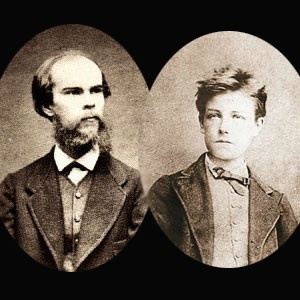
Published as part of his first collection ‘Poèmes saturniens’ in his early 20s, ‘Chanson d’automne’ has always been one of Paul Verlaine’s most popular poems. Even if a very young man saying “I remember the old days, and I cry” seems as questionable as the teenage Mary Hopkin singing “Those were the days, my friend”, the poem rings true. And Verlaine was certainly unsettled. Attracted to men, he soon married a young woman to try to “heal himself of the disease”. But then came Rimbaud.
Le Bateau ivre
Comme je descendais des Fleuves impassibles, Je ne me sentis plus guidé par les haleurs : Des Peaux-Rouges criards les avaient pris pour cibles Les ayant cloués nus aux poteaux de couleurs.
English translation: The Drunken Boat
As I went down impassive rivers, I no longer felt myself guided by the haulers: Yelling Redskins used them as targets Having nailed them naked to coloured stakes.
This is the first quatrain of Arthur Rimbaud’s 100-line poem The Drunken Boat, one of his very best, written when he was 16. It is technically traditional, written in alexandrine quatrains rhyming abab. Told in the voice of the boat itself on a river, the drunken boat is throwing off the restrictions and requirements of its old life, feeling an inescapable desire to follow the natural flow to its destiny, the sea. Some of the sights are appalling (like a dead whale rotting), some ecstatic (like phosphorescent waters), as the boat fills with water and the desire to be completely absorbed.
Earlier that year Rimbaud had explained his approach to poetry in a letter: “I’m now making myself as scummy as I can. Why? I want to be a poet, and I’m working at turning myself into a seer. You won’t understand any of this, and I’m almost incapable of explaining it to you. The idea is to reach the unknown by the derangement of all the senses. It involves enormous suffering, but one must be strong and be a born poet. It’s really not my fault.”
He then introduced himself to Verlaine by letter with various poems including The Drunken Boat. Verlaine, 11 years older than him, invited him to stay and fell for him completely. Rimbaud moved in, behaved scummily (belching and spitting at the table, talking with his mouth full) and made an immediate enemy of Mrs Verlaine who he only ever referred to as “the rat”. He had to leave. None of Verlaine’s friends could put up with him, so Verlaine rented rooms for him. Within a year Verlaine had effectively abandoned wife and young son, moving in with Rimbaud, and so together to London, then Brussels. Having fired a couple of pistol shots at Rimbaud in a fit of drunken jealousy, Verlaine was imprisoned for 18 months. Rimbaud moved on to new lovers and new countries–Java, Aden, Ethiopia, writing ever more experimental poetry, before returning to die in France at age 37. Verlaine taught in England for a few years, then taught English in France; he fell in love with one of his pupils, but lost him to typhus. He wrote increasingly symbolist poetry and sank into drug addiction, alcoholism (absinthe, of course) and poverty. He died five years after Rimbaud, aged 51.
And now the French government is grappling with a petition to relocate both poets from their comparatively obscure burial places to the Pantheon, “alongside other great literary figures like Voltaire, Rousseau, Dumas, Hugo and Malraux”. The Culture Minister is in favour of the idea, but there is an angry backlash. There is a BBC story here.
But there is no argument that the poetry itself is among the best produced by France.

 Form in Formless Times