Tag Archives: Auden

Weekend read: Essay: Victoria Moul, ‘On rugby and metre’ (excerpt)

Victoria Moul writes: When I hear or read people — often though not only American “formalists” — discussing “correct” metre in English, and the supposed dominance of accentual-syllabic forms in general and the iambic pentameter in particular, I often think rather impatiently of poets like Arnold and Yeats. Arnold’s verse is musical, highly memorable and — to my ears at least — mostly very straightforward to speak correctly. But it’s often not very iambic at all and he typically uses lines of very varying syllable length. ‘Rugby Chapel’ is a good example of this — its pattern is, technically speaking, more trochaic (rugby) than iambic (endured), the trochaic pattern is established very clearly at the outset (‘Coldly, sadly descends’) and the lines have between six and nine syllables each. If you (inexplicably) wanted to spend an hour “scanning” it you’d find a complex variety of combinations of stressed and unstressed syllables. But its music is easy to hear and read, and very easy to remember, because regardless of the number of the syllables all the lines have three stresses.

Repeated three-stress lines are relatively unusual in English, especially in longer poems, but the four-stress line is very common, perhaps in fact the most natural English line of all, and indeed a lot of so-called iambic pentameter has a tendency to drift towards four rather than five stresses. ‘The Wild Swans at Coole’ establishes an iambic pattern at the outset (‘The trees are in their autumn beauty / The woodland paths are dry’) but is in stanzas of 4/3/4/3/5/3 stresses, with quite varied syllable length and relatively few perfectly iambic lines. Day-Lewis’ poem, by contrast, looks to the eye like it might be iambic pentameter, since the line-length hovers around 10 syllables (ranging from 9 to 12). But most of the lines are spoken naturally with four stresses, not five (‘A sunny day, with leaves just turning’; ‘Wrenched from its orbit, go drifting away’), and only a handful of lines certainly have five.

As far as I know — do comment if you can think of any counter-examples — there are no really good poems about rugby itself, so the poems I discussed today were just those which came into my mind as I watched the practices. None of these English poems are obscure — all are by poets who were considered major in their own lifetime, and all three have been very well-known at some point even if they are not now — and not one of them is in iambic pentameter. In fact, not one of them is obviously in a ‘syllabic’ metre, strictly speaking, at all (as in the familiar statement that traditional English verse is ‘accentual-syllabic’, i.e. where both the number of stresses and the number of syllables are set by the metrical pattern). These poems, like a great deal of English poetry, establish and follow an accentual pattern — of a certain number of stresses in a line, though this too is open to variation — but not, or only very loosely, a syllabic one. Verse of this kind is very common in the English tradition, and the hundred years of poetry between the mid-19th and mid-20th century, even if you set aside the full-blown “modernists” completely, is particularly rich in metrical variety. It is puzzling that this is not better reflected in most discussions of English metre and form. But the best way to get a feel for the actual — rather than imagined — conventions of a literary tradition is, of course, by reading it.

*****

Editor: The passage above is excerpted with permission from a recent Substack post by Victoria Moul in her ‘Horace & friends’ – the full thing is at https://vamoul.substack.com/p/on-rugby-and-metre. In it, with thoughts inspired by watching her nine-year-old son playing rugby, she discusses Cecil Day-Lewis’ ‘Walking Away’, Yeats’ ‘The Wild Swans at Coole’ and Arnold’s ‘Rugby Chapel’. The piece is engaging in several ways, but the point that stands out the most for me is this:
“These poems, like a great deal of English poetry, establish and follow an accentual pattern — of a certain number of stresses in a line, though this too is open to variation — but not, or only very loosely, a syllabic one.”

This is much on my mind when I consider the forms that create formal verse. From my school days on, I have felt that analysing English grammar with Latin rules was wrong, just as straightjacketing English verse into syllabic requirements was not always useful, beautiful or appropriate. English is a Germanic language, and plays effectively by looser accentual rules: perhaps harder to define and analyse, but truer to the work of poetry which is to be word-for-word memorisable. Rhythm is one of the essential tricks of memorisation, along with rhyme, alliteration, assonance and a host of rhetorical tricks; and rhythm plays a variety of casual games. Also, accentual pattern corresponds to the continuum that I see at the root of poetry: from womb heartbeat, to dance, to music, to song, to formal verse. Formal verse is at its best when it is rhythmic and rich in musicality as well as in ideas and images and wordplay. Without the music, without the rhythm, it is prose… no matter how well expressed.

So rap and spoken word are inherently more poetic because more memorisable than 99% of what has been published as ‘poetry’ in the past 50 or 60 years. All songwriters are of course genuine poets – not all are good ones, but Bob Dylan certainly deserves his Nobel Prize (and I wish it could have been shared with Leonard Cohen).

Another point is that French too, and other Romance languages, are more accentual than professors often claim. When Françoise Hardy sang
Tous les garçons et les filles de mon âge
Se promènent dans la rue deux par deux
she was following the accentual beat, not giving every syllable equal weight, and completely skipping a couple of unstressed syllables. (Are French professors still teaching that all syllables have equal weight in French verse? Surely not! I hope that died out some time last century…)

Not all poetry is singable – but at its best it has a musicality that both creates enjoyment and enhances its ease of memorisation.

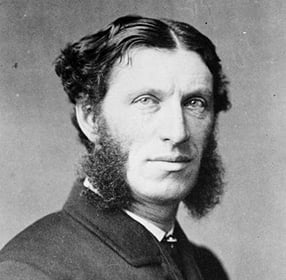
Photo: Matthew Arnold

Poems on Poets: George Simmers, ‘Poets in Residence’

The Head was ambitious and nobody’s fool,
A big man, efficient, and proud of his school.

At the start of the term, as he sorted his post,
The item of mail that intrigued him the most

Was a piece puffing National Poetry Day,
Including a list of the poets who’d stay

And workshop and somehow persuade the whole school
That poets were ‘groovy’ and poems were ‘cool’.

‘Here’s status,’ the Head thought. ‘It’s not to be missed.’
The one problem, though, was the names on the list;

Though doubtless they wrote quite respectable stuff,
Not one of them, frankly, was famous enough.

His school deserved more; his ambition took wing,
And so he decided to do his own thing.

With his usual flair, and with chutzpah exquisite,
He invited the whole English canon to visit.

Geoffrey Chaucer came first, on an equable horse,
And Spenser, and Marlowe, and Shakespeare, of course

(Who was grabbed by the teachers of English, imploring
‘Do come and persuade the Year Nines you’re not boring.’)

Keats arrived coughing, Kipling marched vigorously;
Matthew Arnold began to inspect the school rigorously –

Which delighted the Head, who with pride and elation
Showed the bards of the ages today’s education.

Vaughan was ecstatic, though Clough was more sceptical.
Ernest Dowson puked up in a litter receptacle.

Coleridge sneaked off to discover the rates
Of an unshaven person outside the school gates;

Soon he’d sunk in a private and picturesque dream,
While Auden was ogling the basketball team.

Plath lectured the girls: ‘Get ahead! Go insane!’
Algernon Swinburne cried: ‘Bring back the cane!’

Dylan Thomas soon found the head’s cupboard of booze,
And Swift was disdainfully sniffing the loos.

And then the Head twigged, with a horrified jolt,
That something had sparked a Romantic revolt.

Shelley’d gathered the students out in the main quad,
And roused them to rise against school, Head, and God.

Byron soon joined him, and started to speak.
(He showed his best profile, and spouted in Greek.)

The bards of the thirties were equally Red,
And Milton explained how to chop off a head.

Decadents undermined all the foundations.
Surrealists threw lobsters and rancid carnations.

Pre-Raphaelites trashed the technology room
And the First World War poets trudged off to their doom.

Sidney with gallantry led a great charge in
(Tennyson cheering them on from the margin).

The Deputy Head, who was rather a dope,
Got precisely impaled on a couplet by Pope

(Who, while not so Romantic, was never the chap
To run from a fight or keep out of a scrap).

Then the whole solid edifice started to shake
As it was prophetically blasted by Blake. 

Soon the School was destroyed. Eliot paced through the waste,
And reflected with sorrow and learning and taste,

Which he fused in a poem, an excellent thing,
Though rather obscure and a little right-wing.

He gave this to the Head, who just threw it aside
As he knelt by the wreck of his school, and he cried

Salty tears that went fizz as they hit the school’s ashes.
He said words that I’d better imply by mere dashes:

‘——– Poets! ——– Poetry – rhyme and free verse!
Let them wilt in the face of a Headmaster’s curse!

‘Let poetry wither! How sweet it would be
If all of the world were prosaic as me!’

*****

George Simmers writes: “Poets in Residence was written as a celebration of National Poetry Day many years ago. Several people had been mouthing blandly off about how lovely poetry was in contrast to that horrible pop music young people listen to. Schools were being encouraged to give children a lot of poetry because it was nice and beautiful, and would make them nice. ‘Do these people have no idea of how incendiary the English canon is?’ I wondered. I really enjoyed demolishing the school around the ears of the pompous and pretentious head. I was a teacher at the time.”

George Simmers used to be a teacher; now he spends much of his time researching literature written during and after the First World War. He has edited Snakeskin since 1995. It is probably the oldest-established poetry zine on the Internet. His work appears in several Potcake Chapbooks, and his recent diverse collection is ‘Old and Bookish’.

Photo: “Ndélé highschool student in front of destroyed school” by hdptcar is licensed under CC BY 2.0.

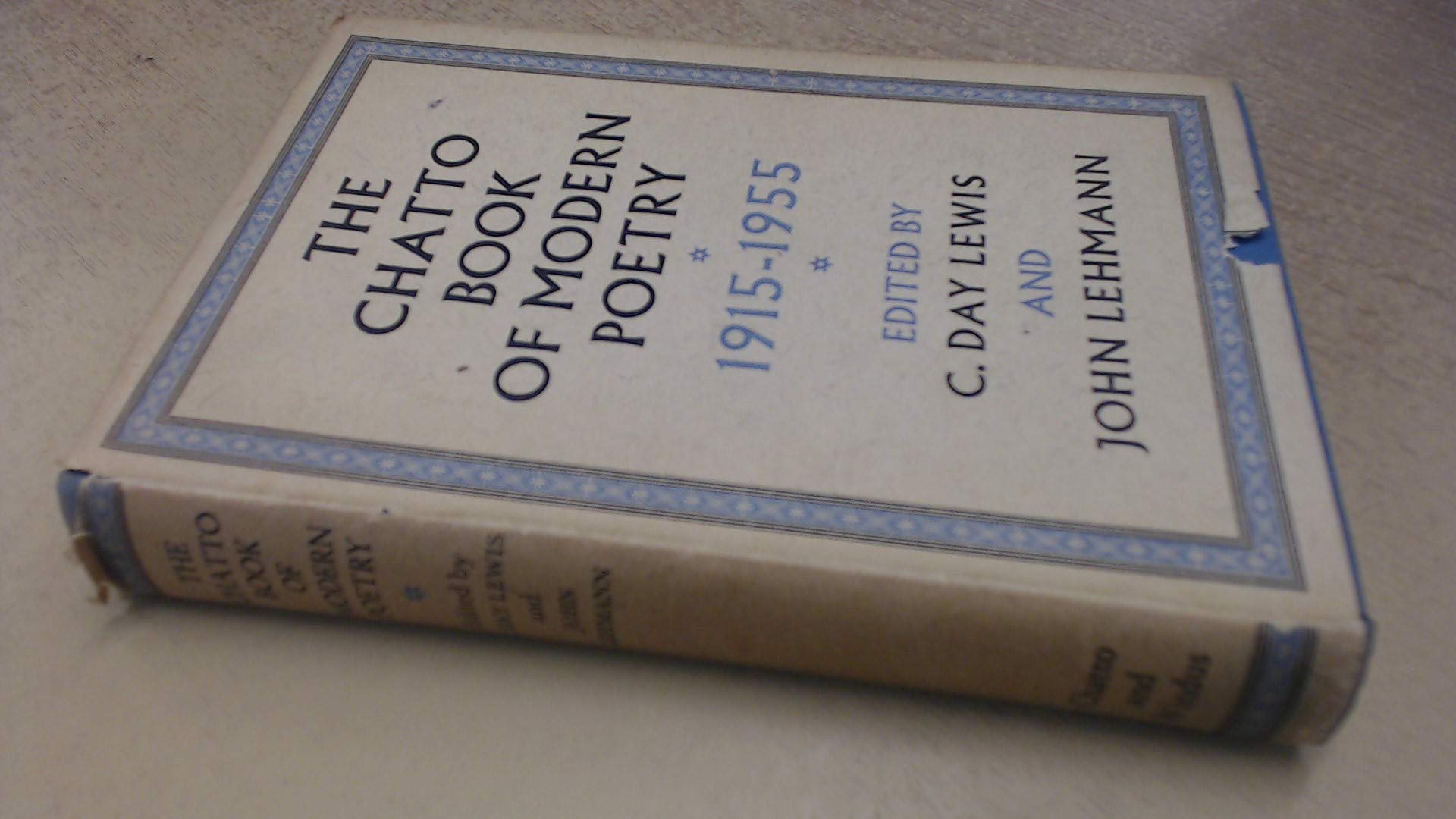
Review: “The Chatto Book of Modern Poetry, 1915-1955”

Chatto Modern Poetry

1915 to 1955 provides quite a range of poetry! From Hardy, Housman, Kipling, Yeats, through two world wars, to Dylan Thomas and twenty poets younger than him. Editors C. Day Lewis and John Lehmann confined themselves to (loosely defined) British poets, and to those aged at least 30 by their final selection. Among the 260 poems are many standards–Hardy’s ‘Afterwards’, Yeats’ ‘Sailing to Byzantium’, Eliot’s ‘East Coker’, Auden’s ‘Lay Your Sleeping Head’, Dylan Thomas’ ‘Fern Hill’–but the real joy is in discovering good work by less well known poets. I give a few excerpts as examples: pastoral, autobiographical, of mortality, a war poem, wistfulness:

Andrew Young, ‘Wiltshire Downs’

The cuckoo’s double note
Loosened like bubbles from a drowning throat
Floats through the air
In mockery of pipit, land and stare.

And one tree-crowned long barrow
Stretched like a sow that has brought forth her farrow
Hides a king’s bones
Lying like broken sticks among the stones.

Laurie Lee, ‘First Love’

Then it was she put up her hair,
inscribed her eyes with a look of grief,
while her limbs grew as curious as coral branches,
her breast full of secrets.

But the boy, confused in his day’s desire,
was searching for herons, his fingers bathed
in the green of walnuts, or watching at night
the Great Bear spin from the maypole star.

Alun Lewis, ‘Water Music’

Cold is the lake water
And dark as history.
Hurry not and fear not
This oldest mystery.

This strange voice singing,
This slow deep drag of the lake,
The yearning, yearning, this ending
Of the heart and its ache.

Keith Douglas, ‘How to Kill’

Now in my dial of glass appears
the soldier who is going to die.
He smiles, and moves about in ways
his mother knows, habits of his.
The wires touch his face: I cry
NOW. Death, like a familiar, hears

and look, has made a man of dust
of a man of flesh. This sorcery
I do. Being damned, I am amused
to see the centre of love diffused
and the waves of love travel into vacancy.
How easy it is to make a ghost.

Sidney Keyes, ‘The Gardener’

Do you resemble the silent pale-eyed angels
That follow children? Is your face a flower?
The lovers and the beggars leave the park–
And still you will not come. The gates are closing.
O it is terrible to dream of angels.

As a collection the poetry is overwhelmingly formal, rural and male. It is titled ‘The Chatto Book of Modern Poetry’, but it predates the formless chaos of what we now call “modern poetry”, the unstructured confessional outpourings of the past half century. The anthology isn’t perfect, but very rewarding for lovers of traditional poetry. (Not hard to find. Used hardcovers are available from $0.99 on Amazon.)

Poem: “Post-Adult”

Adults — earthworn, careweary,
grave, gravid and gravity-constrained —
take it all so seriously, furiously, fearsome and wearisome,
spuriously furious over the small stuff,
incessantly never having enough,
insensibly insatiable, insensate,
irrational, irascible,
driven by status, riven by expense,
dismissive of all greater age and experience.

How fortunate to age into osteoporosis,
bones lightening like a bird’s as you get older,
the wearying weights lifting off the shoulder,
and you drift up into the sky with your levity,
leaving behind adult cares and gravity,
unattached, detached,
careful but careless, unlatched.

This poem was recently published in Bewildering Stories. But what is it, technically? Does it have any form? It has elements of form–alliteration, assonance, scattered rhyme, the kind of rhythm (in parts) that you find in rap with emphasis on stresses, not on syllables–but none of it is organized, structured, codified, repeated…

I think it could be improved. If I come up with a significant improvement, I’ll switch it out. But there’s always the danger that the later “improvement” loses primal energy for the sake of trying to achieve an intellectual outcome. As with Auden’s poetic progress. But a little more formal structure would be good, I think.

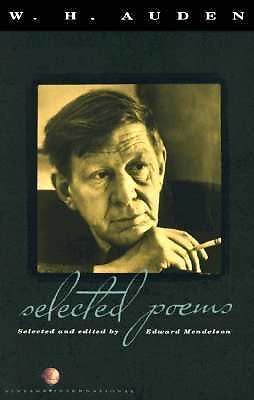
Review: “Selected Poems” by W.H. Auden

Auden

The best of Auden’s poems are so many, so varied, so technically accomplished and so witty that he stands with the greatest poets of the 20th century. My list of favourites includes:

“O where are you going?” said reader to rider
O what is that sound that so thrills the ear
A shilling life will give you all the facts
Look, stranger, at this island now
Miss Gee
As I walked out one evening
In Time of War
Musee des Beaux Arts
In Memory of W.B. Yeats
Law, say the gardeners, is the sun

and what many consider the greatest love-poem of the last 100 years:
“Lay your sleeping head, my love,
Human on my faithless arm”.
There is a universality about Auden’s depiction of relationships, an indeterminate quality that allows his thoughts to be applied to all people. This is in keeping with the fact that he was gay, and writing in a time when homosexuality was illegal. It provides an unexpected strength for his verse.

And yet, and yet… all of those poems listed above were written before he turned 33. He lived to age 66, writing longer and longer works, moving further and further away from traditional verse, and with less of the memorable genius of his youth.

It is therefore somewhat depressing to read these “Selected Poems” because they are set out chronologically, and the writing gets less interesting the further you read. Halfway through the book you run into the poem sequence “The Sea and the Mirror – a commentary on Shakespeare’s The Tempest”, which includes 25 pages of prose crammed with dense imagery and argument. Apparently Auden preferred this prose section, “Caliban to the Audience”, over all his other work. This preference was expressed at the time that he was rewriting the excellent poems of his youth to reflect his newer American, Christian, self-important academic personality. I found it unreadable.

The first edition of “Selected Poems” (selected and edited by Edward Mendelson) contains 100 poems. A more recent edition adds another 20 poems, “broadening its focus to better reflect the enormous wealth of form, rhetoric, tone, and content in Auden’s work. Newly included are such favorites as “Funeral Blues” and other works that represent Auden’s lighter, comic side”.

Unfortunately I only have the 100-poem version. If you buy a copy of this book, make sure it has the 120 poems!