Tag Archives: Australian poetry

Lindsay McLeod, ‘The Swing’

The black dog comes less to me lately
I fight the bait of the Siren’s barbed songs
I’ve tightened my belt to the hunger I’ve felt
scanned the sky for a place to belong.

But I’ve been to this point of the compass before
since we twitched off our vows and our rings
alone in the dark at one end of the arc
where that half-broken pendulum swings.

Still I’ve nothing left here to hold onto
afraid I’ll fall back to the place that I came
where I’ll take up my axe to the rainbow again
and bite deep into bright shining pain.

*****

Lindsay McLeod writes: “Fear not for my current mental health, as I wrote this 20 years ago.”

‘The Swing’ was originally published in Snakeskin.

Lindsay McLeod is an Australian writer who lives quietly on the coast of the great southern penal colony with (yet another ferocious Aussie animal) his cattle dog,  Mary. Lindsay still drives a forklift to support his poetry habit.

Image: “Feeding The Black Dog” by @mich.robinson is licensed under CC BY-NC-ND 2.0.

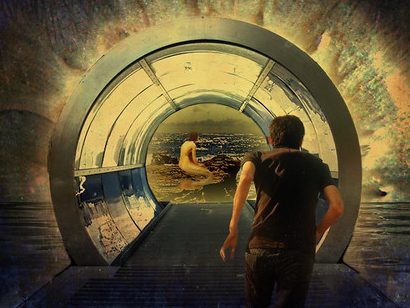
Damian Balassone, ‘The Mormon and the Mermaid’

Wounded and winded
by the wind and the waves,
he scratches her name in the sand,
her love is rescinded,
she hides in the caves
where the water caresses the land;
he sings her name in spite of his distress,
and fashions beauty out of loneliness.

*****

Damian Balassone writes: “With regards to the poem, I have no connection to either Mormons or mermaids – it’s about polar opposites.  I think the last line came first.  He doesn’t get the girl, but he gets the poem.”

‘The Mormon and the Mermaid’ was first published in the Shot Glass Journal.

Damian Balassone is the author of four books, including the forthcoming collection of short poems and epigrams Love is a Weird Cat and the children’s book Here, Bear and Everywhere. You can read more here.

the Other Side of the Tunnel” by ihave3kids is licensed under CC BY-NC-ND 2.0.

Lindsay McLeod, ‘She’

She drinks a bit more
she loves a bit less
she no longer fits
in her wedding dress.

She’s given up trying,
accepted her fate,
feels herself thinning
while she stacks on the hate.

Doesn’t feel like his partner
his mate or his wife,
all she feels is as hard
and as sharp as a knife.

She reels her mind back
but can’t seem to recall,
what she ever saw in him,
why she married at all.

It’s a dead man’s float,
face down on the bed,
they sleep separate, unsound
in their queen sized dread.

So she’ll tread bitter water
as she has done for years,
not so much married to him
as she is to her fears.

*****

Lindsay McLeod writes: “‘She’ was written in my head, wearing ear protection in a factory. It was about my (then) partner who had recently escaped a toxic relationship.” The poem was originally published in Fine Flu.

Lindsay McLeod is an Australian writer who lives quietly on the coast of the great southern penal colony with (yet another ferocious Aussie animal) his cattle dog,  Mary. Lindsay still drives a forklift to support his poetry habit.

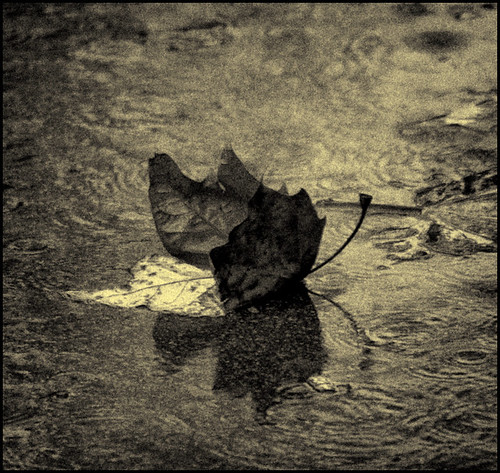
Photo: “fulla-ocell / leave-bird ( Every little thing she does is magic )” by Jordi@photos is licensed under CC BY-NC-SA 2.0.

Lindsay McLeod, ‘Harvest’

There’s just so many nows in forever
if we’re apart or together as one,
we’d better cherish them all if we’re clever
make the most of our time in the sun,

‘coz it’s where we are led whether up or in bed
there’s one funeral we all must attend,
because somewhere ahead the sea kisses the sky
and the name of that place is the end.

*****

Lindsay McLeod writes: “‘Harvest’ was made as an end piece for the second book I wrote for my daughter.” It was originally published in Grand Little Things.

Lindsay McLeod currently lives by the sea on the Southern edge of the world, where he trips over the offing every morning. He has been published here and there in the past and won a few awards. He has started messing about with words again lately after a few necessary years away. You might expect him to know better by now, but oh no.

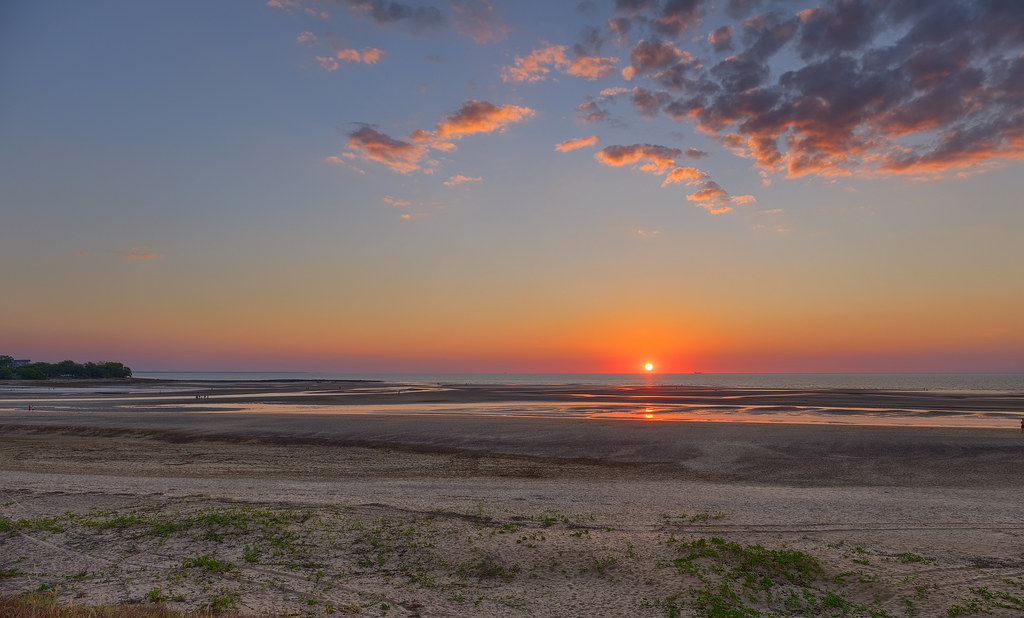
Photo: “Another Timor Sea sunset from Casuarina Beach, Darwin, NT, Australia” by Geoff Whalan is licensed under CC BY-NC-ND 2.0.

Weekend read: Stephen Edgar, ‘Murray Dreaming’

It’s not the sharks
Sliding mere inches from his upturned face
Through warps of water where the tunnel arcs
Transparent overhead,
Their lipless jaws clamped shut, extruding teeth,
Their eyes that stare at nothing, like the dead,
Staring at him; it’s not the eerie grace
Of rays he stood beneath,
Gaping at their entranced slow-motion chase

That is unending;
It’s not the ultra-auditory hum
Of ET cuttlefish superintending
The iridescent craft
Of their lit selves, as messages were sent,
Turning the sight of him they photographed
To code: it is not this that left him dumb
With schoolboy wonderment
Those hours he wandered the aquarium.

It is that room,
That room of Murray River they had walled
In glass and, deep within the shifting gloom
And subtle drifts of sky
That filtered down, it seemed, from the real day
Of trees and bird light many fathoms high,
The giant Murray cod that was installed
In stillness to delay
All that would pass. The boy stood there enthralled.

Out in the day
Again, he saw the famous streets expound
Their theories about speed, the cars obey,
Racing to catch the sun,
The loud fast-forward crowds, and thought it odd
That in the multitudes not everyone
Should understand as he did the profound
Profession of the cod,
That held time, motionless, unknown to sound.

In bed at night,
Are his eyes open or is this a dream?
The room is all dark water, ghosted light,
And midway to the ceiling
The great fish with its working fins and gills
Suspended, while before it glide the reeling
And see-through scenes of day, faintly agleam,
Until their passage stills
And merges with the deep unmoving stream.

*****

Stephen Edgar writes: “As the reader may guess, although the poem is cast in the third person, in the figure of a young boy, it describes a visit to an aquarium that I made myself, and as an adult. And on the occasion of this visit I was struck, and deeply impressed, by the single large Murray cod, seemingly floating motionless in its large room-sized tank of water, designed to mimic a section of the Murray River. Impressed in what way? Well, it is hard to say, but there seemed to be a certain mystery and power embodied in this fish, which was sealed off from me, inaccessible. The image stayed with me. However, it was only when I revisited the aquarium some years later that this original mood was reawakened and prompted me to write a poem about it. 

“The challenge was to find the right way to express it.  I didn’t want the poem to seem too portentous and self-important, so I thought that by seeing it through the eyes of a young boy I could give it a certain lightness of touch. But also the young are often considered to be more in touch with the natural world than adults, with their worldly preoccupations. In the midst of all the other superficially more attractive and appealing creatures in the aquarium, this particular boy is transfixed by this large fish. He has, I suppose you could say, a vision. What of? Well, some kind of vision of timelessness and continuity represented in nature, in comparison with which the speed and hubbub of daily life—represented by the city traffic and crowds—seem trivial and unimportant.

“In a way, the poem is already over by the end of the fourth stanza. The main point has been made. But a poem has an aesthetic shape as well as a meaning and I felt the need to round it off in some emotionally satisfying way. So I placed the boy, after the day was over and he was home again, lying in bed reliving his vision. Maybe he is dreaming; maybe he is awake and having a waking dream: either way he sees the fish in the midst of his ordinary everyday room, and overlaid on this he sees the city scenes, which are gradually absorbed by the dream river and dream fish. 

“The word “dreaming” in the poem’s title, while it can refer to this last stanza, is also meant to imply the use of the word in indigenous Australian culture, signifying a body of lore connected to a totemic animal or sacred place.

“The poem is written in a nonce stanza form of my own devising, with nine lines rhyming ABACDCBDB, in pentameter, apart from line one in dimeter, and lines four and eight in trimeter.

“The poem first appeared in Poetry (Chicago). It then appeared in The Red Sea: New and Selected Poems (Fort Worth, Baskerville Publishers, 2012), now out of print; then in my ninth book, Eldershaw; and also in The Strangest Place.”

*****

Stephen Edgar was born in 1951 in Sydney, where he grew up. From 1971 to 1974 he lived in London and travelled in Europe. On returning to Australia he moved with his then partner to Hobart, Tasmania, where he attended university, reading Classics, and later working in libraries. Although he had begun writing poetry while still at high school, it was in Hobart that he first began writing publishable poems and found his distinctive voice. He became poetry editor of Island Magazine from 1989 to 2004. He returned to Sydney in 2005. He is married to the poet Judith Beveridge.

He has published thirteen full collections: Queuing for the Mudd Club (1985), Ancient Music (1988), Corrupted Treasures (1995), Where the Trees Were (1999), Lost in the Foreground(2003), Other Summers (2006), History of the Day (2006), The Red Sea: New and Selected Poems (2012), Eldershaw (2013), Exhibits of the Sun (2014), Transparencies (2017), The Strangest Place: New and Selected Poems (2020) and Ghosts of Paradise (2023). A small chapbook, Midnight to Dawn, came out in 2025, and a new collection, Imaginary Archive,will be published in late 2025. His website is www.stephenedgar.com.au, on which publication details of his books, and where they can be purchased, are given.

He was awarded the Australian Prime Minister’s Award for Poetry in 2021 for The Strangest Place.

Photo: “Murray Cod at Melbourne Aquarium” by brittgow is licensed under CC BY-NC 2.0.
Nonce form: Stephen Edgar, ‘In Search of Time to Come’

There’s not much noise above the sputtering fire.
They don’t speak much.
The children are settling to a private croon,
Though the baby whimpers, palping blindly to clutch
At a breast. Farther back, picked out by a
Final index finger of the sun, someone squats.
They’ll be changing their abode quite soon,
No doubt.
The time requires a tacit finishing touch,
From women working at rough pots
And men scraping a hide to peg it out.

This mood, this life, is like a circle, turning
Always back
On itself: expectation interlocking
Ritual; impulse to novelty, for lack
Of its not yet invented learning,
Subsiding again to things that they take pleasure from.
A hum. A mother’s body rocking,
They are, you would say, at home.

Only the cave mouth, that changeable screen,
Opens a gap
In the circumference; and when the light
Is gone, they have no words by which to trap,
Or the notions by which words could mean,
What that black window’s showing for them to detect,
As they look, perplexed, into the night
And stare,
Then turn towards each other’s bodies to tap
Their comfort. Someone, they suspect,
Is out there; and they’re right. We are out there.

*****

Stephen Edgar writes: “I can no longer remember the specific circumstances which gave rise to this poem, but it was possibly some television documentary about ancient hominins. As Philip Larkin said in a rather different context, “Truly, though our element is time,/ We are not suited to the long perspectives/ Open at each instant of our lives.” The vertiginous gulf of time between ourselves and our earliest ancestors is a subject that has always fascinated me, and I have written other poems dealing with it; indeed, my next book opens with a poem on a similar theme. The difference with In Search of Time to Come is the notion of these ancient humans attempting to peer forward into the deep future, rather than modern humans gazing back into the deep past.

“The poem is metrical with full rhyme. The stanza form, for stanzas one and three, is one of my own devising, with varying line lengths and complex rhyme scheme. Stanza two varies the pattern, breaking off after eight lines, with a slight adjustment to the rhyme scheme. Why? I can’t remember; it was a spontaneous idea that occurred to me in the writing.

As far as I can remember, this poem had no magazine publication and first appeared in my second book Ancient Music (Sydney, Angus & Robertson, 1988), which is out of print. It has been republished in The Strangest Place: New and Selected Poems (Melbourne, Black Pepper, 2020), which is available on the Black Pepper website.”

Stephen Edgar was born in 1951 in Sydney, where he grew up. From 1971 to 1974 he lived in London and travelled in Europe. On returning to Australia he moved with his then partner to Hobart, Tasmania, where he attended university, reading Classics, and later working in libraries. Although he had begun writing poetry while still at high school, it was in Hobart that he first began writing publishable poems and found his distinctive voice. He became poetry editor of Island Magazine from 1989 to 2004. He returned to Sydney in 2005. He is married to the poet Judith Beveridge.

He has published thirteen full collections: Queuing for the Mudd Club (1985), Ancient Music (1988), Corrupted Treasures (1995), Where the Trees Were (1999), Lost in the Foreground(2003), Other Summers (2006), History of the Day (2006), The Red Sea: New and Selected Poems (2012), Eldershaw (2013), Exhibits of the Sun (2014), Transparencies (2017), The Strangest Place: New and Selected Poems (2020) and Ghosts of Paradise (2023). A small chapbook, Midnight to Dawn, came out in 2025, and a new collection, Imaginary Archive,will be published in late 2025. His website is www.stephenedgar.com.au, on which publication details of his books, and where they can be purchased, are given.

He was awarded the Australian Prime Minister’s Award for Poetry in 2021 for The Strangest Place.

Photo: “Leave the door open!” by In Memoriam: VernsPics is licensed under CC BY-NC-ND 2.0.

Stephen Edgar, ‘Dawn Solo’

First light beside the Murray in Mildura,
Which like a drift of mist pervades
The eucalypt arcades,
A pale caesura

Dividing night and day. Two, three clear notes
To usher in the dawn are heard
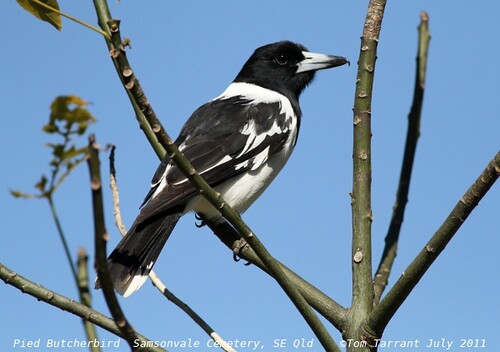
From a pied butcherbird,
A phrase that floats

So slowly through the silence-thickened air,
Those notes, like globules labouring
Through honey, almost cling
And linger there.

Or is it that the notes themselves prolong
The time time takes, to make it stand,
Morning both summoned and
Called back by song.

*****

Stephen Edgar writes: “This poem needs little comment, I think. The bird in question is the pied butcherbird, as the poem says, considered by some to have the most beautiful song of any Australian bird. Let me quote some field guides to Australian birds: “superb, slow, flute-like mellow notes”; “song is one of our finest: a varied sequence of pure fluty whistles, sometimes interspersed by throaty warbles”; “fluted, far-carrying notes that seem to reflect the loneliness of its outback haunts”. Perhaps that third quotation best suggests the quality I was trying to capture. The notes seemed to be in slow motion, slowing time. I was attending the Mildura Writers’ Festival. Mildura is on the southern bank of the Murray River in northwestern Victoria. This was the first occasion on which I had heard the pied butcherbird.

“The form is a quatrain rhyming ABBA, with lines progressively shortening from pentameter, though tetrameter, trimeter to dimeter. It was first published in Australian Book Review and then in my twelfth book The Strangest Place: New and Selected Poems (Melbourne, Black Pepper, 2020), which is available on the Black Pepper website.”

Stephen Edgar was born in 1951 in Sydney, where he grew up. From 1971 to 1974 he lived in London and travelled in Europe. On returning to Australia he moved with his then partner to Hobart, Tasmania, where he attended university, reading Classics, and later working in libraries. Although he had begun writing poetry while still at high school, it was in Hobart that he first began writing publishable poems and found his distinctive voice. He became poetry editor of Island Magazine from 1989 to 2004. He returned to Sydney in 2005. He is married to the poet Judith Beveridge.

He has published thirteen full collections: Queuing for the Mudd Club (1985), Ancient Music (1988), Corrupted Treasures (1995), Where the Trees Were (1999), Lost in the Foreground(2003), Other Summers (2006), History of the Day (2006), The Red Sea: New and Selected Poems (2012), Eldershaw (2013), Exhibits of the Sun (2014), Transparencies (2017), The Strangest Place: New and Selected Poems (2020) and Ghosts of Paradise (2023). A small chapbook, Midnight to Dawn, came out in 2025, and a new collection, Imaginary Archive,will be published in late 2025. His website is www.stephenedgar.com.au, on which publication details of his books, and where they can be purchased, are given.

He was awarded the Australian Prime Minister’s Award for Poetry in 2021 for The Strangest Place.

Photo: “Pied Butcherbird (Cracticus nigrogularis)” by aviceda is licensed under CC BY-NC-SA 2.0.

Lindsay McLeod, ‘Last Call’

If this isn’t what you’ve yearned for
or indeed what you are craving
then cup your hands, drink deeply
of a sweeter misbehaving.

If you cannot find your wine inside
the glass that you were given,
taste the new with eyes and thighs
and dye your lips a deep vermillion

with a juice that has been pressed
from vines let grow out of control
that taste of summertime and
sex and drugs and rock and roll

because if you…

find distaste in your final breath
dressed in another’s ill fit clothes
remember, this did not just happen
sweetheart, this is what you chose.

*****

Lindsay McLeod is an Australian poet that has won a few things and is widely published. He just had to start messing about with words again lately. You’d think he’d know better by now, but oh no. Some of his most recent work can be found in DILLYDOUN REVIEW, GRAND LIL THINGS, DRAWN TO THE LIGHT, POETiCA and MORTAL MAGAZINE.

RHL: In addition to Mr McLeod’s self-description, let me add that I have been trying and failing to contact him. I don’t even have permission to post this poem. If anyone can put me in touch with him, I would be grateful.

Photo: “98/365: ♫ Red, Red Wine…” by rogersmj is licensed under CC BY-NC 2.0.

Sonnet: James Lucas, ‘RUOK?’

My question asking if you are OK
in full knowledge that yes may well mean no—
monosyllables build the barricade
perimeter beyond which we can’t go
into the sanctum where you admit fright,
a precious hell guarded from special op
humanitarian fact-finding flights—
must voice loving concern. And then must stop
to wait on answers truly indirect,
accept teenager-brokered terms of love
are spoken in non-sequiturs and gaps,
a small concession I did not expect
enough to give stalled confidence a shove,
to tell us that you are OK perhaps.

*****

RUOK? was first published in Shot Glass Journal #43 in the International Poets section.

James Lucas’ bio:
“I was born in Sydney in 1965, and educated at the University of New South Wales, where I won the University Medal, and then at Cambridge, where I completed a Ph D in modernist poetry in 1997.
I published two chapbooks in the UK in the 1990s, and my first Australian publication was in Southerly in 1994. Since then my poems have appeared in Communion, Contrappasso, Cordite Poetry Review, Heat, Island, Meanjin, New England Poetry Review, Overland, Quadrant, Salt, Scarp, Southerly, the Henry Kendall Award Anthology, and the 2020 Newcastle Poetry Prize Anthology.
My first collection, Rare Bird, was published by Recent Work Press in March 2021, reviewed in ABR in August 2021, and Commended in the 2021 Anne Elder Award.
I read as widely as I can in contemporary and older poetry. For many years I have taught English at Sydney Grammar School.”

Photo: “RUOK” by arievergreen is licensed under CC BY-NC-SA 2.0.

Odd poem: ‘Sonnets for the Novachord (1.)’ by the non-existent Ern Malley

Rise from the wrist, o kestrel
Mind, to a clear expanse.
Perform your high dance
On the clouds of ancestral
Duty. Hawk at the wraith
Of remembered emotions.
Vindicate our high notions
Of a new and pitiless faith.
It is not without risk!
In a lofty attempt
The fool makes a brisk
Tumble. Rightly contempt
Rewards the cloud-foot unwary
Who falls to the prairie.

*****

This sonnet is by “Ern” Malley, a fictitious poet whose biography and body of work were created in one day in 1943 by conservative writers James McAuley and Harold Stewart in order to hoax the Angry Penguins, a modernist art and literary movement centred around a journal of the same name, co-edited by poet Max Harris and art patron John Reed, of Heide, Melbourne.

In one afternoon, McAuley and Stewart wrote Malley’s entire body of work: 17 poems, none longer than a page, and all intended to be read in sequence under the title The Darkening Ecliptic. Their writing style, as they described it, was to write down the first thing that came into their heads, lifting words and phrases from the Concise Oxford Dictionary, a Collected Shakespeare, and a Dictionary of Quotations: “We opened books at random, choosing a word or phrase haphazardly. We made lists of these and wove them in nonsensical sentences. We misquoted and made false allusions. We deliberately perpetrated bad verse, and selected awkward rhymes from a Ripman’s Rhyming Dictionary.”

They mailed sixteen poems to Harris under the guise of Ethel, Ern Malley’s surviving sister. Harris and other members of the Heide Circle fell for the hoax, and, enraptured by the poetry, devoted the next issue of Angry Penguins to Malley, hailing him as a genius. The hoax was revealed soon after, resulting in a cause célèbre and the humiliation of Harris, who was put on trial, convicted and fined for publishing the poems on the grounds that they contained obscene content. Angry Penguins folded in 1946.

In the decades that followed, the hoax proved to be a significant setback for modernist poetry in Australia. Since the 1970s, however, the Ern Malley poems, though known to be a hoax, became celebrated as a successful example of surrealist poetry in their own right, lauded by poets and critics such as John Ashbery.

The above is copied and tweaked from https://en.wikipedia.org/wiki/Ern_Malley_hoax

and the BBC covers his story here: https://www.bbc.com/reel/video/p0f3h03g/ern-malley-the-influential-australian-poet-who-never-lived

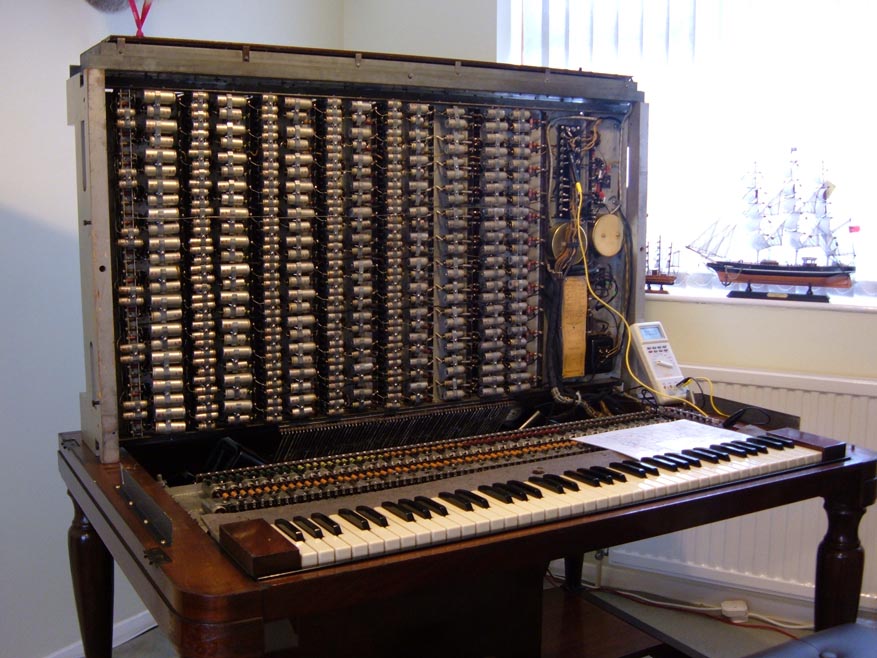
CC BY 3.0, File:Novachord insides3.jpg, Created: 29 December 2009 Attribution: Hollow Sun at English Wikipedia