Tag Archives: F.R. Scott

Free verse: F.R. Scott, ‘W.M.L.K.’

How shall we speak of Canada,
Mackenzie King dead?
The Mother’s boy in the lonely room
With his dog, his medium and his ruins?
He blunted us.
We had no shape
Because he never took sides,
And no sides
Because he never allowed them to take shape.
He skillfully avoided what was wrong
Without saying what was right,
And never let his on the one hand
Know what his on the other hand was doing.
The height of his ambition
Was to pile a Parliamentary Committee on a
Royal Commission,
To have “conscription if necessary
But not necessarily conscription,”
To let Parliament decide—
Later.
Postpone, postpone, abstain.
Only one thread was certain:
After World War I
Business as usual,
After World War II
Orderly decontrol.
Always he led us back to where we were before.
He seemed to be in the centre
Because we had no centre,
No vision
To pierce the smoke-screen of his politics.
Truly he will be remembered
Wherever men honour ingenuity,
Ambiguity, inactivity, and political longevity.
Let us raise up a temple
To the cult of mediocrity,
Do nothing by halves
Which can be done by quarters.

*****

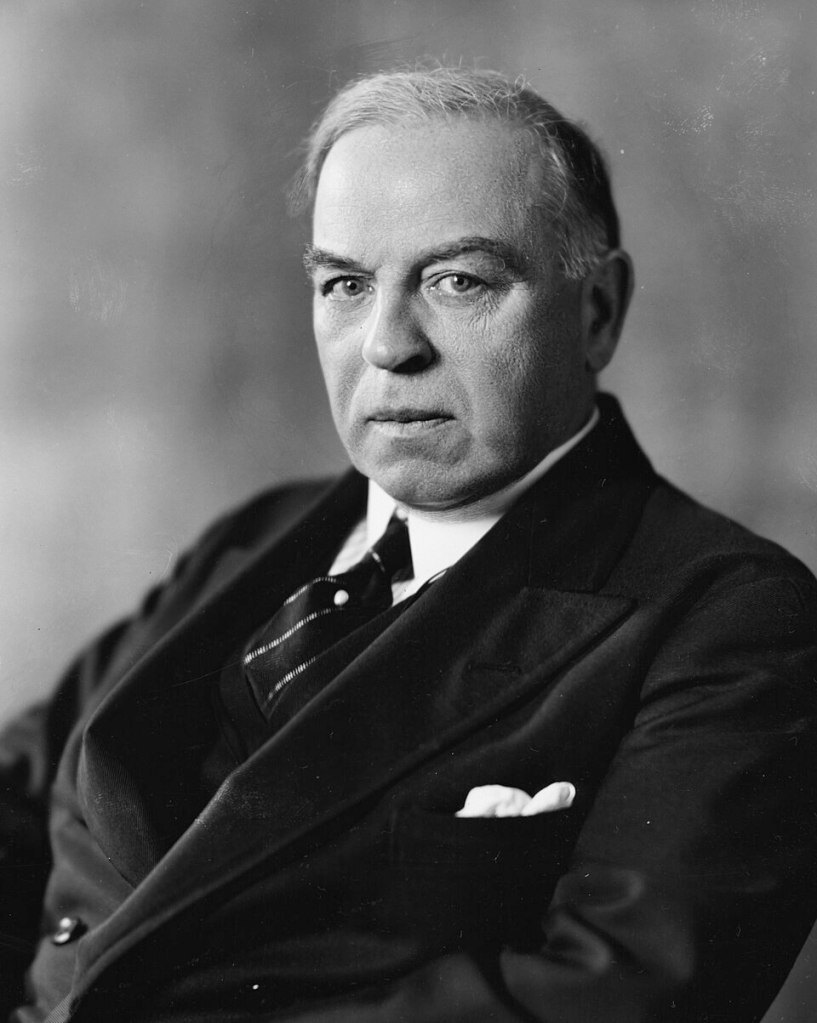
William Lyon Mackenzie King served 21 years and 154 days as Prime Minister of Canada across three non-consecutive terms (1921–1926, 1926–1930, and 1935–1948). He was a consummate political survivor, and he usefully kept things going in times of crisis, but beyond that he was just… strange. As Dennis Lee wrote in his ‘Alligator Pie’ collection:
William Lyon Mackenzie King
Sat in a corner and played with string,
Loved his mother like anything,
William Lyon Mackenzie King.

F.R. Scott’s “poem”… well, my primary criterion for poetry is that it be word for word memorable and memorisable. And there are enough lines in Scott’s piece that have stayed with me for decades, that I have to extend the term “poem” to include it.

File: Prime Minister William Lyon Mackenzie King 1941 (cropped).jpg Public Domain

F.R. Scott, ‘Conflict’

When I see the falling bombs
Then I see defended homes.
Men above and men below
Die to save the good they know.

Through the wrong the bullets prove
Shows the bravery of love.
Pro and con have single stem
Half a truth dividing them.

Between the dagger and the breast
The bond is stronger than the beast.
Prison, ghetto, flag and gun
Mark the craving for the One.

Persecution’s cruel mouth
Shows a twisted love of truth.
Deeper than the rack and rope
Lies the double human hope.

My good, your good, good we seek
Though we turn no other cheek.
He who slays and he who’s slain
Like in purpose, like in pain.

Who shall bend to single plan
The narrow sacrifice of man?
Find the central human urge
To make a thousand paths converge?

*****

This one of F.R. Scott’s poems – not as well known as his sniping at politicians and corporations – is a remarkably generous and forgiving look at human barbarity. It brings Konrad Lorenz’s book ‘On Aggression’ to mind for me for its ideas; and also, for its questioning rhythm, Edwin Muir’s ‘Merlin” which asks if there will ever be “a runner who’ll outrun // Man’s long shadow, driving on, // Burst through the gates of memory // And hang the apple on the tree?”

Photo: “Scenes from Gaza Crisis 2014” by United Nations Photo is licensed under CC BY-NC-ND 2.0.

Semi-formal verse: F.R. Scott, ‘Old Song’

far voices
and fretting leaves
this music the
hillside gives

but in the deep
Laurentian river
an elemental song
for ever

a quiet calling
of no mind
out of long aeons
when dust was blind
and ice hid sound

only a moving
with no note
granite lips
a stone throat

*****

F.R. Scott (1899 – 1985) was a Canadian poet, lawyer, intellectual, and constitutional scholar. He helped found the first Canadian social democratic party, the Co-operative Commonwealth Federation (CCF), and its successor, the New Democratic Party (NDP). Born in Quebec City, he was Dean of the Faculty of Law at McGill; UN representative in Burma (now Thailand); and a member of the Royal Commission on Biculturalism and Bilingualism. A lover of the Laurentian wilderness, he was a member of the ‘Preview’ group of Montreal poets… and… with A.J.M. Smith he co-edited The Blasted Pine: An Anthology of Satire, Invective, and Disrespectful Verse.

Photo: Simple Living – Flickr – Malcolm Carlaw.jpg, Wikimedia Commons

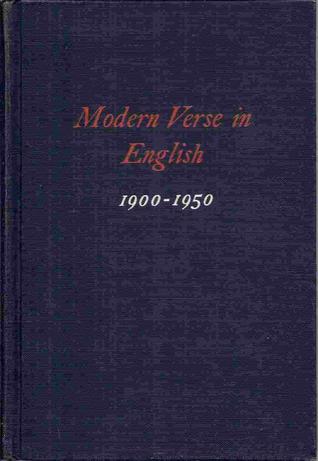
Review: “Modern Verse in English, 1900-1950”

Modern Verse in English

I’m reading ‘Modern Verse in English, 1900-1950‘, ed. David Cecil and Allen Tate, published in 1958. It provides a good look at a large number of poets from that time period–some have lasted, some haven’t. It is an extensive and useful volume, but it raises some concerns:

1. Lord David Cecil‘s introduction (to the English poems) includes “though during the twenties there was a fashion for free and rhymeless verse, it has passed. Most young poets today write in strictly regular forms.” This was published in 1958, remember. Not really prescient, unfortunately, so you question his insight. He regrets omitting “the work of writers who have made their reputation since 1950, for example, Miss Audrey Beecham, Mr. Philip Larkin and Mr. Thom Gunn.” Well, two out of three’s not bad.

2. The ‘1900-1950′ seems a bit misleading, given that the poets include Emily Dickinson and Gerard Manley Hopkins who both died in the 1880s. True, Hopkins’ poetry wasn’t published until the 1930s–but would we consider an unknown Shakespeare poem 21st century if it was only discovered and published today? And as for Dickinson, three Series of her poems were published in the 1890s.

3. Although a couple of poets born in Ireland and South Africa, and Kipling, are included, the volume contains nothing by Canadians (Bliss Carman, Robert Service and F.R. Scott would fit the time line), Australians, West Indians, etc; and nothing by any people of colour such as Langston Hughes or Gwendolyn Brooks (one of my absolute favourites). Any of these would be far more worthy of inclusion than, for example, Donald Davidson whose chief merit for the editor of the American poems, Allen Tate, must have been their shared support for racial segregation. The volume would be better titled ‘Modern White English and American Verse, from Emily Dickinson to Richard Wilbur‘. Still not perfectly accurate, but so it goes.

It is a useful book. But it is less complete than its title suggests, and it is tainted.