Tag Archives: formal verse

Susan McLean, ‘My Evil Twin’

My evil twin is full of feminine
self-deprecation. Don’t be taken in
by her rapt nods and deference, which mask
her sly, satiric humor. While you bask
in her respect, she’ll turn away and grin.

You think you’ve won an argument? Her chin
is cocked. She’s packing nitroglycerin.
Why can’t she let the matter slide? Don’t ask
my evil twin.

One minute she’s as sweet as saccharin,
but then, like any snake, she sheds her skin.
If you suspect that it’s a hopeless task
to coax this genie back into her flask,
you’re right. But don’t be fooled: I’ve always been
my evil twin.

*****

Susan McLean writes: “I have always loved the French repeating forms for their songlike appeal. The villanelle is my favorite among them, and I have also written a fair number of triolets, but the rondeau is a form I have rarely tried. At fifteen lines long, with only two rhymes, it is extremely demanding to write, since in English most words have relatively few rhymes. That difficulty made for a fascinating challenge and some unusual rhymes. It’s hard to imagine another poem in which I would use both ‘nitroglycerin’ and ‘saccharin.’

Twins have a long history of featuring in comedies of mistaken identity, from Plautus to Shakespeare and onward, but the ‘evil twin’ is a relatively recent development, I think, with origins in Stevenson’s Jekyll and Hyde. Soap operas, comic books, and serial dramas are full of them. Yet in real life, most people behave differently at different times and with different people. Actors often prefer playing the villain to playing the hero; viewers love to watch characters who break taboos with impunity, a sort of vicarious release from the inhibitions of civilized life. So, is this poem a self-portrait? More a self-caricature, but caricatures are often more recognizable than photographs.

This poem was originally published in the online journal Umbrella, and it also appears in my second book, The Whetstone Misses the Knife.”

Susan McLean has two books of poetry, The Best Disguise and The Whetstone Misses the Knife, and one book of translations of Martial, Selected Epigrams. Her poems have appeared in Light, Lighten Up Online, Measure, Able Muse, and elsewhere. She lives in Iowa City, Iowa.
https://www.pw.org/content/susan_mclean

Photo: “(Be Gone) Evil Twin Gum” by found_drama is licensed under CC BY-NC-SA 2.0.

Opposing Poems: Marcus Bales, ‘All the Blues’, ‘When the Sun Shines’

Since you left the sky’s expanse of grey
Is what the sun and clouds may briefly cruise
As light comes after dark for each dull day;
My lover leaving used up all the blues.

And since she left me I’ve been color-blind;
Now half the world’s in greys I cannot use
Since vivid red and yellow’s all I find:
My lover leaving used up all the blues.

My friends assure me better times will come,
But tinkly happy songs do not amuse
My soul still wants the searing wail and thrum
Of pain and sadness spreading like a bruise,
But now instead of tunes there’s just a hum —
My lover leaving used up all the blues.

Oh, since she left I don’t miss her at all
Though autumn leaves spread half a rainbow’s hues
Across a landscape ripening to fall:
My lover leaving used up all the blues.

*****

Marcus Bales writes: “Barbara Ehrenreich happened to read my poem ‘All the Blues’ on Facebook when I posted it some years back, and left the terse comment “It’s even worse when the sun shines.” I was at the moment so into the notion of the fall and the coming dark that I was startled by her insight, which prompted another poem, ‘When the Sun Shines’. I was gratified by her notice.

When The Sun Shines
for Barbara Ehrenreich

They sing their songs of their pure pain;
They lose their taste for the real wines
Of love and life when they weep rain.
It’s even worse when the sun shines.

When the sun shines
And the birds sing
And the green twines
On everything
And your love’s gone
And life’s a curse
In the dim dawn
Each poem’s lines
Are even worse
When the sun shines.

They write like they’ve known every hell
And mined despairing’s deepest mines;
But no one knew how far I fell.
It’s even worse when the sun shines.

Not much is known about Marcus Bales except that he lives and works in Cleveland, Ohio, and that his work has not been published in Poetry or The New Yorker. However his ’51 Poems’ is available from Amazon. He has been published in several of the Potcake Chapbooks (‘Form in Formless Times’).

Photo: “Shut out the world.” by Neil. Moralee is licensed under CC BY-NC-ND 2.0.

Odd poem: ‘The Naughty Preposition’ by Morris Bishop

I lately lost a preposition:
It hid, I thought, beneath my chair.
And angrily I cried: “Perdition!
Up from out of in under there!”

Correctness is my vade mecum,
And straggling phrases I abhor;
And yet I wondered: “What should he come
Up from out of in under for?”

*****

Morris Bishop had a high regard for light verse: “The aim of poetry, or Heavy Verse, is to seek understanding in forms of beauty. The aim of light verse is to promote misunderstanding in beauty’s cast-off clothes. But even misunderstanding is a kind of understanding; it is an analysis, an observation of truth, which sneaks around truth from the rear, which uncovers the lath and plaster of beauty’s hinder parts.”

Bishop was an acknowledged master of rhyme and meter, but that doesn’t imply that he would be limited by the grammatical restrictions of the apparently well-educated. He employed and enjoyed common speech.

Now this may sound strange coming from me, someone who writes a blog dedicated to the expansion of formal verse, but many “rules of grammar” are garbage. To me, correct speech is whatever unambiguously communicates what the speaker intended. This is naturally aided by the use of predictable patterns of word usage, because we are a pattern-recognition species, and this in turn leads to “rules”; but these rules are really only “commonly used patterns”.

Similarly the forms of traditional verse are there because they are useful: rhythm guides and builds emotion; rhyme, rhythm and wordplay all create engagement and help memorisation. The forms are neither arbitrary nor sacrosanct. The formality is purely useful (and part of its use is creating fun). Grammatical rules and formal verse have that in common.

Winston Churchill is often cited as the author of a scribbled comment on someone “correcting” his grammar: “This is the sort of nonsense up with which I will not put.” But that joke appears to predate his involvement with the issue: there is a lengthy discussion of it here in the Quote Investigator.

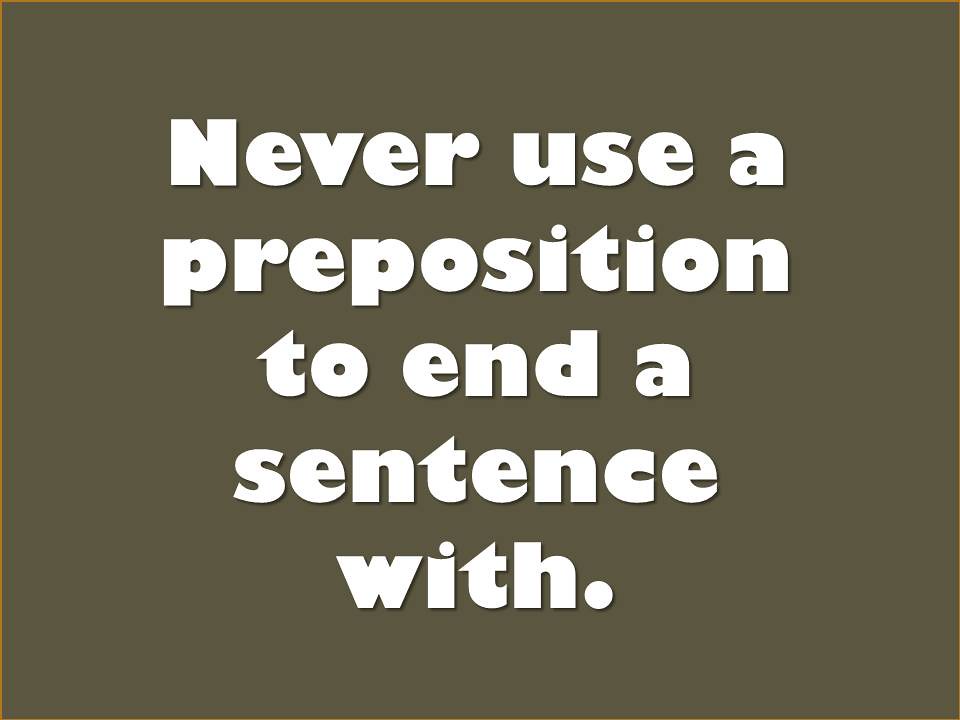
English has particularly confusing and contradictory rules because of the blending of several waves of Germanic speakers (Anglo-Saxons, followed by Danish invaders and later Dutch merchants) overrunning the British (i.e. Celtic speakers with their complicated auxiliary verbs: “How did you do that?”), in turn being overrun by French-speaking conquerors supported by Latin-speaking priests. (I recommend John McWhorter’s ‘Our Magnificent Bastard Tongue‘.) It was this latest ruling class that was averse to (among other things) ending a sentence with a preposition. But that’s a natural and correct part of speech for a Dane to end with.

And I’m an Anglo-Dane.

T-shirt Slogan: ‘Never use a preposition to end a sentence with.’” by Ken Whytock is licensed under CC BY-NC 2.0.

Sonnet: ‘The Arrogance of Youth’

How fortunate the arrogance of youth—
the optimism and innumeracy,
lack of experience, perspective, truth—
giving hopes, visions that they’d never see
if they but knew the small chance of success
in major league politics, business, sports.
Most fail, adopt some wage-slave form of dress
that not dreams, but a family, supports.

Without those early dreams, with a clear view
of stats on making it in the Big Time,
they’d all give up, seeing how very few
truly succeed. Then we’d miss those sublime
insane few dreamers who can win their race,
make the discoveries, blast into space.

*****

This Shakespearean sonnet has just been published in Shot Glass Journal – thanks, Mary-Jane Grandinetti!

Photo: “Arrogance” by De kleine rode kater is licensed under CC BY-NC-ND 2.0.

Nina Parmenter: ‘The Quantum Fox’

Have you seen the quantum fox,
the fox in flux, the paradox?
His whereabouts is rare, because
he’s in his den, and in this box.

This hokum locus tends to vex
the best of us; the mind rejects
the concept of his flightiness
as fiction or as foxy hex.

But fiction’s just refocused facts –
a lens that bends, a parallax.
The fact remains that Foxy lacks
a fix, til someone interacts.

See, should you pry inside the box,
you’ll find a fox, or not a fox,
and then this quantum nonsense stops
and everything is orthodox.

*****

Nina Parmenter writes: “I love reading ‘Quantum Fox’ out loud because it’s one of the few poems of mine I reliably know by heart and if performing it, I read it with props (er, a fox and a box funnily enough). Sometimes I  also recite it to myself to distract my brain if it’s overheating! It’s one of the older poems in my book ‘Split, Twist, Apocalypse‘ (relatively – written around 2019 I think) and I can’t remember where the inspiration came from – I think it was just the nice feel of the words ‘Quantum Fox’!”

Nina Parmenter has no time to write poetry, but does it anyway. Her work has appeared in Lighten Up Online, Snakeskin, Light, The New Verse News, Ink, Sweat & Tears, and the Potcake Chapbook ‘Houses and Homes Forever’. Her home, work and family are in Wiltshire.
https://ninaparmenter.com/

Fennec fox in box” by Joel Abroad is licensed under CC BY-NC-SA 2.0.

Launch: Potcake Chapbook 12, ‘City! Oh City!’

City! Oh City! – poems on the light and dark of urban life. Thirteen of the best contemporary English-language poets present their wildly differing takes on the glamour and squalor, the joy and heartbreak, the varied people and the hidden wildlife of our modern cities.

Five of the poets are new to the Potcake Chapbook series, and I’m delighted to be adding Kate Bingham of England, Francis O’Hare of Northern Ireland, Pino Coluccio of Canada, and Quincy R. Lehr and J.D. Smith of the US. They join eight returning poets. Amit Majmudar and Maryann Corbett deserve special mention for their brilliant use of form to capture contradictory situations: Majmudar’s static street scene which suddenly changes pace to a hectic chase, Corbett’s interwoven Baroque chamber ensemble and homeless encampment with their separate realities in a shared evening in Saint Paul, Minnesota. In addition: Michael R. Burch, Jerome Betts, Terese Coe, Marcus Bales, Martin Elster and myself; everyone contributes to this memorable capture of the complexity of the modern city.

Bios, photos and links to read more of their work can all be found on the Sampson Low site’s Potcake Poets page, while all the chapbooks in the series, showing which poets are in which, are here. Each of the 12 chapbooks is profusely illustrated (of course) by Alban Low, and can be yours (or sent as an intriguing gift) for the price of a coffee.

Value the city – citification is civilisation!

Poem: ‘Some Fling Away’

Some fling away
Some stay and cling—
Each their own Way
To do their own thing.

Sacrifice meaning
For love of the rhyme;
Know that in dreaming
You make up the time.

Sacrifice meaning—
When thought becomes sight
Your soul from its mole-hole
Blinks into life-light.

*****

An early poem, from when I was searching for meaning and questioning the various Meanings that were presented. Decades later, I feel the answer to the meaning of everything is best expressed by Leonard Cohen at the end of Tower of Song. That, and by John Cleese in the photo’s poster, and Douglas Adams’ “42”. Do your own thing, indeed; and keep dreaming and rhyming.

‘Some Fling Away’ was first published in ‘Metverse Muse‘ in India.

Do Your Own Thing” by mikecogh is licensed under CC BY-SA 2.0.

Sonnet: ‘Ultimate Control’ (from the series ‘Voices from the Future’)

If you’ve the aptitude and love the role,
the Army’s always been the place to be.
Rise in the ranks, absorbing strategy:
coordinate, consolidate, control.
And what a blessing when those new implants
gave mind-to-mind awareness… and command.
Like the unthinking fingers on your hand
you can maneuver thousands with a glance.
The battle then’s to see what you can wrest
from other leaders, fighting mind-to-mind;
you have to grow, or you get left behind:
can you control ten million, like the best?
Of would-be kings there’s never been a dearth…
will it be only one who rules all Earth?

*****

This sonnet has just been published in Pulsebeat Poetry Journal’s 3rd issue (thanks, David Stephenson!) It is one of a series written in response to a comment from Maryann Corbett (a brilliant formalist poet) about the bleakness of my vision of the future. Well, she’s a Christian, so she has a totally different take on humanity’s future from my irreligious SF-infused speculations. Another sonnet in the series, ‘Exiled Leader‘, was published by Star*Line.

I don’t find it bleak to think that there will be unprecedented individual and planetary disruptions. I’m not distressed at the thought of humans being supplanted some posthuman higher intelligence. Should the earliest rat-like mammals of 145 million years ago be upset to learn that their human descendants build cities and kill any rats they find in them? Should they identify only with the familiar rats and wish that evolution had stopped there, or instead be proud that they have also developed into humans (and dogs, and whales, etc)?

For myself, life is a wild ride, and I long to see where it will take humans in a hundred or in a thousand years. Because of the current revolutions in genomics, robotics, AI and nanotechnology, I doubt we can reasonably forecast even a hundred years into the future. We can speculate all we like but once we merge a human with AI, create a cyborg, all bets are off.

20120401 – Hand – IMG_2898” by Nicola since 1972 is licensed under CC BY-NC-ND 2.0.

Michael R. Burch: ‘For All That I Remembered’

For all that I remembered, I forgot
her name, her face, the reason that we loved …
and yet I hold her close within my thought:
I feel the burnished weight of auburn hair
that fell across her face, the apricot
clean scent of her shampoo, the way she glowed
so palely in the moonlight, angel-wan.

The memory of her gathers like a flood
and bears me to that night, that only night,
when she and I were one, and if I could …
I’d reach to her this time and, smiling, brush
the hair out of her eyes, and hold intact
each feature, each impression. Love is such
a threadbare sort of magic, it is gone
before we recognize it. I would crush

my lips to hers to hold their memory,
if not more tightly, less elusively.

*****

Michael R. Burch writes: “For All That I Remembered” is one of my personal favorites and one of a number of poems I have written about the transience of memory, along with “The Effects of Memory,” “Violets,” “Moments,” “Distances,” “Redolence,” “Vacuum,” “Afterglow” “Memento Mori” and “Remembrance.” “For All That I Remembered” has been published by The Raintown Review, Boston Poetry Magazine, la luce che non muore (Italy), The Eclectic Muse (Canada), Kritya (India), Jewish Letter (Russia), Gostinaya (in a Russian translation by Yelena Dubrovin), Freshet, Orchards Poetry, Poetry Life & Times, Sonnetto Poesia (Canada), Trinacria, The New Formalist and Pennsylvania Review.”

Michael R. Burch is an American poet who lives in Nashville, Tennessee with his wife Beth and two outrageously spoiled puppies. Burch’s poems, translations, essays, articles, reviews, short stories, epigrams, quotes, puns, jokes and letters have appeared more than 7,000 times in publications which include TIME, USA Today, The Hindu, BBC Radio 3, CNN.com, Daily Kos, The Washington Post and hundreds of literary journals, websites and blogs. Burch is also the founder and editor-in-chief of The HyperTexts, a former columnist for the Nashville City Paper, and, according to Google’s rankings, a relevant online publisher of poems about the Holocaust, Hiroshima, the Trail of Tears, Darfur, Gaza and the Palestinian Nakba. Burch’s poetry has been taught in high schools and universities, translated into fifteen languages, incorporated into three plays and two operas, set to music by twenty composers, recited or otherwise employed in more than forty YouTube videos, and used to provide book titles to two other authors. To read the best poems of Mike Burch in his own opinion, with his comments, please click here: Michael R. Burch Best Poems.

Memory” by Kris Krug is licensed under CC BY-NC-ND 2.0.

Short poem: ‘Disappearance’

I’ve always been around, since before I can remember,
so it just would be so strange, if one day I should dismember,
and my body disappear, like a swallow in September…
Will there be no glowing coal? Of my life survive no ember?

*****

This short poem was published on a page of ‘Senior Moments’ in the current Lighten-Up Online. I like the rhythm (there’s a pause in the patter in the middle of each line) but the simile is bogus: unlike with swallow migration, dead people are unlikely to show up again the next spring…

Photo: “Swallows” by Marie Hale is licensed under CC BY 2.0.