Tag Archives: formal verse

Review: ‘The Lesser Mortal’ by Geoff Lander

Geoff Lander has produced a score of full-page formal poems about various scientific luminaries: Maxwell, Einstein, Mendeleev and so on, combining career highlights with odd trivia about them. The poems are technically very skilful, with a variety of forms and metres being used (though the book is marred in a couple of places by the typesetting failing to follow the structure of lines and rhymes). Here is an excerpt from ‘On the Shoulders of Others’:

Does the gentle polymath,
Monsieur Henri Poincaré,
buried there in Montparnasse,
ponder how it came to pass
Einstein’s name now dominates
all things relativité?
(…)
In the central USA
near St. Louis one fine day
in 04 he first declared
E might equal mc2.

That was news to me. And it does raise the question of why Einstein should get all the recognition. Another of Lander’s poems, ‘Socks Off to Einstein’, suggests a possible answer:

While others may claim to have seen mc2,
they weren’t sock-eccentric, they weren’t spiky haired.
Their names are forgotten. Quite rightly that rankles–
the price you might pay if you coddle your ankles.
So three cheers for Albert, and get your heels bared!

Lander is a chemist by training and a computer programmer by profession, and poetry only came along when he started writing out other people’s verse to help his right hand recover from a stroke. Then, “encouraged from Scotland by Helena Nelson and from the grave by John Betjeman”, he started writing his own verse of which only a tiny fraction has been published.

New historical information and skilful light verse makes for a powerful combination! This very interesting little book from HappenStance Press contains most of what Geoff Lander has published to date.

R.I.P. Susan de Sola

Wonderfully warm and witty poet Susan de Sola passed away last week after a short battle with cancer–she was only 59, very active, and had recently published ‘Frozen Charlotte‘ with Able Muse Press. Tributes in Snakeskin’s blog and Light Poetry Magazine have shown some of her charming, amusing work.

Her work appeared in a couple of the Potcake Chapbooks–‘Family and Other Fiascoes’ and ‘Strip Down’–but I think the most fitting poem for showing her spirit is the last poem in ‘Frozen Charlotte’. She likens the lives of humans to the brief lives of fruit flies and ends, acceptingly, with
“The fruit is fine, the day is long.
Let us feed, buzz, rejoice
.”

Indeed. But many of us miss you, all the same.

New magazine’s Call For Submissions – Pulsebeat Poetry Journal

Poet (and engineer) David Stephenson contacted me recently with the message “I am starting a new journal, Pulsebeat Poetry Journal, for poems with a strong musical element, especially poems in meter and rhyme. I don’t think there are enough venues for rhyming poetry.” He is putting out a general Call for Submissions on his web page https://pulsebeatpoetry.com/guidelines/

“Poems full of music, using meter and rhyme or other means, previously unpublished… Theme should be the human condition… Submissions by December 31, 2021, for the first issue to be posted in January, 2022.” More submission details are at that link above.

David Stephenson has published in The Formalist, The Lyric, etc. His ‘Rhythm and Blues‘ won the Richard Wilbur Award in 2007, which puts him in excellent company. On the Masthead page of his web site you can find links to more recent poems of his, published in Autumn Sky Poetry and Avatar Review.

I look forward to reading the Pulsebeat Poetry Journal, and wish David Stephenson good luck with the venture.

Poem: ‘Wild Oats’

He sowed wild oats
From John O’Groats
As far as Walvis Bay;
West to Cancun,
Up to the Moon,
And back to old Cathay.

Who will forgive
The way he lived?
Where are the children, though?
Daughters and sons
Under what suns?
Who’ll ever even know?

Now settled down,
Mayor of his town,
Friend to both poor and rich,
He’s no regrets
For he forgets…
That selfish son of a bitch.

This poem started with those first two lines, triggered by a photographer’s fundraising paramotor trip from John O’Groats to Land’s End this past summer. BBC story and photos here. No wild oats are involved in the story, but ‘John O’Groats’ is such an evocative name, you have to rhyme it with something… and then you just end up following the rhymes wherever they go. That’s how it often is for me, anyway. No editorial opinion is implied, no persons living or dead, no animals were harmed, etc.

The poem was published in Snakeskin 289, i.e. this October. Editor George Simmers was good enough to point out a particularly weak rhyme and a suggested improvement for it, which I happily took.

“wild oats” by john curley is licensed under CC BY-NC-SA 2.0

Review: ‘101 Sonnets’ edited by Don Paterson

This has to rank as one of the all-time great poetry anthologies. Yes, it contains only sonnets. Yes, several of them are dense in structure or in language (several are in Scots, with words and phrases translated in footnotes). Yes, there is only one sonnet per poet. It is very rich material, and took me a couple of weeks for a first read because there is a lot of absorb. And it has a fabulous Introduction by the British editor Don Paterson – a well-respected poet who avoided including any sonnet of his own.

The sonnets are not put into any formal grouping, but rather flow conversationally from one to the next, the themes often shifting through unexpected juxtaposition. So the first nine run through an amazing sequence of idealised love, woman as muse, kissing, sensual religiosity, obscenity, and charm. It starts with Robert Frost’s
She is as in a field a silken tent
and progresses to Robert Graves’ woman/muse
This they know well: the Goddess yet abides.
Though each new lovely woman whom She rides

to Jo Shapcott’s ‘Muse’
When I kiss you in all the folding places
to Alexander Montgomerie’s
So swete a kis yistrene fra thee I reft
to Wilfred Owen’s
Between the brown hands of a server-lad
The silver cross was offered to be kissed

John Donne’s
Batter my heart, three-personed God
William Alabaster’s ‘Upon the Crucifix’
Feed greedy eyes and from hence never rove,
Suck hungry soul of this eternal store,
Issue my heart from thy two-leaved door,
And let my lips from kissing not remove.

Craig Raine’s ‘Arsehole’
I dreamed your body was an instrument
and this was the worn mouthpiece
to which my breathing lips were bent.

to Robert Herrick
A sweet disorder in the dress
Kindles in clothes a wantonness

The 101 Sonnets provide a wild ride. The next in the book are Poe’s ‘An Enigma’, Wordsworth’s
The world is too much with us; late and soon,
Getting and spending, we lay waste our powers

(incidentally the first sonnet I learnt by heart, one that helped shape my life) and J.K. Stephens’ parody critique of Wordsworth
Two voices are there: one is of the deep (…)
And one is of the old half-witted sheep (…)
And, Wordsworth, both are thine
.

And so on through all aspects of life and death, English landscapes, Irish history, real parents, imaginary children, mythology, poetry, the seasons, the close observation of small everyday items… Wendy Cope paired with Edmund Spenser, Gwendolyn Brooks with John Milton… A very rich and rewarding collection.

And the 17-page Introduction is the single best essay on poetry that I’ve ever read. Naturally it is focused on the sonnet, covering its definition, its history, its structure; but in so doing it talks about wider issues such as the nature of iambic pentameter, and in a couple of places it goes into the nature of poetry itself: it mentions one of the advantages of the sonnet being that it is small enough
to be easily memorised, which is the whole point of the poem–that it should lodge itself permanently in our brains. We should never forget that of all the art forms, only the poem can be carried around in the brain perfectly intact. The poem is no more or less than a little machine for remembering itself: every device or trope, whether rhyme or metre, metaphor or anaphora, or any one of the thousand others, can be said to have a mnemonic function in addtion to its structural or musical one. Poetry is therefore primarily a commemorative act–one of committing worthwhile events and thoughts and stories to memory.

Later Paterson states
Poetic arguments appear to cohere simply because they rhyme. Rhyme always unifies sense, and can make sense out of nonsense; it can trick a logic from the shadows where one would not have otherwise existed. This is one of the great poetic mysteries.

All in all a brilliant book, and highly rereadable.

Potcake Poet’s Choice: Ann Drysdale, ‘Sleeping in Tongues’

Three of us breathing; me and dog and cat.
Awoken by a faint and plaintive mew,
I hold my own breath, ascertaining that
the sound comes from one of the other two.
I act upon an educated guess
and lay a hand on cat, who quickly twists
into a different pose of idleness
and settles, silent. But the sound persists.
So dog it is, who wheezes in a dream
that has bestowed on him the gift of tongues
and things both are, and are not, what they seem.
I let the captive air out of my lungs.
Three of us breathing, dog and cat and me;
companionable synchronicity.

Ann Drysdale writes: “This poem emerged from a situation that took a minute to happen and evolved into a sonnet that takes a minute to read. I can almost believe that it sprang fully-formed from my fingertips, now that the pile of sawdust, chippings and paintflakes generated by the making of one into the other has been swept under the carpet and forgotten.”

Ann Drysdale now lives in South Wales and has been a hill farmer, water-gypsy, newspaper columnist and single parent – not necessarily in that order. Her most recent volume of poetry, Vanitas, joined a mixed list of published writing, including memoir, essays and a gonzo guidebook to the City of Newport. Another collection is accreting nicely and is due to be published next year.

Her poems have been published in several of the Potcake Chapbooks:
Tourists and Cannibals
Rogues and Roses
Careers and Other Catastrophes
Families and Other Fiascoes
Houses and Homes Forever
… all available from Sampson Low for the price of a coffee.

Potcake Poet’s Choice: Gail White, ‘Julian of Norwich in Seclusion’

Because an anchoress could have a cat,
We may assume she had one. That it sat
Beside her while the pilgrims came and went,
Giving, like her, a lesson in content.
That it was quiet when her visions came
And when they passed it slumbered just the same,
But any mice who trespassed in the cell
Were given reason to believe in hell.
That with a feline love of body heat
It nestled in her lap or on her feet.
That it died peacefully, grown old and fat.
Love was my meaning, purred St. Julian’s cat.

Gail White writes: “The Ancrene Wisse or Ancrene Riwle (Rule for Anchoresses), written in Middle English in the 13th century, states that an anchoress might have a cat, although other animals were forbidden. I have therefore taken the liberty of sketching the life of a cat belonging to Julian of Norwich. Her book, A Revelation of Divine Love in Sixteen Showings, ends by asking if the reader wishes to know God’s meaning in her visions, and replies ‘Love was His meaning’. I have transferred this sentiment to her cat.”

Gail White is the resident poet and cat lady of Breaux Bridge, Louisiana. Her books ASPERITY STREET and CATECHISM are available on Amazon. She is a contributing editor to Light Poetry Magazine. ‘Tourist in India’ won the Howard Nemerov Sonnet Award for 2013.

Her poems appear in several of the Potcake Chapbooks:
Tourists and Cannibals
Rogues and Roses
Families and Other Fiascoes
“Strip down,” she ordered
… all available at https://sampsonlow.co/potcake-chapbooks/ for the price of a coffee.

Potcake Poet’s Choice: John Beaton, ‘Shadow-casting’

Cast your line toward the sun
and let your shadow fall behind you.
Face the glare, absorb its stun,
and cast your line toward the sun
for casting shade makes wild things run;
so face the brightness though it blind you—
cast your line toward the sun
and let your darkness fall behind you.

John Beaton writes: “It’s often said that fly-fishing is about more than fish—that it has mystical, or at least meditative, aspects. I feel that way. This little poem illustrates how my fly-fishing thoughts one day wandered from the river-bank to philosophy.

The title echoes a term from the book and subsequent movie, A River Runs Through It. Away from the river Brad Pitt may have become a hellion but, on the water, he’s a magician. Supposedly, by casting repeatedly in the air he can make the trout think a hatch of flies is taking place. It’s a dubious concept, but the term suits the way light and fly-casting in the poem take on metaphorical significance.

The poem has been previously published in Gray’s Sporting Journal. Its form, which comes from medieval French poetry, is the “triolet”. The triolet has only eight lines and some repeat. The first, fourth and seventh lines are almost identical, as are the second and eighth. The rhyme pattern is ABaAabAB, with capital letters denoting repeats. My version has four-beat lines (“tetrameter”) and the beats in the first line are: CAST your LINE toWARD the SUN.”

John Beaton’s metrical poetry has been widely published and has won numerous awards. He recites from memory as a poetry performer. This poem appears in his book “Leaving Camustianavaig” published by Word Galaxy Press. Raised in the Scottish Highlands, John lives in Qualicum Beach on Vancouver Island.

https://www.john-beaton.com/

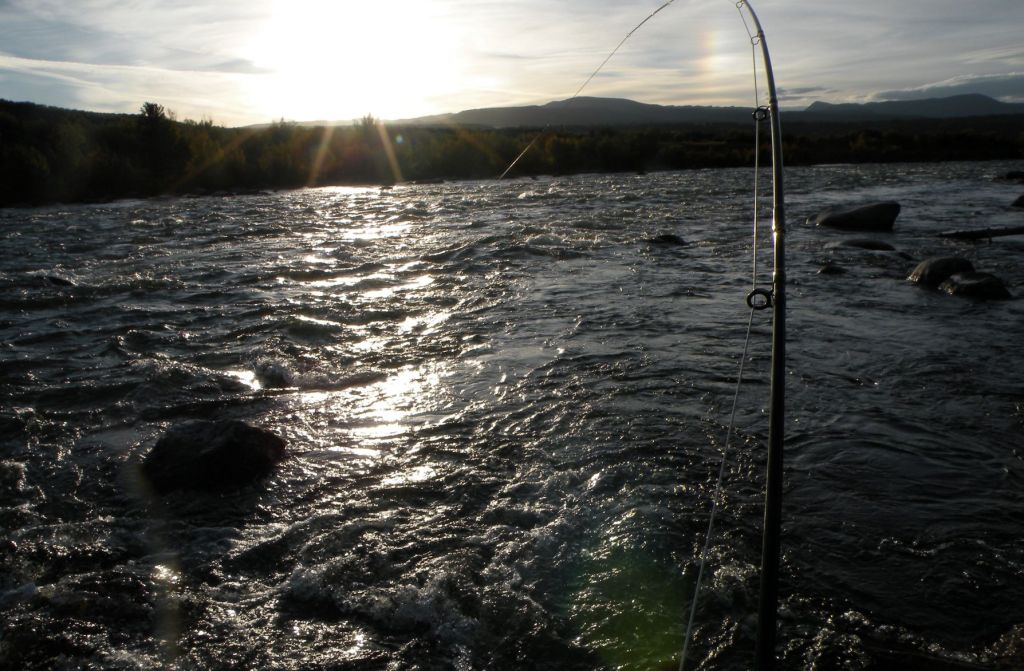
Photo: ‘Deschutes shadow-casting’ from John Beaton

Potcake Poet’s Choice: Max Gutmann, ‘Old Growth’

So rooted
seem couples to a child! Firm-trunked and tall.
Some scrawny: sparsely leaved or badly fruited,
but fixed and solid, works of nature all.
It challenges imagination
that choice was part of the creation.

That they,
these halves, weren’t mingled always, childhood fails
to comprehend. The stories of the way
one’s parents met are magic, fairy tales.
To know the seed becomes the tree
does not dispel the mystery.

Divorce,
unless it strikes our parents, flashes where
it cannot burst our faith. A sudden force
that leaves the broken trunks deformed but there,
disaster-stricken, strangely ill,
but giving partial shelter still.

We feel
this all collapse as childhood’s shed. The trees
we thought so firm and fixed were never real.
To navigate by them can only tease.
Whatever fantasies persist,
unmoving couples don’t exist.

To find
one’s half and gather height and leaves are less
like acts of nature than like hiking blind.
Soil shifts and landmarks vanish. We must guess,
our one-time orchard morphing to
a wood no map can guide us through.

Max Gutmann writes: “It took me a long time to make a poem I liked of this thought/experience. The form supports emphasis where it’s helpful, and that it varies from the iambic pentameter some readers expect mirrors the sense. I rarely feel my verse quotable, but I feel that about ‘To know the seed becomes the tree/does not dispel the mystery’.”

Max Gutmann has worked as, among other things, a stage manager, a journalist, a teacher, an editor, a clerk, a factory worker, a community service officer, the business manager of an improv troupe, and a performer in a Daffy Duck costume. Occasionally, he has even earned money writing plays and poems.

‘Old Growth’ was first published in Able Muse. Some of his ‘Travels with Alice’ limericks appear in the Potcake Chapbook ‘Travels and Travails‘. You can find more of his work at maxgutmann.com

Various updates

I am shifting the focus of this blog to give more coverage to the wide range of formal poets currently writing (especially those who have contributed to the Potcake Chapbooks) and to songwriters who, at their best, are superb poets with tricks up their sleeves not accessible to regular versifiers.

The Potcake Chapbooks continue to be produced on an occasional basis: the tenth in the series, ‘Travels and Travails’, came out recently and the 11th, ‘Lost Love’, has been assembled to be illustrated by Alban Low. Future titles may (or may not) include chapbooks on cities, on teachers, on the seasons, on pets… it all depends on my finding or being sent enough strong and diverse poems on an interesting theme.

I had hoped to have a Christmas-season-themed chapbook out this year, but I am having difficulty finding the diversity I want. Not only diversity of style, but also of content: I would like to acknowledge not just Christmas and Christmas trees and Christmas parties, but also Hanukkah, Kwanzaa, Festivus… everything around the solstice that has given birth to celebrations of the change in the year. (And with some recognition that this looks very different in the southern hemisphere.) Perhaps I will find enough to pull this chapbook together for the end of 2022.

In the meantime I welcome submissions of formal poems on any theme to robinhelweglarsen@gmail.com, but I prefer poems previously published: I don’t have an “accept or reject” procedure, I simply hang onto poems I like until, one of these years, I may have a use for some of them. So, as I don’t want anyone getting antsy about a poem not being available for use elsewhere, the Potcake Chapbooks should not normally be your first place publishing any given poem.

“Temple of British Worthies” by foshie is licensed under CC BY 2.0