Tag Archives: inspiration

A poem’s origins: Robert Burns, ‘A Red, Red Rose’

O my luve’s like a red, red rose
That’s newly sprung in June:
O my luve’s like the melodie
That’s sweetly play’d in tune.

So fair art thou, my bonnie lass,
So deep in luve am I;
And I will luve thee still, my dear,
Till a’ the seas gang dry.

Till a’ the seas gang dry, my dear,
And the rocks melt wi’ the sun:
And I will love thee still, my dear,
While the sands o’ life shall run.

And fare thee weel, my only luve!
And fare thee weel awhile!
And I will come again, my luve,
Tho’ it were ten thousand mile!

*****

January 25th being the birthday of Robert Burns (and the opportunity for a Burns Night celebration), it seems the right day to post an interesting fact that I was unfamiliar with until reading a 1964 Canadian high school poetry text book: ‘A Red, Red Rose’ was fashioned from three distinct songs that Burns had heard in the Highlands of Scotland. Part of each song was reworked by him into a single poem:

(Song 1)
Her cheeks are like the roses
That blossom fresh in June;
O, she’s like a new-strung instrument
That’s newly put in tune.

(Song 2)
The seas they shall run dry,
And rocks melt into sands
Then I’ll love you still, my dear,
When all these things are done.

(Song 3)
Altho’ I go a thousand miles
I vow thy face to see,
Altho’ I go ten thousand miles,
I’ll come again to thee, dear love,
I’ll come again to thee.

Wikipedia (as often) is a good place to look for more information, and here is an extensive quotation from its article on the poem:

Sources
Burns is best understood as a compiler or a redactor of “A Red, Red Rose” rather than its author. F.B. Snyder wrote that Burns could take “childish, inept” sources and turn them into magic, “The electric magnet is not more unerring in selecting iron from a pile of trash than was Burns in culling the inevitable phrase or haunting cadence from the thousands of mediocre possibilities.”

One source that is often cited for the song is a Lieutenant Hinches’ farewell to his sweetheart, which Ernest Rhys asserts is the source for the central metaphor and some of its best lines. Hinches’ poem, “O fare thee well, my dearest dear”, bears a striking similarity to Burns’s verse, notably the lines which refer to “ten thousand miles” and “Till a’ the seas gang dry, my dear”.

A ballad originating from the same period entitled “The Turtle Dove” also contains similar lines, such as “Though I go ten thousand mile, my dear” and “Oh, the stars will never fall down from the sky/Nor the rocks never melt with the sun”. Of particular note is a collection of verse dating from around 1770, The Horn Fair Garland, which Burns inscribed, “Robine Burns aught this buik and no other”. A poem in this collection, “The loyal Lover’s faithful promise to his Sweet-heart on his going on a long journey” also contains similar verses such as “Althou’ I go a thousand miles” and “The day shall turn to night, dear love/And the rocks melt in the sun”.

An even earlier source is the broadside ballad “The Wanton Wife of Castle-Gate: Or, The Boat-mans Delight”, which dates to the 1690s. Midway through the ballad, Burns’ first stanza can be found almost verbatim: “Her Cheeks are like the Roses, that blossoms fresh in June; O shes like some new-strung Instrument thats newly put in tune.” The provenance for such a song is likely medieval.

Thank you, Wikipedia! Love you!

And everyone: Have a good Rabbie Burns Day!

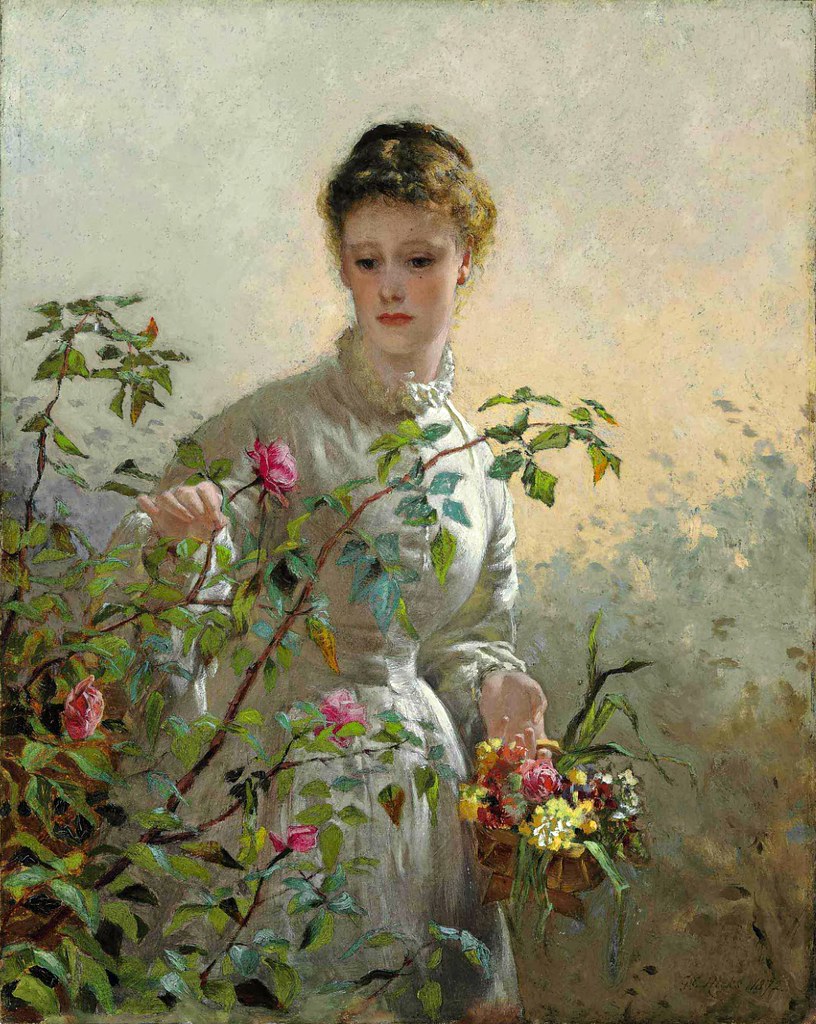
O my Luve’s like a red, red rose that’s newly sprung in June” by Cait Clerin is licensed under CC BY-NC-ND 2.0. The work is ‘A Summer Bouquet’ by George Elgar Hicks, 1878.

Morri Creech, ‘Mileage’

The car mechanic’s counting out his bills
behind the E-Z Mart at one a.m.;
he’ll toss rocks at beer bottles just for thrills
until his dealer comes, it’s fine with him.

He draws in a deep breath and sees the light
swerve from the highway, puzzling the back wall
he leans against just to keep out of sight.
A quarter bag and some fentanyl, that’s all.

His phone vibrates again though nothing’s wrong.
For two years he’s been living in a trailer
with a girl who works at Publix. They get along
even if sometimes she says he’s a failure—

what can he say to that? Sure. He lives cheap.
They’ll fight until she forces a decision,
then roll around on the couch. Once she’s asleep
he’ll take a dose and watch some television.

At night he dreams of cylinders and sprockets,
the trucks and cars too busted up to fix;
startled awake, eyes aching in their sockets,
he’ll watch the clock hands grope their way to six.

A car pulls up but he can see it’s not
his hookup. Just kids with nothing else to do
but drink a six-pack in the parking lot
before they head out to the lake to screw.

He had his share of mischief, too, Lord knows.
The girls don’t eye him in the check-out aisle
much anymore, the ones with painted toes.
A few years back, at least, they used to smile.

The boys can see the grease that stains his hands;
they all think, damn, who wants to work that hard?
He spends the day beneath their dads’ sedans
while they play tackle football in the yard.

Chasing a football blew out both his knees
and broke his wrist. That was three years ago.
Customers say, “go Stags,” and toss their keys,
then look at him real close as if they know.

A text says no one’s coming. The BP sign
flickers over the pumps, and though it’s half-
past two now, and he’s tired, he’s feeling fine
enough to think it’s all a bust, and laugh.

And, anyway, it’s good to be alone
with the gas fumes and blinking traffic light
and fifteen missed calls lighting up his phone.
Later, he thinks, once he and his girl fight,

and once she falls asleep on his left arm,
he’ll stare at the divots on the ceiling tile
and wait to hear the clock sound its alarm
while the night’s odometer counts one more mile.

*****

Morri Creech comments: “As Mark Strand once said, I write to find out what I have to say. I don’t start a poem with an idea; I start with a line, an image, a rhetorical stance. Then I write in search of context: how can I situate this in a situation, a narrative moment, an argument, a meditation? The language takes me wherever I end up. This poem was constructed like that. I started with a first line and then wrote toward trying to figure out the context of the line. In this case, it led me to a character sketch. It was fine to discover what this character was about; the decisions I made about his character and circumstances were largely directed by rhymes. They steered me in what I hope was the right direction.”

Morri Creech is the author of five collections of poetry, including the Sleep of Reason, a finalist for the Pulitzer Prize, Blue Rooms, and The Sentence (published by LSU Press, and which includes this poem). A recipient of NEA and Ruth Lilly Fellowships, as well as North Carolina and Louisiana Artists Grants, he teaches at Queens University of Charlotte.
www.morricreech.com

Photo: “Let’s Talk Tires” by gfpeck is licensed under CC BY-ND 2.0.

Using form: Sonnet: Max Gutmann, ‘How to Inspire a Sonnet – advice from the pros’

Inspire amore first, but molto forte
If in sonetti dolci you’d be sung.
Then see that you stay bella. You’ll support a
Passione deep and long by dying young.
— Laura

If thou upon his stage the Muse’s part
Wouldst play, each act thou study’st must prolong
Thy Poet’s pain. ‘Tis pain shall prompt great Art.
Then con thy lines with style, and do him wrong.
— The Dark Lady

Stay always by her. Never for a day
Be from her cherished side. ‘Tis paramount
To share the highest love. (And, by the way,
It helps to choose a lover who can count.)
— Robert Browning

‘Tis mystery that fires the crucial spark,
So make him wait–and keep him in the dark.
— Milton’s blindness

*****

Max Gutmann writes: “A reader of Light Quarterly (the marvellous Light back in its days as a print journal) was so offended by a poem of mine ridiculing a lousy president that he cancelled his subscription. Beloved editor John Mella forwarded a copy of the note to me. It was a sonnet! I’d never thought I could inspire a sonnet. I had a ways to go before rivaling Laura or the Dark Lady, but I’d taken the first step. That inspired this poem.

“John declined the poem, so it first appeared in a journal that didn’t specialize in light verse, one highly thought of. (Digging it out now, I see that contributors to the issue the poem appeared in included, among others I admire, Updike, Espaillat, Turner, Gioia, and Hadas.) But the journal goofed. They changed sonnetti dolci to sonnetti dolce (plural noun, singular adjective). This must have been a typo, I imagined, but when I asked, the chief editor not only admitted the change had been intentional, but defended the decision. Dolce being the more familiar form, he argued, it was reasonable to make the change without consulting the writer. I never sent them anything again

“This story calls for a shout-out to Jerome Betts, who reprinted ‘How to Inspire a Sonnet’ in Lighten Up Online (LUPO). (To avoid the impression that Jerome is less than meticulous about acknowledgements–or about anything–I should make clear that I asked him not to acknowledge the earlier journal, and I didn’t name it for him.) Jerome, like most editors I’ve worked with, always asks before making changes–and his proposed changes are usually improvements, often big ones!”

Editor’s note: This poem suggests what might be appropriate ways to inspire sonnets, according to the subjects of sonnets: Petrarch’s Laura, Shakespeare’s Dark Lady, Elizabeth Barrett Browning’s Robert and Milton’s blindness. Self-referentially, the poem is itself a Shakespearean sonnet, written in response to being the subject of a sonnet. Gutmann is therefore both sonneteer and sonnetee, and has the credentials to write a “How to –“

Max Gutmann has worked as, among other things, a stage manager, a journalist, a teacher, an editor, a clerk, a factory worker, a community service officer, the business manager of an improv troupe, and a performer in a Daffy Duck costume. Occasionally, he has even earned money writing plays and poems.

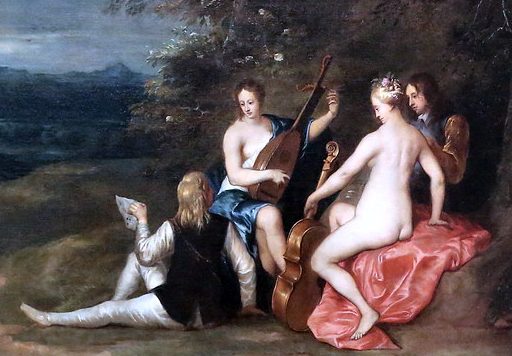
Photo: “IMG_0323C Frans Wouters. 1612-1659. Antwerp. The rural concert. 1654. Dole” by jean louis mazieres is licensed under CC BY-NC-SA 2.0.

Non-traditional sonnet: Marcus Bales, ‘The Durable Rain’

The durable rain was conducting its drumming descent
Without any decent regard for the dawning of day
As if a dim evening was all of the morning it meant
To allow from a sun that was doing a landscape in grey.
Never begin with the weather the boffins have said.
If nature’s as stormy and dark as a novelist’s mind
The reader will sneer at the metaphor. Offer instead
A prose that’s so difficult readers are left far behind.
But back to my tale. Is it cozy inside, or does rain
Express what discursive description would talk past in vain?
Does a cry break a heart when the kettle releases its steam
Or, piping, awaken a lover up out of their dream?
What it will mean will depend on your context and age.
A poem exists in the reader and not on the page.

*****

Marcus Bales writes: “The first four lines rolled out without much trouble. I had let the dogs out after they’d woken me at what they thought was the right time but which to me was five in the a.m. It was cold and grey but not rainy at all. Who can figure how the brain works. I did worry briefly about the alliteration but finally put it off, hoping it would sound like rain on the roof. Sort of. And it seemed portentous and poetry-like, but where to go from that?

“I don’t know where I first heard that you’re not supposed to open with the weather. It sounds like one of those pieces of advice the internet kicks up from time to time purportedly by Elmore Leonard, along the lines of “You know those parts that readers skip over? Don’t write those.” Or “You got to know when to hold ‘em and know when to fold ‘em.” Advice that is absolutely both spot-on and worthless at one and the same time. If you know you don’t need any advice; if you need advice, it’s because you don’t know. It makes sense in that maddening way of all advice, but it is untakeable. However much you may agree that the reader doesn’t care what the weather is, they care what happens and who it happens to, there I still was without anyone there to have something happen to, except the damn rain.

“Sitting at breakfast reading my usual dollop of Wodehouse, I noticed that when things are going well for his characters the weather gets some generous play, and when not, not. Then I reflected that really I don’t have a large supply of written descriptions of the weather from anywhere. There’s ‘Neutral Tones’, of course, where the weather is a metaphor for the breaking relationship, and “Nothing that is not there and the nothing that is.” And ‘Stopping By Woods’ where the weather is the reason for the stopping, or the first lines of ‘Journey of the Magi’. There’s Auden’s ‘In Memory of Yeats’, Housman’s cherries hung like snow, if that even works, though who Snow was and how Housman knew is a mystery. And after that it’s vague references to this or that month or season generally in Keats, Poe, Byron, or Shelley, and the inference that all of Yeats happens in the summer what with swans and people fighting the horses of the sea, and all. And finally, again, all those descriptions of the morning in the Blandings and the golf stories. After that my memory starts to flail about. This isn’t the sort of thing where research is indicated at five in the ack emma. Perhaps you remember more examples of how the weather is used in prose and poetry, but it’s too late now, isn’t it.

“I wasn’t sure how to go on. It seemed as if nearly the whole practice of poetry in English was against me, aside from the sub-genre of song with all those deep and crisp and evens, and sleigh rides that began to echo in the back of my head, along with all those singers who seem to be perpetually crying or dancing or walking in the rain. Then I thought well, why not use that? I might get three or four lines out of it, and then maybe something else would occur to me. Well, I got my four lines and arrived at the volta of the sonnet, if sonnet it turned out to be. What now?

“Turning at the question that had stopped me I trod upon that patch for a few lines, and then I had got to the couplet. Well, I really had nothing, did I, among all this meta- bit, and what I had seemed to call for some digging into the whats and whys of how literature worked. Well, of course no one knows. I worried some about having failed to provide any context for the reader to see me through, and put it aside to eat breakfast.

“After that, and a shower, and a bit of humor watching the dogs return to the scene of the five o’clock crime outside to chase a squirrel in the yard, somehow the notion of context reasserted itself, and I remembered a sort of juicy quote from a professor 50 years ago who was gassing on about how a poem isn’t the sounds or the words or the meanings as the poet meant them, but rather the unpredicatable ways that the people misread poems. I recall he had half a dozen examples right to hand, as scholars so annoyingly seem to do, but I couldn’t bring a single one to mind. Fortunately, I’m a poet, not a scholar, so I don’t have to be able to give good – or any – examples, so I decided to steal his assertion and let it go at that.

“And there it is. A complete mishmash of false starts, interrupted middles, and squishy endings. Enjoy!”

Not much is known about Marcus Bales except that he lives and works in Cleveland, Ohio, and that his work has not been published in Poetry or The New Yorker. However his ‘51 Poems‘ is available from Amazon. He has been published in several of the Potcake Chapbooks (‘Form in Formless Times’).

Photo: “Rainy Day” by SammCox is licensed under CC BY-NC-ND 2.0.

Short poem: Peggy Landsman, ‘Speech Impediment’

My every breath
An inspiration—
Breathlessness
My deathtination.

*****

Peggy Landsman writes: “About ‘Speech Impediment’: Need I say more?”

Peggy Landsman is the author of the full-length poetry collection, Too Much World, Not Enough Chocolate (Nightingale & Sparrow Press, 2023), and two poetry chapbooks, Our Words, Our Worlds (Kelsay Books, 2021) and To-wit To-woo (Foothills Publishing, 2008). She lives in South Florida where she swims in the warm Atlantic Ocean every chance she gets. ‘Speech Impediment’ was originally published in The Lyric, and a selection of her poems and prose pieces can be read on her website:  https://peggylandsman.wordpress.com/

Breathless” by eeblet is licensed under CC BY-NC-ND 2.0.

Marcus Bales, ‘Lighthouse’

She needed constant, searching light
And some firm continent
From which to dive into the night
To find what darkness meant.

She fought the horses of the tides
And they her urgency.
She caught their lunar reins and rides
Triumphant out to sea.

And now she knows the powers of
The dark sea’s character,
And scorns the note her former love
Moans out, moans out to her.

*****

Marcus Bales writes: “Probably poets ought not tell this sort of story about their work. I found a stash of very old poems, carefully typed out on now-yellowed paper in a metal file box amid 5” Tandy floppy discs, and printed on a dot-matrix printer, a little faded, some months ago, and have started the often painful task of retyping them into my little electronic library of my work. Many of them are obviously student stuff, but this one seemed a little less studious than the rest. It brought back its context in my mind pretty clearly.
This is a very early poem, maybe sophomore year. I’d read someone’s comment that Yeats wrote about his friends as if they were characters in a Greek myth, and it had struck me as a sudden truth — to me, anyway. Nothing would do, of course, except to try the thing on my friends. Then a woman I knew gave me a copy of Adrienne Rich’s ‘Transformations’, which tells the stories of ancient myths about women, mostly, as if they had much more contemporary attitudes, and that seemed like a much better model than the Yeats tone and manner — and besides, Yeats had already done that tone and manner. So though the idea originated in Yeats, it is really Rich’s idea that I tried to follow, trying for the tone of metaphor in a contemporary voice. And Larkin was in there somewhere too, as I recall, having discovered him when asked to write a paper contrasting and comparing one of his poems to one of Wilbur’s. The Larkin was the one starting:
Sometimes you hear, fifth-hand,
As epitaph:
He chucked up everything
And just cleared off,

And that led me to many others, notably ‘The Trees’, with its amazingly unlarkinish  repetition at the end.
Steal from the best has long been my motto.”

Not much is known about Marcus Bales except that he lives and works in Cleveland, Ohio, and that his work has not been published in Poetry or The New Yorker. However his ’51 Poems’ is available from Amazon. He has been published in several of the Potcake Chapbooks (‘Form in Formless Times’).

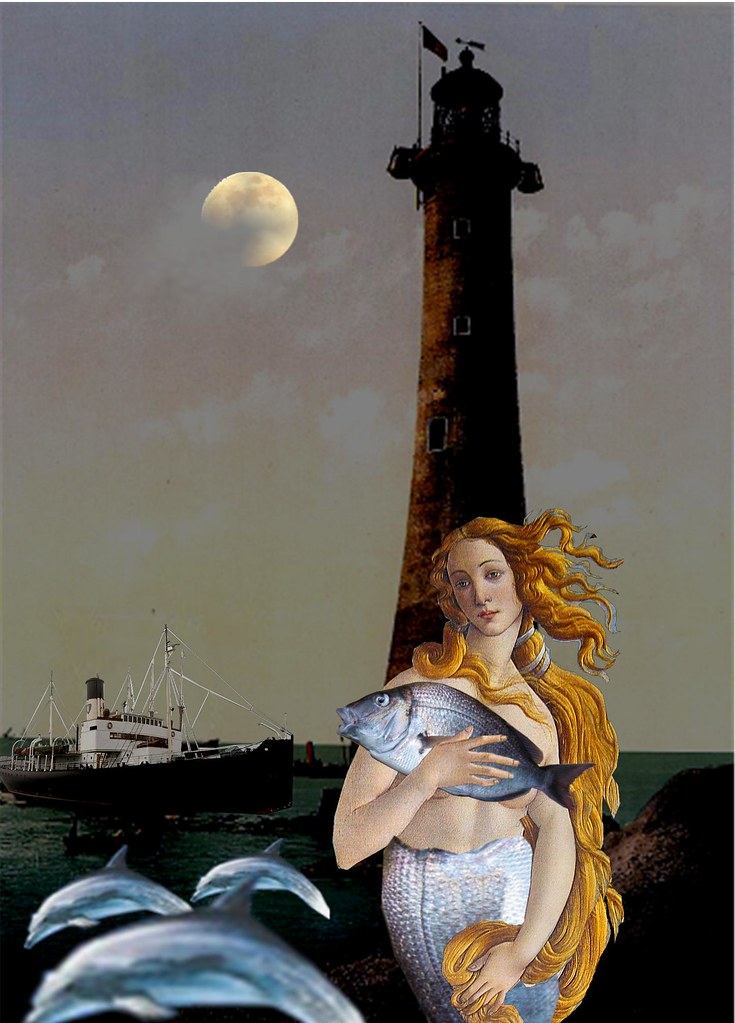
Photo: “my father was the keeper of the eddystone light” by sammydavisdog is licensed under CC BY 2.0.

Using form: Ballade: Marcus Bales, ‘Scary Home-Life’ (for GTZ)

Get up, get out, and get away–I went
as early as I could to leave one vile
exposure for another. School. It meant
escape from home at least a little while,
not long enough, and trading family guile
for reading sullen peers and teacher spin,
except for you, beside me on the aisle–
I was the girl with the scary home-life and bad skin.

I was first to homeroom every day.
And how did Mr Romo ever know
that half a sausage sandwich was the way
a skinny girl survived. He’d always go
“Good morning,” handing me a half as though
that half were mine and we were somehow kin;
I’d nod my thanks and sit in the back row–
I was the girl with the scary home-life, and bad skin.

And you, who sat beside me, always kind
to me, and always kind of sassy tough
to other kids who other years combined
to make me almost miserable enough
to stay at home, from you I learned to bluff
my inner fear, to fake a cocky grin,
and start to walk as if it wasn’t rough
to be the girl with the scary home-life, and bad skin.

L’envoi
Yeah, it was you and Mr Romo, in the end,
who gave me things that I could not begin
to pay you back for, so even I’d befriend
the girl with the scary home-life, and bad skin.

*****

Marcus Bales writes: “I have a modest file of poems that have got me unfriended, blocked, or banned by people or publications, for one reason or another. Sometimes, as in this case, the reason is unknown to me. 

“Back in the old days when I was a working salesman at the sort of retail store where it takes an hour or two to walk around the store with your salesperson and discuss wants and needs and preferences, it is often the case that the customer gets comfortable enough to tell things about themselves or their lives that they might hesitate to repeat without canny encouragement. Here, a vivacious and attractive young couple were moving in together and needed furniture and a bed. They were excited, and money was not an issue. It turned out the young woman had been an officer in the Marines or the Army — I forget which at this distance — in one of the rougher, tougher units, and I admired her for having the stuff to lead in that mise en scene. She recounted that she had felt driven to it by a harrowing early family life, complete with the sort of acne that is every teen’s nightmare. A scary home-life and bad skin was her description of it. After the sale was completed I wrote most of this poem in the break room in the back, after climbing on the table to turn off the Muzak speaker so I could think. 

“I discovered she had friended me on Facebook and had written some nice things about me at the store, which was very nice of her. Of course even back then I was posting my poems on Facebook, and posted this one, without her name, but with her initials. All the details are entirely fictional. I made them all up, except for that one line. She blocked me right away.”

Editor’s note: a ballade is a very suitable form for this poem, with iambics for thoughtful mood, claustrophobically restricted rhyme scheme, steady refrain, and final summation addressed to a superior person. From the Wikipedia entry ‘Ballade (forme fixe)‘: “The ballade as a verse form typically consists of three eight-line stanzas, each with a consistent metre and a particular rhyme scheme. The last line in the stanza is a refrain. The stanzas are often followed by a four-line concluding stanza (an envoi) usually addressed to a prince. The rhyme scheme is therefore usually ababbcbC ababbcbC ababbcbC bcbC, where the capital C is a refrain.”

Not much is known about Marcus Bales except that he lives and works in Cleveland, Ohio, and that his work has not been published in Poetry or The New Yorker. However his ’51 Poems’ is available from Amazon. He has been published in several of the Potcake Chapbooks (‘Form in Formless Times’).

Photo: “skinny girl” by Villegación is licensed under CC BY-NC-SA 2.0.

Calling the Poem: 11. ‘Inspiration 2’

The poem enters your head as a litter of kittens
brought in by a cat from somewhere hidden,
place of birth unknown.
A word, image, rhyme,
an idea, a tone,
they are brought one at a time
In no order, no preference, no ruling or schooling,
they just need to come in, like refugees at the border.
And they have no order,
they crawl over each other, blind and mewling,
and here comes another, and then here comes another.
So the thoughts enter your head like kittens. Give thanks to the Mother.

*****

Where do ideas come from? No idea. (An oxymoronic observation that is not so different from saying that all the Universe comes from nothing, or that there was no time before the beginning of time.) But simply having ideas is nothing in itself – you can have ideas and ignore them (and generally irritate the Muse that is offering you ideas), and so you will have nothing to show for them. Canadian poet Pino Coluccio recently pointed me at an old piece by British poet Philip Larkin, which begins:

“It is sometimes useful to remind ourselves of the simpler aspects or things normally regarded as complicated. Take, for instance, the writing of a poem. It consists of three stages: the first is when a man becomes obsessed with an emotional concept to such a degree that he is compelled to do something about it. What he does is the second stage, namely, construct a verbal device that will reproduce this emotional concept in anyone who cares to read it, anywhere, any time. The third stage is the recurrent situation of people in different times and places setting off the device and re-creating in themselves what the poet felt when he wrote it. The stages are interdependent and all necessary. If there has been no preliminary feeling, the device has nothing to reproduce and the reader will experience nothing. If the second stage has not been well done, the device will not deliver the goods, or will deliver only a few goods to a few people, or will stop delivering them after an absurdly short while. And if there is no third stage, no successful reading, the poem can hardly be said to exist in a practical sense at all.”

So, 1) become obsessed; 2) construct a verbal device that captures the obsessiveness; 3) have it read by people who thereby experience your obsession.

This series of poems in the ‘Calling the Poem’ chapbook focuses on how to be open to the internal wellspring of ideas, obsessions, emotions, words and images to reach Larkin’s first stage (these first 11 poems); and some thoughts about the construction of the “verbal device” of his second stage (the remaining four poems that are coming up). As for the third stage… well, if the poem is strong enough, it will resonate appropriately with those who read it; but how to get it read–that is a different problem entirely.

Photo: “Newborn kittens” by In dust we trust is licensed under CC BY-NC-SA 2.0.

Calling the Poem: 10. ‘Inspiration 1’

When the god’s in you, you’re not blessed nor raped;
it’s not Zeus in whatever guise he wears,
nor Yahweh taking Mary unawares,
nor anything which could be fought, escaped;
nor is it there where your complete orgasm–
from curling toes to skull-top tingling hair–
meets voodoo god who rides you as nightmare,
meets “therapy” of ECG’s dead spasm.

But winkled from your shell by muse or god
you’re in unmoving time, in time that seems
to Rip Van Winkle ordinary, not odd,
there where True Thomas by fay queen is smitten…
and when you wake from momentary dreams
two hours have gone by, and the first draft’s written.

*****

Even if, as some artists relate, they have been taken over by a god, muse, or supernatural force of inspiration, the feeling is not one of fear or terror as you might expect from being possessed. The process of inspired creation typically gives a feeling of calm, concentration and controlled excitement. The aftereffects can be completely different: exhaustion, exuberance, depression… The connection has been broken, the mind returns to a different state.

This version of the sonnet has been cleaned up from what was originally published as an e-chapbook by Snakeskin in issue 236 (unfortunately Archives are still down at time of writing). I have removed the four-letter words from the first four lines and generally reduced the probable offensiveness to my Christian and Muslim friends. However I think there are two points to be made that are more important than sacrilegious language:

Why is it acceptable to portray the coarseness of other people’s gods to schoolchildren, while it is forbidden to discuss the immorality of one’s own group’s preferred deity, even among adults?

And more importantly, why is it considered acceptable for a god (Yahweh) to impregnate a young female (Mary) without her consent? Isn’t this a Handmaid’s Tale level of thinking about the rights of the male and the insignificance of the female? Isn’t this a dangerously inappropriate story to be telling our children?

Of course the “Immaculate Conception” is just an unscientific fairytale. It is far more likely that, as contemporary Jewish rumour had it, Mary got pregnant by a Roman soldier called Pantera, and that Joseph (through love or pity) took her away to have the child in his home town of Bethlehem rather than have her stoned to death as would have been likely for having sex before marriage, especially with one of the idolatrous, beard-shaving, pig-eating Western soldiers of the Occupation

Photo: Life size bronze of Rip Van Winkle sculpted by Richard Masloski, copyright 2000; Photograph by Daryl Samuel

Calling the Poem: 7. ‘The Tiger’

That wild white wind that whips the world away –
The darkness deep and dread in dazzling day –
The light and dark that fuse with furious force –
The leaping tiger that gives no recourse –
Acknowledge, fear, that lurking tiger’s rage,
The terrifying sense of spring-taut powers,
Menacing, tail-tip twitching while it glowers,
Lethal both to ignore or to engage.
Acknowledge it, succumb: you’ve been rewarded.
And now produce – because the debt’s recorded.

*****

This is the 7th of the 15 poems of the Snakeskin e-chapbook ‘Calling the Poem’. ‘The Tiger’ and the next few poems deal with the difficulties of first begging your Muse for inspiration and then finding that the inspiration is uncomfortable – personally, socially, politically, whatever. Perhaps the inspiration isn’t what you were hoping for… but what are your obligations once you have in effect contracted to receive something unknown?

The Muse, the gods, the unconscious or however you like to think of your source of inspiration is not to be trifled with. It is to be respected if you want to stay on good terms with it and benefit from it.

The word ‘music’, by the way, means Muse-ish, ‘of the Muses’. The following is blended from passages in Wikipedia: According to Pausanias in the later 2nd century AD, there were three original Muses, three original Boeotian muses before the Nine Olympian Muses were founded: Aoidē (“song” or “voice”), Meletē (“thought” or “contemplation”), and Mnēmē (“memory”). Together, these three form the complete picture of the preconditions of poetic art in cult practice.

So song, contemplation and memory are the Muses that together drive poetry. Poetry is totally Muse-ish. Therefore poetry is inherently musical. Its music is essential.

(And it was only after writing this blog that I found that the current Oglaf comic features a tiger…)

Photo: ‘Tiger’ by Captain Chickenpants is licensed under WordPress Openverse.