Tag Archives: Lighten Up Online

Using form: Jerome Betts, ‘Villanelle For Darcy’

Darcy the diabetic cat has died
His fans were told by email recently,
A life remembered with no little pride.

The Fiat-driver now feels mortified
To think because he simply failed to see
Darcy, the diabetic cat has died.

Was this the fatal ninth and last he’d tried?
Whichever, it will surely prove to be
A life remembered with no little pride.

His poor squashed frame has been discreetly fried
With all involved expressing sympathy;
Darcy the diabetic cat has died.

The people in his road could not abide
The flattening of such fine felinity,
A life remembered with no little pride.

So, some of them sent cards, and others cried
And stuck a sign upon his favourite tree:
Darcy the diabetic cat has died,
A life remembered with no little pride.

*****

Jerome Betts writes: “It’s always interesting when a line you read sparks off a quite unexpected result. In this case the line was in a friend’s email from Cambridge which mentioned in passing, as an item of local news, that Jasper the diabetic cat has died. Further details followed about one of those neighbourhood favourites known to many more people than its owners. Eventually, with Darcy substituted for Jasper (partly to secure a run of Ds and partly as I was at odds with a garden-molester of that name at the time) a villanelle took shape which was published in Snakeskin and subsequently in the anthology Love Affairs At The Villa Nelle (Kelsay Books, 2018) edited by Marilyn L. Taylor and James P. Roberts.”

Jerome Betts lives in Devon, England, where he edits the quarterly Lighten Up Online. Pushcart-nominated twice, his verse has appeared in a wide variety of UK publications and in anthologies such as Love Affairs At The Villa NelleLimerick Nation, The Potcake Chapbooks 1, 2 and 12, and Beth Houston’s three Extreme collections. British, European, and North American web venues include Amsterdam QuarterlyBetter Than StarbucksLightThe Asses of ParnassusThe HypertextsThe New Verse News, and Snakeskin.

Photo: “Dead Cat” by Denty One is licensed under CC BY-NC-ND 2.0.

Short poem: RHL, ‘Coat’

Sew, sew, sew your coat
Gently down the seam;
Threadily, threadily, threadily, threadily,
Joseph wants a dream.

*****

A throwaway poem. For anyone unfamiliar with the references, it blends what is often sung as a round:
Row, row, row your boat
Gently down the stream;
Merrily, merrily, merrily, merrily,
Life is but a dream

with the idea behind the Andrew Lloyd Webber / Tim Rice musical Joseph and the Amazing Technicolour Dreamcoat.

The poem was published in Lighten Up Online (aka LUPO). Thanks, Jerome Betts!

Photo: “Benjamin School District 25 production of ‘Joseph and the Amazing Technicolor Dream Coat’. March 9th, 2013.” by old06cphotos is licensed under CC BY-NC-ND 2.0.
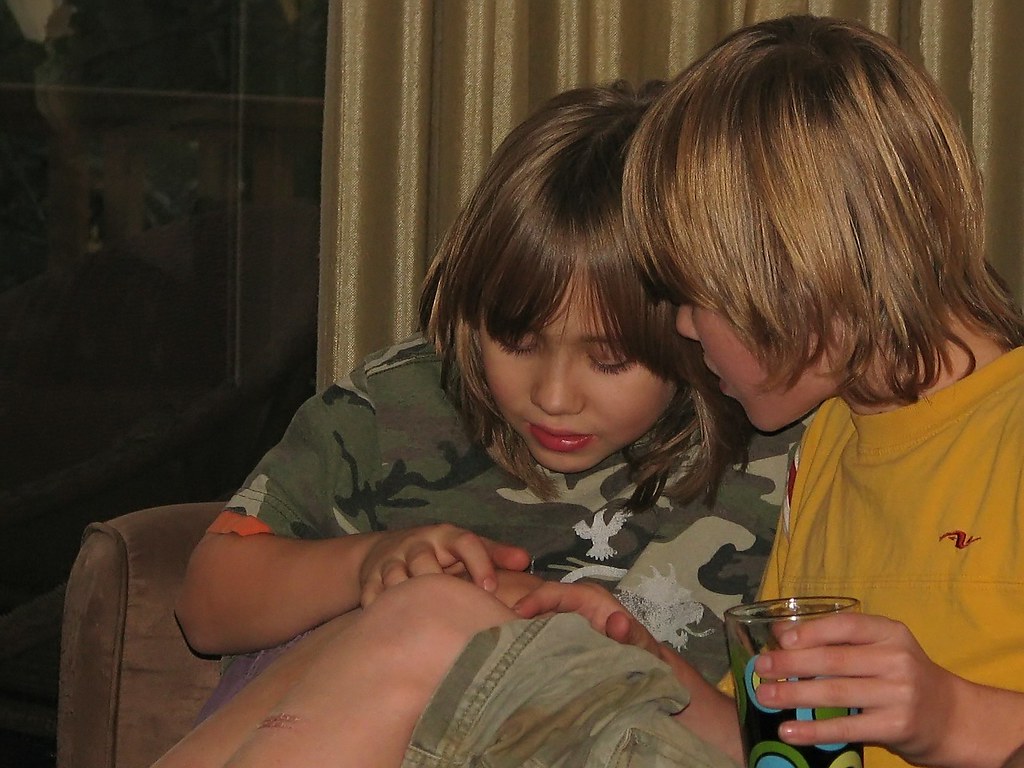
RHL, ‘Boy With Scab’

The boy he’s always been still takes delight
In testing scabs on elbows, knees,
To see if fingernails can assert their right
To lift with satisfying ease
The lid from off the mystery healing box
And see the flesh beneath the skin
Where the wise body-mind slowly unlocks
Corpuscles and white pus within.
The hint of pain, like some itch that you scratch,
Is fun alongside look-and-see.
What does the boy do with that useless patch,
The scab? Easy: autophagy.

*****

Curiosity is a useful aspect of intelligence. This poem first published in Lighten Up Online (aka LUPO). Thanks, Jerome Betts!

Photo: “War Stories” by Noël Zia Lee is licensed under CC BY 2.0.

Melissa Balmain, ‘No Ifs, Ands, Or Bots’

Tradwife? No, thanks. I’m not the type you’ll find
exclaiming “Yippee!” “Yesiree!” or “YOLO!”
at thoughts of chores I might be doing solo –
especially the old-school kitchen kind.
Churn butter? Grow a sill of herbs? You’re kidding.
Give me boxed broth and Hellman’s mayonnaise
and sourdough I didn’t have to raise.
Give me technology that does my bidding.

Yet how I love to cook up verse from scratch:
to handpick thoughts I planted as a kernel
within the fertile pages of a journal,
add rhymes (a meaty or a salty batch),
then whip them into something that – although it
may stink at times – tastes vastly fresher than
the glop inside an algorithmic can
because you know it comes from me, Tradpoet.

*****

This poem was the lead poem in the latest Lighten Up Online (“LUPO”). Melissa Balmain writes: “Ironically, in the weeks since I wrote this poem, a health condition has forced me to do a lot more tradwifely stuff in the kitchen–making low-acid salad dressing, say. But I still refuse to churn butter.”

Melissa Balmain’s third poetry collection, Satan Talks to His Therapist, is available from Paul Dry Books (and from all the usual retail empires). Balmain is the editor-in-chief of Light, America’s longest-running journal of light verse, and has been a member of the University of Rochester’s English Department since 2010. She is a recovering mime.

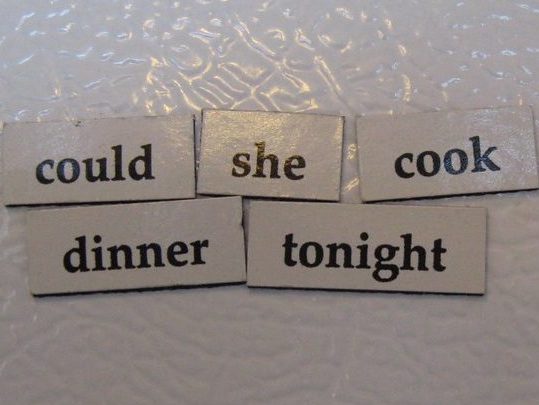
Photo: “could she cook” by aprilskiver is licensed under CC BY 2.0.

Using form: Sonnet: Max Gutmann, ‘How to Inspire a Sonnet – advice from the pros’

Inspire amore first, but molto forte
If in sonetti dolci you’d be sung.
Then see that you stay bella. You’ll support a
Passione deep and long by dying young.
— Laura

If thou upon his stage the Muse’s part
Wouldst play, each act thou study’st must prolong
Thy Poet’s pain. ‘Tis pain shall prompt great Art.
Then con thy lines with style, and do him wrong.
— The Dark Lady

Stay always by her. Never for a day
Be from her cherished side. ‘Tis paramount
To share the highest love. (And, by the way,
It helps to choose a lover who can count.)
— Robert Browning

‘Tis mystery that fires the crucial spark,
So make him wait–and keep him in the dark.
— Milton’s blindness

*****

Max Gutmann writes: “A reader of Light Quarterly (the marvellous Light back in its days as a print journal) was so offended by a poem of mine ridiculing a lousy president that he cancelled his subscription. Beloved editor John Mella forwarded a copy of the note to me. It was a sonnet! I’d never thought I could inspire a sonnet. I had a ways to go before rivaling Laura or the Dark Lady, but I’d taken the first step. That inspired this poem.

“John declined the poem, so it first appeared in a journal that didn’t specialize in light verse, one highly thought of. (Digging it out now, I see that contributors to the issue the poem appeared in included, among others I admire, Updike, Espaillat, Turner, Gioia, and Hadas.) But the journal goofed. They changed sonnetti dolci to sonnetti dolce (plural noun, singular adjective). This must have been a typo, I imagined, but when I asked, the chief editor not only admitted the change had been intentional, but defended the decision. Dolce being the more familiar form, he argued, it was reasonable to make the change without consulting the writer. I never sent them anything again

“This story calls for a shout-out to Jerome Betts, who reprinted ‘How to Inspire a Sonnet’ in Lighten Up Online (LUPO). (To avoid the impression that Jerome is less than meticulous about acknowledgements–or about anything–I should make clear that I asked him not to acknowledge the earlier journal, and I didn’t name it for him.) Jerome, like most editors I’ve worked with, always asks before making changes–and his proposed changes are usually improvements, often big ones!”

Editor’s note: This poem suggests what might be appropriate ways to inspire sonnets, according to the subjects of sonnets: Petrarch’s Laura, Shakespeare’s Dark Lady, Elizabeth Barrett Browning’s Robert and Milton’s blindness. Self-referentially, the poem is itself a Shakespearean sonnet, written in response to being the subject of a sonnet. Gutmann is therefore both sonneteer and sonnetee, and has the credentials to write a “How to –“

Max Gutmann has worked as, among other things, a stage manager, a journalist, a teacher, an editor, a clerk, a factory worker, a community service officer, the business manager of an improv troupe, and a performer in a Daffy Duck costume. Occasionally, he has even earned money writing plays and poems.

Photo: “IMG_0323C Frans Wouters. 1612-1659. Antwerp. The rural concert. 1654. Dole” by jean louis mazieres is licensed under CC BY-NC-SA 2.0.

RHL, ‘Everyone’

Everyone’s naked under their clothes,
everyone’s bald under their hair;
hide if you like, everyone knows!
Everyone sees what you’re like under there.

Everyone’s meat under their skin,
everyone’s bones under their meat;
we know what your outside is hiding within:
hiding will always end in defeat.

So banish the words and censor the book,
draw little clothes on the cartoons for kids;
everyone knows where your dirty eyes look,
everyone sees that your life’s on the skids.

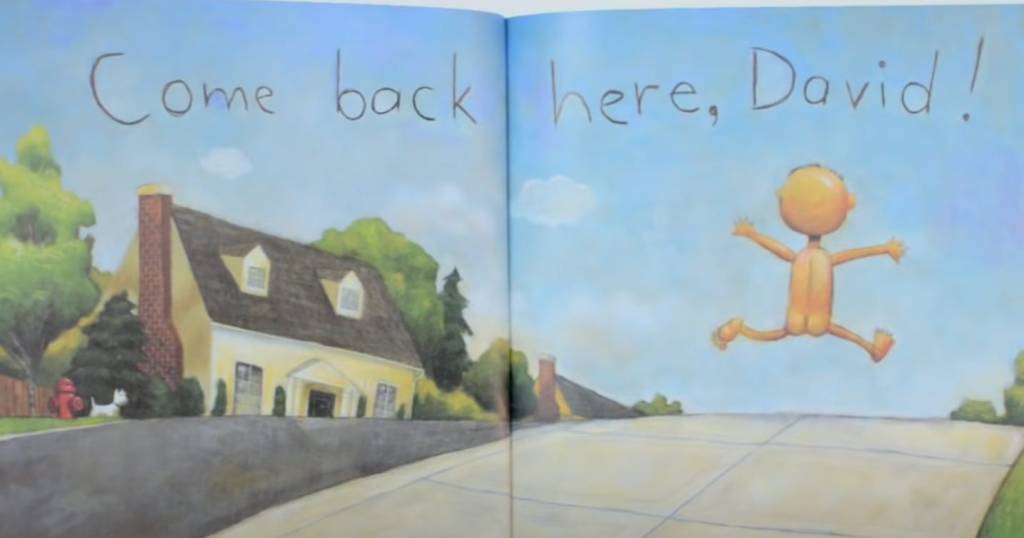
This poem was a response to the news out of Florida that elementary schools are being forced to draw clothing on cartoon characters in children’s books if the printed images show nakedness of either front or back. The right-wing nutcase group ‘Moms For Liberty’ is causing the trouble.
This link https://popular.info/p/pressed-by-moms-for-liberty-florida gives details and shows some of the results.
Incidentally, one co-founder of the Moms for Liberty group is Bridget Ziegler. Apparently she and her husband Christian Ziegler had sexual threesomes with another woman; and when Bridget backed out of a planned threesome event in October 2023, Christian went along anyway; the third party declined sex, saying she was in it more for Bridget; so Christian raped her. The woman then filed a complaint with the police.
Why is it that the hysterically over-moral types seem to be the ones causing most of the problems?

This poem was published in the March 2024 issue of Lighten Up Online (aka LUPO); thanks, Jerome Betts!

Photo: illustration from ‘No, David!‘, written and illustrated by David Shannon.

Duncan Lawrence, ‘The Poet is the Luckiest of Artists’

There is no struggling with a wayward cello on the train 
Or carting a large canvas through dank cornfields in the rain.

No need to worry chapter sixteen has somehow been deleted 
Or that the woodwind section remains a long way from completed.

No welding burns to speak of, hammered thumbs or calloused palms,
No temperamental band mates whose bad habits raise alarms.

No fearing, that the next plié will surely split these tights 
Or some acerbic, carping critic has got you in their sights.

Just, fingers crossed the last few lines like miracles unfold 
Before the walk is over or the bath become too cold.

Yes, I concede the poet’s lucky, yet still I do despair 
For all the artful artistry the money isn’t there.

*****

Duncan Lawrence writes: “I do not remember any specific incident as a catalysis for this poem. I did see an interview with John Cooper Clarke on the BBC, he said something to the effect that one might splash out on Tap Dance lessons only to discover that you were not that good but a pencil and a bit of paper are always available. That was either the source of the piece or resonated because I had just written it.
As to the form, I understand that it might be “Iambic heptameter with some anapestic
substitutions” but I don’t really know what that means.
I cannot sit down with a blank piece of paper and decide to write about something. The
poem just forms in my head over a few days. I then write it down and clean it up a bit. After I put it aside and continue to mull it over on a walk or in the bath before looking it
over again and, with luck, if it sounds all right, finishing it off.”

Duncan Lawrence is a retired English Teacher. Originally from the United Kingdom, he is a long-term resident in rural Japan. Here he spends an inordinate amount of time walking dogs for the local Guide Dog Association.
He has had three poems (including this one) published by Jerome Betts on his magazine Lighten Up Online.

Photo: “Who says I can’t relax?” by Ed Yourdon is licensed under CC BY-NC-SA 2.0.

Using form: Quatrains: Stephen Gold, ‘So Pseud Me’

My verse is of the humorous variety,
And does its best to brighten up society.
To spread a little joy’s a noble calling,
A life without a laugh would be appalling.

Yet still, of late, I’ve had a thought that niggles;
What worth is work that just produces giggles?
Should it be judged as slight and ineffectual,
Compared to art we label intellectual?

And so I did what “proper” poets do,
And signed up to The Scrivener’s Review,
“The connoisseur of poesy’s magazine”,
Where scribes will scratch your eyes out to be seen.

I found it was a terrifying place,
Where people were obsessed with lower case,
Allusions veered from cryptic to absurd,
And “meaning” seemed to be a dirty word.

Their poetry was like the peace of God,
That passeth understanding – truly odd.
Some claimed to write for womxn and for mxn,
Though none had come across the verb, “to scxn”.

With open mind, I asked, “Is it my fault
That there is nothing here I can exalt?”
But days of dredging through this awful rot
Confirmed beyond all doubt that it was not.

Each new excrescence served to reinforce
That I had veered disastrously off course.
I wheeled around and fled back to the light
Which shines upon the droll and erudite,

Bring on a world where rhyme and meter matters,
And isn’t full of folk as mad as hatters.
Adieu to “Scrivener’s Review”, I quit.
Do I need what you’re full of? Not one bit.

*****

Stephen Gold writes: “The idea for So Pseud Me came from wading through an august poetry periodical which had better remain nameless, and coming to the following conclusion: WTF?
There was some good, thoughtful work, but much of it was pretentious drivel, written by the deservedly obscure with their heads rammed firmly up that place where the Lord causeth not the sun to shine.
If you were to ask them, I guess most would place high verse on a pedestal, way above light. But on this, I am with Kingsley Amis, who wrote in the New Oxford Book of Light Verse:
“Light verse makes more stringent demands on the writer’s technique. A fault of scansion or rhyme, an awkwardness or obscurity that would damage only the immediate context of a piece of high verse endangers the whole structure of a light-verse poem. The expectations of the audience are different in the two cases, corresponding to the difference in the kind of performance offered. A concert pianist is allowed a wrong note here and there; a juggler is not allowed to drop a plate.”
‘So Pseud Me’ is a light-hearted attempt to speak up for jugglers.”

Stephen Gold was born in Glasgow, Scotland, and practiced law there for almost forty years, robustly challenging the notion that practice makes perfect. He and his wife, Ruth, now live in London, close by their disbelieving children and grandchildren. His special loves (at least, the ones he’s prepared to reveal) are the limerick and the parody. He has over 700 limericks published in OEDILF.com, the project to define by limerick every word in the Oxford English Dictionary, and is a regular contributor to Light and Lighten Up Online (where this poem was first published).

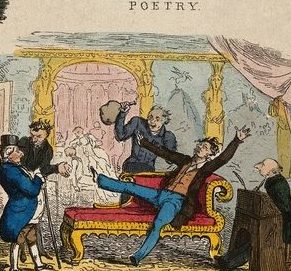
Illustration: “A group of poets carousing and composing verse under the influence of laughing gas. Coloured etching by R. Seymour after himself, 1829.” is licensed under CC BY 4.0.

Short poem: RHL, ‘Friendship, Not Passion’

I had a friendship, more than passionate love, for you;
we could have been so good, easy, together.
But there’s that issue of your strong religious thoughts,
whereas I let my thoughts change with the weather.

I… well, and who’s the I you think that you address?
I ramble, googly-eyed, my arms elastic.
There are so many sweet but sadly firm believers.
I’m – more than atheist – iconoclastic.

*****

If you’re used to iambic pentameter the meter of this poem feels just a little off, with its lines of alternating 12 and 11 syllables, i.e. alternating hexameters and feminine-ending pentameters… not quite comfortable. Which is perfectly in keeping with the relationship described. And I don’t remember precisely which long-ago not-quite-girlfriend I had in mind when I wrote it; I’ve been attracted to more than one charming female, wonderfully calm and sane except for some unfortunate religious orientation or other.

I’m reminded of the 19th century Punch cartoon of the two guests at a dinner party:
She: “And what is your religion, sir?”
He: “Madam, all men of sense are of the same religion.”
She: “And which religion is that, pray tell?”
He: “Madam, men of sense never say.”

Which is all very well for friendship, but hardly a solid basis for a deeper relationship. You’re better off if you hold out for someone philosophically compatible, unless you (and they) really don’t care. In which case, you’re philosophically compatible!

‘Friendship, Not Passion’ was originally published in Lighten Up Online, edited by Jerome Betts.

Illustration: “Friendship” by h.koppdelaney is licensed under CC BY-ND 2.0.

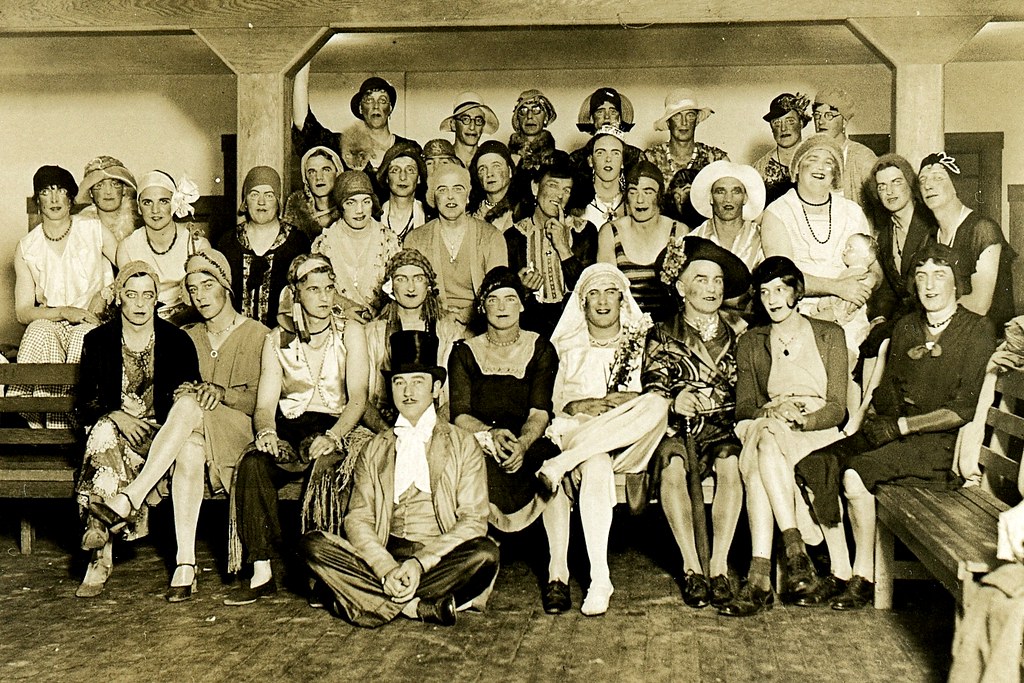
Ed Shacklee, ‘I Think Continually Of Men Dressed As Catherine The Great’

I think continually of men dressed as Catherine the Great,
Betty Boop or Greta Garbo, queens of film and state
who hitched their wagons to a star and switched the sex of Fate.

I think of fervid men in furs, the Humphries and the Dannies,
those lads who walked the walk in highest heels and padded fannies
and promenaded on the stage with debutantes and grannies –

the young, the old, the gayly bold who sashayed with panache
through droll burlesque or discotheques and made a spangled splash
in rainbow-hued ensembles that, while loud, would never clash.

They shaved and plucked, then nipped and tucked, ignoring boring foes
whose morals lagged while knuckles dragged around their unclipped toes.
These Joans – both Crawford and of Arc – and Marilyn Monroes

were kicked for kicks and picked upon, but got back up again;
and whether they were women inside men, or simply men
who liked to paint their nails and put on lipstick now and then,

I think continually of those whose vampy, cutting wit
and campy fame enflamed, then tamed, the bigot and the twit,
who were hammered till they stammered by their glamour and their grit
until a world a size too small became the perfect fit.

*****

This poem by Ed Shacklee, with its reference to Stephen Spender’s ‘I think continually of those who were truly great‘, was published in the current issue of Lighten Up Online.

Ed Shacklee lives on a boat in the Potomac River. His first collection, “The Blind Loon: A Bestiary,” was published by Able Muse Press.

And for those who like odd information and representations of animals, The Blind Loon: A Bestiary Facebook group is worth joining.

Photo: “Men in Drag” by jacki-dee is licensed under CC BY-NC-ND 2.0.