Tag Archives: love poems

Using form: Tritina: Nicole Caruso Garcia, ‘Love Poem in Winter, with Blackout Shades’

Beginning with a line by Aimee Nezhukumatathil

My husband is a pale blur. The dark
turns grainy as the blue hour tints our bedroom,
my glasses somewhere near the nightstand’s edge.

He could almost be U2’s guitarist, Edge:
goatee, pale arms, black T-shirt, trademark dark
wool skull cap. Me: his groupie. His hotel room.

Distortion fades. Before he leaves the room,
I feel a toe-squeeze, hear an air-kiss: edge
of day, his way of sugaring the dark,

our portrait in the darkroom of a marriage.

*****

Nicole Caruso Garcia writes: “The inspiration for the tritinaLove Poem in Winter with Blackout Shades‘ came from a workshop led by Matt. W. Miller at the 2022 Poetry by the Sea Conference. He had us select one line from among a dozen or so poems by other poets, then use the line use as a springboard and incorporate it somewhere in a new poem of our own. My poem’s first sentence is a line from the middle of Aimee Nezhukamatathil’s ‘I Could Be a Whale Shark‘.” 

Love Poem in Winter with Blackout Shades‘ was first published in Crab Orchard Review.

Nicole Caruso Garcia’s full-length debut OXBLOOD (Able Muse Press) received the International Book Award for narrative poetry. Her work appears in Crab Orchard ReviewLightMezzo CamminONE ARTPlumeRattleRHINO, and elsewhere. Her poetry has received the Willow Review Award and won a 2021 Best New Poets honor. She is an associate poetry editor at Able Muse and served as an executive board member at Poetry by the Sea, an annual poetry conference in Madison, CT. Visit her at nicolecarusogarcia.com.

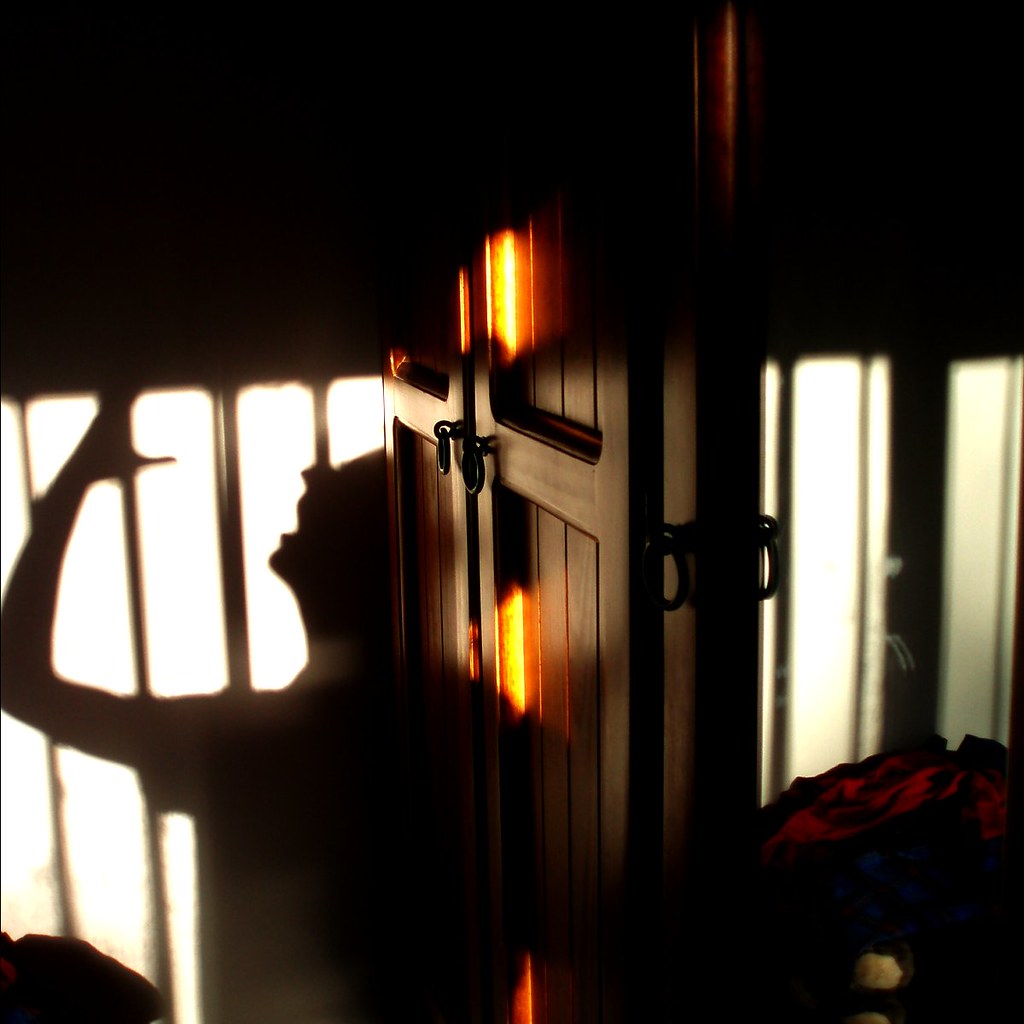
Photo: “29/05/2009 (Day 3.149) – We Are Sane” by Kaptain Kobold is licensed under CC BY-NC-SA 2.0.

Lucius Falkland, ‘Sado-Masochism in Love Poetry’

Some like being bound up in leather and chains,
Others spanked with a branch from a tree,
But the people who truly get turned on by pain
Try to publish their love poetry.

The poet’s not known for his psychical health:
He wrestles despair, feels dejected,
Not that undisposed to killing himself,
Yet his heart’s work so often rejected.

Sometimes he must wait the best part of a year,
Like an innocent man on death row,
To have to him confirmed his most terrible fear,
For they are quite sadistically slow.

And the hurt they inflict? It’s not over yet.
Do they find wounding fragile souls funny?
Some journals won’t read the submissions they get
If the poets don’t first send them money!

Once it’s crafted and honed and as good as Ted Hughes,
On a par with their earlier choices,
They find a new method to mentally abuse:
They prioritize “marginalised voices.”

The agony felt by a hounded young deer
As he’s brought to the ground by a predator
Is as nothing compared to the suffering and fear
That’s induced in a poet by an editor.

*****

Lucius Falkland writes: ‘I wrote this poem in response to having so many of my love poems rejected by poetry journals. It struck me as absurd that poets experience feelings, including being in love, so intensely that they must process them via poetry, they share the most poignant aspects of their lives with journal editors, and yet they know they will frequently get rejected. It is as though they write about their deepest pain only to then subject themselves to the further pain of being told that they can’t even express their pain properly. ‘Are we poets Masochists?’ I wondered. Naturally, this poem was itself rejected by a number of editors – with one even commenting that he was sympathetic to my plight. before rejecting it anyway because ‘it’s not the right fit’ (euphemism for ‘I don’t like it!) – before being published in The New English Review.”  

Lucius Falkland is the nom de plume of a writer and academic originally from London. His first poetry volume, The Evening The Times Newspaper Turned Into Jane Eyre, was published in 2025 with Exeter House Publishing. It can be purchased here.

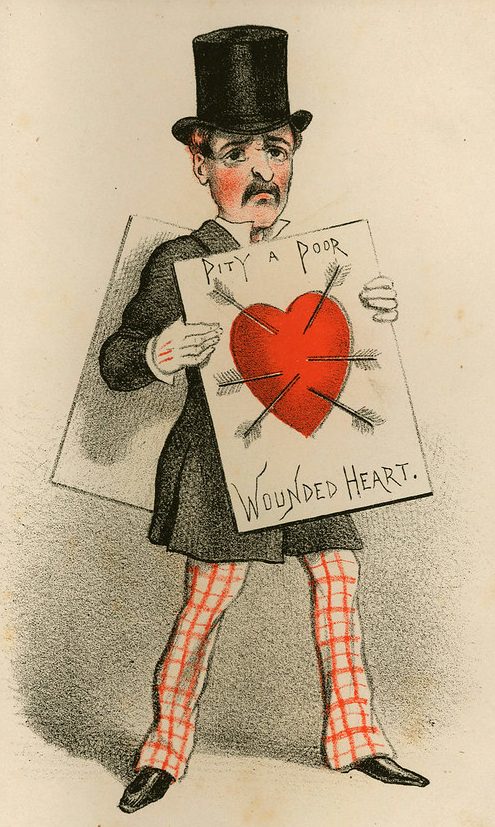
Illustration: “Vinegar Valentine – 05” by BioKnowlogy is marked with Public Domain Mark 1.0.

A poem’s origins: Robert Burns, ‘A Red, Red Rose’

O my luve’s like a red, red rose
That’s newly sprung in June:
O my luve’s like the melodie
That’s sweetly play’d in tune.

So fair art thou, my bonnie lass,
So deep in luve am I;
And I will luve thee still, my dear,
Till a’ the seas gang dry.

Till a’ the seas gang dry, my dear,
And the rocks melt wi’ the sun:
And I will love thee still, my dear,
While the sands o’ life shall run.

And fare thee weel, my only luve!
And fare thee weel awhile!
And I will come again, my luve,
Tho’ it were ten thousand mile!

*****

January 25th being the birthday of Robert Burns (and the opportunity for a Burns Night celebration), it seems the right day to post an interesting fact that I was unfamiliar with until reading a 1964 Canadian high school poetry text book: ‘A Red, Red Rose’ was fashioned from three distinct songs that Burns had heard in the Highlands of Scotland. Part of each song was reworked by him into a single poem:

(Song 1)
Her cheeks are like the roses
That blossom fresh in June;
O, she’s like a new-strung instrument
That’s newly put in tune.

(Song 2)
The seas they shall run dry,
And rocks melt into sands
Then I’ll love you still, my dear,
When all these things are done.

(Song 3)
Altho’ I go a thousand miles
I vow thy face to see,
Altho’ I go ten thousand miles,
I’ll come again to thee, dear love,
I’ll come again to thee.

Wikipedia (as often) is a good place to look for more information, and here is an extensive quotation from its article on the poem:

Sources
Burns is best understood as a compiler or a redactor of “A Red, Red Rose” rather than its author. F.B. Snyder wrote that Burns could take “childish, inept” sources and turn them into magic, “The electric magnet is not more unerring in selecting iron from a pile of trash than was Burns in culling the inevitable phrase or haunting cadence from the thousands of mediocre possibilities.”

One source that is often cited for the song is a Lieutenant Hinches’ farewell to his sweetheart, which Ernest Rhys asserts is the source for the central metaphor and some of its best lines. Hinches’ poem, “O fare thee well, my dearest dear”, bears a striking similarity to Burns’s verse, notably the lines which refer to “ten thousand miles” and “Till a’ the seas gang dry, my dear”.

A ballad originating from the same period entitled “The Turtle Dove” also contains similar lines, such as “Though I go ten thousand mile, my dear” and “Oh, the stars will never fall down from the sky/Nor the rocks never melt with the sun”. Of particular note is a collection of verse dating from around 1770, The Horn Fair Garland, which Burns inscribed, “Robine Burns aught this buik and no other”. A poem in this collection, “The loyal Lover’s faithful promise to his Sweet-heart on his going on a long journey” also contains similar verses such as “Althou’ I go a thousand miles” and “The day shall turn to night, dear love/And the rocks melt in the sun”.

An even earlier source is the broadside ballad “The Wanton Wife of Castle-Gate: Or, The Boat-mans Delight”, which dates to the 1690s. Midway through the ballad, Burns’ first stanza can be found almost verbatim: “Her Cheeks are like the Roses, that blossoms fresh in June; O shes like some new-strung Instrument thats newly put in tune.” The provenance for such a song is likely medieval.

Thank you, Wikipedia! Love you!

And everyone: Have a good Rabbie Burns Day!

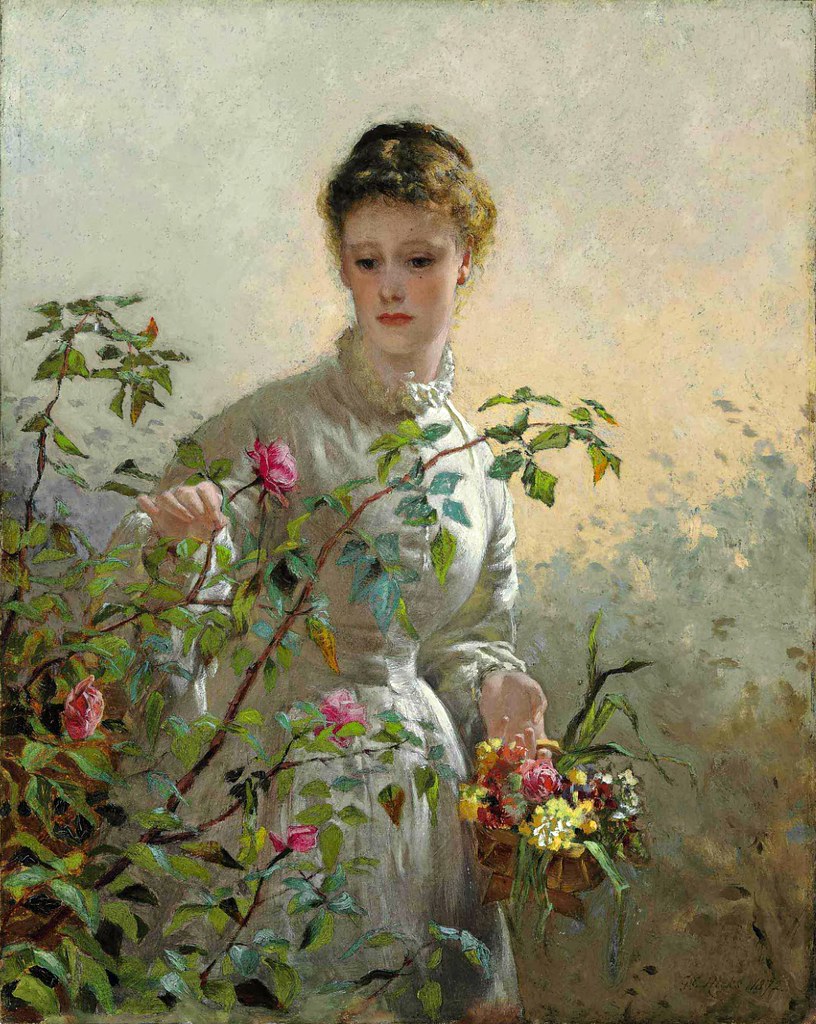
O my Luve’s like a red, red rose that’s newly sprung in June” by Cait Clerin is licensed under CC BY-NC-ND 2.0. The work is ‘A Summer Bouquet’ by George Elgar Hicks, 1878.
Verse into Verse: George Simmers translates Catullus ‘VII’

Lesbia, you ask me quantify
How many of your kisses I
Might think enough. My answer? Count,
When you’re in Libya, the amount
Of tiny sand grains on the beach
Along the shining miles that reach
Between Jove’s shrine and Battus’s tomb.
Or count the stars that pierce the gloom
To stare all-seeing from above
Upon the privacies of love.
Let’s kiss and kiss with such excess
We’ll make all voyeurs’ minds a mess;
Add kiss on kiss, till we’ve a sum
So vast all gossips are struck dumb.

*****

This is one of the translations from Catullus to be found in the recently published pamphlet, Riffs, by George Simmers, editor of Snakeskin, the world’s longest-running monthly ezine for poetry. Riffs is a grab-bag of translations of poems that have appealed to him, from Ovid, Virgil, Catullus, the Greek Anthology and Francois Villon. For sample pages (featuring Ovid’s version of the myth of Narcissus) click here.

The plentiful illustrations are by Bruno Vars, whose pictures enlivened George’s previous pamphlet, Old, Old.

Riffs costs £5, and should be available from Amazon, but if you’d like a signed copy, email him: simmersgeorge@yahoo.co.uk and he’ll arrange one for you at no extra cost.

Robert Frost said that poetry is what gets lost in translation. George Simmers has tried to find it again. This is the ideal Christmas gift for the classicist in your life.

Launch: Potcake Chapbook 11, ‘Lost Love’

‘Lost Love – poems of what never happened, and of the end of things that did’… how bittersweet; but what a collection of poets, and what a diversity of stories and observations!

Seventeen poets are packed into this chapbook. Seven have appeared before: Marcus Bales, Melissa Balmain, Michael R. Burch, Vera Ignatowitsch, Martin Parker, Gail White and myself. Ten are new to the series, with wicked little pieces from Brooke Clark, Cody Walker and three from Wendy Cope, and with longer poems from N.S. Thompson, James B. Nicola, Mary Meriam, Helena Nelson, David Whippman, Richard Fleming and Vadim Kagan. Bios, photos and links to read more of their work can all be found on the Sampson Low site’s Potcake Poets page, while all the chapbooks in the series, showing which poets are in which, are here. Each of the 11 chapbooks is profusely illustrated (of course) by Alban Low, and can be yours (or sent to an ex) for the price of a coffee.

Heartbreak has never had a happier manifestation!

Poem: ‘Love Poetry’

All the love expressed in poems overtly
Seems so pure they can be taught in schools,
Yet reading lives of all these divine fools
You realise that the impulses
That drove them to express themselves in verse
Include love that repulses
(Differing by era), and was forbidden:
Incest, same sex, underage, interracial,
Interfaith, cross-generational,
BDSM – even a pet, a dog.
Scandalous, and kept hidden,
At worst horrific and at best uncouth –
Yet all identity is just a fog
Of “You, my love”, expressed covertly.
And kids in school are never taught the truth.

Seriously, no one seems to pay any attention to the realities behind the love poetry that is taught and studied in schools. But much of the reason for the admired poem being so forceful is often that the poet was conflicted about being able to express their love at all – gay in a time of homosexual suppression is the one most easily identified now (in Shakespeare, Byron, etc, just as there are similar non-poetic gay passages in the Bible), but any strong but forbidden desire is capable of producing fine art.

This poem is not really formal. It has rhyme and meter but it is unstructured. Semi-formal, then, like much of the best work of Arnold and Eliot. It was published in that edgy, carefree journal the Rat’s Ass Review – thanks, Rick Bates!

“Love Poetry” by Kez Price is licensed under CC BY 2.0

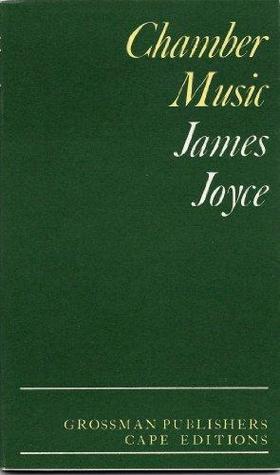
Review: ‘Chamber Music’ by James Joyce

James Joyce’s ‘Chamber Music’ was published in 1907, a tightly organised collection of very singable little love songs published three years after he met his future wife, Nora Barnacle. She was a chambermaid from Galway, and their first outing together–a walk through the Dublin suburb of Ringsend–was sufficently memorable (she masturbated him) that the date of 16 June 1904 was made the day of the events of Joyce’s novel ‘Ulysses’, and is now celebrated in various fashions around the world as Bloomsday.

The first poem of ‘Chamber Music’ sets the tone, not necessarily what you would expect from Joyce, but definitely related to his very fine singing voice:

Strings in the earth and air
Make music sweet;
Strings by the river where
The willows meet.

There’s music along the river
For Love wanders there,
Pale flowers on his mantle,
Dark leaves on his hair.

All softly playing,
With head to music bent,
And fingers straying
Upon an instrument.

Yes, well… Anyway, apart from the Joycean suggestiveness the lyrics provide a simple narrative over the 36 poems, short poems of eight to 18 lines. He sings of a girl, a maiden, shy, beautiful; she is a dove, a sweetheart, his true love, and only becomes a lady in Number 28. Then in the last three we have the “unquiet heart”, then “the grey winds”, and finally the last dream poem begins “I hear an army charging upon the land” and ends “My love, my love, my love, why have you left me alone?”

The narrative of the lyrics does not reflect Joyce’s life with Nora. She had moved with him to Austria-Hungary in 1904, and they stayed together until his death in 1941.