Tag Archives: Martial

Epigram: Brooke Clark, ‘Still Waiting’

You say your memoirs offer pointed re-evaluations
of countless authors’ puffed-up reputations
so you’ve arranged to have them published once you’re safely dead.
Nestor, it’s time your memoirs were read.

*****

Brooke Clark writes: “The original for this is by Martial: Epigrams IV.33; it’s a good example of the alternating 7-stress, 5-stress lines I finally settled on as the best way to capture the feeling of Martial’s elegiac couplets in English. Martial has a number of these “hurry up and die already” poems; if you read through large chunks of his epigrams at a go you’ll find a lot of themes recur over and over with slight variations. The addressee in the original is a poet, but somehow I found the idea of a writer who has left a “poison pen” memoir revealing what he really thinks of all his contemporaries more interesting. Nestor is one of the recurring “characters” in Urbanities, an idea I picked up from Martial’s treatment of Zoilus and expanded until I had a small cast whose stories developed over the course of the book.”

‘Still Waiting’ was originally published in Literary Imagination.

Brooke Clark is the author of the poetry collection Urbanities and has published work in ArionLiterary ImaginationTHINKThe WalrusLA Review of Books, and other places. He is also the editor of the online epigrams journal The Asses of Parnassus and the book reviews editor at Able Muse.
Twitter: @thatbrookeclark
Bluesky: @brookeclark.bsky.social

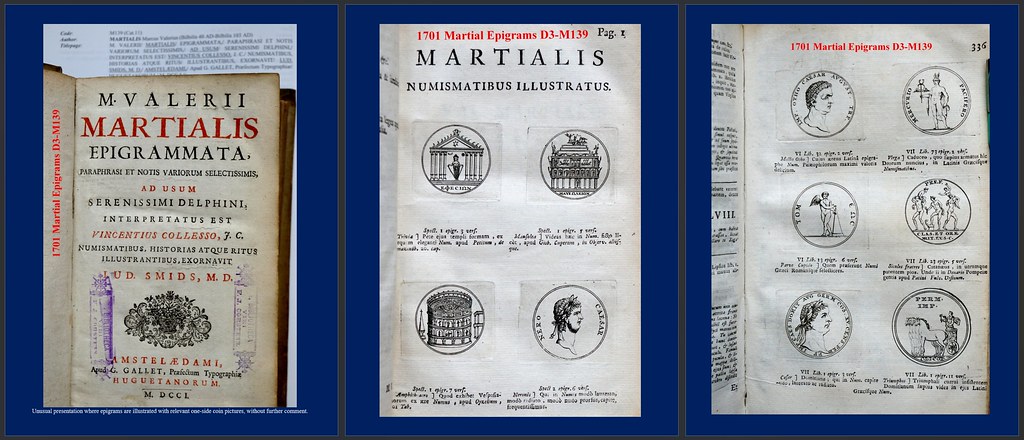
Photo: “1701 Martial Epigrams Dekesel M139” by Ahala is licensed under CC BY-NC 2.0.

Brooke Clark, ‘Letter from an Unknown Writer’

We met one night at a book launch,
we drank, we talked, we laughed,
I said, “I’m writing a novel,”
and you said, “Send me a draft.”

So I sent it to your address
hoping a well-placed word
from you would get me started;
I waited, but never heard.

Now you’ve published your latest
and the critics fellate you in print,
it’s a runaway bestseller
and Hollywood’s taken the hint.

I read it myself last weekend
and my entrails turned to stone—
my book, but so badly rewritten
you’d almost made it your own.

*****

Brooke Clark writes: “This two-liner by Martial (Epigrams I.38) is the basis of my poem:
quem recitas meus est, o Fidentine, libellus:
sed male cum recitas, incipit esse tuus.
(The book you’re reciting is mine, Fidentinus; but when you recite it badly, it begins to be yours.)
Originally read in Wheelock’s Latin, I think, when I was learning the language, this was one of the first versions of Martial I did that I was happy with. I obviously expanded it greatly (I hadn’t learned to appreciate Martial’s concision) but I liked the swingy rhythm and the treatment of it as a mini-narrative that I landed on. Also one of the first epigrams I published, in Light, which gave me some confidence that the project of turning ancient epigrams into contemporary poems might be worth pursuing.”

Brooke Clark is the author of the poetry collection Urbanities and has published work in ArionLiterary ImaginationTHINKThe WalrusLA Review of Books, and other places. He is also the editor of the online epigrams journal The Asses of Parnassus and the book reviews editor at Able Muse.
Twitter: @thatbrookeclark
Bluesky: @brookeclark.bsky.social

Photo: “Treasures of Ushaw Book Launch in Westminster” by Catholic Church (England and Wales) is licensed under CC BY-NC-SA 2.0.

Potcake Poet’s Choice: Brooke Clark, ‘At a Child’s Funeral’

Today we give to the earth the body of our little girl,
our little darling; we’ll never watch her twirl
around the house again in her impenetrable games
or listen as she wheedles and whines our names
in that annoying tone we tried to break her of before;
now we’d give anything to hear it once more.
She’ll find whatever waits for all of us when this life ends–
eternal silence or the souls of friends–
while, left behind, we bow our heads to see what prayers can do.
Lie lightly, earth–she stepped so lightly on you.

*****

Brooke Clark writes: “‘At A Child’s Funeral‘ is loosely adapted from one of Martial’s epigrams. This poem interested me because it’s quite a departure from Martial’s usual satirical style. In it, he attempts to convey a genuinely tender emotion, which is well outside his usual register of scorn verging on disgust. That made it a departure for me too, and I struggled to get the tone right — emotional without being mawkish. I hope I succeeded! In terms of form, it’s in rhyme, and uses alternating 7-stress and 5-stress lines in imitation of Martial’s elegiac couplets.”

Brooke Clark is the author of the poetry collection Urbanities, the editor of the epigrams website The Asses of Parnassus and the book reviews editor at Able Muse. Twitter: @thatbrookeclark

Photo: “Filipino child funeral” by Ted Abbott is licensed under CC BY-NC-ND 2.0.

Poetry Resources: The Asses of Parnassus. Poem: “Success!”

The shortest, wittiest, most formal poetry publication that I know of is Brooke Clark’s Tumblr-based Asses of Parnassus. This is the place for pieces as short as a couplet or perhaps a couple of quatrains, whether you are submitting for publication or you simply like reading them.

The irreverence is illustrated with the Tumblr heading: a detail of a Goya etching from his series of caprichos, morbid, satirical and anti-establishment in outlook.

The Asses of Parnassus used to contain a lot of translations (in rhyme) from Greek and Latin authors – lots of rude, snide, scurrilous comments from Martial and Catullus – but is now dominated by more current material. The most recent item as this post is being written is a 24-line screed from Daniel Galef on being denied a Wikipedia entry. The one before is my own couplet, Success:

“Success!” he toasted. Though I wished him dead
I smiled and raised my glass: “Suck cess!” I said.


But though rude and snide are allowed, you are unlikely to find any bigotry or hatred. Brooke Clark retains tolerance and even compassion in The Asses of Parnassus. He is Canadian, after all.