Tag Archives: Michael R. Burch

The Two-State Dissolution: Yankevich, Kenny, Helweg-Larsen, Foster, Vaughan, Jackson, Bales, Burch

Leo Yankevich: ‘The Terrorist’

Only six, she stands before a tank,
looking at its armour, while inside
soldiers heed orders from a higher rank.
There isn’t any place for her to hide,
no door to head for, no abandoned car
to slide beneath. Pure terror rules her land.
When finally crushed, she rises past the star
of David, with a stone clutched in her hand.

Janet Kenny: ‘Didn’t They Know?’
(In memory of a lost poem by Robert Mezey)

Didn’t they know that when they swarmed
and slashed and slaughtered what they saw
as an oppressor’s nest, the rage
that they aroused would turn and pour
with molten heat back on their house?

Their captive children now must pay,
small targets in a concrete cage.
No treaty, pact, no peace no truce.
Didn’t they know? Didn’t they know?

No map to show another way.
Olive farmers pay for crimes
of other nations, other times.
No mercy here, no one is just.
Two agonies, two brains concussed.

Nothing to see here. False alarm.
Police not needed to disarm
two weeping peoples each aware
that no solution slumbers there.
Hearth and cradle now makes clear
an ancient poem brought them here.

Where is the psalm that both can share?

Robin Helweg-Larsen: ‘Both Sides Justify Their Terrorism’

When pleas for justice are of no avail,
when governments praise death and theft,
and courts say you’re in error;
when the UN is blocked to fail,
the only recourse left
is terror.

When no one cares that Yahweh willed
that Jews alone should have this land
(and God’s never in error)
and prior residents must be killed,
yet they won’t leave, they force your hand:
to terror.

Gail Foster: ‘On The Occasion of Benjamin Netanyahu Quoting Dylan Thomas’

Don’t tell me that you fight a righteous fight
How many children have you killed today
I’ll give you rage. I’ll give you rage alright

Your anger and your ego burning bright
Are razing all that’s standing in your way
Don’t tell me that you fight a righteous fight

How many have you sent into the light
Before they even had the time to pray
I’ll give you rage. I’ll give you rage alright

How many have you saved or sent in spite
Up to the sky in ashen clouds of grey
Don’t tell me that you fight a righteous fight

In clouds as those who in the fog and night
Were put in trains and disappeared away
I’ll give you rage. I’ll give you rage alright

You speak as if your soul was white as white
Yet deep inside you darkness holds its sway
Don’t tell me that you fight a righteous fight
I’ll give you rage. I’ll give you rage alright

Tom Vaughan: ‘The Land’

Let’s pretend that the war
could be over, and peace
reigned even if only
this evening. O please

pick up your anger
and soak it with mine
in six large barrels
of miracle wine

and then let us dance
like lovers, as though
this land’s many meanings
didn’t all signal no

and we could make ploughshares
out of our swords
and translate the past
into one shared world

and even if dawn
will scatter the night
and send us both stumbling
into the light

where smooth olives glisten
in the warm sun
like belts of bright bullets
ripe for a gun.

Jean MacKay Jackson: ‘War’

Some say that war is bright flares and drama,
A glory of fireworks illumining skies.
This is all lies.
War is a child calling out for his mama
And getting no answer.
War is a merchant of hatred and grief:
War is a thief,
War is a cancer.
Some say that war is hell. Perhaps that is so.
Yet hell has a lack
Of innocent bystanders, hell has no
Collateral damage, no accidental black
Body-bags for old women and babies.
Hell has no maybes;
Everything makes sense.
In hell there is no defense:
You belong there. You chose your path.
Hell has a cold, hard justice drained of wrath.
War is the horrified look in the eye
Of a young person dying without knowing why.

Tom Vaughan: ‘Aleppo’

Never again we say, each time
never, never again,
and every time we mean it so
when it happens again

we watch it on our screens, and say
never, never again

we meet and vote and all agree
never, never again.

Marcus Bales: ‘Genocide is Genocide’

Genocide is genocide. There’s no
Legitimacy on the table. None.
Your killing and your maiming only show
What horrors piled on horrors you have done.

The US taught the method to the Germans
The Trail of Tears leads to the Holocaust.
And now Israeli policy determines
They’ll do the same in Gaza. That boundary’s crossed.

Why not, instead, a reconciliation,
Where all the old and evil wounds can be
Accepted by each side without probation?
With zealotry forgiven, all are free.

Until that happens, hate corrupts you all,
With “Ams Yisrael Chai” the new decree —
Unless it turns out that the final call
That wins is “From the river to the sea.”

And that’s the choice: that each side does the worst
That it can do to keep the hatreds growing,
Shouting slogans of revenge, and cursed
To trade atrocities that keep the business going.

The other choice is reconciliation.
Yes, all the old and evil wounds will be
Accepted by each side without probation,
And zealotry forgiven, to be free.

If “Look at what they did to us!” is your
Refrain, then all you’ve done is to condemn
Your children to a world where they’ll endure
Their children’s gloat: “Look what we did to them!”

There’s always someone left to live resenting
The evils your revenges made you do —
And they will spend their hearts and souls inventing
A suitable revenge to take on you.

Be strong enough for reconciliation
Where all the old and evil wounds must be
Accepted by each side without probation.
With zealotry forgiven, all are free.

Michael R. Burch: ‘Epitaph for a Palestinian Child’

I lived as best I could, and then I died.
Be careful where you step: the grave is wide.

*****

Acknowledgements:

Leo Yankevich: ‘The Terrorist’, collected in ‘Tikkun Olam & other poems’, Counter Currents, 2012
Tom Vaughan: ‘The Land’, published on Hull University Middle East Study Centre website, 2022, and in Professor Raphael Cohen-Almagor’s December 2022 Politics Newsletter
Tom Vaughan: ‘Aleppo’, published in Snakeskin 233, October 2016
Michael R. Burch: ‘Epitaph for a Palestinian Child’, first published in Romantics Quarterly, and many places since. Michael R. Burch is the founder and editor-in-chief of The HyperTexts, and its extensive collections of poetry include ones on both the Holocaust and the Nakba.

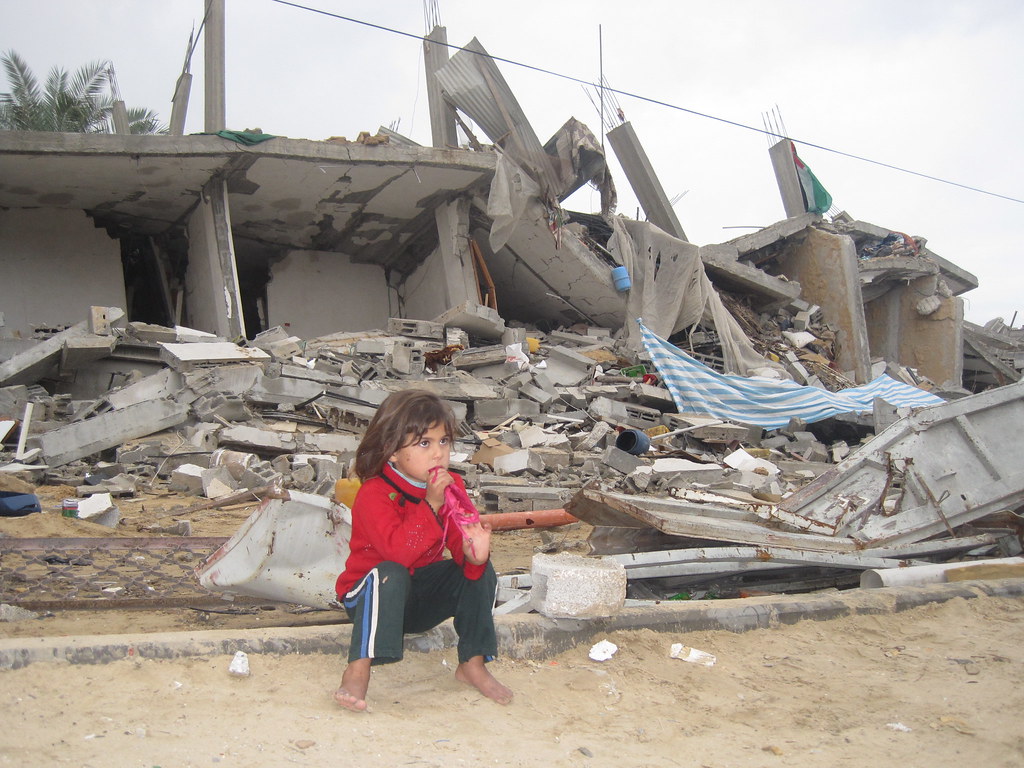
Photo: “Gaza war Nov2012” by EU Civil Protection and Humanitarian Aid is licensed under CC BY-NC-ND 2.0.

Weekend read: Sonnet variation: Michael R. Burch, ‘Erin’

All that’s left of Ireland is her hair—
bright carrot—and her milkmaid-pallid skin,
her brilliant air of cavalier despair,
her train of children—some conceived in sin,
the others to avoid it. For nowhere
is evidence of thought. Devout, pale, thin,
gay, nonchalant, all radiance. So fair!

How can men look upon her and not spin
like wobbly buoys churned by her skirt’s brisk air?
They buy. They grope to pat her nyloned shin,
to share her elevated, pale Despair …
to find at last two spirits ease no one’s.

All that’s left of Ireland is the Care,
her impish grin, green eyes like leprechauns’.

*****

Michael R. Burch writes: “My poem is set in the present and really has nothing to do with poverty. All that’s left of Ireland of yore is the young mother’s red hair, fair skin, a tendency toward melancholy (“despair), and her train of children. She’s a practicing Catholic except for a few affairs. Otherwise she’s a modern woman, drinking and flirting in a pub. I was trying to capture a bit of Ireland in a young mother, very loosely inspired by one of my Irish cousins who was a bit of a “wild child” in her youth.”

(Editor’s aside: My bad for thinking that “All that’s left” implied poverty, which was not in Michael R. Burch’s mind at all. True, Ireland goes through enormous swings of fortune, but the Ireland of even some years ago no longer matches the fabulously rich Ireland of today – the people are 50% richer than Americans or Norwegians…

2024 top GDP.png

… putting the UAE and Switzerland in the shade as well.)

Michael R. Burch’s poems have been published by hundreds of literary journals, taught in high schools and colleges, translated into 22 languages, incorporated into three plays and four operas, and set to music, from swamp blues to classical, 61 times by 32 composers. He is also the founder and editor-in-chief of The HyperTexts.

Photo: “Irish Fire at the Barn” by Trey Ratcliff is licensed under CC BY-NC-SA 2.0.

Weekend read: Michael R. Burch, ‘Modern Orpheus, or, William Blake’s Whistle’

I.
Many a sun
and many a moon
I walked the earth
and whistled a tune.

I did not whistle
as I worked:
the whistle was my work.
I shirked

nothing I saw
and made a rhyme
to children at play
and hard time.

II.
Among the prisoners
I saw
the leaden manacles
of Law,

the heavy ball and chain,
the quirt.
And yet I whistled
at my work.

III.
Among the children’s
daisy faces
and in the women’s
frowsy laces,

I saw redemption,
and I smiled.
Satanic millers,
unbeguiled,

were swayed by neither girl,
nor child,
nor any God of Love.
Yet mild

I whistled at my work,
and Song
broke out,
ere long.

******

Michael R. Burch writes: “W. H. Auden famously (or infamously) said “poetry makes nothing happen.” I sympathize with his sentiment but beg to differ. William Blake has been a profound influence on modern culture and societies, not only through his own poetry, art and engravings, but also through his influence on singer-songwriters like Bob Dylan, John Lennon and Jim Morrison. When Dylan met the Beatles the first time, things were a bit cool at first, until Allen Ginsberg broke the ice by bringing up Blake. It turned out that everyone in the room was a fan. Morrison named his group the Doors after Blake’s ‘Doors of Perception’.

“William Blake has been a primary influence on my work, not only as a poet, but also as a translator, editor and publisher of poems about the Holocaust, the Palestinian Nakba, the Trail of Tears, and other similar instances of Blake’s three-headed hydra of church, state and industry doing its worst to make life on earth hell.

A Passing Observation about Thinking Outside the Box’ by Michael R. Burch

William Blake had no public, and yet he’s still read.
His critics are dead.

“William Blake was not an “art for the sake of art” adherent. Quite the contrary. Blake was an ardent reformer. For instance, he and Charles Dickens, who from what I understand lived on the same London street or nearby, wrote movingly about the plight of child chimneysweeps and other minors forced to work long, gruelling, sometimes dangerous, hours by unscrupulous businessmen, and before long England and other nations like the United States were passing child labor laws. Some poets do make things happen with their poetry…”

*****

Michael R. Burch is an American poet who lives in Nashville, Tennessee with his wife Beth, their son Jeremy, two outrageously spoiled puppies, and a talkative parakeet. Burch’s poems, translations, essays, articles, reviews, short stories, epigrams, quotes, puns, jokes and letters have appeared in hundreds of literary journals, newspapers and magazines. He is also the founder and editor-in-chief of The HyperTexts, a former columnist for the Nashville City Paper, and, according to Google’s rankings, a relevant online publisher of poems about the Holocaust, Hiroshima, the Trail of Tears and the Palestinian Nakba. Burch’s poetry has been taught in high schools and universities, translated into 19 languages, incorporated into three plays and two operas, set to music 61 times by 32 composers, from swamp blues to classical, and recited or otherwise employed in more than a hundred YouTube videos. To read the best poems of Mike Burch in his own opinion, with his comments, please click here: Michael R. Burch Best Poems.   

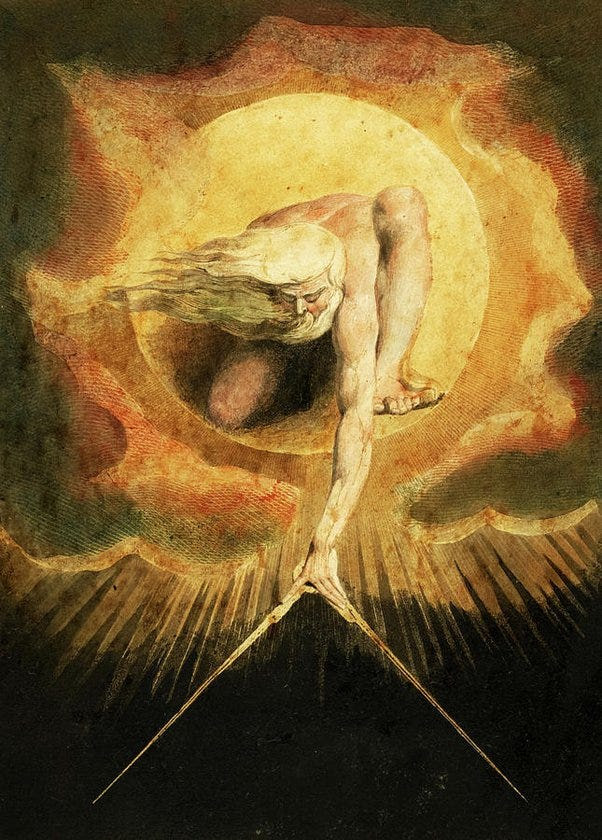
Illustration: ‘Ancient of Days’ by William Blake

Early poem: Michael R. Burch, ‘Will There Be Starlight’

Will there be starlight
tonight
while she gathers
damask
and lilac
and sweet-scented heathers?

And will she find flowers,
or will she find thorns
guarding the petals
of roses unborn?

Will there be starlight
tonight
while she gathers
seashells
and mussels
and albatross feathers?

And will she find treasure
or will she find pain
at the end of this rainbow
of moonlight on rain?

*****

Michael R. Burch writes: “The real test of a poem, for me, is whether I can remember it or not. If I can’t remember a poem, if it doesn’t leave a lasting impression, it simply vanishes like a windblown tumbleweed and cannot be a “keeper.” I decided to apply an “instant recall” test to my own poems and translations, to see which ones leapt to mind first. Ironically, or perhaps not, several of these poems turned out to be about memories and/or how the human memory works, or sometimes doesn’t. ‘Will There Be Starlight’ is one.

“I wrote it around age 18 as a high school student and it has been published by TALESetc, Starlight Archives, The Word (UK), Poezii (in a Romanian translation by Petru Dimofte), The Chained Muse, Famous Poets & Poems, Grassroots Poetry, Inspirational Stories, Jenion, Regalia, Chalk Studio, Poetry Webring and Writ in Water. ‘Will There Be Starlight’ has also been set to music by the award-winning New Zealand composer David Hamilton and read on YouTube by Ben E. Smith. To have a poem written as a teenager translated into Romanian, set to music by a talented composer, performed by one of the better poetry readers, and published in multiple literary journals was not a bad start to my career as a poet!”

Michael R. Burch is an American poet who lives in Nashville, Tennessee with his wife Beth, their son Jeremy, two outrageously spoiled puppies, and a talkative parakeet. Burch’s poems, translations, essays, articles, reviews, short stories, epigrams, quotes, puns, jokes and letters have appeared in hundreds of literary journals, newspapers and magazines. He is also the founder and editor-in-chief of The HyperTexts, a former columnist for the Nashville City Paper, and, according to Google’s rankings, a relevant online publisher of poems about the Holocaust, Hiroshima, the Trail of Tears and the Palestinian Nakba. Burch’s poetry has been taught in high schools and universities, translated into 19 languages, incorporated into three plays and two operas, set to music 61 times by 32 composers, from swamp blues to classical, and recited or otherwise employed in more than a hundred YouTube videos. To read the best poems of Mike Burch in his own opinion, with his comments, please click here: Michael R. Burch Best Poems.   

Photo: “Star Girl” by Tobias Mayr is licensed under CC BY-NC-SA 2.0.

Michael R. Burch, ‘Suffer the Little Children’

for the children of Gaza

I saw the carnage . . . saw girl’s dreaming heads
blown to red atoms, and their dreams with them . . .

saw babies liquefied in burning beds
as, horrified, I heard their murderers’ phlegm . . .

I saw my mother stitch my shroud’s black hem,
for in that moment I was once of them . . .

I saw our Father’s eyes grow hard and bleak
to see his roses severed at the stem.

How could I fail to speak?

*****

Michael R. Burch writes: “Three decades ago, I began working with Jewish Holocaust survivors and other Jewish poets to publish translations of previously unpublished poems written in Polish and Yiddish by victims of the Holocaust. Some were written by children. In some cases the poems survived but the names of the poets did not. I considered it a sacred task and believed we were saying “Never again!” to any and all Holocausts. But in my discussions with my Jewish friends, it became apparent that “Never again!” did not apply to the Palestinians. When I asked questions about Israel’s brutal abuses of Palestinians and the theft of their land – armed robbery – my Jewish friends became defensive and told me, essentially, to shut up and never question Israel. Their sudden change in attitude convinced me that something was wrong, deeply wrong. I decided to research the subject independently, invested considerable time, and came to the conclusion that the Palestinian Nakba (“Catastrophe”) is a Holocaust sans ovens, a modern Trail of Tears. And while my country, the United States, has opposed other Holocausts, it is funding this one and supplies Israel with terrible weapons that are being used to mass murder children and their mothers, fathers and families. I will continue to say “Never again!” to any and all Holocausts and invite readers to join me and do what they can to end and prevent such atrocities.”

‘Suffer the Little Children’ has been published by Art in Society (Germany), Pick Me Up Poetry, Jadaliyya (Egypt), The HyperTexts andMESPI (Middle East Studies Pedagogy Institute). According to Google the poem now appears on 462 web pages.

Michael R. Burch is an American poet who lives in Nashville, Tennessee with his wife Beth, their son Jeremy, two outrageously spoiled puppies, and a talkative parakeet. Burch’s poems, translations, essays, articles, reviews, short stories, epigrams, quotes, puns, jokes and letters have appeared in hundreds of literary journals, newspapers and magazines. He is also the founder and editor-in-chief of The HyperTexts, a former columnist for the Nashville City Paper, and, according to Google’s rankings, a relevant online publisher of poems about the Holocaust, Hiroshima, the Trail of Tears and the Palestinian Nakba. Burch’s poetry has been taught in high schools and universities, translated into 19 languages, incorporated into three plays and two operas, set to music by 31 composers, and recited or otherwise employed in more than a hundred YouTube videos. To read the best poems of Mike Burch in his own opinion, with his comments, please click here: Michael R. Burch Best Poems.   

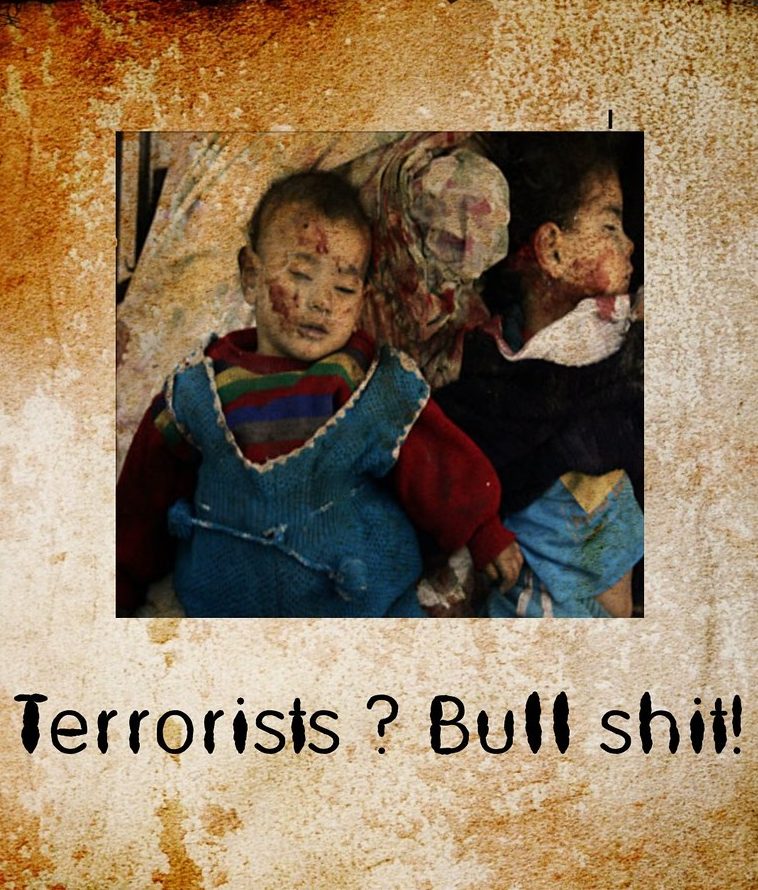
Photo: “Untermensch – Hannukah 2008 – Palestinian children killed by Israel in Gaza” by smallislander is licensed under CC BY-NC-SA 2.0.

Michael R. Burch, ‘Redolence’

Now darkness ponds upon the violet hills;
cicadas sing; the tall elms gently sway;
and night bends near, a deepening shade of gray;
the bass concerto of a bullfrog fills
what silence there once was; globed searchlights play.

Green hanging ferns adorn dark window sills,
all drooping fronds, awaiting morning’s flares;
mosquitoes whine; the lissome moth again
flits like a veiled oud-dancer, and endures
the fumblings of night’s enervate gray rain.

And now the pact of night is made complete;
the air is fresh and cool, washed of the grime
of the city’s ashen breath; and, for a time,
the fragrance of her clings, obscure and sweet.

*****

Michael R. Burch writes: “I wrote the poem as the sun was going down over my son Jeremy’s pee-wee football practice. The first stanza is a pretty accurate description of the scene. However, by the second stanza I was letting my imagination run free. By the last four lines it was pure imagination. Or my wife would have killed me!”

Michael R. Burch is an American poet who lives in Nashville, Tennessee with his wife Beth and two outrageously spoiled puppies. Burch’s poems, translations, essays, articles, reviews, short stories, epigrams, quotes, puns, jokes and letters have appeared in hundreds of literary journals, newspapers and magazines. Burch is also the founder and editor-in-chief of The HyperTexts, a former columnist for the Nashville City Paper, and, according to Google’s rankings, a relevant online publisher of poems about the Holocaust, Hiroshima, the Trail of Tears and the Palestinian Nakba. Burch’s poetry has been taught in high schools and universities, translated into 17 languages, incorporated into three plays and two operas, set to music by 27 composers, and recited or otherwise employed in more than a hundred YouTube videos. To read the best poems of Mike Burch in his own opinion, with his comments, please click here: Michael R. Burch Best Poems

Photo: “Ferns at night” by ikewinski is licensed under CC BY 2.0.

Michael R. Burch, ‘Water and Gold’

You came to me as rain breaks on the desert
when every flower springs to life at once.
But joys? Mere wan illusions to the expert:
the Bedouin has learned how not to want.

You came to me as riches to a miser
when all is gold, or so his heart believes,
until he dies much thinner and much wiser,
his gleaming bones hauled off by chortling thieves.

You gave your heart too soon, too dear, too vastly;
I could not take it in; it was too much.
I pledged to meet your price, but promised rashly.
I died of thirst, of your bright Midas touch.

I dreamed you gave me water of your lips,
then sealed my tomb with golden hieroglyphs.

*****

Michael R. Burch writes:

Published by The Lyric, Black Medina, Dusure Abueaoa (Tokelau), Shabestaneh (Iran), The Eclectic Muse (Canada), Kritya (India), Anthology of Contemporary American Poetry, Freshet, Captivating Poetry (Anthology), Strange Road, Shot Glass Journal (the first stanza as “Dry Hump”), Better Than Starbucks, The Chained Muse, Famous Poets and Poems, Poetry Life & Times and Sonnetto Poesia (Canada)

The last time I checked, Google reported that “Water and Gold” appeared on 1,500 web pages. That’s a lot of cutting and pasting and suggests a number of readers have liked the poem enough to share it.

I’m a fan of nature shows and the opening lines were inspired by a nature show about the sudden flowering of deserts after any kind of rainfall. But deserts also produce mirages and it occurred to me that Bedouins would realize that the rain might be an illusion and that in any case the flowering would be unlikely to last. Love affairs can be like that.

None of the poem was planned and I didn’t know how it would end until I wrote the closing couplet. I came up with the title “Water and Gold” after the fact. The first image brought to mind other desert images: of mirages, Bedouins and pyramids. Midas with his “golden touch” just popped into my mind. I write most of my poems “organically” with no planning. My method is to “open myself to words” and I often have no idea how a poem will end when I begin.

Surprisingly, many such poems of mine end up telling coherent stories with unusual twists at the end. I’m not sure how that happens but I think not imposing too much of my myself on a poem probably helps.

I have never liked picky “rules” about sonnets and other poetic forms. I always do as I please and any sonnet can be shorter or longer than 14 lines, but 14 lines seemed to suit this poem.

There are different versions of the poem with line three being one of the following:

But joy is an illusion to the expert:
But joys are wan illusions to the expert:
But joys? Mere wan illusions to the expert:
But joys are mere mirages to the expert:
But joys are heat mirages to the expert:
But joys are heat’s mirages to the expert:

Which one do you prefer? Please let me know in the comments, because I continue to waffle.

These are comments that have been made about the poem over the years…

I was especially moved by your beautiful poems “Water and Gold” and “Memory.” The music of “Water and Gold” is admirable, and the variations very strong. – Terese Coe, poet and translator

I have been reading more of your work: “Distances” and “Water and Gold” are some magical pieces, and “Something” is a tug too deep. – Rafia Bilkis, poet

I was going through your poems again to see which ones would be published in issue one [of New Lyre]. I LOVE “Will there be starlight” and “Regret”. SO DREAMY. Love it, love it. “Lady’s Favor” and “Water and Gold” are some of my other favorites. – David B. Gosselin, poet and editor

David Gosselin later led off the first issue of The New Lyre with five of my poems: “Distances,” “Will There Be Starlight,” “Water and Gold,” “Lady’s Favor” and “Regret.”

It’s a great sonnet!—Joyce Wilson, poet and editor of Poetry Porch and Sonnet Scroll

A really brilliant piece of writing. I’m not surprised it has been published so widely. Thank you for sharing. I for one am enriched from the experience of reading it. – Griffonner, poet

Marie Stella, a student in the Philippines, chose “Water and Gold” for analysis and criticism.

Robert L. Smith mentioned “Water and Gold” in a review of one of my books:

Michael R. Burch’s Violets For Beth is an exceptional collection, compromised mostly of formalist poems that seem so fluid and natural that it’s easy to forget they are rhymed and metered. Mr. Burch’s technical virtuosity is not what makes this collection memorable, however. These poems, all of them, possess an extraordinary emotional depth and tenderness, and resonate in the heart as well as in the mind. Consider the sonnet “Water and Gold,” one of my favorite pieces in a cornucopia of gems. The poem is flawless from start to finish, but its exquisite concluding couplet is positively breathtaking:

“I dreamed you gave me water of your lips,
Then sealed my tomb with golden hieroglyphs.”

There are no subpar poems anywhere here, and more than a few would truly be worthy of Yeats or Rilke in their prime. Other favorites of mine include “Redolence” and the gorgeous “Infinity.” Mike Burch is a true poet in the very best sense of the word, and this haunting little book is a treasure to be read, reread, and savored for generations to come.

*****

Michael R. Burch is an American poet who lives in Nashville, Tennessee with his wife Beth and two outrageously spoiled puppies. Burch’s poems, translations, essays, articles, reviews, short stories, epigrams, quotes, puns, jokes and letters have appeared more than 7,000 times in publications which include TIME, USA Today, The Hindu, BBC Radio 3, CNN.com, Daily Kos, The Washington Post and hundreds of literary journals, websites and blogs. Burch is also the founder and editor-in-chief of The HyperTexts, a former columnist for the Nashville City Paper, and, according to Google’s rankings, a relevant online publisher of poems about the Holocaust, Hiroshima, the Trail of Tears, Darfur, Gaza and the Palestinian Nakba. Burch’s poetry has been taught in high schools and universities, translated into fifteen languages, incorporated into three plays and two operas, set to music by twenty composers, recited or otherwise employed in more than forty YouTube videos, and used to provide book titles to two other authors. To read the best poems of Mike Burch in his own opinion, with his comments, please click here: Michael R. Burch Best Poems.

Photo: “Gold and Blue Water Reflection” by Stanley Zimny (Thank You for 52 Million views) is licensed under CC BY-NC 2.0.

Launch: Potcake Chapbook 12, ‘City! Oh City!’

City! Oh City! – poems on the light and dark of urban life. Thirteen of the best contemporary English-language poets present their wildly differing takes on the glamour and squalor, the joy and heartbreak, the varied people and the hidden wildlife of our modern cities.

Five of the poets are new to the Potcake Chapbook series, and I’m delighted to be adding Kate Bingham of England, Francis O’Hare of Northern Ireland, Pino Coluccio of Canada, and Quincy R. Lehr and J.D. Smith of the US. They join eight returning poets. Amit Majmudar and Maryann Corbett deserve special mention for their brilliant use of form to capture contradictory situations: Majmudar’s static street scene which suddenly changes pace to a hectic chase, Corbett’s interwoven Baroque chamber ensemble and homeless encampment with their separate realities in a shared evening in Saint Paul, Minnesota. In addition: Michael R. Burch, Jerome Betts, Terese Coe, Marcus Bales, Martin Elster and myself; everyone contributes to this memorable capture of the complexity of the modern city.

Bios, photos and links to read more of their work can all be found on the Sampson Low site’s Potcake Poets page, while all the chapbooks in the series, showing which poets are in which, are here. Each of the 12 chapbooks is profusely illustrated (of course) by Alban Low, and can be yours (or sent as an intriguing gift) for the price of a coffee.

Value the city – citification is civilisation!

Michael R. Burch: ‘For All That I Remembered’

For all that I remembered, I forgot
her name, her face, the reason that we loved …
and yet I hold her close within my thought:
I feel the burnished weight of auburn hair
that fell across her face, the apricot
clean scent of her shampoo, the way she glowed
so palely in the moonlight, angel-wan.

The memory of her gathers like a flood
and bears me to that night, that only night,
when she and I were one, and if I could …
I’d reach to her this time and, smiling, brush
the hair out of her eyes, and hold intact
each feature, each impression. Love is such
a threadbare sort of magic, it is gone
before we recognize it. I would crush

my lips to hers to hold their memory,
if not more tightly, less elusively.

*****

Michael R. Burch writes: “For All That I Remembered” is one of my personal favorites and one of a number of poems I have written about the transience of memory, along with “The Effects of Memory,” “Violets,” “Moments,” “Distances,” “Redolence,” “Vacuum,” “Afterglow” “Memento Mori” and “Remembrance.” “For All That I Remembered” has been published by The Raintown Review, Boston Poetry Magazine, la luce che non muore (Italy), The Eclectic Muse (Canada), Kritya (India), Jewish Letter (Russia), Gostinaya (in a Russian translation by Yelena Dubrovin), Freshet, Orchards Poetry, Poetry Life & Times, Sonnetto Poesia (Canada), Trinacria, The New Formalist and Pennsylvania Review.”

Michael R. Burch is an American poet who lives in Nashville, Tennessee with his wife Beth and two outrageously spoiled puppies. Burch’s poems, translations, essays, articles, reviews, short stories, epigrams, quotes, puns, jokes and letters have appeared more than 7,000 times in publications which include TIME, USA Today, The Hindu, BBC Radio 3, CNN.com, Daily Kos, The Washington Post and hundreds of literary journals, websites and blogs. Burch is also the founder and editor-in-chief of The HyperTexts, a former columnist for the Nashville City Paper, and, according to Google’s rankings, a relevant online publisher of poems about the Holocaust, Hiroshima, the Trail of Tears, Darfur, Gaza and the Palestinian Nakba. Burch’s poetry has been taught in high schools and universities, translated into fifteen languages, incorporated into three plays and two operas, set to music by twenty composers, recited or otherwise employed in more than forty YouTube videos, and used to provide book titles to two other authors. To read the best poems of Mike Burch in his own opinion, with his comments, please click here: Michael R. Burch Best Poems.

Memory” by Kris Krug is licensed under CC BY-NC-ND 2.0.

Potcake Poet’s Choice: Michael R. Burch, ‘The People Loved What They Had Loved Before’

We did not worship at the shrine of tears;
we knew not to believe, not to confess.
And so, ahemming victors, to false cheers,
we wrote off love, we gave a stern address
to bards whose methods irked us, greats of yore.
And the people loved what they had loved before.

We did not build stone monuments to stand
six hundred years and grow more strong and arch
like bridges from the people to the Land
beyond their reach. Instead, we played a march,
pale Neros, sparking flames from door to door.
And the people loved what they had loved before.

We could not pipe of cheer, or even woe.
We played a minor air of Ire (in E).
The sheep chose to ignore us, even though,
long destitute, we plied our songs for free.
We wrote, rewrote and warbled one same score.
And the people loved what they had loved before.

At last outlandish wailing, we confess,
ensued, because no listeners were left.
We built a shrine to tears: our goddess less
divine than man, and, like us, long bereft.
We stooped to love too late, too Learned to whore.
And the people loved what they had loved before.

*****

Michael R. Burch writes: “If I remember correctly, the poem was written after I read some disparaging comments by Formalists about Keats and Shelley being ‘too emotional.’ In the poem I make fun of the naysayers by pointing out how they now wail about a lack of attention from readers. I was also told by poets on Eratosphere – I call it ErraticSphere – not to use the word ‘love’ in a love poem and to avoid abstractions and personification. Such wisdom! When I pointed out that Erato was the abstract personification of love poetry, I was banned for life! So I worked that into the poem: ‘We wrote off love.’ One might think the wailing poets are free versers, but the inspiration for the poem was actually Formalists who object to abstract language, personifications and even the word ‘love’ in modern poetry.”

Michael R. Burch is an American poet who lives in Nashville, Tennessee with his wife Beth and two outrageously spoiled puppies. Burch’s poems, translations, essays, articles, reviews, short stories, epigrams, quotes, puns, jokes and letters have appeared more than 7,000 times in publications which include TIME, USA Today, The Hindu, BBC Radio 3, CNN.com, Daily Kos, The Washington Post and hundreds of literary journals, websites and blogs. Burch is also the founder and editor-in-chief of The HyperTexts, a former columnist for the Nashville City Paper, and, according to Google’s rankings, a relevant online publisher of poems about the Holocaust, Hiroshima, the Trail of Tears, Darfur, Gaza and the Palestinian Nakba. Burch’s poetry has been taught in high schools and universities, translated into fifteen languages, incorporated into three plays and two operas, set to music by twenty composers, recited or otherwise employed in more than forty YouTube videos, and used to provide book titles to two other authors. To read the best poems of Mike Burch in his own opinion, with his comments, please click here: Michael R. Burch Best Poems.

Photo: “Folk Band” by garryknight is licensed under CC BY 2.0.