Tag Archives: mortality

Richard Fleming, ‘Memento Mori’


An ambulance howls like a hurt cat;
parts traffic as Moses did the waves.
Worms burrow in awaiting graves.
A police car buzzes like a gnat.

Stuck in a jam of steaming cars,
I contemplate how life transforms
in moments. How they wait, those worms,
so patiently, for us, for ours.

*****

Richard Fleming writes: “Ambulance sirens have been part of the soundtrack of my adult life, from the troubled years in Belfast to, more recently, my relatively tranquil life on the island of Guernsey.
There’s something about the sound, like that of a modern-day banshee, that chills the blood like no other. In common with all those who love unreservedly, I live with a constant fear of loss and a keen awareness of the terrible fragility of those things that we hold dear. This short poem attempts to articulate that fear.”

Richard Fleming is an Irish-born poet currently living in Guernsey, a small island midway between Britain and France. His work has appeared in various magazines, most recently Snakeskin, Bewildering Stories, Lighten Up Online, the Taj Mahal Review and the Potcake Chapbook ‘Lost Love’, and has been broadcast on BBC radio. He has performed at several literary festivals and his latest collection of verse, Stone Witness, features the titular poem commissioned by the BBC for National Poetry Day. He writes in various genres and can be found at www.redhandwriter.blogspot.com or Facebook https://www.facebook.com/richard.fleming.92102564/

Photo: “Ambulance” by gwire is licensed under CC BY 2.0.

Potcake Poet’s Choice: Tom Vaughan, ‘Afterwards’

Afterwards, I’ll shake the hand
of total strangers in the street
as though they were my oldest friend
and as and when that friend I’ll meet

we’ll stroll across Green Park towards
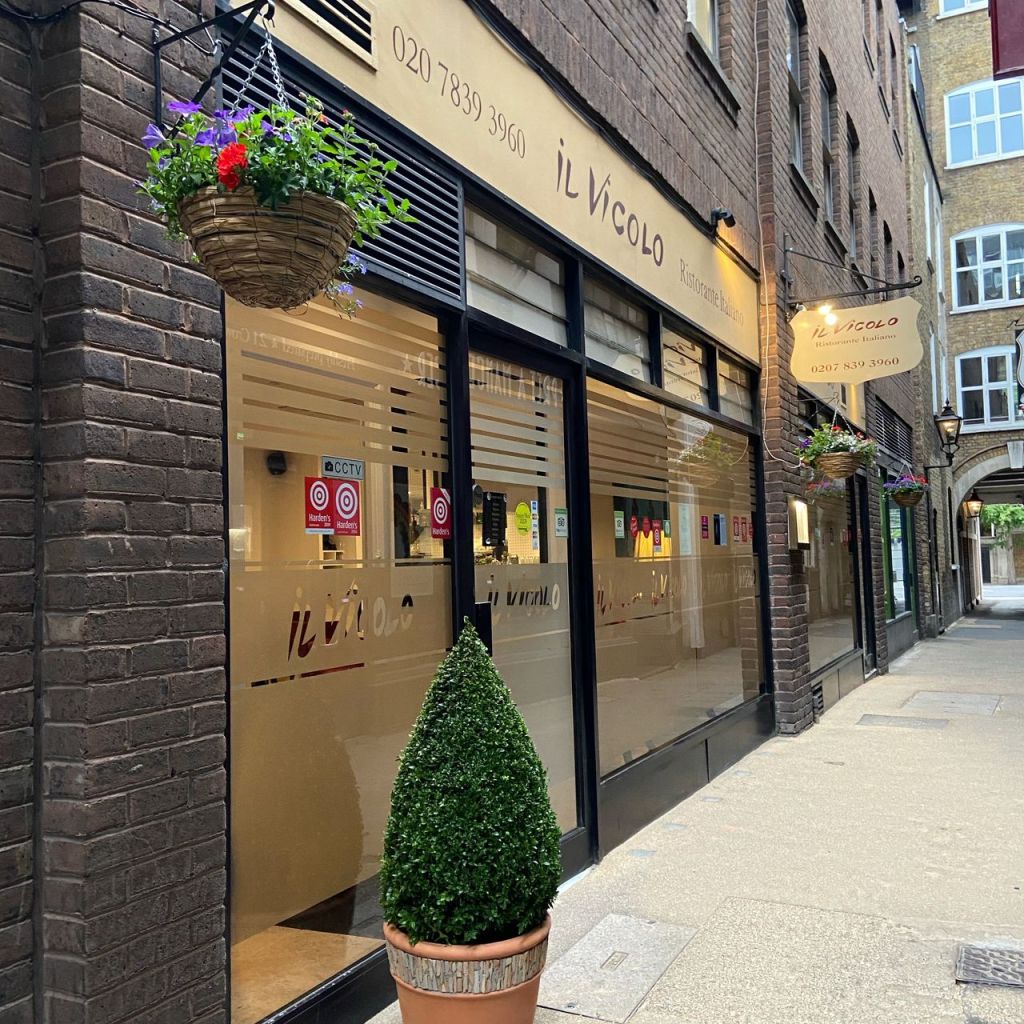
Crown Passage’s Il Vicolo
to dip our bread in olive oil
and drink wine till our faces glow

and talk of this and maybe that
as if we had all day to kill
then we’ll argue who should pay, aware
we’ll agree at last to split the bill

and when we say goodbye, we’ll know
how rare and wonderful it was
to be together, even though
neither will say so. Why? Because

why even hint the day might come
when public or private fresh disaster
prevents we two from sitting there
to share a salad and a pasta?

First published in Snakeskin 276, September 2020.

Tom Vaughan writes: “I have a soft spot for Afterwards because I hope it strikes the balance I often try to achieve between light-heartedness and seriousness. Plus it’s pinned in the real world: a London restaurant I very much like. I had submitted it originally The Spectator, which originally rejected it. George Simmers then accepted it for the September 2020 Snakeskin. Shortly thereafter I noticed a very positive restaurant review of Il Vicolo in The Spectator and, apparently quite independently, their poetry editor came back to me saying that on reflection he wanted to publish it, which he then did in October that year (with a suitable acknowledgement to Snakeskin as its first home). Then I learnt that the much-loved owner of Il Vicolo had died a few months previously – although not of Covid – but that his admirable daughters had decided to continue to run the restaurant. So, somewhere underneath the poem, the note of all-too-actual human mortality.”

Tom Vaughan is not the real name of a poet whose previous publications include a novel and two poetry pamphlets (A Sampler, 2010, and Envoy, 2013, both published by HappenStance). His poems have been published in a range of poetry magazines, including several of the Potcake Chapbooks:
Careers and Other Catastrophes
Familes and Other Fiascoes
Strip Down
Houses and Homes Forever
Travels and Travails.
He currently lives and works in London.
https://tomvaughan.website

My own favourites: ‘To Myself In 50 Years Time’

Old fool! You really think yourself the same
As I who write to you, aged 22?
Ha! All we’ve got in common is my name:
I’ll wear it out, throw it away,
You’ll pick it up some other day….
But who are you?

My life’s before me; can you say the same?
I choose its how and why and when and who.
I’ll choose the rules by which we play the game;
I may choose wrong, it’s not denied,
But by my choice you must abide….
What choice have you?

If, bored, I think one day to see the world
I pack that day and fly out on the next.
My choice to wander, or to sit home-curled;
Each place has friends, good fun, good food,
But you sit toothless, silent, rude….
And undersexed!

Cares and regrets of loss can go to hell:
You sort them out with Reason’s time-worn tool.
Today’s superb; tomorrow looks as well:
The word “tomorrow” is a thrill,
I’ll make of mine just what I will….
What’s yours, old fool?

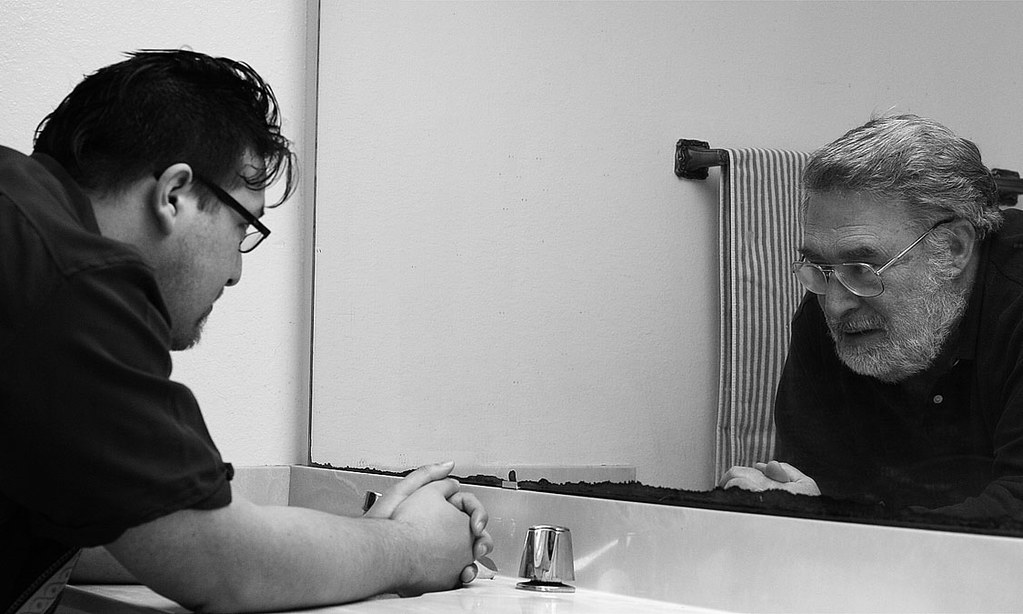
This poem, first published in Snakeskin No. 147, September 2008 and recently reprinted in the Extreme Formal Poems Contemporary Poets anthology edited by Beth Houston, is symptomatic of my constant concern with mortality. It was also a way to be provocative: under the guise of insulting myself, I got to insult all older generations. And it was also an exercise in poetic structure: each stanza presents an aspect of the superiority of present youth over future age. (Premise and conclusion aren’t necessarily made as statements, many times rhetorical questions are used instead.) The structure of each stanza is to begin with pentameters for a sense of reasonableness in the first three lines, pick up the pace for the next two lines, and end with a short punchline. Aggressive and effective.

Yes, I wrote it when I was 22. I don’t know if I will be able to concoct a suitably terse and dismissive answer when I’m 72. But it’s a favourite poem of mine, and I owe it a response.

Photo: “Day 005: The child is father to the man.” by JesseMenn is licensed under CC BY-NC-ND 2.0

Short Poem: ‘Days’

Where do they go, the days, twirling around?
Leaves in a dust-devil, swirled on the ground –
Water makes whirlpools just touching a drain –
Then the basin is empty. And no days remain.

September, heading towards the equinox and (in the northern hemisphere) winter. The end of the summer, back to school, back to work, loss of freedom, into the cold and the dark. Another year gone–having a September birthday doesn’t help!–the trees giving up, dry leaves falling and whirling in outside corners of asphalt and concrete… Head south, where it is still summer!

This short poem was published on a page of short pieces in the September issue of Lighten-Up Online – thanks, Jerome Betts!

“Water down the drain” by David Blackwell. is licensed under CC BY 2.0

Poem: ‘The Future as CDG Terminal 1’

The future is a long low passage,
Whitewashed, undulating,
A moving forward-flowing track,
No chance of going back.

The future has no message,
Its ads are guides only to the past,
Misleaders, redesignposts,
Echoes, undefined ghosts.

The future is travelled without presage,
Always onward, none comes back.
Predestination without destination.
Stationary or walking, you’ve no final station.

The future goes on until you get off.
I won’t. I will not to get off.

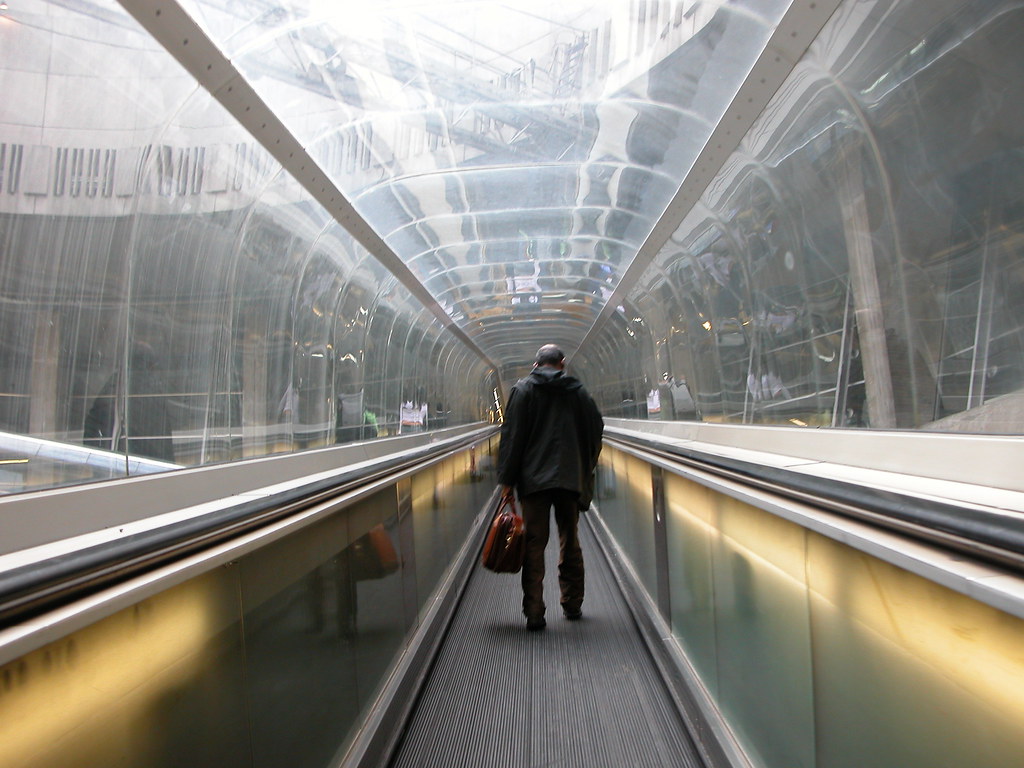
This poem (set in Charles de Gaulle airport’s people-mover) is halfway to being a sonnet: it has three sets of four lines and a final couplet, and its lines are not far from being tetrameters or pentameters. But the rhyme scheme is idiosyncratic: abcc adee afgg hh. But even that is being kind: the last couplet doesn’t rhyme, it just repeats its end words.

And yet, mishmash though it is, it was published in The Rotary Dial, Canada’s leading formal poetry publication for the few years of its incandescent life. So perhaps it is at least semi-formal poetry.

“sba-cdg85” by dsearls is licensed under CC BY 2.0

Short poem: ‘Nothing’s Yours Always’

Nothing’s yours always, anyhow,
And Time shall lift from off your brow
Your troubles, wrinkles, hat and wig,
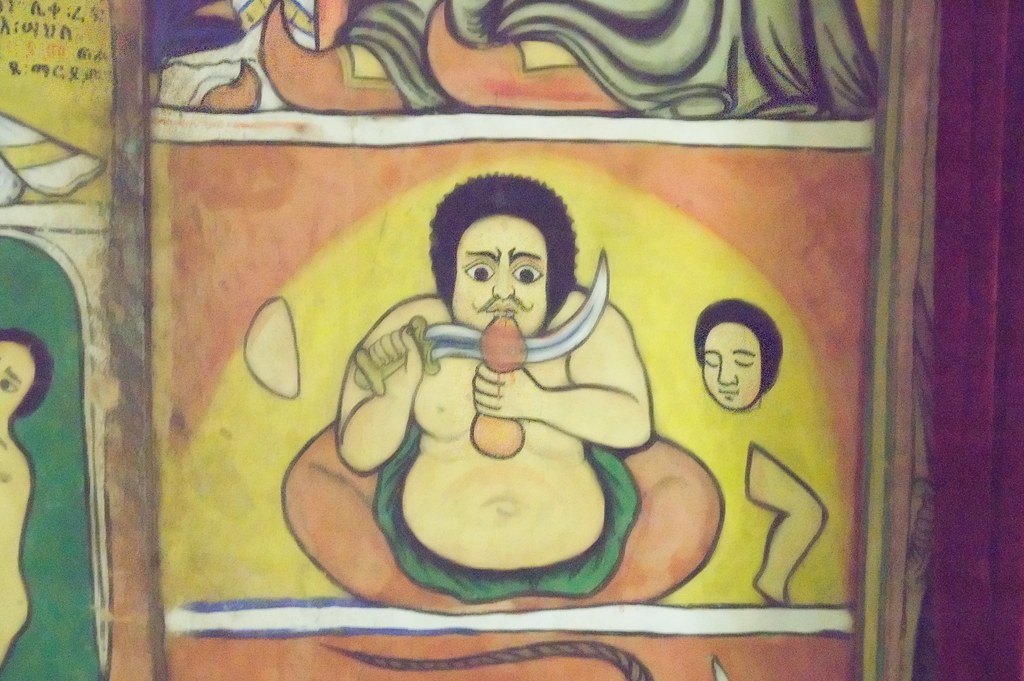
Leave you the basis for “long pig”.

So many unusual foods are described as “tastes like chicken”; it’s worth remembering that there is one that apparently tastes like pork. And really, when you’re dead, does it matter who benefits from the recycling of your atoms? The picture is of a figure from Ethiopian legend, Belai the Cannibal.

This poem was published in Metverse Muse, a long-established Indian journal that champions traditional verse, edited by Dr. Tulsi Hanamanthu.

Photo: “Belai the Cannibal” by A.Davey is licensed under CC BY 2.0

Potcake Poet’s Choice: Maryann Corbett, “Dutch Elm”

Maryann Corbett

That trees would die
yearly, we knew. The columns of the nave
of Summit Avenue, the architrave
of openwork where canopies unfold,
green or briefly gold,
the arched, leaf-dripping limbs
backlit with sky—

in every year, some go.
Some ends arrive with force: the papers warn
with pictures, after every storm,
of fallen branches, hollow at the heart,
or great trunks snapped apart,
battering cars and houses with the blows.
(We knew, but now we know.)

Some ends are quiet: the red
stripes appearing, like a garotting wound,
on trunks where the inspectors found
beetles in bark, bare limbs lurking in shade.
The tree crew and the chainsaw blade
will come—we know now—soon—
The stripe says, This is dead.

They make short work of things
with sweat and cherry pickers, saws and zeal
rope and rappelling acrobatic skill
and limb-shredding machines.
Only the stump remains
and is soon sawdust: nothing left to chance
but next year’s fairy rings.

No help for it, then.
This cut to sky, this coring of the heart.
These trees too far apart.
This just delivered balled-and-burlapped stick,
its trunk two inches thick,
decades from beauty. What we always knew:
We start again.

Maryann Corbett writes: “All day today I’ve been hearing, and sometimes watching, the process of the removal of my neighbor’s enormous elm, which peeled apart suddenly in a recent storm, exposing a hollow core. I was reminded that I’ve seen this process so many times in my city that it prompted a poem over a decade ago, and it’s a poem I’m happy to remember. It first appeared in The Lyric and is included in my second book, Credo for the Checkout Line in Winter.”

Maryann Corbett earned a doctorate in English from the University of Minnesota in 1981 and expected to be teaching Beowulf and Chaucer and the history of the English language. Instead, she spent almost thirty-five years working for the Office of the Revisor of Statutes of the Minnesota Legislature, helping attorneys to write in plain English and coordinating the creating of finding aids for the law. She returned to writing poetry after thirty years away from the craft in 2005 and is now the author of two chapbooks, five full-length collections already published, and a forthcoming book. Her fifth book, In Code, contains the poems about her years with the Revisor’s Office. Her work has won the Willis Barnstone Translation Prize, has appeared in many journals on both sides of the Atlantic, and is included in anthologies like Measure for Measure: An Anthology of Poetic Meters and The Best American Poetry 2018.

Her web page: maryanncorbett.com

Poem: “Time”

Time takes the young child by the hand
and leads it through a golden land
so timeless it will never note
Time’s other hand is at its throat.

This little poem was just published in Snakeskin, in one of its richest issues ever. I’m glad to have been included, along with several others–Claudia Gary, Tom Vaughan, George Simmers, Marcus Bales–of the formalist poets who appear in the Potcake Chapbooks. And a shout-out to Nikolai Usack, who made me clear up clumsy pronouns in the original draft.

Sonnet: “From the Sudden Sun”

Life bioengineers its seamless rounds
with green leaves scarleting in fierce blue skies,
falling from sudden sun or winds that rise
with violin-sad sighing, dying, sounds.
Toddlers in pointlessly expensive clothes
with pregnant women breadily approach
some non-migrating geese which with reproach
lift in unfrantic flight to lake’s repose.
Despite such fertile life, the living leaves
blaze with the imminence of winter’s touch
and dead leaves blow beyond the groundsman’s clutch
in a wind chilled for one who disbelieves
that life entails the sudden cutting short
of your expression flowering in mid

Another of my existential sonnets, first published by Bewildering Stories (thanks, Don Webb). And, again, Don gave it a crisper title than my original “The Interplay of Life and Death in Fall”. I wrote this in Chapel Hill, North Carolina, watching the Canada geese at a small lake behind an upscale not-really-rural office building. Fall is, like every season, intensely evocative of human life.

I admit the ending involves a cheap trick–but leaving off the last word is designed to drive home the thought of mortality, and the missing rhyme is a perfect one… at least with an English accent, if not an American one…


Poem: “Head of the Table”

Your grandparents die
And your children are born;
Then your parents die
Then grandchildren are born;
And you move one more seat
Round the mad table
To the head of the table,
At which point you’re expected to go.

As when the crow came
Wild, not tame – all the same
It cawed you the news
That confirmed death and time;
So when your time comes
And you feel in your bones
That the body is over
Where will you, the guest, go?

Then bring food and drink!
Glasses clink! Glance and wink
As you move to the brink
Of eternity.
Who knows what follows next?
“Afterlife” is absurd –
But then all life’s absurd –
We just know, when it’s time, that we go.

This is about as religious as I’ve found myself in the past 30 or 40 years – in other words, I waver between mild atheism (“None of this God stuff makes sense”) and militant agnosticism (“I don’t know, and neither do you.”) But at least you have a seat at the table! Enjoy the party while you can (preferably while being pleasant to others).

Originally published in Snakeskin No. 232 (or #232).