Tag Archives: night

Breaking my own rules: RHL, ‘Tropic Full Moon’

Under the midnight moon, the high garden’s outlined palms
Wait. The sky round the white moon
Is blue. And the clouds in the blue sky
Are white. And the shadows in the white clouds
Are blue. Below, offshore,
Where three green islands lay in daylight’s blue sea,
Tonight in the moon’s silver sea lie four black islands
And one, gliding imperceptibly north,
Is the black shadow of a white cloud in the blue sky.
Gone are the golden butterflies from the pink hibiscus,
Gone are the orange Monarchs from the purple bougainvillaea;
Black lizards hunt black insects through black flowers of black bushes.
The palms are black against the blue,
Complex silhouettes of simple forms,
Bending bowed fronds towards the moon –
To the white Moon in her blue sky.

*****

I’m always embarrassed in writing or sharing “poetry” that lacks form. But oh well. There are still things in it I enjoy. This one was published in Abraxas.

Photo: “Full moon eve” by John & Mel Kots is licensed under CC BY-NC-ND 2.0.

Morri Creech, ‘Mileage’

The car mechanic’s counting out his bills
behind the E-Z Mart at one a.m.;
he’ll toss rocks at beer bottles just for thrills
until his dealer comes, it’s fine with him.

He draws in a deep breath and sees the light
swerve from the highway, puzzling the back wall
he leans against just to keep out of sight.
A quarter bag and some fentanyl, that’s all.

His phone vibrates again though nothing’s wrong.
For two years he’s been living in a trailer
with a girl who works at Publix. They get along
even if sometimes she says he’s a failure—

what can he say to that? Sure. He lives cheap.
They’ll fight until she forces a decision,
then roll around on the couch. Once she’s asleep
he’ll take a dose and watch some television.

At night he dreams of cylinders and sprockets,
the trucks and cars too busted up to fix;
startled awake, eyes aching in their sockets,
he’ll watch the clock hands grope their way to six.

A car pulls up but he can see it’s not
his hookup. Just kids with nothing else to do
but drink a six-pack in the parking lot
before they head out to the lake to screw.

He had his share of mischief, too, Lord knows.
The girls don’t eye him in the check-out aisle
much anymore, the ones with painted toes.
A few years back, at least, they used to smile.

The boys can see the grease that stains his hands;
they all think, damn, who wants to work that hard?
He spends the day beneath their dads’ sedans
while they play tackle football in the yard.

Chasing a football blew out both his knees
and broke his wrist. That was three years ago.
Customers say, “go Stags,” and toss their keys,
then look at him real close as if they know.

A text says no one’s coming. The BP sign
flickers over the pumps, and though it’s half-
past two now, and he’s tired, he’s feeling fine
enough to think it’s all a bust, and laugh.

And, anyway, it’s good to be alone
with the gas fumes and blinking traffic light
and fifteen missed calls lighting up his phone.
Later, he thinks, once he and his girl fight,

and once she falls asleep on his left arm,
he’ll stare at the divots on the ceiling tile
and wait to hear the clock sound its alarm
while the night’s odometer counts one more mile.

*****

Morri Creech comments: “As Mark Strand once said, I write to find out what I have to say. I don’t start a poem with an idea; I start with a line, an image, a rhetorical stance. Then I write in search of context: how can I situate this in a situation, a narrative moment, an argument, a meditation? The language takes me wherever I end up. This poem was constructed like that. I started with a first line and then wrote toward trying to figure out the context of the line. In this case, it led me to a character sketch. It was fine to discover what this character was about; the decisions I made about his character and circumstances were largely directed by rhymes. They steered me in what I hope was the right direction.”

Morri Creech is the author of five collections of poetry, including the Sleep of Reason, a finalist for the Pulitzer Prize, Blue Rooms, and The Sentence (published by LSU Press, and which includes this poem). A recipient of NEA and Ruth Lilly Fellowships, as well as North Carolina and Louisiana Artists Grants, he teaches at Queens University of Charlotte.
www.morricreech.com

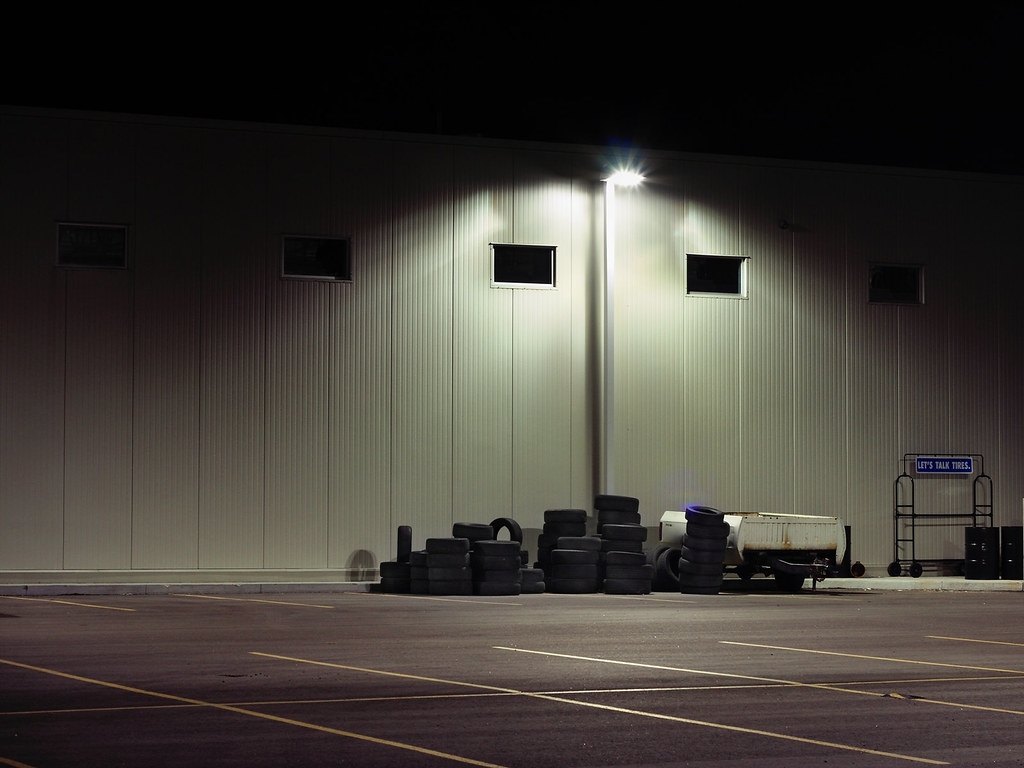
Photo: “Let’s Talk Tires” by gfpeck is licensed under CC BY-ND 2.0.

Amit Majmudar, ‘Nocturne’

“A healthy man can expect to get hard three to five times per night….Doctors call these erections while you sleep “nocturnal penile tumescence.” — Men’s Health

Why do they happen at all, much less
five times a futile night—
nested, within the circadian, their
sprung rhythm of delight?

Unless delight misreads the message.
Unless they choke and strain
against their loneliness like starved
Rottweilers on a chain.

Who visits in the witching hour
as REM begins
and slides her darkling mouth around
his hardening and grins?

Lascivious sylph or cocktease yakshi
or ex from some past life,
coaxing a husband into sin
at arm’s length from his wife.

Or else someone that when awake
he would not dare to daydream,
verboten body, evanescent
pelvis figure-eighting,

or maybe all his fantasies
since age twelve coalesce,
voluptuous ghosts that flash him their
aurora borealis.

A hundred mayflies in his blood
take wing at once above
the hushed and shingled houses, seeking
the ones they shied to love,

desperately swooping down and left,
back up, around, and right,
a minute to mate, then drift and fade
on a humid summer’s night.

*****

Editor’s note: I see this poem, which was first published in Only Poems, as existing where one’s various worlds overlap: the body, the mind, work (Amit Majmudar is a medical doctor), family… Amit Majmudar wisely provides no comment on his poem.

Amit Majmudar is a poet, novelist, essayist, translator, and the former first Poet Laureate of Ohio. He works as a diagnostic and nuclear radiologist and lives in Westerville, Ohio, with his wife and three children. He is the author of twenty books so far in a variety of categories, with different bodies of work published in the United States and in India.
His poetry collections include 0’, 0’ (Northwestern, 2009), shortlisted for the Norma Faber First Book Award, and Heaven and Earth (2011, Storyline Press), which won the Donald Justice Prize. These volumes were followed by Dothead (Knopf, 2016) and What He Did in Solitary (Knopf, 2020). His poems have won the Pushcart Prize and have appeared in the Norton Introduction to LiteratureThe New Yorker, and numerous Best American Poetry anthologies as well as journals and magazines across the United States, UK, India, and Australia. Majmudar also edited, at Knopf’s invitation, a political poetry anthology entitled Resistance, Rebellion, Life: 50 Poems Now.
One of Majmudar’s forthcoming volumes is a hybrid of prose, drama, and poetry, entitled Three Metamorphoses (Orison Books, 2024). A new poetry collection is forthcoming from Knopf in 2026.

For links to Majmudar’s Nonfiction, Fiction, Mythology and Translations, please see his website.

Photo: “I Dream Of Love” by toddwshaffer is licensed under CC BY-NC-ND 2.0.

Michael R. Burch, ‘Redolence’

Now darkness ponds upon the violet hills;
cicadas sing; the tall elms gently sway;
and night bends near, a deepening shade of gray;
the bass concerto of a bullfrog fills
what silence there once was; globed searchlights play.

Green hanging ferns adorn dark window sills,
all drooping fronds, awaiting morning’s flares;
mosquitoes whine; the lissome moth again
flits like a veiled oud-dancer, and endures
the fumblings of night’s enervate gray rain.

And now the pact of night is made complete;
the air is fresh and cool, washed of the grime
of the city’s ashen breath; and, for a time,
the fragrance of her clings, obscure and sweet.

*****

Michael R. Burch writes: “I wrote the poem as the sun was going down over my son Jeremy’s pee-wee football practice. The first stanza is a pretty accurate description of the scene. However, by the second stanza I was letting my imagination run free. By the last four lines it was pure imagination. Or my wife would have killed me!”

Michael R. Burch is an American poet who lives in Nashville, Tennessee with his wife Beth and two outrageously spoiled puppies. Burch’s poems, translations, essays, articles, reviews, short stories, epigrams, quotes, puns, jokes and letters have appeared in hundreds of literary journals, newspapers and magazines. Burch is also the founder and editor-in-chief of The HyperTexts, a former columnist for the Nashville City Paper, and, according to Google’s rankings, a relevant online publisher of poems about the Holocaust, Hiroshima, the Trail of Tears and the Palestinian Nakba. Burch’s poetry has been taught in high schools and universities, translated into 17 languages, incorporated into three plays and two operas, set to music by 27 composers, and recited or otherwise employed in more than a hundred YouTube videos. To read the best poems of Mike Burch in his own opinion, with his comments, please click here: Michael R. Burch Best Poems

Photo: “Ferns at night” by ikewinski is licensed under CC BY 2.0.

Using form: nonce form; John Beaton, ‘Wolves’

I’m wakened, drawn towards the ice-thin window,
to witness scenes as faint and still as death.
How bleak the moon; how bare the trees and meadows;
sky’s pale maw overhangs
Earth bleached beneath star fangs.
Night’s curled lip sneers on shadows
of mountains set like teeth.

Two bow waves shear the median of the valley,
iced hayfield yields as feral muscles glide–
hoarfrost disturbed by wakes of live torpedoes.
Grey shoulders breach and lope,
implode and telescope,
impelled by ruthless credos
of chilled and vicious pride.

The wolves tear savage furrows down the nightscape;
their eyes are shined with blood, their mission clear.
Grass springs back shocked to green behind their passage–
twin tracks traverse the vales,
cold comets trailing tails
leave scarred in frost their message:
the wolves, the wolves passed here.

*****

John Beaton writes: “This describes a real incident on our acreage when I woke in the middle of a frosty night for no apparent reason and looked out the window. I was struck by the grace, power, and sense of danger the wolves evoked.
“The first three lines are pentameter and the endings alternate—feminine, masculine, feminine. The next four lines contract to trimeter to give a sense of speed and acceleration. Lines two and seven have a masculine rhyme that closes the stanza and ties its parts together. The overall rhyme-scheme is xabccba. My intent was to convey the power and motion of the wolves running and I built in alliteration and internal rhyme to help with this.”

John Beaton’s metrical poetry has been widely published and has won numerous awards. He recites from memory as a spoken word performer and is author of Leaving Camustianavaig published by Word Galaxy Press. Raised in the Scottish Highlands, John lives in Qualicum Beach on Vancouver Island.
https://www.john-beaton.com/

Photo: “Wolves With Northern Lights (Color Corrected)” by edenpictures is licensed under CC BY 2.0.

Short Poem: ‘Darkness’

I miss the dark.
Nights pitchblack as pitch in the seams of the planks of boats on a starlit sea
when you walk in a garden
with hands out in front in case you walk into a tree.
Moonless nights
where stars let you grope over rocks at the beach with blind eye –
and then the moon rises
like the sunlit reflecting rock that it is. Then you can see. Can see why.
Why I miss the dark.

*****

This poem was originally published in Snakeskin. It seems to have a structure, i.e. it isn’t completely formless. Perhaps it needs more work. But it’s very much like the rural moonless nights where I was brought up, and where I have returned. I stumble around happily in many aspects of life.

A Forest / At Night (The Cure photographic cover)” by Max Sat is licensed under CC BY-NC-ND 2.0.

Review: A.E. Stallings, ‘Like’

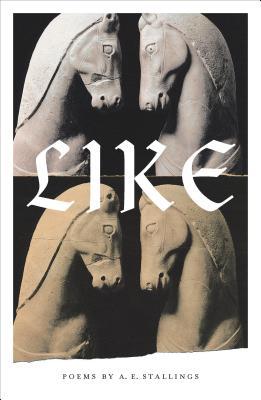
‘Like’ is the fourth volume of poetry from A.E. Stallings, the best poet that I know of who is writing in English today. The themes in ‘Like’ are the same as in her earlier collections: American childhood, Greek adulthood, children, memory, local wildlife, Greek mythology… and concern for the abused, whether women in the patriarchy or refugees in the Mediterranean. There is a difference of organization, though: instead of four or five different sections, ‘Like’ lumps all the poems together and arranges them alphabetically by title; the result is a smooth, wide-ranging read.

Stallings has a superb mastery of form, and plays endless tricks with it. Start on ‘Battle of Plataea: Aftermath’ and the apparent prose in 11 lines when read alertly turns out to be a rhymed sonnet in iambic pentameter. Or take the eponymous ‘Like, the Sestina’ which uses the word “like” as the rhyme for every one of the requisite 39 lines plus 3 mid-line rhymes (with such variations as “unlike”, “dislike”, “look-alike”). See how the most substantial poem, ‘Lost and Found’, carries its rambling dream-and-memory dissertation on for 36 stanzas of ottava rima in iambic pentameter, whereas the shorter and more time-sensitive ‘Swallows’ uses 6 stanzas in iambic tetrameter. Her ‘Refugee Fugue’ attacks the unmanageable and unimaginable horrors of the desperate and drowned through a blues poem, a host of epigrams, a found poem – an appropriately confused assemblage of forms for a situation not amenable to coherent resolution.

But forget the technicalities! The beauty is in the easy music of her verse, the casual wordplay as with the doorbell that
Portended importunity from Porlock,
the throwaway etymological observations as of nighttime thoughts:
To consider means to contemplate the stars,
the poem on a ‘Pencil’ that ends
And Time the other implement
That sharpens and grows shorter,
the playfulness of ‘Night Thoughts’ that begins
Night thoughts are not like bats
and then goes on to describe the flight of bats in extended lyrical detail, before finally ending with how night thoughts are different…
And always the underlying awareness of thousands of years of history, showing through in the description of sky, contemporary but ancient, as
the contrailed palimpsest of blue.

And that leads me to my only regrets about Stallings’ verse: too much Greek literature with which I’m barely familiar. I’m not saying it’s a failing on her part, it’s merely a regret on my part that I can’t keep up. Although I would love to come across work by her with Norse themes…

But I will settle for what she offers: a very wide range. She can be very succinct as with ‘Paradox’:
Of the ones that happened to die, the little ones and the old,
Of hypothermia, or drowning, all died of cold.

Equally, she can be extensive and thorough in her exploration of a theme as with ‘Lost and Found’, where she is wandering through a dream of mountainous moonscapes, landfill landscapes, of things lost – toys, gloves, loves, baby teeth, time, opportunities, keys, coins – led by Mnemosyne, Memory herself, the mother of all the muses. The smooth formal stanzas of ottava rima, maintained steadily for 288 lines, provide the same meditative state as the 250 lines of Matthew Arnold’s ‘Scholar Gypsy’ or Edward FitzGerald’s even longer ‘Rubaiyyat of Omar Khayyam’.

My personal favorite in ‘Like‘ is her semi-formal ‘Crow, Gentleman’ (whose title I am guessing was changed from the original ‘Gentleman Crow’ to prevent it from coming between two poems in ‘Like’ addressed to her daughter). It begins:
Pacing to and fro
Along the autumn shore
Among the wrack and reek

With your arms clasped behind your back
And sporting your grey frock coat
Trimmed in black

And your black hat and your lean long-legged stride,
Up and down the strand perusing
The headlines of the tide:

and ends:
Life is a joke you crack,
Wry and amusing,
And death a dainty snack.

I find Stallings’ work altogether delightful: by turns sardonic, detached, passionate, compassionate, always observing carefully, always expressing wittily, always in masterful control of rhythm and rhyme. I repeat: I don’t know of a better poet writing in English today.

Poem: ‘Winter Night Roads’

Full midnight moon on fields that yield but snows,
Air apple-clean, crisp, sweet
In lungs and nose,
The only sound your feet
Past silent woods –
Inhaling moods and modes
Of midnight roads.

In twenty minutes, you hear only this:
A dog bark twice. An owl hoot once.
A horse snort by a fence.
Some heavy breath behind a hedge: a cow.
A mile away a car’s lights show, then go.
You walk unknown, alone, towards some place
With light and life, perhaps a warm cafe
To make a break in travelling towards day.

This quiet little winter poem (sorry about the timing, Australia…) was first published in The Orchards Poetry Journal. The editors tend toward the bucolic and the formal… but they make exceptions, thank goodness, because this piece is not quite formal. It may be in iambics, but without a pattern to the line length or to what rhyme there is.

But it’s true to the winter outdoor experience–and pleasant enough, so long as you have good boots and adequate clothes!

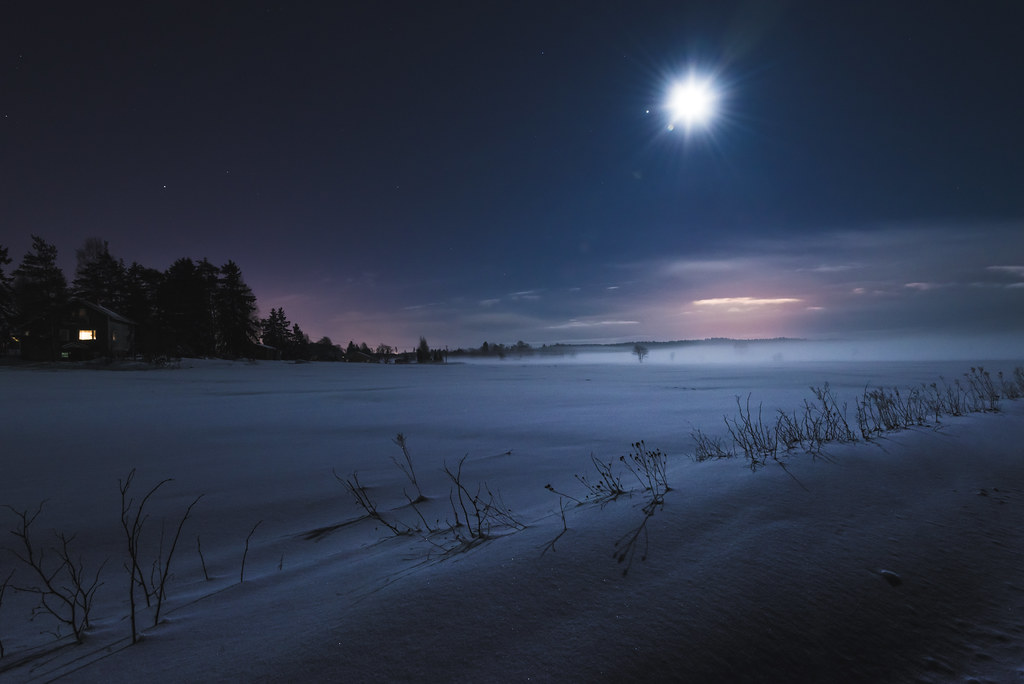
Photo: “Moonlight” by Jyrki Salmi is licensed under CC BY-NC-SA 2.0

Poem: “The Knife of Night”

Dark Woods

“Dark Trees” by MonoStep

The knife of night
Spreads swirls of black and white
Over the slice of here.

The taste is bold:
A pinch of cold,
Spiced with primeval fear.

This little poem was first published in Candelabrum, a British print magazine that ran twice yearly from 1970 for some 40 years. Its editor, Leonard McCarthy, was a lone voice dedicated to keeping traditional poetic sensibilities of metrical and rhymed
verse alive.

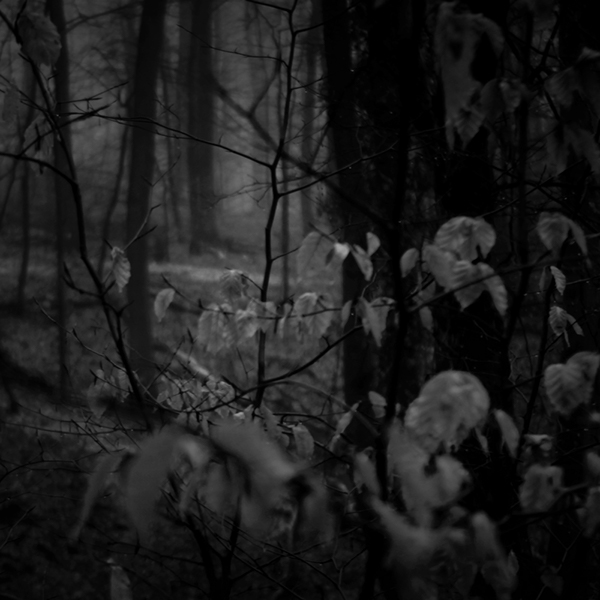
The poem itself came from a nighttime ramble in the forests that cut through the residential areas of Chapel Hill, North Carolina. Hundreds of acres in town are undevelopable because of steep slopes, creeks and ravines. Where the night woods are unlit except by moon and stars, there are deer, possums, foxes, flying squirrels, owls… copperheads… poison ivy… The night is beautiful, but you can’t help moving through its darkness in a different state of being, compared with daylight.