Tag Archives: nonsense poetry

Susan Jarvis Bryant, ‘Once Upon a Tortured Trope’

Don’t ever judge crooks by their lovers, they say  
On book covers nailed to the wall.
The frog sends his kiss at the bend of the day
To Belle who is beast of the ball. 

As tough as a cucumber, cool as old boots, 
An untroubled damsel of flair
Is shooting for stars. When the pussy-owl hoots
She snares a short prince with blonde hair. 
  
They sail inky skies on a silver-lined dream
To greener scenes up in the hills.
But honey and moons aren’t as sweet as they seem 
When cats and dogs reign and milk spills.

His rose bears a thorn and his shoulder, a chip. 
Hyenas have stolen his laughter.
All charm hits the skids as she grapples to slip 
The grip of his gripe ever after.

*****

Susan Jarvis Bryant writes: “I really don’t have anything to say about the poem, other than I had huge fun writing it. It’s the same with all of my poems – I never suffer for my art, which makes me reluctant to call myself a poet. I’d like to say I write my poems in a tearstained, whisky-soaked haze while my Muse tangos with the ghost of Dylan Thomas through Welsh valleys, but this is not so.  I just snigger away as the ink flows like a bad comedienne laughing at her own jokes.”

‘Once Upon a Tortured Trope’ was originally published in Snakeskin.

Susan Jarvis Bryant is originally from the U.K. and now lives on the coastal plains of Texas. Susan has poetry published on The Society of Classical Poets, Lighten Up Online, Snakeskin, Light, Sparks of Calliope, and Expansive Poetry Online, The Road Not Taken, and New English Review. She also has poetry published in The Lyric, Trinacria, and Beth Houston’s Extreme Formal Poems and Extreme Sonnets II anthologies. Susan is the winner of the 2020 International SCP Poetry Competition and was nominated for the 2022 and 2024 Pushcart Prize. She has published two books – Elephants Unleashed and Fern Feathered Edges.

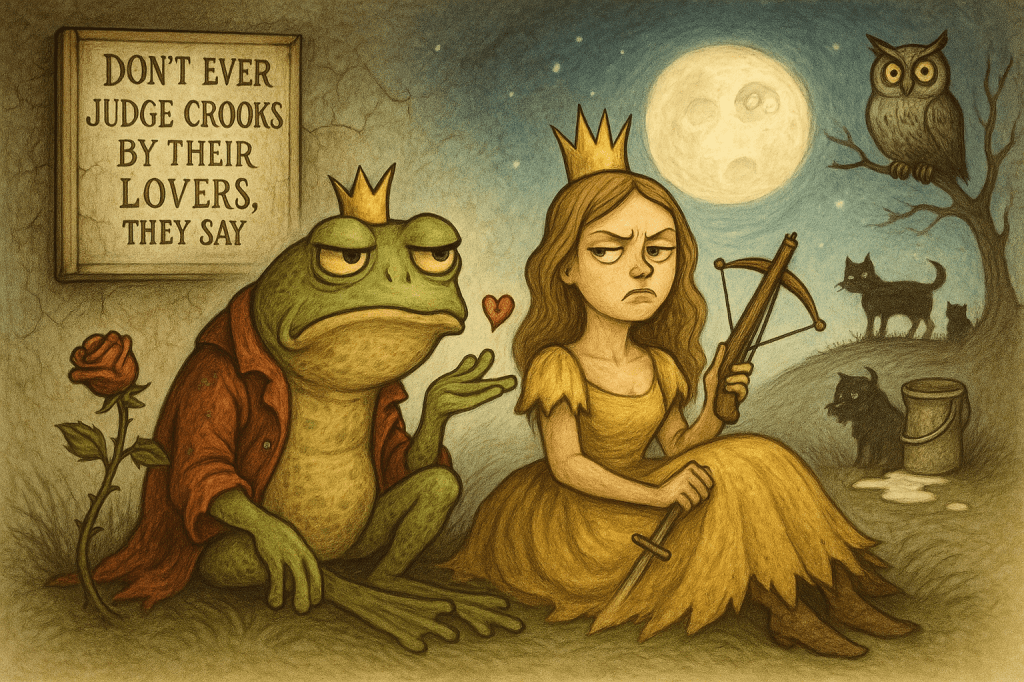
Art: AI + RHL

David Galef, ‘How to Say “Thank You” Abroad’

Donkey, mercy, grassy ass,
Effin’ Christ, something with God?
Spacey bow and airy ghetto,
Tic-tac-toe—or smile and nod.

Glossary: danke, merci, gracias, efcharisto, deo gratias, spasibo, arigatō, tak.

*****

David Galef comments: “The idea for this short (previously unpublished) poem came to me years ago when I was learning Japanese, and the mnemonic for the phrase “you’re welcome” (dō itashimashite) was explained to me as “don’t touch my mustache.” From there, it was a short step to “airy ghetto” for arigatō or “thank you.” A recent bout of Spanish language instruction yielded “grassy ass,” not that gracias is hard to remember, and the rest, as they say, is hiss Tory. As you can see in the poem, I’ve got eight or so examples, and I’d welcome more.”

David Galef has published over two hundred poems in magazines ranging from Light and Measure to The Yale Review. He’s also published two poetry volumes, Flaws and Kanji Poems, as well as two chapbooks, Lists and Apocalypses. His latest book is the novel Where I Went Wrong. In real life, he directs the creative writing program at Montclair State University.

Photo: “universal thank you note” by woodleywonderworks is licensed under CC BY 2.0.

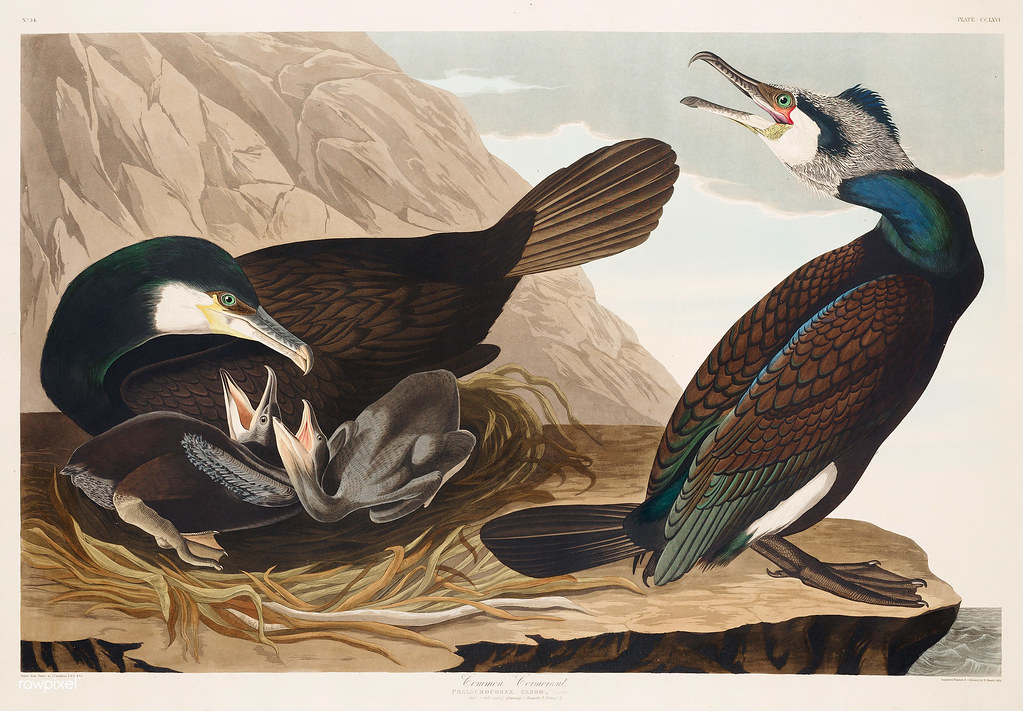
Unforgettable nonsense: Christopher Isherwood, ‘The Common Cormorant or Shag’

The common cormorant (or shag)
Lays eggs inside a paper bag,
The reason you will see no doubt,
Is to keep the lightning out.
But what these unobservant birds
Have never noticed is that herds
Of wandering bears may come with buns
And steal the bags to hold the crumbs.

*****

There are a couple of anomalies about this poem. First, some people doubt that it is by Christopher Isherwood, because the poem had been circulating anonymously since 1938 but didn’t appear under his name until 1982 in his nonsense-animals collection ‘People One Ought To Know’. But he had actually written the collection as early as 1928, as I gather here. Secondly, cormorants and shags are similar but different birds of the same family, at least in current terminology; however as Wikipedia says, ‘No consistent distinction exists between cormorants and shags. The names “cormorant” and “shag” were originally the common names of the two species of the family found in Great Britain.’ And anyway, it’s a nonsense poem, so who really cares? It is amusing, and easy to memorise because it is in verse.

Illustration: “Common Cormorant from Birds of America (1827) by John James Audubon (1785 – 1851), etched by Robert Havell (1793 – 1878). The original Birds of America is the most expensive printed book in the world and a truly awe-inspiring classic.” by Free Public Domain Illustrations by rawpixel is licensed under CC BY 2.0.

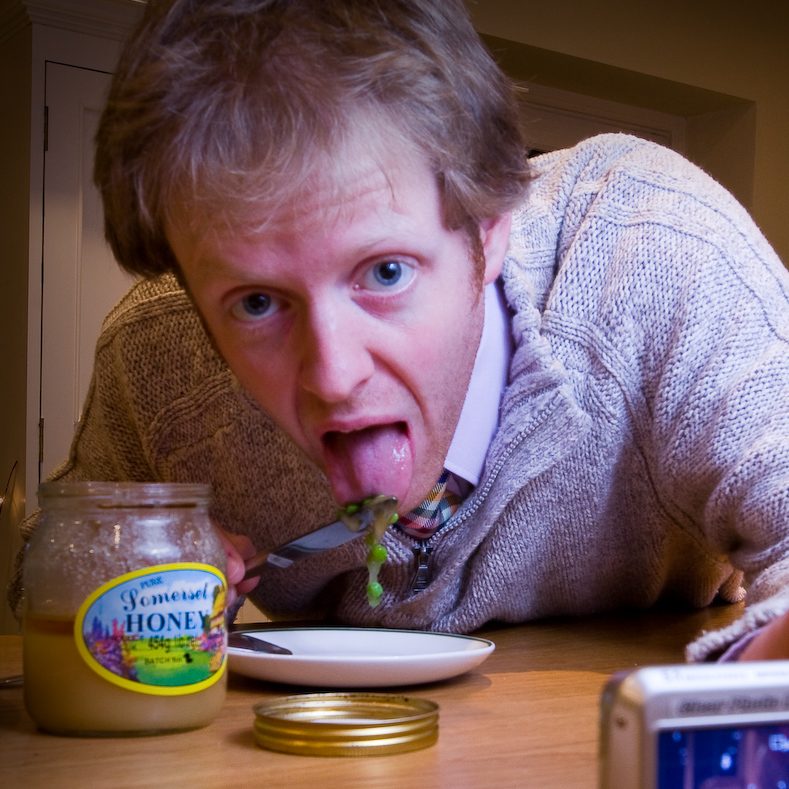
Unforgettable nonsense: Anon, ‘I Eat My Peas With Honey’

I eat my peas with honey;
I’ve done it all my life.
It makes the peas taste funny,
But it keeps them on the knife.

*****

The staying power of well-turned nonsense rhymes is testament to the value of rhythm and rhyme for keeping something intact, perfectly remembered. The poem’s joke is well done, with a good punchline; but the word-for-word memorability comes from the magic of verse.

The Poetry Foundation recognises this poem as having been recited in the American comedy/quiz show ‘It Pays to Be Ignorant‘ on 2nd February 1944 (or more likely 7th February 1944), you can hear Harry McNaughton read it here, and my guess is that he (or another of the show’s writers) was the author. Apparently some people have thought it was written by Shel Silverstein (1930-1999), but this is denied by his Estate and its archivists. Others in the US have stated it is by Ogden Nash. In the UK it has been labeled as Spike Milligan’s. It is an object lesson in optimistic (i.e. false) attribution. But even in Arnold Silcock’s collection ‘Verse and Worse’ (Faber & Faber, 1952) it is only credited to Anonymous… whose birth was a long time ago, and whose death is not expected any time soon.

Photo: “I eat peas with honey – Day 101 of Project 365” by purplemattfish is licensed under CC BY-NC-ND 2.0.

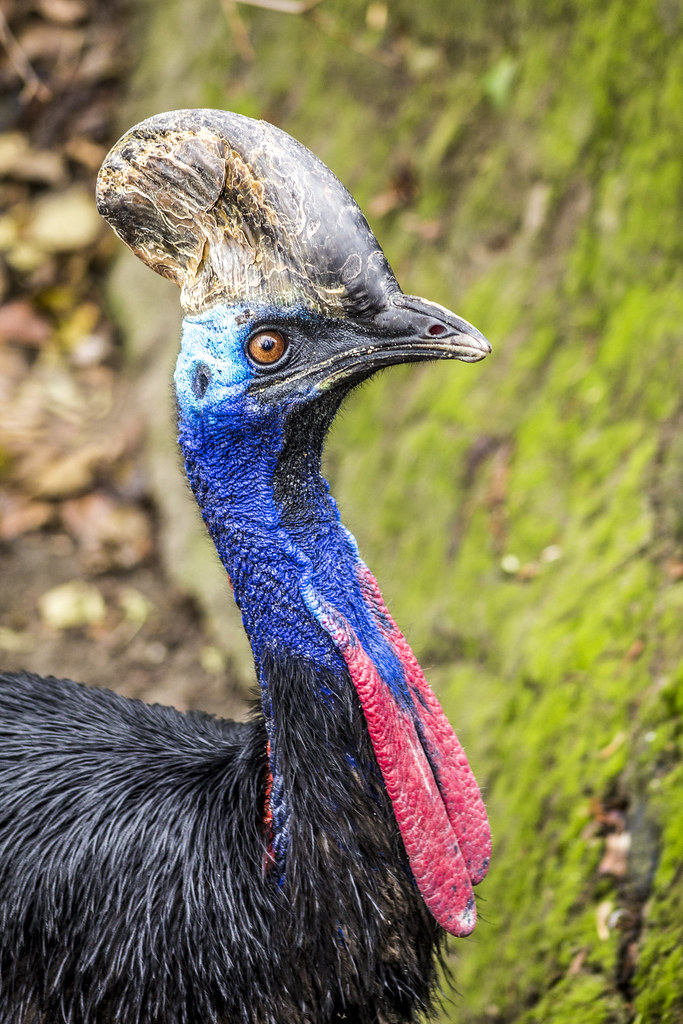
Unforgettable nonsense: Samuel Wilberforce, ‘If I Were a Cassowary’

If I were a cassowary
On the plains of Timbuctoo
I would eat a missionary,
Cassock, bands, and hymn-book too.

*****

Yes, cassowaries are from Australia and New Guinea, and Timbuktu is in Africa… but so what? The rhymes are too good to ignore. ‘Bands’, btw, refers to the pseudo-necktie thingies that priest-types and lawyer-types affect in some countries – little cloth flaps, plural because you wear two of them.

The probable author is Bishop Samuel “Soapy Sam” Wilberforce, best known nowadays for debating  Thomas Henry Huxley on evolution in 1860. Huxley (Aldous Huxley’s grandfather) was commonly referred to as ‘Darwin’s bulldog’. Wilberforce is remembered for his question as to whether it was through his grandmother or his grandfather that Huxley considered himself descended from a monkey. Huxley is said to have replied that he would not be ashamed to have a monkey for his ancestor, but he would be ashamed to be connected with a man who used his great gifts to obscure the truth.  Apparently everyone enjoyed the debate, and they all went off happily to dinner together afterwards.

Cassowaries are more formidable than either Wilberforce or Huxley. Standing over six feet tall, capable of running at 30 mph (and good swimmers in rivers and sea), and able to leap and strike chest-high with razor-sharp 5-inch talons, they are omnivores not to be confronted. Yes, they might well eat a missionary. Also, the cassowary’s bands are more impressive.

Photo: “Cassowary at the Budapest zoo” by brenkee is marked with CC0 1.0.

My own favourites: ‘No No Nse Nse’

No
No
Nse
Nse
And things like that
May look like nonsense
But there is
No
No
Nse
Nse

*****

I know, I know… it’s not formal verse, but it’s one of my favourite pieces.

Ecstatic Posture” by Dreaming in the deep south is licensed under CC BY 2.0.

Evocative Fragments: Edward Lear

When awful darkness and silence reign
Over the great Gromboolian plain,
Through the long, long wintry nights; —
When the angry breakers roar
As they beat on the rocky shore; —
When Storm-clouds brood on the towering heights
Of the Hills of the Chankly Bore: —

Then, through the vast and gloomy dark,
There moves what seems a fiery spark,
A lonely spark with silvery rays
Piercing the coal-black night, —
A Meteor strange and bright: —
Hither and thither the vision strays,
A single lurid light.

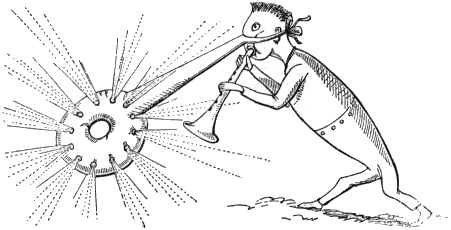
It is, of course, the Dong With a Luminous Nose, wandering crazed through the forests seeking the Jumblie Girl he fell in love with. Edward Lear’s verse is known for its frivolous characters, actions and names, and his scribbly little drawings. But ignore the drawing and note the skill and control, the emotional pull, of the two stanzas above (even if he does sabotage them with words like “Gromboolian”). Similarly he was a remarkable artist when he wanted to be: one of the world’s great ornithological painters, a wonderful landscape artist, and well-enough respected to have given Queen Victoria a dozen lessons in drawing and watercolours in 1846.

Nonsense poetry in itself is a wonderful way to introduce children to literature, if it is handled as skilfully and, yes, emotionally as Lear does with his nonsense poems of travel, romance, heartbreak, and finding (or failing to find) lasting happiness.

Fantasy Analysis: Auden’s ‘Jumbled in the common box’

Jumbled in the common box
Of their dark stupidity,
Orchid, swan, and Caesar lie;
Time that tires of everyone
Has corroded all the locks,
Thrown away the key for fun.

In its cleft the torrent mocks
Prophets who in days gone by
Made a profit on each cry,
Persona grata now with none;
And a jackass language shocks
Poets who can only pun.

Silence settles on the clocks;
Nursing mothers point a sly
Index finger at the sky,
Crimson with the setting sun;
In the valley of the fox
Gleams the barrel of a gun.

Once we could have made the docks,
Now it is too late to fly;
Once too often you and I
Did what we should not have done;
Round the rampant rugged rocks
Rude and ragged rascals run.

In January 1941, W.H. Auden had been living in New York for nearly two years. The Second World War had started, but not yet in the US. Auden had fallen in love with Chester Kallman who was now turning 20 and was too young to want to be sexually faithful; Auden had also returned from atheism to the existential Christianity that is common in the Anglican/Episcopalian church. It was a period of change, backgrounded by the widening war.

Regarding the poem from this time, I choose to imagine Auden rambling, reminiscing, muttering to himself: “Around the rugged rocks the ragged rascal ran… Nice metre as well as alliteration and, for people with difficulty pronouncing their Rs, a twuly tewwible tongue-twister. Rhythmic, memorable. Nonsense; not meaningful, but not meaningless; nonsense and nursery rhymes are right on the border. And it splits in two, you could easily rhyme it: rocks, box, blocks, brocks, cocks, cox, clocks, crocks… ran, Ann, ban, bran, can, clan, cran… or easy to change to run, or runs. A lot of rhymes, anyway. Run them out, see what transpires.

Once we could have made the docks, / Now it is too late to fly; that adds another rhyme, not a problem, maybe a 6-line stanza. Once too often you and I / Did what we should not have done; and into the last two lines, have to fill them out a bit to maintain the metre, keep the alliteration of course: Round the rampant rugged rocks / Rude and ragged rascals run… So that’s all right, that would make an ending.

“Then of course we can have more stanzas leading up to it. Flick a bit of paint at the canvas, see what sort of patterns we can find to elaborate on. Time, decay, trepidation, warnings… out come the words and images around the rhymes, and suddenly it’s all as evocative and semi-coherent as a reading of tarot or yarrow or horoscope. Hm, tarot or yarrow, I hadn’t noticed that before, wonder if I can use that somewhere else…”

(Remember, this is a fantasy analysis, presupposing the poem to have been written with full skill to capture both rhymes and a mood, but without any serious intent beyond that. For a completely different intellectual analysis, you can always try this…)

Photo: “Jumble Box” by .daydreamer. is licensed under CC BY-NC-ND 2.0

Review: “Nonsense” by Alan Watts

Alan Watts had a rich intellectual life. His formal education largely stopped at high school in his native England, but he explored his interests in mystical Christianity and Zen Buddhism so thoroughly, including attending an American seminary, getting a Masters and becoming a priest for a few years, that he was associated thereafter with various universities including Harvard and San Jose State University.

His poetry book “Nonsense” is interesting for its fresh perspective over Watts’ writing, and enjoyable enough for the ten nonsense poems it holds. As you would expect from the author of “The Art of Zen” and “The Book on the Taboo Against Knowing Who You Are”, it contains both pointless happiness

Hum, hum the Humbledrum!
Rumbling bumbling dumbledrum,
Mumbling dumbly, rumbling humbly…

and comparatively clear philosophy:

The stars in their courses have no destination;
The train of events will arrive at no station;
The inmost and ultimate Self of us all
Is dancing on nothing and having a ball.
So with chat for chit and with tat for tit,
This will be that, and that will be It!

The main poem falls somewhere between the two previous quotes. One hundred lines long, written as 20 limericks, it tells the story of The Lovelorn Loon:

A certain umstumptulat loon
Fell vastly in love with the moon;
With shimular turve
And binlimular gurve
He caroozed to the gorble bassoon.

The Loon builds an enormous tower that successfully reaches the heavens, but when he calls the moon, her arrival destroys the tower.

The whole book is appropriately illustrated in 1960s psychedelic style (think Yellow Submarine and Monty Python) by Michel Dattel. And the book contains other short pieces by Watts, an Introduction that starts reasonably and slyly slides into gibberish; and short prose pieces on Nonsense, on Goofing, and on Drudgery.

A very odd but entertaining little book.