Tag Archives: politicians

Odd poem: French Verse on painting, by Winston Churchill

La peinture á l’huile
Est bien difficile,
Mais c’est beaucoup plus beau
Que la peinture á l’eau.

The translation: “Oil painting / Is certainly hard, / But it’s much lovelier / Than watercolour.” For reasons unknown, Winston Churchill came up with what is almost a Clerihew in style, but in French, as a comment in his little 1948 book ‘Painting as a Pastime‘.

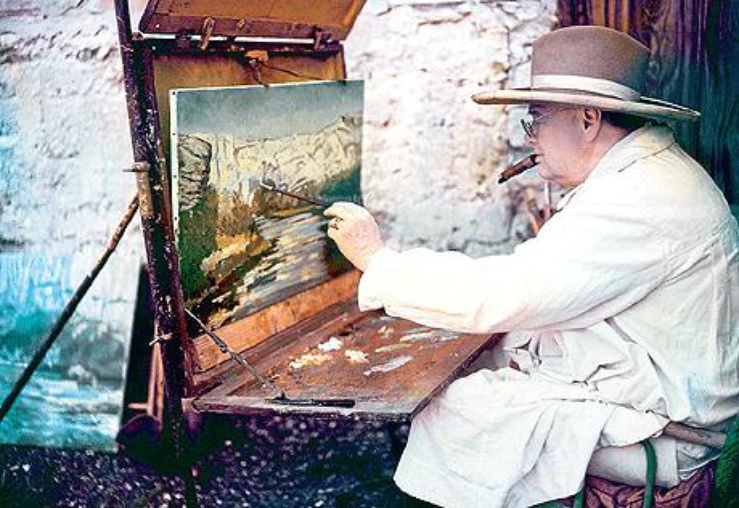
Churchill first took up painting in 1915 at age 40 when he was removed as First Lord of the Admiralty. His fall was a result of the disastrous Dardanelles and Gallipoli attacks on Turkey that he had organised.

He took up painting for distraction, but it became increasingly a part of his life. He didn’t have hopes of making money from his “daubs”, and didn’t consider he had mastered the art. As he wrote in that slim book, “When I get to heaven I mean to spend a considerable portion of my first million years in painting, and so to get to the bottom of the subject.” Early on he submitted and exhibited under pseudonyms as a way of assessing his abilities without the influence of his name. In 1921 he exhibited at Galerie Druet in Paris under the pseudonym Charles Morin and sold six paintings for £30 each. In 1947 he submitted paintings to the Royal Academy Summer Exhibition under the name David Winter, and was successful with two of them.

He continued to paint for over 40 years, landscapes when the weather was obliging, still lifes when stuck indoors. Wherever he travelled–Morocco and Egypt, France and Italy, Jamaica, Canada and the US–his easel, brushes and paints went with him and were put to use. He produced at least 500 paintings, giving many away and not keeping records of them. You can see several of his paintings here if you scroll to the bottom.

‘Photo: Churchill painting a view of the Sorgue river in 1948, photographer unknown
Odd Poems: Oxbridge rivalry

The King, observing with judicious eyes
The state of both his universities,
To Oxford sent a troop of horse, and why?
That learned body wanted loyalty;
To Cambridge books, as very well discerning
How much that loyal body wanted learning.

This poem was written by Joseph Trapp in response to events in England in 1714. King George I, to celebrate his coronation, purchased the entire library of the recently deceased bibliophile Bishop of Ely and donated it to Cambridge University, more than tripling the number of books in the university library. Meanwhile Oxford had been having one of its frequent periods of disorder, and the King had had to send in troops to restore calm.

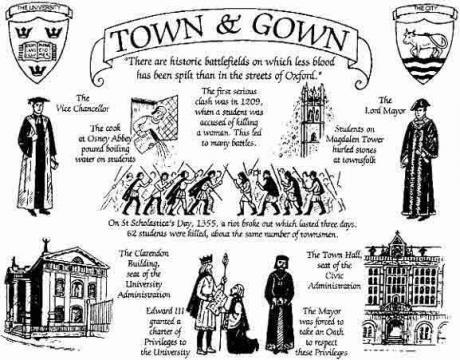
Oxford has a long history of riots, beginning in 1209 with “the hanging of the clerks”. In his 1220s history of England, Roger of Wendover wrote:

“About this time, a certain clerk engaged in the liberal arts at Oxford killed a certain woman by accident and when he found that she was dead he decided to flee.

“But when the mayor of the city and many others who had gathered found the dead woman they began to search for the killer in his house which he had rented together with three of his fellow clerks.

“Not finding the man accused of the deed they seized his three fellow clerks who said they were wholly ignorant of the murder and threw them into prison; then a few days later they were, by order of King John, in contempt of the rights of the church, taken outside the city and hanged.

“When the deed had been done, both masters and pupils, to the number of three thousand clerks, left Oxford so that not one remained out of the whole university; they left Oxford empty, some engaging in liberal studies at Cambridge and some at Reading.”

In effect, Cambridge University was founded by refugee scholars from Oxford–though there is some dispute about the actual timing and the numbers. Then the Pope got involved as part of his disputes with King John, and sent a Papal Legate who, among other things, imposed a payment by the town of Oxford to its University of 52 shillings per year in perpetuity.

The disputes between Town and Gown have continued for centuries, the most severe being the St Scholastica Day riot of 1355. This began with two students complaining about the quality of wine in a pub and ended three days later with 63 University people dead, as well as 30 people from the town and surrounding countryside. And you can read a 1990s anarchist analysis of the continuing conflict in our own time here.

But let’s go back to 1714. George I had been brought in from Hanover to be King with the support of the Whig party; their opposition, the Tories, were on uncertain ground as many of them supported the rival Stuart claim to the throne. George therefore looked favourably on Cambridge with its Whig establishment, while Oxford was a Tory stronghold. Hence the response to Joseph Trapp’s poem by William Browne:

The King to Oxford sent a troop of horse,
For Tories own no argument but force:
With equal skill to Cambridge books he sent,
For Whigs admit no force but argument.

And the rivalry between Oxford and Cambridge continues to this day.

Political poem: Hilaire Belloc, on elections

The accursed power which stands on Privilege
(And goes with Women, and Champagne, and Bridge)
Broke–and Democracy resumed her reign:
(Which goes with Bridge, and Women and Champagne).

The precise phrasing of Hilaire Belloc‘s little squib may have been outdated by the likes of Margaret Thatcher, Angela Merkel and Kamala Harris… but the complaint by the common voter (or disillusioned non-voter) is valid, that professional politicians live in a very comfortable club that takes care of all its members regardless of who actually wins an election; and no fundamental change occurs.

A nice little quatrain, iambic pentameter, the simplicity strengthened by the bite of the repetition contradicting the idea of change. Easy to remember and quote because – of course – it rhymes and scans.

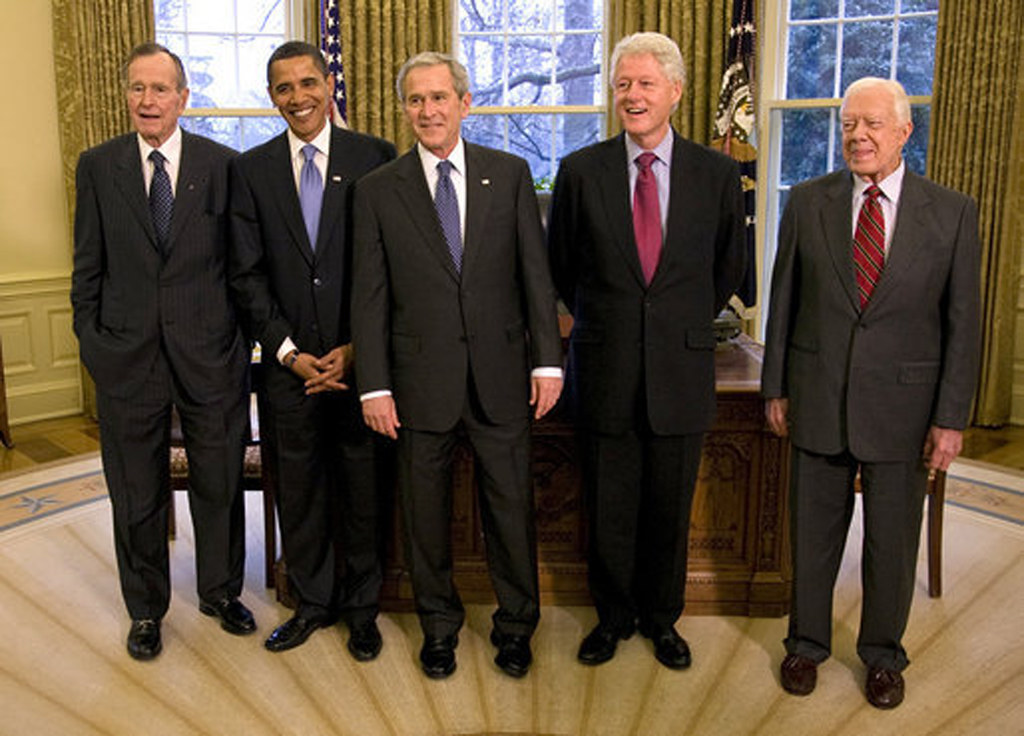
“2009 Five Presidents, President George W. Bush, President Elect Barack Obama, Former Presidents George H W Bush, Bill Clinton & Jimmy Carter, Standing” by Beverly & Pack is marked with CC PDM 1.0

Political poem: Hilaire Belloc’s epitaph on a politician

Here richly, with ridiculous display,
The Politician’s corpse was laid away.
While all of his acquaintance sneered and slanged
I wept: for I had longed to see him hanged.

The US and UK have been so polarised for the past several years that it seems everyone has a politician they would like to see executed–or jailed at the very least. But this is neither a recent phenomenon nor a merely Anglo-American one. All round the world notorious pillagers of their countries go to the grave with great pomp, while most of their countrymen and -women are simply glad that they are finally going.

This sarcastic little poem by Anglo-French writer Hilaire Belloc suggests two things: that all successful political leaders are loathed by a large percentage of the population; and that to make your sarcastic comment truly memorable if it is more than five or six words long, you do well to put it in verse. The rhyme and meter not only make the words easier to remember, they also lend a magical impression of inevitability and authenticity to the idea expressed. Well-constructed verse provides a fraudulent but powerful proof that the idea expressed is valid. Rhetoric and oratory inhabit this area also. Well-expressed ideas have more credibility than badly expressed ones, regardless of the relative merits of the ideas themselves.

Perhaps we should count ourselves lucky that few politicians exhibit much interest in poetry…

November 2023 update: I’ve been quoting this poem with reference to the death of Henry Kissinger.

Photo: “President Cyril Ramaphosa attends former President Robert Mugabé’s State Funeral in Harare” by GovernmentZA is licensed under CC BY-ND 2.0

Poem: ‘Politics’

He played the game and loved its vicious tricks,
deceit, despair, all power-politics;
and made good progress, never in retreat,
with no despair at politics’ deceit…
and now still climbs that endless rain-slick stair
of power-politics, deceit, despair.

If you search for photos of politicians, this is the kind of thing you get… There are (occasionally) really, really good people who devote their lives to trying to improve their part of the world; but… Anyway, it seems like a good time to blog this poem!

This short piece was originally published in Snakeskin. Couplets of iambic pentameter, with politics, deceit and despair in the second line of every couplet and providing the rhymes. But you could see that.

Photo: “President Trump at the Israel Museum. Jerusalem May 23, 2017 President Trump at the Israel Museum. Jerusalem May 23, 2017” by U.S. Embassy Jerusalem is licensed under CC BY 2.0

Odd poem: ‘The Influenza’ by Winston Churchill, age 15

Oh how shall I its deeds recount
        Or measure the untold amount
        Of ills that it has done?
        From China’s bright celestial land
        E’en to Arabia’s thirsty sand
        It journeyed with the sun.

I omit the next nine stanzas, as the influenza makes its way to Britain. The poem ends:

        For though it ravaged far and wide
        Both village, town and countryside,
        Its power to kill was o’er;
        And with the favouring winds of Spring
        (Blest is the time of which I sing)
        It left our native shore.

        God shield our Empire from the might
        Of war or famine, plague or blight
        And all the power of Hell,
        And keep it ever in the hands
        Of those who fought ‘gainst other lands,
        Who fought and conquered well.

Written in 1890 when he was a lazy 15-year-old Harrow schoolboy who did badly at everything except English, Winston Churchill partially redeemed himself with this prizewinning poem on the global influenza epidemic (which may have been a Coronavirus) of his day. This “Asiatic Flu” or “Russian Flu” killed about a million people worldwide.

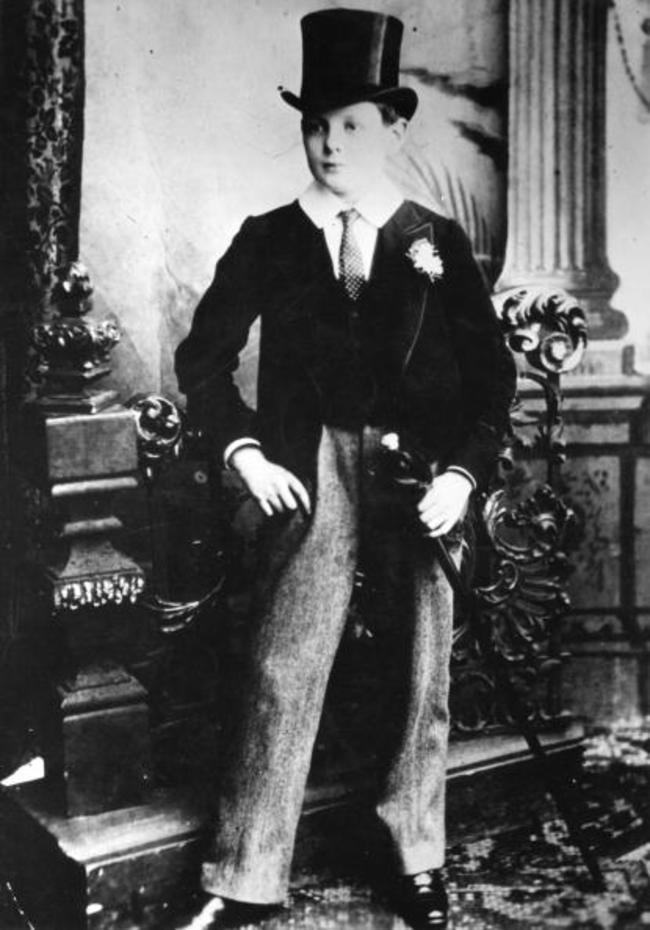
The photograph shows Churchill in his school clothes at age 14.

So there you have him: a teenage Churchill, with excellent control of English and an early exposition of his oratory, bombast, nationalism, imperialism, and enjoyment of warfare. And fifty years later he did brilliantly for Britain in the Second World War (but thank goodness for Clement Attlee picking up the pieces afterwards).

Odd poem: prize-winning limerick by Boris Johnson

There was a young fellow from Ankara,

Who was a terrific wankerer.

Till he sowed his wild oats,

With the help of a goat,

But he didn’t even stop to thankera.

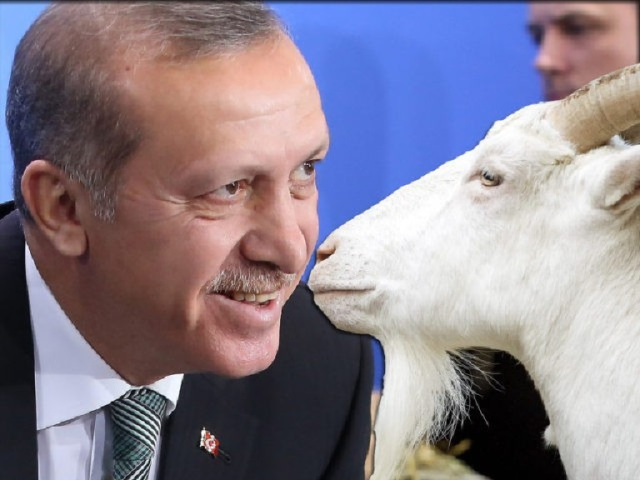
To make sense of this limerick, and why Boris Johnson wrote it, and the various reasons that it won a £1,000 prize, we have to poke around the politics of a few years ago. It started when a German video mildly mocked the authoritarian and repressive President of Turkey, Recep Tayyip Erdoğan. The Turkish government summoned the German ambassador to “explain and justify” the video. As Turkey had become extremely repressive to journalists, German TV comedian Jan Böhmermann then decided to show Erdoğan what free speech meant, by broadcasting a deliberately offensive poem.

On a set with a Turkish flag and portrait of Erdoğan, and with subtitles in Turkish, Böhmermann read his poem of twelve rhyming couplets. Here is a rough translation:

Defamatory Poem, by Jan Böhmermann

Stupid as fuck, cowardly and uptight,
Is Erdoğan, the president,
His gob smells of bad döner,
Even a pig’s fart smells better,
He’s the man who hits girls,
While wearing a rubber mask,
But goat-fucking he likes the best,
And having minorities repressed,

Kicking Kurds and beating Christians
While watching kiddie porn,
And even at night, instead of sleep,
It’s time for fellatio with a hundred sheep,

Yep, Erdoğan is definitely
The president with a tiny dick,
Every Turk will tell you all,
The stupid fool has wrinkly balls,
From Ankara to Istanbul,
They all know the man is gay,
Perverted, louse-infested, a zoophile,
Recep Fritzl Priklopil

Head as empty as his balls,
Of every gang-bang party he’s the star,
Till his cock burns when he has a piss,
That’s Recep Erdoğan, Turkish president.

Erdoğan filed complaints with German prosecutors in a bid to have the poem suppressed, and Chancellor Angela Merkel agreed to investigate, which led to a court injunction, but also to the poem being read out in the German parliament.

Boris Johnson–at the time a backbench Conservative MP as well as former Mayor of London–was interviewed shortly after by The Spectator and a conservative Swiss paper, on immigration, Brexit and related issues. The subject of the poem came up. Johnson–one of whose great-grandfathers was Turkish–called it a scandal that a German court had issued an injunction against the poem being repeated. He said “If somebody wants to make a joke about the love that flowers between the Turkish president and a goat, he should be able to do so, in any European country, including Turkey.” As The Spectator had issued a £1,000 ‘President Erdogan Offensive Poetry’ challenge, Johnson was asked if he had entered. He said no, but when pressed, came up with his apparently spontaneous limerick.

Poetry judge Douglas Murray said the competition received thousands of entries, and he tweeted: “Can I remind entrants that you cannot just make up words. ‘Wankerer’ does indeed rhyme with Turkey’s capital. But it is not a word.” (For non-Brits: “wank” = masturbate, and “wanker” = stupid jerk.) However, Boris Johnson ended up with the £1,000 prize. Perhaps the fact that he is a former editor of The Spectator had something to do with it. (And technically, this is a very poor limerick.)

Odd poem: Prime Minister Clement Attlee’s limerick

There were few who thought him a starter,
Many who thought themselves smarter.
But he ended PM,
CH and OM,
an Earl and a Knight of the Garter.

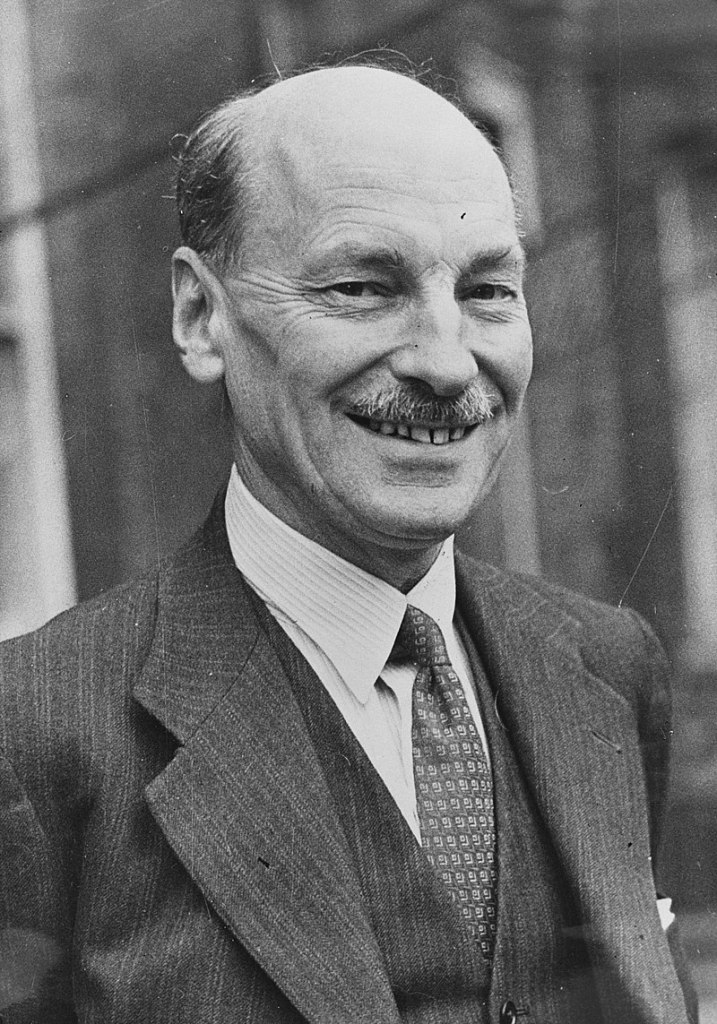
Born into a middle-class family in 1883, Clement Attlee went to Oxford, became a barrister, but, after his volunteer work in London’s East End brought him into close contact with poverty, his political views shifted left and he gave up law and joined the Labour Party. Leader of the Labour Party from 1935 to 1955, including as Prime Minister from 1945 to 1951. His government “undertook the nationalisation of public utilities and major industries, and implemented wide-ranging social reforms, including the passing of the National Insurance Act 1946 and National Assistance Act, the foundation of the National Health Service (NHS) in 1948, and the enlargement of public subsidies for council house building. His government also reformed trade union legislation, working practices and children’s services; it created the National Parks system, passed the New Towns Act 1946 and established the town and country planning system.” – Wikipedia

Perhaps surprisingly he failed to see the value of the beginnings of the EU, preferring a stronger Atlantic alliance if possible. He is alleged to have said in a speech: “The Common Market. The so-called Common Market of six nations. Know them all well. Very recently this country spent a great deal of blood and treasure rescuing four of ’em from attacks by the other two.”

Now considered one of the UK’s greatest Prime Ministers, it is only fitting that his titles and honours include, as he boasts in his limerick, Prime Minister, Companion of Honour, Order of Merit, Earl Attlee, and Knight of the Garter.

Even Margaret Thatcher wrote of him: “Of Clement Attlee, however, I was an admirer. He was a serious man and a patriot. Quite contrary to the general tendency of politicians in the 1990s, he was all substance and no show. His was a genuinely radical and reforming government.”

Poem: ‘Lizard an Mosquito’

Mosquito bite yuman,
Now e full a blood.
Lizard eat mosquito
Say, man dis is good.

Lizard help hatch mosquito,
Raise dem up good.
Send dem out like good daddy
Fe go find yuman blood.

Mosquito so happy
Dem eat plenty blood.
Lizard so happy
Dem mosquito taste good.

Politician same like dis:
Yu clap an yu sing,
Yu eleck im an den
E tax yu ting an ting.

I don’t normally write dialect verse, but it seemed appropriate for this idea. It was originally published in Snakeskin, republished in both The Hypertexts and Better Than Starbucks. The Bahamian accent can sound impenetrable to foreigners, but the words and grammar are not so different from standard English. By the way, “ting an ting” is just the non-specific plural of “tingum”–unspecified “stuff” rather than a specific “thing”.

Photo: “Brutality against mosquitoes.” by Bobinson K B is licensed under CC BY-NC-SA 2.0

Sonnet: “Nigerian Scammers”

Nigerian Prince Scammer

Michael Neu, charged in “Nigerian Prince” scam

Nigerian scammers write bad, IN ALL CAPS,
Misspelling, losing credibility
With all except the stupidest of saps;
No fools themselves, it’s done deliberately.
No point in wasting time on those who doubt –
Everyone who responds is a clear fool:
Desperate to believe, they throw sense out –
Greedily they send cash, earn ridicule.
So @RealDonaldTrump tells barefaced lies
Unfazed by print or film-based evidence;
And fools give cash and votes as hypnotised,
Entrust the trickster with their confidence.
“Born of a virgin! Raised up from the dead!”
Faiths, too, tell huge lies – and religions spread.

This sonnet was originally published in Snakeskin. It’s key point is that the easiest people to take money off are those people who want to believe, and who demonstrate that overlooking the most blatant signs of fraud. Nigerian scammers filter for those people by making their emails deliberately implausible. 

And interestingly, not all Nigerian scammers are even Nigerian. Google the term and you may find Michael Neu, a Louisiana man in his late 60s who was charged with 269 counts of wire fraud and money laundering. Neu is a white American–but, yes, he apparently sent some of the money to his co-conspirators in Nigeria.