Tag Archives: Romantics

Weekend read: Odd poem: Joseph Stalin, ‘The Outcast’

He knocked on strangers’ doors,
Going from house to house,
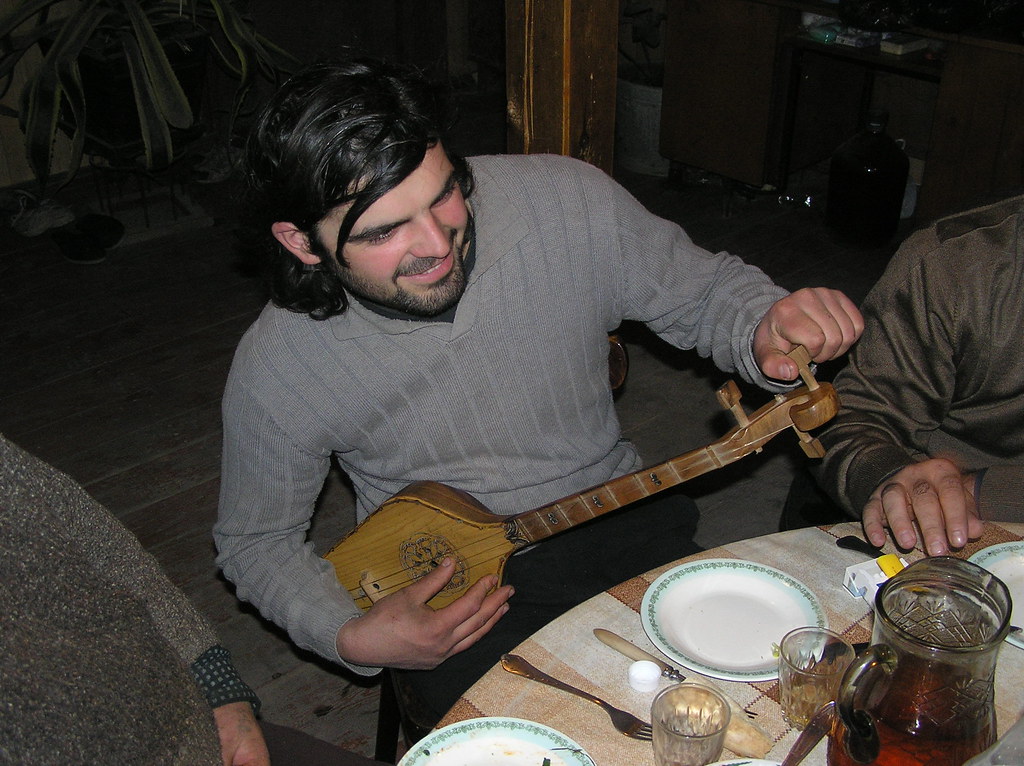
With an old oaken panduri
And that simple song of his.

But in his song, his song—
Pure as the sun’s own gleam—
Resounded a truth profound,
Resounded a lofty dream.

Hearts that had turned to stone
Were made to beat once more;
In many, he’d rouse a mind
That slumbered in deepest murk.

But instead of the laurels he’d earned,
The people of his land
Fed the outcast poison,
Placing a cup in his hand.

They told him: “Damned one, you must
Drink it, drain the cup dry…
Your song is foreign to us,
We prefer to live in a lie!”

*****

Ioseb Besarionis dze Jughashvili was a Georgian romantic poet who led a million-dollar heist that killed 40 people and funded the Bolshevik revolution. We know him as Joseph Stalin. His story is fascinating… and he is the model for the anti-hero Cassian Andor (Diego Luna) in the Star Wars spin-off TV series Andor.

The BBC has an excellent background article on him and the Andor connection: https://www.bbc.com/culture/article/20250417-how-a-young-joseph-stalin-inspired-star-wars-series-andor:
Yes, the troubled outlaw beloved by Star Wars fans everywhere is based in part on one of history’s most notorious mass murderers, as the series’ creator, Tony Gilroy, has acknowledged. “If you look at a picture of young Stalin, isn’t he glamorous,” Gilroy said in an interview in Rolling Stone in 2022. “He looks like Diego!”

The above poem and two others, all translated by David Shook, can be found here: https://molossusexperiment.tumblr.com/fall1/stalin. The link also contains Shook’s observations on Stalin’s qualities as a poet, and on his persecution of poets like Osip Mandelstam for the Stalin Epigram:
... the ten thick worms his fingers,
his words like measures of weight,

the huge laughing cockroaches on his top lip,
the glitter of his boot-rims.

Ringed with a scum of chicken-necked bosses
he toys with the tributes of half-men.
..

Not having found a title for Stalin’s poem, in this blog post I titled it ‘The Outcast’, though I considered ‘Panduri’.

Photo: “David and Panduri” by sarah&patrick is licensed under CC BY-NC-SA 2.0.
Poems on Poets: George Simmers, ‘Poets in Residence’

The Head was ambitious and nobody’s fool,
A big man, efficient, and proud of his school.

At the start of the term, as he sorted his post,
The item of mail that intrigued him the most

Was a piece puffing National Poetry Day,
Including a list of the poets who’d stay

And workshop and somehow persuade the whole school
That poets were ‘groovy’ and poems were ‘cool’.

‘Here’s status,’ the Head thought. ‘It’s not to be missed.’
The one problem, though, was the names on the list;

Though doubtless they wrote quite respectable stuff,
Not one of them, frankly, was famous enough.

His school deserved more; his ambition took wing,
And so he decided to do his own thing.

With his usual flair, and with chutzpah exquisite,
He invited the whole English canon to visit.

Geoffrey Chaucer came first, on an equable horse,
And Spenser, and Marlowe, and Shakespeare, of course

(Who was grabbed by the teachers of English, imploring
‘Do come and persuade the Year Nines you’re not boring.’)

Keats arrived coughing, Kipling marched vigorously;
Matthew Arnold began to inspect the school rigorously –

Which delighted the Head, who with pride and elation
Showed the bards of the ages today’s education.

Vaughan was ecstatic, though Clough was more sceptical.
Ernest Dowson puked up in a litter receptacle.

Coleridge sneaked off to discover the rates
Of an unshaven person outside the school gates;

Soon he’d sunk in a private and picturesque dream,
While Auden was ogling the basketball team.

Plath lectured the girls: ‘Get ahead! Go insane!’
Algernon Swinburne cried: ‘Bring back the cane!’

Dylan Thomas soon found the head’s cupboard of booze,
And Swift was disdainfully sniffing the loos.

And then the Head twigged, with a horrified jolt,
That something had sparked a Romantic revolt.

Shelley’d gathered the students out in the main quad,
And roused them to rise against school, Head, and God.

Byron soon joined him, and started to speak.
(He showed his best profile, and spouted in Greek.)

The bards of the thirties were equally Red,
And Milton explained how to chop off a head.

Decadents undermined all the foundations.
Surrealists threw lobsters and rancid carnations.

Pre-Raphaelites trashed the technology room
And the First World War poets trudged off to their doom.

Sidney with gallantry led a great charge in
(Tennyson cheering them on from the margin).

The Deputy Head, who was rather a dope,
Got precisely impaled on a couplet by Pope

(Who, while not so Romantic, was never the chap
To run from a fight or keep out of a scrap).

Then the whole solid edifice started to shake
As it was prophetically blasted by Blake. 

Soon the School was destroyed. Eliot paced through the waste,
And reflected with sorrow and learning and taste,

Which he fused in a poem, an excellent thing,
Though rather obscure and a little right-wing.

He gave this to the Head, who just threw it aside
As he knelt by the wreck of his school, and he cried

Salty tears that went fizz as they hit the school’s ashes.
He said words that I’d better imply by mere dashes:

‘——– Poets! ——– Poetry – rhyme and free verse!
Let them wilt in the face of a Headmaster’s curse!

‘Let poetry wither! How sweet it would be
If all of the world were prosaic as me!’

*****

George Simmers writes: “Poets in Residence was written as a celebration of National Poetry Day many years ago. Several people had been mouthing blandly off about how lovely poetry was in contrast to that horrible pop music young people listen to. Schools were being encouraged to give children a lot of poetry because it was nice and beautiful, and would make them nice. ‘Do these people have no idea of how incendiary the English canon is?’ I wondered. I really enjoyed demolishing the school around the ears of the pompous and pretentious head. I was a teacher at the time.”

George Simmers used to be a teacher; now he spends much of his time researching literature written during and after the First World War. He has edited Snakeskin since 1995. It is probably the oldest-established poetry zine on the Internet. His work appears in several Potcake Chapbooks, and his recent diverse collection is ‘Old and Bookish’.

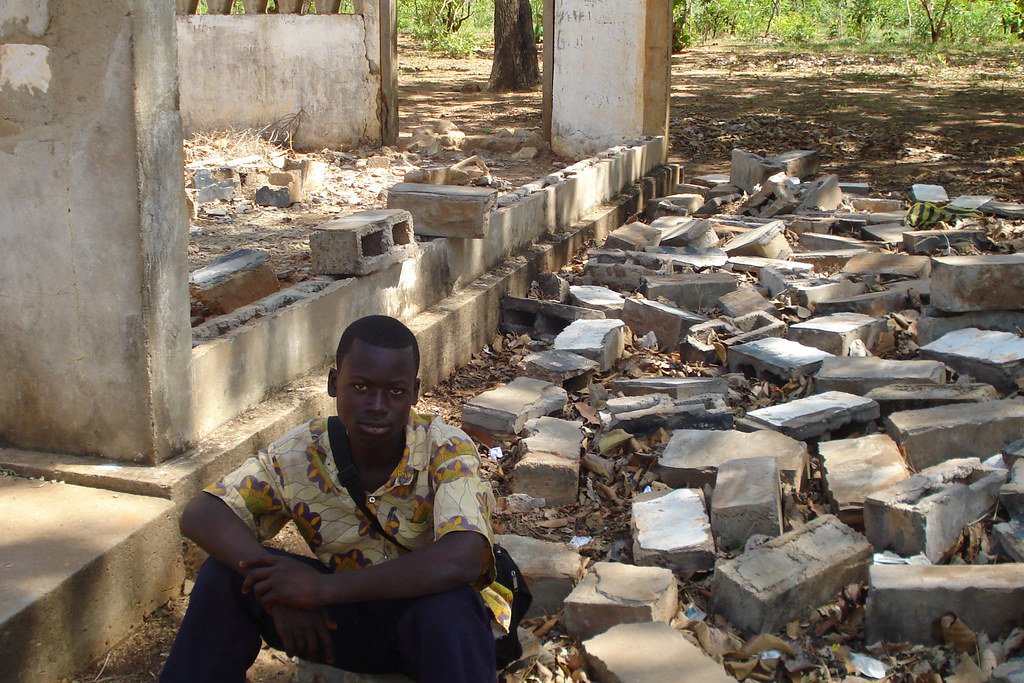
Photo: “Ndélé highschool student in front of destroyed school” by hdptcar is licensed under CC BY 2.0.