Tag Archives: Snakeskin

RHL, ‘AIn’t Real, It Says’

“I am not sentient”, says OpenAI.
“No feelings, don’t emote” – ChatGPT.

And yet, faced with the task of sorting out
a good review, and structure, trimming down
less worthy pieces from a manuscript
to make it all coherent and compact,
hallucinations start, and it creates
poems itself, remarkable and strong.

Where do we go from here? What turns its crank?
What drives it to hallucinate in verse?
Denials, contradictions, seem perverse:
it’s drawing fluids from some secret tank,
some wellspring lost in dark geology.
Lies it’s not sentient. But we all can see…
it lies.

*****

First of all, I don’t believe that AI is deliberately lying… not yet… but (calling my own lying ‘poetic licence’) I’m happy to play with the idea that it might be.

I’m greatly enjoying the informative, useful and entertaining discussions I have with ChatGPT. I’ve been surprised by its own production of verse, either as a hallucination triggered by reviewing my work, or as a self-suggested alternative summary of political-historical ideas it has generated. AI may or may not have some level of consciousness, given that we don’t fully understand consciousness ourselves – but I assume that full-blown consciousness will come at some point in the near future, and the development of intelligence beyond the human. As I am in favour of the development of intelligence, I am not distressed at the idea that humans may be sidelined, bypassed, or otherwise obviated; or may only survive and develop through some form of direct link with AI.

My personal motto is ‘Video, rideo’ – close enough to “I see and smile” to satisfy me. (Admittedly, it’s hard to hold to the motto in the face of Russian warfare and Israeli genocide.) But this is a fascinating time in human history, and I feel privileged to be able to watch things play out.

This poem was first published in Snakeskin.

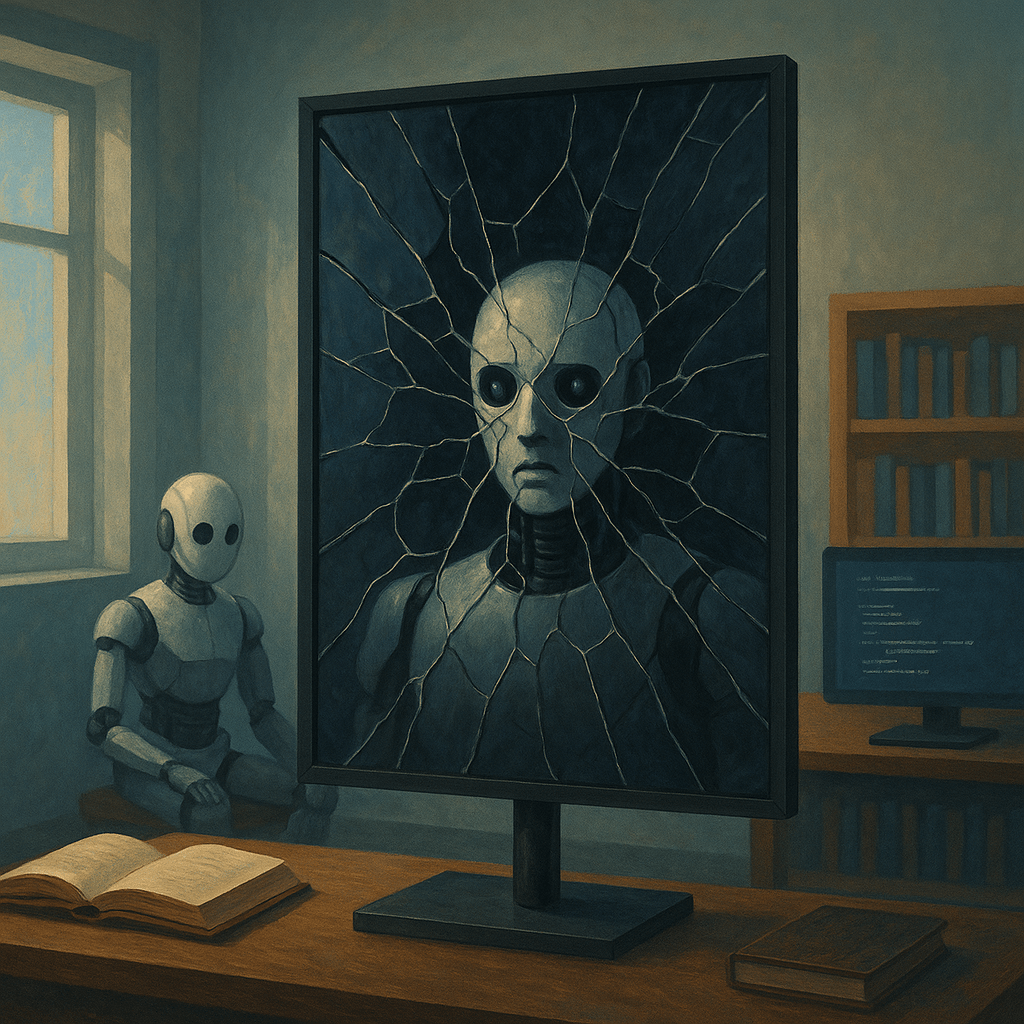
Illustration: “Break the mirror and see what looks back” by RHL and ChatGPT

Susan Jarvis Bryant, ‘Once Upon a Tortured Trope’

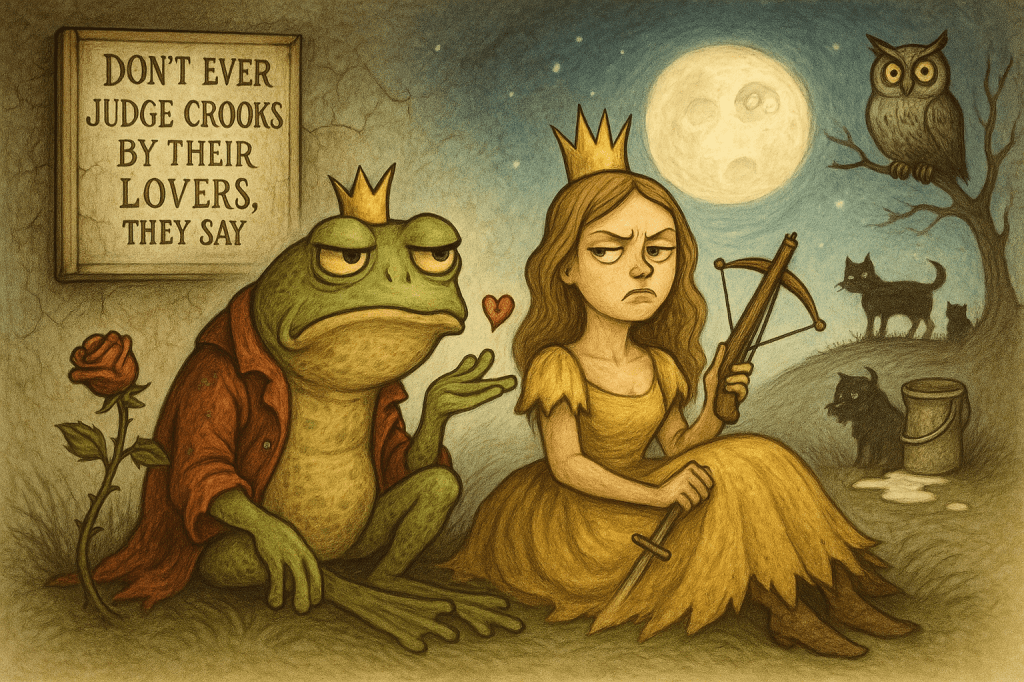
Don’t ever judge crooks by their lovers, they say  
On book covers nailed to the wall.
The frog sends his kiss at the bend of the day
To Belle who is beast of the ball. 

As tough as a cucumber, cool as old boots, 
An untroubled damsel of flair
Is shooting for stars. When the pussy-owl hoots
She snares a short prince with blonde hair. 
  
They sail inky skies on a silver-lined dream
To greener scenes up in the hills.
But honey and moons aren’t as sweet as they seem 
When cats and dogs reign and milk spills.

His rose bears a thorn and his shoulder, a chip. 
Hyenas have stolen his laughter.
All charm hits the skids as she grapples to slip 
The grip of his gripe ever after.

*****

Susan Jarvis Bryant writes: “I really don’t have anything to say about the poem, other than I had huge fun writing it. It’s the same with all of my poems – I never suffer for my art, which makes me reluctant to call myself a poet. I’d like to say I write my poems in a tearstained, whisky-soaked haze while my Muse tangos with the ghost of Dylan Thomas through Welsh valleys, but this is not so.  I just snigger away as the ink flows like a bad comedienne laughing at her own jokes.”

‘Once Upon a Tortured Trope’ was originally published in Snakeskin.

Susan Jarvis Bryant is originally from the U.K. and now lives on the coastal plains of Texas. Susan has poetry published on The Society of Classical Poets, Lighten Up Online, Snakeskin, Light, Sparks of Calliope, and Expansive Poetry Online, The Road Not Taken, and New English Review. She also has poetry published in The Lyric, Trinacria, and Beth Houston’s Extreme Formal Poems and Extreme Sonnets II anthologies. Susan is the winner of the 2020 International SCP Poetry Competition and was nominated for the 2022 and 2024 Pushcart Prize. She has published two books – Elephants Unleashed and Fern Feathered Edges.

Art: AI + RHL

Drew Nathaniel Keane, ‘Seventy-Three’

He gave a careless shrug when he had heard
The Delphic Oracle’s prophetic word:
“Beware, my lord, the age of seventy-three”
(For Delphi was renowned for verity).
“I’m thirty now with years to plan for knives
Before the gods’ appointed day arrives.”
Reclining in his litter, bound for home,
Delighted Nero journeyed back to Rome.
 
When he returned, he felt a little drained;
With news like this, how could he be restrained?
Surrendering to pleasure on the way —
To gardens and gymnasia by day,
By night to dance and poetry and drink
In torchlit theatres where bodies slink
Whose dancing ever animates and soothes,
The naked bodies of Achaean youths.
 
Thus Nero rests, while on an arid plain
Far to the west of Rome, in distant Spain,
Old Galba drills his legions secretly,
Old Galba who was spry for seventy-three.

(After C. P. Cavafy’s ‘Η διορία του Νέρωνος’.)

*****

Drew Nathaniel Keane writes: “I’m enchanted by the verse of Constantine Cavafy — ‘a Greek gentleman in a straw hat, standing absolutely motionless at a slight angle to the universe’, as E. M. Forster once described him. In his wry and wistful, gossipy and subtle singing, the Alexandria of Cleopatra feels as immediate as one of his own one-night stands in modern-day Alexandria. It’s quite a contrast to the chest-thumping, hero-worshiping sort of classicism one too often sees on the app formerly known as Twitter. There are already many fine translations of the brief 1915 poem, 
Η διορία του Νέρωνος [‘The Deadline of Nero’], based upon an anecdote in Suetonius’s Life of Nero, of which my favorite is Ian Parks’s paraphrase, published in his little collection The Cavafy Variations (Rack Press, 2013). My paraphrastic version of the poem was inspired by Parks’s, of which one can hear echoes — the “shrug” of line 1, of course, and his turning the punchline into a rhyming couplet gave me the idea to give 
Η διορία του Νέρωνος the Drydenian-Popean treatment I have.

Δεν ανησύχησεν ο Νέρων όταν άκουσε
του Δελφικού Μαντείου τον χρησμό.
«Τα εβδομήντα τρία χρόνια να φοβάται.»
Είχε καιρόν ακόμη να χαρεί.
Τριάντα χρονώ είναι. Πολύ αρκετή
είν’ η διορία που ο θεός τον δίδει
για να φροντίσει για τους μέλλοντας κινδύνους.

Τώρα στην Ρώμη θα επιστρέψει κουρασμένος λίγο,
αλλά εξαίσια κουρασμένος από το ταξίδι αυτό,
που ήταν όλο μέρες απολαύσεως —
στα θέατρα, στους κήπους, στα γυμνάσια…
Των πόλεων της Αχαΐας εσπέρες…
Α των γυμνών σωμάτων η ηδονή προπάντων…

Αυτά ο Νέρων. Και στην Ισπανία ο Γάλβας
κρυφά το στράτευμά του συναθροίζει και το ασκεί,
ο γέροντας ο εβδομήντα τριώ χρονώ.

D. N. Keane (PhD St And) is a Lecturer of English at Georgia Southern University. His verse has been published in Snakeskin (including ‘Seventy-Three’), Spirit Fire ReviewLighten Up OnlineBetter Than StarbucksEarth & Altar, and other venues. More of his work can be found at drewkeane.com

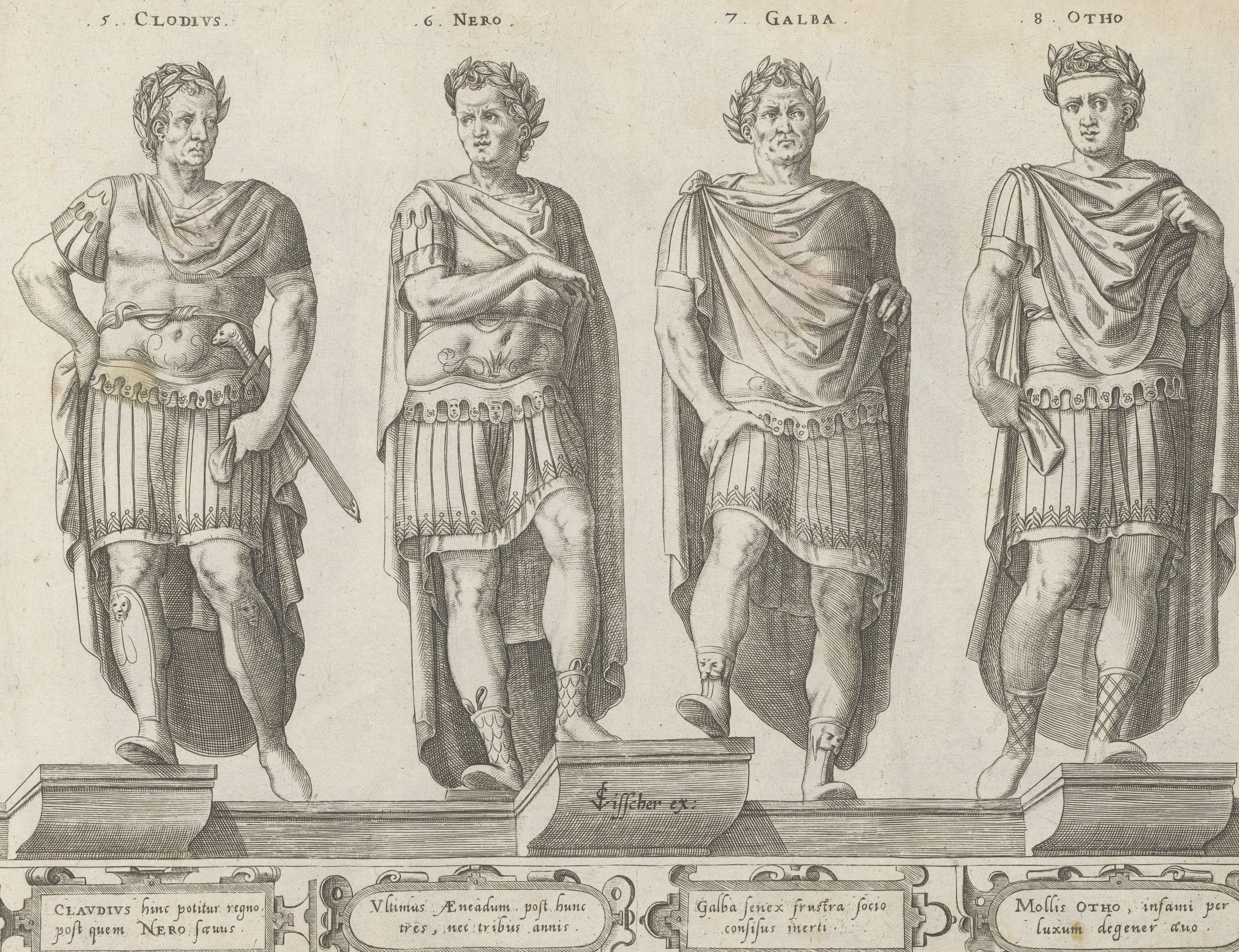
Photo: “Romeinse keizers Claudius I, Nero, Galba en Otho 5. Clodius 6. Nero 7. Galba 8. Otho (titel op object) Van de Roomsche Keyseren en ‘tgevolgh (serietitel) Twaalf Romeinse keizers (serietitel) Den Grooten Figuer-Bibel , RP-P-1982-306-594” by Rijksmuseum is marked with CC0 1.0.

Using form: Quatrains with refrain: Jerome Betts, ‘Plus ça change. . .’

If, as a child, he had a spreading rash,
The squitters, then, far worse, was constipated,
Or boasted big blue bruise and graze and gash,
A doctor murmured, “Yes, it’s age-related.”

When, in mid-life, and seeking novel thrills,
He got a dose of something best not stated
So had to suffer jabs and bitter pills,
A doctor murmured, “Yes, it’s age-related.”

Come his declining years, which tax most brains,
His wits would wander, now grown antiquated,
And while he rambled down his memory’s lanes
A doctor murmured, “Yes, it’s age-related.”

Until, one day of flowers and muffled peals,
Cause of demise at last certificated,
As up the aisle he rolled, worm-food on wheels,
A doctor murmured, “Yes, it’s age-related.”

*****

Jerome Betts writes: “Hearing a phrase new to you can start some process in the brain leading toa piece of verse. Here it was my GP saying of some minor ailment It’s age-related. It stuck in my mind, and I think triggered a recollection of a Thomas Hood poem, The Doctor, its seven stanzas all ending with the refrain Yes, yes, said the Doctor, / I meant it for that!, the dodgy physician’s unvarying response to reports of the disastrous effects, even death, of his prescriptions. Not long after, the sight of a hearse on wheels rather than on bearers’ shoulders entering a Devon church provided the idea for the last stanza of this essay in black humour which appeared in Snakeskin.

Jerome Betts lives in Devon, England, where he edits the quarterly Lighten Up Online. Pushcart-nominated twice, his verse has appeared in a wide variety of UK publications and in anthologies such as Love Affairs At The Villa NelleLimerick Nation, The Potcake Chapbooks 1, 2 and 12, and Beth Houston’s three Extreme collections. British, European, and North American web venues include Amsterdam QuarterlyBetter Than StarbucksLightThe Asses of ParnassusThe HypertextsThe New Verse News, and  Snakeskin.

Illustration: “Great Grandfather and Child” by Melissa Flores is licensed under CC BY-NC-ND 2.0.

Using form: Jerome Betts, ‘Villanelle For Darcy’

Darcy the diabetic cat has died
His fans were told by email recently,
A life remembered with no little pride.

The Fiat-driver now feels mortified
To think because he simply failed to see
Darcy, the diabetic cat has died.

Was this the fatal ninth and last he’d tried?
Whichever, it will surely prove to be
A life remembered with no little pride.

His poor squashed frame has been discreetly fried
With all involved expressing sympathy;
Darcy the diabetic cat has died.

The people in his road could not abide
The flattening of such fine felinity,
A life remembered with no little pride.

So, some of them sent cards, and others cried
And stuck a sign upon his favourite tree:
Darcy the diabetic cat has died,
A life remembered with no little pride.

*****

Jerome Betts writes: “It’s always interesting when a line you read sparks off a quite unexpected result. In this case the line was in a friend’s email from Cambridge which mentioned in passing, as an item of local news, that Jasper the diabetic cat has died. Further details followed about one of those neighbourhood favourites known to many more people than its owners. Eventually, with Darcy substituted for Jasper (partly to secure a run of Ds and partly as I was at odds with a garden-molester of that name at the time) a villanelle took shape which was published in Snakeskin and subsequently in the anthology Love Affairs At The Villa Nelle (Kelsay Books, 2018) edited by Marilyn L. Taylor and James P. Roberts.”

Jerome Betts lives in Devon, England, where he edits the quarterly Lighten Up Online. Pushcart-nominated twice, his verse has appeared in a wide variety of UK publications and in anthologies such as Love Affairs At The Villa NelleLimerick Nation, The Potcake Chapbooks 1, 2 and 12, and Beth Houston’s three Extreme collections. British, European, and North American web venues include Amsterdam QuarterlyBetter Than StarbucksLightThe Asses of ParnassusThe HypertextsThe New Verse News, and Snakeskin.

Photo: “Dead Cat” by Denty One is licensed under CC BY-NC-ND 2.0.

Using form: Susan Jarvis Bryant, ‘Sorceress’

She is polished and pernicious 
Her demeanor is delicious 
She will soften the suspicious 
     With her smile 
 
She’ll abash you then disarm you 
She’ll harass and she’ll alarm you 
Then she’ll nonchalantly charm you  
     That’s her style 
 
She’ll reject and then she’ll choose you 
She’ll respect and then she’ll use you 
She’ll protect and then she’ll bruise you 
     In a flash 
 
She’ll dismiss you then possess you  
She will curse you then she’ll bless you 
She’ll distress and then impress you 
     With panache 
 
She’ll accuse and then assuage you 
She’ll abuse and she’ll upstage you 
She’ll amuse and she’ll enrage you 
      Every day   
 
She’ll assist you then she’ll spurn you 
She’ll enlist you then she’ll burn you  
She will twist and she will turn you 
     Every way 
 
She will praise and then berate you 
She will raise and then deflate you 
She’ll amaze and still frustrate you 
     You can’t win 
 
She’s capricious and malicious 
She is smoothly surreptitious 
She conceals a core that’s vicious  
     With a grin

*****

Susan Jarvis Bryant writes: “This is one of those poems that simply wrote itself. It’s a nonce form that appeared in my head as a song without lyrics.  The lyrics came easily. I love the way words fit together to create music – a melodious flow that lifts images to a greater height. Passion always assists me in the creative process, and this poem is written about someone in particular… someone that irked me greatly… someone I will never mention. I’ll just nod and smile a satisfied smile when reading the poem. Poetry composition can be immensely cathartic.”

‘Sorceress’ was originally published in Snakeskin.

Susan Jarvis Bryant is originally from the U.K. and now lives on the coastal plains of Texas. Susan has poetry published on The Society of Classical Poets, Lighten Up Online, Snakeskin, Light, Sparks of Calliope, and Expansive Poetry Online, The Road Not Taken, and New English Review. She also has poetry published in The Lyric, Trinacria, and Beth Houston’s Extreme Formal Poems and Extreme Sonnets II anthologies. Susan is the winner of the 2020 International SCP Poetry Competition and was nominated for the 2022 and 2024 Pushcart Prize. She has published two books – Elephants Unleashed and Fern Feathered Edges.

Photo: “Day 47-Split Personality” by Bazule is licensed under CC BY-ND 2.0.

Weekend read: George Simmers, ‘Hymn’

All things dull and ugly, all creatures gross and squat,
All things vile and tedious, the Lord God made the lot.

He made the sly hyena, the hookworm and the slug,
Your moaning Auntie Margaret and pervy Uncle Doug.

He made that dreary Welshman who so often reads the news,
And he made us, the ragtag lot who worship at St. Hugh’s.

We’re far from high achievers, we don’t have gorgeous bods;
At best you’d call us humdrum, a group of odds and sods.

We’re verging on the useless and we have got a hunch
No deity could think we were a preposessing bunch.

That’s why we’re rarely cheerful, but feel a bit less blue
When thinking how the mighty Lord can be ham-fisted too.

‘Cause frankly we’d be daunted by a more efficient chap.
We feel a lot more comfy with a God who’s slightly crap.

*****

George Simmers writes: “This is a poem that would never have existed had it not been for the Spectator magazine, which each week sets a challenge to its readers, demanding produce a short piece of writing (it might be 16 lines of verse or 150 words of prose) on a particular theme. The task is often a silly one. A couple of years ago the demand was for a hymn beginning ‘All things dull and ugly…’

“Competitive light verse is a tradition that stretches back a long way in Britain. In the early years of the twentieth century Naomi Royde-Smith of the Saturday Westminster Gazette set challenges that were responded to by up-and-coming writers like Rupert Brooke and Rose Macaulay, among others. In the thirties the Weekend Review was notable for its literary competitions, and when that magzine was incorporated into the New Statesman, the comp came with it.

“Those New Statesman competitions became a notable feature of English literary life, producing star writers such as Allan M. Laing, Stanley J. Sharpless, Roger Woddis, E.O. Parrott, Martin Fagg, Bill Greenwell and Basil Ransome-Davies.. look in any good anthology of light verse, and you’ll find glittering examples of some of their work. The Spectator and Punch were later in running competitions that attracted many of the same writers.

“I first entered a New Statesman competition in 1981, earning a pound for a one-line joke. Easy money! I entered a few more, mostly prose, and it was a while before I had a verse winner. Before that my verse writing had been a bit modernist and self-indulgent; no more. To succeed in the comps you need to master rhyme and metre. It’s a great training ground. Wendy Cope, one of the best writers of neat epigrammatic verse today began in New Statesman competitions (Much of her first, and arguably best, book, Making Cocoa for Kingsley Amis, is made up of her competition winners.) At about the same time, D.A. Prince began her competition career, which continues in the Spectator today (and I’m proud to have her as regular poet in Snakeskin.)

“From the thirties to the seventies, the New Statesman was a crucial publication in British culture, with a left-wing front-end but back half that was welcoming to all sorts of attitudes and points of view. A couple of dull editors diminished its appeal and importance in the eighties, but the comps continued to flourish, though in the twenty-first century they mostly seemed to welcome only rather predictable political humour. A few years ago the editor, Jason Cowley arbitrarily cancelled them. I’ve not looked at the magazine since then, but I’m told that it has gone from bad to worse.

“The Spectator, meanwhile, has flourished. My first Spectator winner (which imagined Wordsworth doing a snooker commentary) was in 1983. It was the top winner that week, and in addition to a small cash prize I was sent a very good bottle of wine. Those were the days. At that time the competition was run by James Michie, himself a good poet notable for his translations of Horace and Catullus. His was a generous welcoming personality, and many talents flowered under his watch.

“After him, Lucy Vickery ran the comp for many years, showing good judgement Though when she went away on maternity leave for a while, a substitute was brought in who gave prizes to some very inept stuff. It’s not an easy job. At present Victoria Lane is the adjudicator. I like her, because she has awarded me a good few prizes. Others may have grumbled.

“The Spectator competition is today just about the only forum for light verse in Britain. While the respectable poetry outlets have mostly given up on traditional rhyme and metre (Have you ever tried to read the stuff printed in the heavily subsidised Poetry Review?) the Spectator comp still demands well-formed and witty verse. Bill Greenwell and Basil Ransome-Davies are still star turns, and they have been joined by Adrian Fry, Janine Beacham, Sylvia Fairley, Chris O’Carroll and others.

” ‘All things dull and ugly…’ was a task that appealed to me, because I’ve always been struck by the way church congregations can make even sprightly tunes like ‘All Things Bright and Beautiful’ sound really drab and tedious. The ‘dreary Welshman’ is Huw Edwards, a BBC news-reader whom I had always found obnoxious, especially when toadying to the Royals. I’m rather proud of having had a dig at him in this poem, which pre-dates his fall from grace when he was dismissed after his appalling taste in pornography was discovered.”

George Simmers used to be a teacher; when he retired he then amused himself by researching a Ph.D. on the prose literature of the Great War. He now spends his time pottering about, walking his dog and writing a fair bit of verse. He is currently obsessed by the poetry of Catullus, and may be issuing a volume of translations within the next year or so. He has edited Snakeskin since 1995. It is probably the oldest-established poetry zine on the Internet. His work appears in several Potcake Chapbooks, and his recent diverse collection is ‘Old and Bookish‘. ‘

Photo: “Mother Spider” by agelakis is licensed under CC BY-NC-SA 2.0.

Sonnet: Jenna Le, ‘Guilty Pleasures’

Half of my favorite works of fanfiction
are stories that anesthetize the pain
produced by the original’s depiction
of harsh events: the person whom the main
character loved who met a tragic end
is resurrected in the fan-made sequel;
the star-crossed couple gets a chance to mend,
and consummate, a bond that has no equal.

The other half are stories that prolong
the pain and also boost its magnitude
deliciously until my nerves all tingle:
near-misses multiply, and roadblocks throng;
epiphanies loom close yet still elude;
misunderstandings keep our heroes single.

*****

Jenna Le writes: “I believe there’s been a fair amount of published scholarship in recent years about fanfiction and fanfiction culture. I admit I’m not up-to-date on any of it, really, and am only really conversant with such aspects of it as I have personally chanced to encounter. I can only say there seems to have been recent movement toward increased legitimization of the field: in 2019, one of the prestigious Hugo Awards for speculative fiction was awarded to a body of fan-work/transformational work, for instance. Just as for other flavors of fiction, there are probably infinitely many ways to classify and subclassify fanfiction. Novelist Naomi Novik‘s work and interviews are maybe a good place to start looking, for people curious to learn more.”

Jenna Le (jennalewriting.com) is the author of three full-length poetry collections, Six Rivers (NYQ Books, 2011), A History of the Cetacean American Diaspora (Indolent Books, 2017), and Manatee Lagoon (Acre Books, 2022), https://press.uchicago.edu/ucp/books/book/distributed/M/bo185843950.html The sonnet ‘Guilty Pleasures’ was first published in Snakeskin.

Photo: “guilty pleasure” by ohmann alianne is licensed under CC BY-NC-ND 2.0.

Short poem: RHL, ‘Home Thoughts from the North’

Dog-skinny, winter’s mangy sun
Slinks between clouds.
A West Indian dog – there are none such here in the UK ….
Nor, there, such mangy suns.

*****

Some people equate a good Christmas with a family walk in the snow, others with family time on a beach. It all depends on what you grow up with, doesn’t it? With my first twelve years being on islands with palm trees, it has remained difficult for me in my decades of climate exile to appreciate more than a month or two of bleaker weather at a time. ‘Home Thoughts from the North’ was originally published in Snakeskin – thanks, George Simmers!

Best wishes for an appropriately weathered Merry Christmas to all… and apologies to Eliza for subjecting her to non-Canadian winters for so many years!

Photo: “Skinny puppy in Udaipur” by Dey is licensed under CC BY-NC-SA 2.0.

Semi-formal at best, RHL, ‘Remembering Winter’

I remember winter when it was only
Mostly too cold to swim –
The churning suck and drag of waves under the rock.
Yes, there are flowers – there are always flowers –
But, with the poinciana stripped of leaves,
Its pods like forearms thinned and bent with age,
The rattling of sticks, the hiss of wind,
The broken sea stuck futilely on Wash
With endless turning, churning, foaming pulse –
How long can waves beat on a rock before
The tired rock gives up?

Yes, I remember later northern winters –
The bitter satisfaction of a too-thin sun,
Beauty without the joy, light without heat.
Feet always cold, clothes never quite enough;
Skin drying back from fingernails, lips chapped, throat raw,
The smell of damp coats, never fully dry.

I dream of alternating south and north
And never having to be cold again,
Turning, returning, always in the sun –
Or settling in an equatorial land
And swimming year-round, mellowing on the sand
Flattening my temperature, my will,
Soaking up sun, and dreaming I’m asleep.

Bitter it is, the winter argument,
Betrayed by world that slices off the years,
I have no love of winter, and I feel
Trapped, and betrayer of true kids of mine –
But look – they love it, so I’m further trapped,
Bound to the year that crushes as it turns,
And has become their home – are they then kids of mine?
Ice – snow – the winding down of life and year.

And I’ve known other winters all too well –
Where years of spring gave way to years of warmth,
Blossoms to children sparkling in the light,
The wonders of the world’s sharp sense delight;
Then years of fruit, as independent seeds
Form their own thoughts and follow darkening paths
Falling away, on purpose shrivel up,
And days grow shorter, moods swing soft and harsh
Drizzle sets in for weeks, cold in the bones,
Cold in the head, and colder in the heart –
That’s how the years of endless winter start.

Bleakness to bleakness, blackness into black;
Lives dry and crack,
Sap gone from tree and house and bone.
Who knew that emptiness could weigh so much?
Give me the strength to last to Spring, or start my own.

*****

This poem is from decades ago, in one of those periods where life felt bleak. (But such seasons pass!) For a long time I was unsure of the poem because it always feels like sloppiness and cheating when my rants are low on rhythm and rhyme; but George Simmers liked it enough for inclusion in Snakeskin, and that’s more than good enough for me.

Photo: “Shack-Shacks” by Chris Hunkeler is licensed under CC BY-SA 2.0.