Tag Archives: Ted Hughes

Odd poem: Parody of a Self-Parody of a Self-Parody: Melissa Balmain, ‘How Unpleasant to Meet Mrs. Hughes’

From the files of Sylvia Plath

How unpleasant to meet Mrs. Hughes,
Who’s so thoroughly, willfully odd.
It’s a wonder Ted happened to choose
Such a creature. (He’s rather a god.)

Her lipstick is always a mess.
She’ll go on for an hour or three
About Nazis or bees—as you’d guess,
This does not get her asked out to tea.

Her headbands aren’t quite comme il faut.
(They’re a match for her queer Yankee frocks.)
She knows more than a lady should know
Of low-voltage electrical shocks.

Come to think of it, lately she’s been
More appalling than ever before.
She looks sullen and terribly thin;
If you knock, she won’t answer the door.

Her complexion grows whiter and whiter.
She wears the most horrible shoes.
You can certainly tell she’s a writer.
How unpleasant to meet Mrs. Hughes!

*****

Melissa Balmain writes: “I believe this one started when a contest—probably in The Spectator—called for poems riffing on Edward Lear’s self-mocking ‘How Pleasant to Know Mr. Lear’ (and T.S. Eliot’s equally self-mocking parody of it). I found it funny and sad to imagine Sylvia Plath writing about how her English neighbors might see her. The poem was published in Mezzo Cammin.”

Melissa Balmain’s third poetry collection, Satan Talks to His Therapist, is available from Paul Dry Books (and from all the usual retail empires). Balmain is the editor-in-chief of Light, America’s longest-running journal of light verse, and has been a member of the University of Rochester’s English Department since 2010.

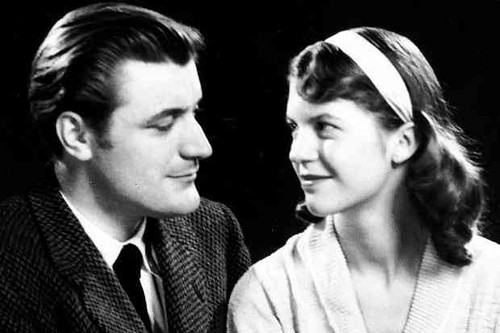
Photo: “TED HUGHES AND SYLVIA PLATH” by summonedbyfells is licensed under CC BY 2.0.

Poems on poets: A.M. Juster, ‘Houseguests’

There’s shouting by the stove (it’s Plath & Hughes)
as Wystan wanders off without his shoes
and Whitman picks the Cheetos off his beard.
The Larkin-Ginsberg chat is getting weird,
for after countless hours they have found
bizarre pornography is common ground.
Old Emily is not
As prim as billed—
When Dylan finds her bra-hooks—
She is thrilled.
Poe strokes his bird; Pound yawps that it’s a pity
Eliot can’t sleep without his kitty.
Rimbaud’s on eBay searching for a zebra
while sneering, “Oui, a cheemp can write vers libre!”
The Doctor’s soggy chickens start to smell
and Stevens has insurance he must sell.
The readings are spectacular, I know,
but is there any way to make them go?

*****

A.M. Juster writes: “This was first published in The Barefoot Muse. It looks like I wrote it in late 2008, it was a fairly prolific period for me and I was a little distracted because I was running the Social Security Administration. (Under his unpoetic name, Michael J. Astrue. – Editor). I don’t remember now the impetus for writing it, but I did enjoy taking these poetry idols off their pedestals and making them more human for a few laughs. This was about the time that I finished my translation of Horace’s Satires in something like 1850 heroic couplets, so I was much more comfortable with the form than I would have been five years before. I think the imitation of Emily Dickinson’s form is an amusing touch for the reader, although it is undetected when I read it because it remains in rhymed iambic pentameter.”

A.M. Juster’s poems and translations have appeared in Poetry, The Paris Review, The Hudson Review and other journals. His tenth book is Wonder and Wrath (Paul Dry Books 2020) and his next book will be a translation of Petrarch’s Canzoniere, which W.W. Norton will release in early 2024. He also overtweets about formal poetry @amjuster.

Photo: “me drunk & chris’_MMVI” by andronicusmax is licensed under CC BY 2.0.

Susan McLean, ‘The Whetstone Misses the Knife’

I answered your desire to meet
resistance and be honed by friction.
Sharp as you were, you couldn’t beat
the zero-sum of contradiction.

Abrasion was your privilege,
the only stroking I have known.
Now you have lost your cutting edge
and I am just another stone.

*****

Susan McLean writes: “This poem was inspired indirectly by the suicide of a talented poet whom I had seen at conferences, but had never had a conversation with. I heard that she had killed herself on Christmas Eve because of an unhappy love affair. Since I knew nothing about her personal life, this poem is not about her, but her fate made me think about unhappy relationships, particularly those in which both partners have strong but conflicting personalities. I had in mind such stormy creative relationships as those of Sylvia Plath and Ted Hughes, Diego Rivera and Frida Kahlo, Camille Claudel and Auguste Rodin, in which the clashes are initially part of the attraction, yet turn destructive eventually. However, the imaginary relationship depicted in this poem is not based on the specifics of any of those relationships.
Balance and antithesis are the key characteristics of the theme of this poem, so I thought two quatrains with a rhyme scheme of ABAB would give equal weight to the “I” and the “you” of the poem.
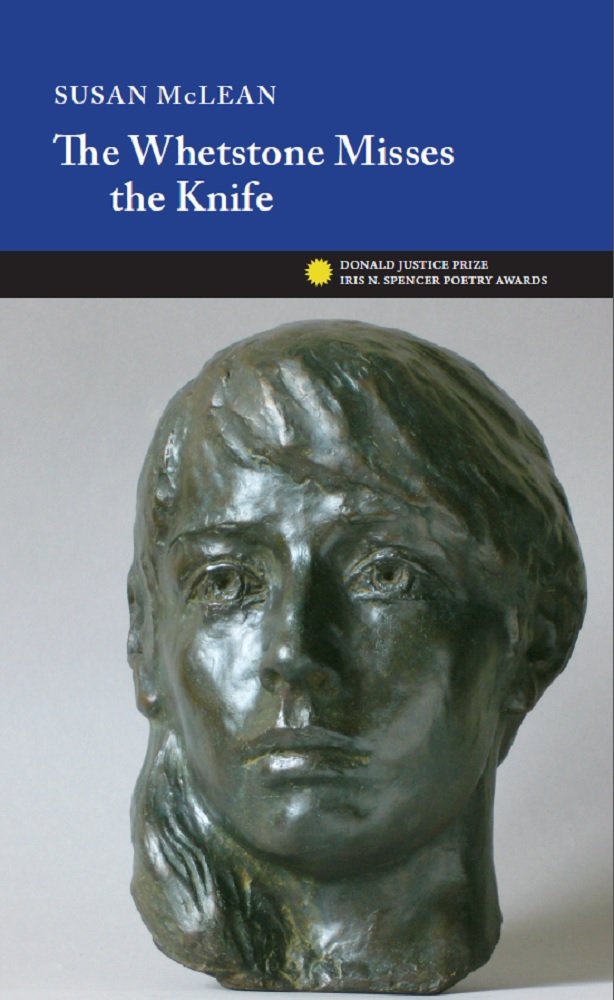
This poem first appeared in Mezzo Cammin, an online journal of female formalist poets, and later was published in my second book, The Whetstone Misses the Knife, which featured a bronze bust of Camille Claudel by Jacques Chauvenet on the cover.”

Susan McLean has two books of poetry, The Best Disguise and The Whetstone Misses the Knife, and one book of translations of Martial, Selected Epigrams. Her poems have appeared in Light, Lighten Up Online, Measure, Able Muse, and elsewhere. She lives in Iowa City, Iowa.
https://www.pw.org/content/susan_mclean

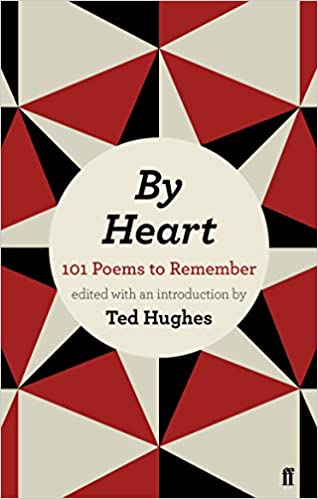
Review: ‘By Heart – 101 poems to remember’, ed. Ted Hughes

This book’s theme is the memorisation of poems, and there are things I like and things I don’t like about both Ted Hughes’ introduction to the subject and the 101 poems that he has chosen.

First, the introduction. I like that it encourages people to learn poems by heart. But although the book’s title is ‘By Heart‘, Hughes instead teaches ‘by head’. His method is extremely cerebral, using the kind of image-association-chain taught by neuro-linguisitic program consultants to help you remember the names of business associates and clients. Hughes would have you construct a Cumberbatch-Sherlock Holmes ‘mind palace’. Taking Hopkins’ poem ‘Inversnaid’ as an example, Hughes explains that the opening lines
This darksome burn, horseback brown,
His rollrock highroad roaring down,
can be dealt with as follows:
For ‘peaty burn’ it might be enough simply to imagine, like a frame in a colour film, a dark torrential mountain stream coming down among boulders. But to make sure it is ‘burn’ and not ‘stream’ that you remember, it might be better to imagine the stream actually burning, sending up flames and smoke: a cascade of dark fire, scorching the banks. The next item, ‘brown horse’, now has to be connected to the burning stream. The most obvious short-cut is to put the horse in the torrent of fire, trying to scramble out – possibly with its mane in flames.
He then goes on to connect it to the horse causing an avalanche (rollrock highroad) which comes down on a lion (roaring down), and so on.

My difficulty with all this is that the images he is creating are simply not what the poem is about. When Hopkins writes ‘burn’ meaning stream, it’s not appropriate to set it on fire. Of course the poem summons up images, and they are useful for memorizing… but for godssake, why not think of it as a Scottish stream rather than setting it on fire? The burn is brown and in spate, and rocks are rolling down it and it makes a roaring noise – and that is the picture you can hold in your head as you recite Hopkins’ lovely rich words, without having to involve fires, animals and avalanches.

It seems to me that Hughes is in danger of losing the beauty of the actual poem by going through his ‘mind palace’ activities. He appears to be reducing the memorisation of poetry to a party trick, performed at the expense of the poem itself. If he didn’t love the poem for its actual imagery, what did he love it for? When he memorised a poem, did he check it off and then forget it? Wouldn’t all the peripheral imagery have gotten in the way when he tried to recite the poem a few decades later? Better and safer to my mind to stay with the essential images and the richness of the language, rather than setting fire to a stream because the poet uses the word ‘burn’.

And this leads in to my thoughts about the selection of the 101 poems to be learnt by heart. Auden, Blake, Dickinson, Eliot, Frost, Wordsworth and Yeats each get at least five poems, and Shakespeare over a dozen. The less-represented poets are a wider mix, from John Betjeman to Elizabeth Bishop, Elizabeth Barrett Browning, Lewis Carroll… The poems themselves are interesting, and many of them are perfect for memorising, so it is a worthwhile read.

But I don’t think it appropriate to waste five or six pages on the 130 or 170 lines of Blake’s ‘Auguries of Innocence’ or Wordsworth’s ‘Tintern Abbey’. Perhaps Ted Hughes learnt those two along with Blake’s ‘The Tyger’ and Wordsworth’s ‘Upon Westminster Bridge’, but the latter two are far more suitable than the former for a book that is meant to encourage others to achieve memorisation.

Again, most of the poems are good for learning by heart, but too many of them have none of the qualities that make it easy to learn poetry in English: rhyme, metre, alliteration, wordplay. William Empson’s translation of the Japanese poem ‘From the Small Bird to the Big’ is interesting, but inappropriate for this book. The same goes for Pound’s ‘The Return’ and Eliot’s ‘Marina’ – inappropriate because they are missing the music, the song-like qualities, that make memorisation easy. Easy, that is, if you are learning by heart, as the book’s title requires.