Tag Archives: using form

Using form: Couplets/Sonnet: Gail White, ‘Prayer Updated’

To Anyone who still may be
attentive from Infinity,
we bless you from our dot in space
and thank you for our privileged place.

Give us this day on which to feed
a bit more gluten than we need,
and when we’re adequately fed,
help us to get and stay ahead
and save for our retirement
enough plus twenty-five per cent.

May old age find us cheerful still,
our life in order like our will,
with neither pain nor care nor debt.
Thy kingdom come, but not just yet.

*****

Gail White writes: “Religion and irony are not incompatible I find that a good deal of poetry comes from taking a speculative or questioning view of Bible stories (e.g, how did Adam and Eve react to the murder of Abel by Cain? We don’t hear a peep out of them about it.) And I’ve often said that if God hadn’t wanted at least one cynical feminist poet, I wouldn’t exist.”

‘Prayer Updated’ was published in the current issue of Lighten Up Online.

Gail White is the resident poet and cat lady of Breaux Bridge, Louisiana. Her books ASPERITY STREET and CATECHISM and the chapbook SONNETS IN A HOSTILE WORLD are available on Amazon. She is a contributing editor to Light Poetry Magazine. “Tourist in India” won the Howard Nemerov Sonnet Award for 2013. Her poems have appeared in the Potcake Chapbooks ‘Tourists and Cannibals’, ‘Rogues and Roses’, ‘Families and Other Fiascoes’, ‘Strip Down’ and ‘Lost Love’.

Illustration: “Global Prayer” by thorntonsdigital is licensed under CC BY-ND 2.0.

Using form: Pantoum: Brian Allgar, ‘And then I told you’

We kissed. And then I told you (it was over
dinner at some fancy restaurant)
I loved you, but I couldn’t live like this,
meeting from time to time; I needed more.

Dinner at some fancy restaurant,
and timid sex at your place; that was all, each
meeting. From time to time, I needed more
than you were ready for, so reticent

and timid. Sex at your place – that was all. Each
meeting’s end, I tried not to ask more of you
than you were ready for. So, reticent,
I touched your face in silence, lovingly.

Meetings end. I tried not to ask more of you;
I loved you, but I couldn’t live like this.
I touched your face. In silence, lovingly,
we kissed, and then I told you it was over.

*****

Brian Allgar writes: “In general, I don’t much care for poetic forms, such as the triolet and the villanelle, with repeated lines. But I was attracted by the pantoum’s requirement that the repeated lines, though containing exactly the same words, should somewhat change in meaning each time.”

‘And then I told you’ was first published in Snakeskin.

Brian Allgar was born a mere 22 months before Adolf Hitler committed suicide, although no causal connection between the two events has ever been firmly established. Despite having lived in Paris since 1982, he remains immutably English. He started entering humorous competitions in 1967, but took a 35-year break, finally re-emerging in 2011 as a kind of Rip Van Winkle of the literary competition world. He also drinks malt whisky and writes music, which may explain his fondness for Mendelssohn’s Scottish Symphony. He is the author of The Ayterzedd: A Bestiary of (mostly) Alien Beings and An Answer from the Past, being the story of Rasselas and Figaro. He is also the co-author, with Marcus Bales, of Baleful Biographica, all published by Kelsay Books and available from the publisher or from Amazon.

Photo: “French restaurant with Jean” by obvio171 is licensed under CC BY-SA 2.0.

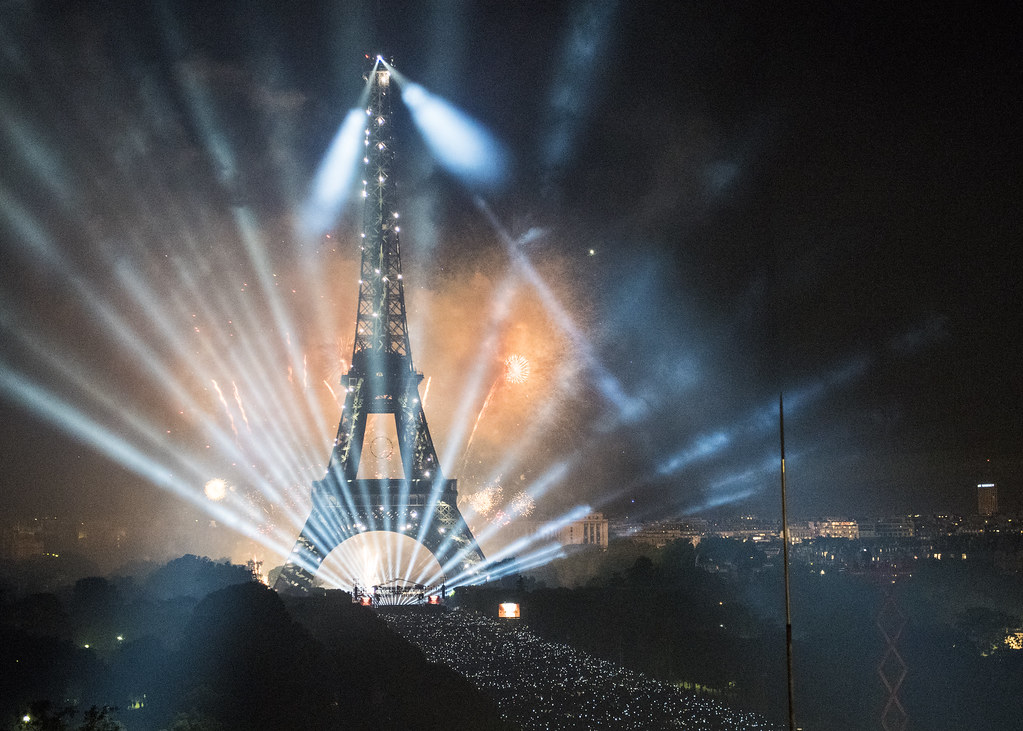
Weekend read: Odd poem: French President Emmanuel Macron, ‘Pour Sophie’

On a trip to Paris one day, little Sophie
Met a giant lady lighting up the night sky.
“What’s your name, you magical monster?”
“My many visitors call me the Eiffel Tower.”
“In all your attire, don’t you sometimes tire
Of being seen only as a humdrum tower?
You, a dragon, a fairy watching over Paris,
An Olympic torch held aloft in grey skies?”
“How you flatter me! So few poets these days
Ever sing the praises of my Parisian soul,
As did Cocteau, Aragon, Cendrars,
Trénet and Apollinaire… Since you’re so good
At seeing beneath the surface, you could
– If you like, when you’re back from France –
Take up your pen and write down
Why you like me – it would be nice and fun!”
“You can count on me! There’s so much to say!
I’ll write twenty lines… but who will read them?”
“Well, I know a man who’ll read your verse.”
“Really? Who?”
“The President of France.”

En voyage à Paris, la petite Sophie
Croisa une géante illuminant la nuit.
“Comment t’appelles-tu, monstre surnaturel?”
“Mes nombreux visiteurs m’appellent Tour Eiffel.”
“N’es-tu pas parfois lasse, avec tes mille atours
Que l’on ne voie en toi qu’une banale tour?
Toi le dragon, la fée, qui veille sur Paris,
Toi, immense flambeau planté dans le ciel gris!”
“Quel plaisir tu me fais! Ils sont devenus rares
Ceux qui comme Cocteau, Aragon ou Cendrars,
Trenet, Apollinaire, avaient su célébrer
Mon âme parisienne aux charmes singuliers.
Puisque tu sais si bien percer les apparences,
Tu pourrais, si tu veux, à ton retour de France,
Prendre à ton tour la plume et conter en anglais
(It would be nice and fun) ce qui chez moi te plaît!”
“Tu peux compter sur moi! Il y a tant à dire!
Je t’écrirai vingt vers… Mais qui voudra les lire?”
“Oh, moi j’en connais un qui lira ton cantique.”
“C’est?”
“Monsieur le président de la République.”

*****

This poem by French President Emmanuel Macron is in French alexandrine: 12 syllable lines, rhyming couplets. The translation is either by him (he is fluent in English) or by the French Embassy in London, as the poem was written for the English girl Sophie’s 13th birthday. She herself had initiated everything with the poem below, which she had sent in April 2017 to the French President… at that time the President was François Hollande, but Macron won the presidency later that year, and responded for Sophie’s birthday on November 1st. Her poem was 20 lines long, written out on her drawing of the Eiffel Tower; his response is also 20 lines long (counting the final question and answer as a single line, which it clearly is by metre and rhyme).

Here is 12-year-old Sophie’s ‘Centre of Attention’:

She has four beautiful legs,
Which help her stand proud,
She looks over everyone,
With her head in the clouds,
She is elegant and tall,
Wears a pretty, lacy skirt,
Whilst staring at her in awe,
Your eyes will not avert,
Her spine is amazingly straight,
Whilst her head touches the sky,
People look up and take pictures of her,
As they are passing on by,
You need to tilt your head up,
To be able to see all of her,
But when you do,
She is as pretty as a picture,
She is the centre of attention,
Noticed by everyone.
She is the Eiffel Tower,
She is second to none.

Macron created a nice circularity with his response to Sophie’s poem, by pretending it was written first and caused Sophie’s poem, rather than the other way round. All very playful.

Photo: “170714-D-PB383-151” by Chairman of the Joint Chiefs of Staff is licensed under CC BY 2.0.

Weekend read and listen: RHL, 3 audio + text poems

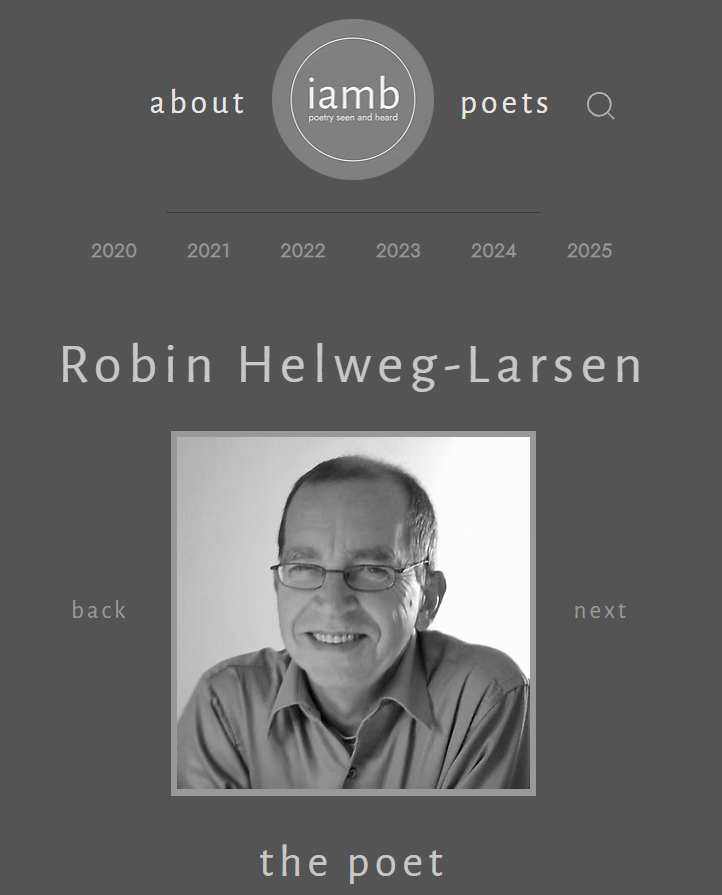
“iamb – poetry seen and heard” is the creation of Mark Antony Owen, showcasing poets with their readings of three of their poems. Begun in 2021, Mark describes his project as “part library of poets, part quarterly journal, iamb is where established and emerging talents are showcased side by side. Not just their words, but their readings of them. Expect new poems, every three months, free to your device of choice.”

Accompanied by an out-of-date photograph, three of my poems are available here. They are not among my most recent work, but they are favourites and I chose them for their very different moods, themes, and forms: ‘Camelot at Dusk’, ‘Old Sailors’, and ‘This Ape I Am’. And their use of form sets them apart from all the other poems in this 21st ‘wave’ of iamb. I can’t decide if I am stuck in the past, or write in the style of the only verse that has a chance of being remembered in 100 years. But maybe that’s not an either/or – maybe only verse that is rooted in the historical rhythms of the language will last. So I suspect.

​Auditions will reopen in September for next year’s waves.

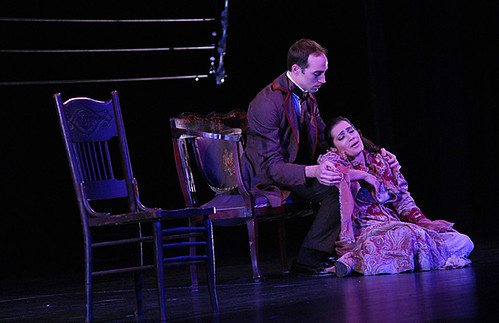
Using form: Ballade variant: Barbara K. Loots, ‘Opera: a Ballade’

Sometimes the heroine is just a girl,
an innocent set up to be betrayed.
Whether she loves a hero or a churl,
she’ll face a three- or four-hour escapade
in which her feelings and her fate are swayed
by charm, by force, deception, or disguise
she’s helpless to resist or to evade.
And then she dies.

Sometimes around the heroine unfurl
fate’s sinister entrapments. Undismayed,
she feels the storm of accusation swirl
and knows the price of honor must be paid.
Beset by Powers That Must Be Obeyed,
she suffers while the chorus vilifies.
Her hopes of justice and redemption fade.
And then she dies.

Sometimes the heroine, a perfect pearl,
whether a princess or a village maid,
regardless of her protest or demurral,
becomes the object of an evil trade,
a bloody game, a sinister charade,
with hidden motives and transparent lies,
with clash of insult and with flashing blade.
And then she dies.

Through every lamentation and tirade,
each heroine embraces her demise
despite how fervently she might have prayed.
And then…

*****

First published in Light with the note “After watching 33 free streamed operas from the MET during quarantine.” Barbara Loots writes: “Watching those gorgeous productions from the MET day after day during COVID confinement was a saving grace. I have a journal with a complete list, where I starred the ones I liked best for future reference. Kansas City’s excellent Lyric Opera recording of the brand new opera “The Shining” (yes, based on the horror story by Stephen King) recently won a Grammy.”

Barbara Loots resides with her husband, Bill Dickinson, and their boss Bob the Cat in the historic Hyde Park neighborhood of Kansas City, Missouri. Her poems have appeared in literary magazines, anthologies, and textbooks since the 1970s. She is a frequent contributor to Light. Her three collections are Road Trip (2014), Windshift (2018), and The Beekeeper and other love poems (2020), at Kelsay Books or Amazon. More bio and blog at barbaraloots.com

Photo: “This picture makes me happy” by James Jordan is licensed under CC BY-ND 2.0.

Using form: Parody with a message: Marcus Bales, ‘The Easy Way Taken’

Two friends diverged in a yelling mood
And sorry I could not keep them both
And still maintain one attitude,
I scrolled down through one’s page, and viewed
Some green and gold of writing growth.

Then saw the other was just as good,
With maybe even a better claim
Because so well misunderstood
Within the writing neighborhood,
Though as for that they’re much the same.

And each that morning equally laid
The blame upon the other’s back.
I had no way to tell who’d made
The first or worst move; I’m afraid
I have no feel for clique or claque.

Online I have too many friends
To keep good track, so, nothing loath
To making enemies or ends
Where there are no real dividends,
I shook my head – and blocked them both.

*****

Marcus Bales writes: “Most of the fraught relationships online are due to people not being able to write very well on one end, or read very well on the other. Stuff that in in-person conversation would go completely unnoticed is taken up as deliberate slighting. Mostly its merely awkward phrasing, or one interlocutor is already two comments past when the reply to the third interaction scrolls by and it’s misinterpreted as an instant response to the most recent reply when it was really intended to answer something two or three comments back.

“Now in the case of political disagreements where the polarized sides are already firmly established and one side or the other or both are determined to fight that’s a whole other thing. There it’s got nothing to do with how well or ill something is read or written and everything to do with the sport of online woofing.

“It’s one of those things where over the years people block and get blocked and complain to their friends about either end of it and then it all goes away pretty fast as the opportunity to be triggered — again at either end — fades with the blocking.”

(The original poem on which this parody is based, for those not familiar with it, is Robert Frost’s ‘The Road Not Taken‘. – RHL)

Not much is known about Marcus Bales except that he lives and works in Cleveland, Ohio, and that his work has not been published in Poetry or The New Yorker. However his ‘51 Poems‘ is available from Amazon. He has been published in several of the Potcake Chapbooks (‘Form in Formless Times’).

Photo: “Yotsuba & Tech Support” by Liberty Photos is licensed under CC BY-NC 2.0.

Using form: Rondeau: J.D. Smith, ‘Sans Issue’

What ends with me? A set of genes,
The notion that my slender means
Might turn into a son’s estate,
The hope that, at some distant date,
Beside my grave, my line convenes

To recollect my days’ routines,
My counsels, and the vanished scenes
Whose witnesses would recreate
What ends with me:

The consciousness that struts and preens
In holding that its passing means
An altering of our species’ fate,
My thought possessed of untold weight.
Yet, on that thought, the question leans–
What ends with me?

*****

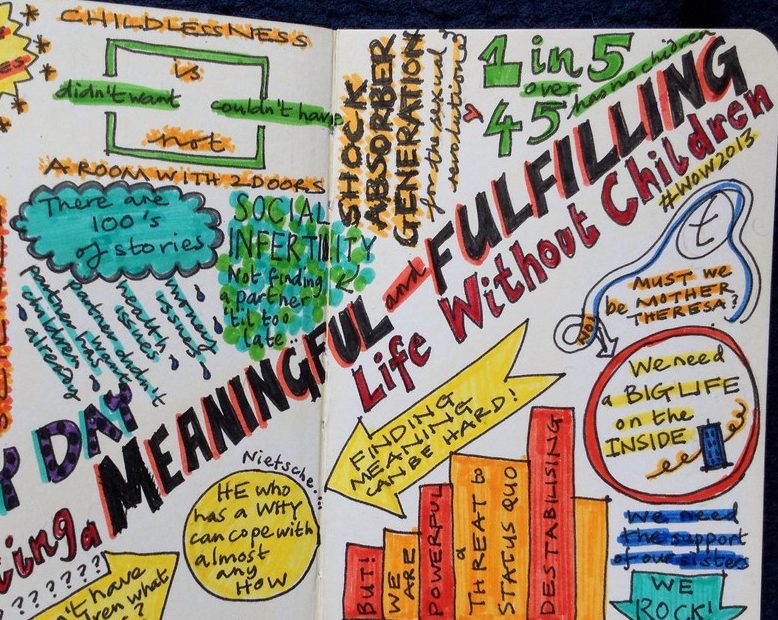
J.D. Smith writes: “After reaching a certain age and making certain commitments, I found myself coming to grips with never being a parent. As in other instances of following form, the repetitions of the rondeau gave me a way to enclose and develop my response to the situation.”

J.D. Smith has published six books of poetry, most recently the light verse collection Catalogs for Food Lovers, and he has received a Fellowship in Poetry from the United States National Endowment for the Arts. This poem is from The Killing Tree (Finishing Line Press, 2016). Smith’s first fiction collection, Transit, was published in December 2022. His other books include the essay collection Dowsing and Science, and his seventh collection, The Place That Is Coming to Us, will be published by Broadstone Books in 2025. Smith works in Washington, DC, where he lives with his wife Paula Van Lare and their rescue animals.
X: @Smitroverse

Photo: “Creating a meaningful and fulfilling life without children #sketchnotes #gatewaywomen #jodyday” by etcher67 is licensed under CC BY-NC-ND 2.0.

Using form: Shakespearean sonnet: Susan McLean, ‘Foreshadowing’

You’re a holiday.
—”Holiday,” The Bee Gees

One month from when you met me, when you brought
the first of many gifts, a 45
of plaintive praise and longing, who’d have thought
that forty-five years later we’d survive
on weekends, holidays, and summer breaks,
a foretaste of the end in every start,
anticipation ballasted with aches
as we put love on hold and live apart?

You are a holiday. The working week
unspools like toilet paper from a roll.
My attitude goes airborne when we speak,
and when we meet, my heart swoops like a shoal
of fish. Would we have lost this giddy glow,
living together? Better not to know.

*****

Susan McLean writes: “It makes me feel ancient to realize that for younger readers I will have to explain that a 45 was a record with one song on each side, which played on a record player at 45 revolutions per minute. Love poems themselves tend to feel old-fashioned these days, though this one is about a relatively modern problem, the long-term, long-distance relationship in which both people are employed full time at jobs far apart from one another. The form, a Shakespearean sonnet, mirrors the content, in that the rhymes are separated from one another until the end, when they are reunited. The poem was originally published in the online journal of female formalist poets Mezzo Cammin, and it later appeared in my second book of poetry, The Whetstone Misses the Knife.

Photo: “File:45 record.png” by laurianne is marked with CC0 1.0.

Using form: William Trowbridge, ‘Song of the Black Hole’

radially extracted by NASA

You can almost see Vincent Price, black-robed,
hunched above the console of a jumbo organ
in the bowels of his creaky haunted manse; or
maybe a stadium of damned souls, strobed
in lurid red and howling nettle-robed
as they plummet into Pandemonium, pore
and pith aflame. It’s no troubadour,
undoubtedly, this vast atonal gob.

As with the Roach Motel, we’d check in,
but never out—us or anything, since
it can swallow errant planets whole, and still,
however much the mass, can’t eat its fill.
Though it’s larger far than Jupiter or Mars,
we can barely see it, thank our lucky stars.

*****

 William Trowbridge writes in Rattle, where this poem was published: “I’ve spent most of my years as a poet writing free verse, though lately I find myself turning toward form. Unlike those who see formalist verse as dry and effete, I find it can generate power by means of barriers to play against—‘the net’ as Frost put it, by which he also meant boundary lines. If you pour gunpowder in a pile and light it, a mere flash occurs. But pack it tightly into a container, and you can get something more powerful. And, as opposed to the notion that form is restrictive, I agree with Richard Wilbur that it often liberates one from choosing the easy word in order to discover the better, surprising one. I haven’t moved into this part of town yet, but I stop there more and more.”

William Trowbridge’s tenth poetry collection, Father and Son, was published by Wayne
State College Press Press in April. His poems have appeared in more than 45
anthologies and textbooks, as well as on The Writer’s Almanac, AnAmerican Life in
Poetry, and in such periodicals as Poetry, The Gettysburg Review, The Georgia Review,
The Southern Review, Plume, Rattle, The Iowa Review, Prairie Schooner, Epoch, and
New Letters. He is a mentor in the University of Nebraska-Omaha Low-residency MFA
in Writing Program and was Poet Laureate of Missouri from 2012 to 2016. For more
information, see his website, williamtrowbridge.net.

YouTube: Data Sonification: Black Hole at the Center of the Perseus Galaxy Cluster (X-ray), NASA’s Marshall Space Flight Center

Weekend read: Maryann Corbett, ‘A Valediction: of Maintenance Work’

Time was, we spent our muscle and our nous
propping an aging house
against the pummeling of its hundred years.
Clean paint, neat gardens, upkeep rarely in arrears,
sober as Donne. Yet now each year afresh
burdens us with new failings of the flesh:

Legs that once mounted ladders without qualm
tremble. Nor are we calm
confronting pipework; torsos will not shrink,
backs bend, or shoulders fold to grope below a sink.
Hands shake; eyeballs glaze over. What appalls
is that our bodies buckle like our walls:

plaque in arteries, soot in chimney stacks,
stubborn and troublous cracks
in teeth, in plaster. House! Ought we to call
ourselves—and you—new poster children for the Fall,
for that hard doctrine grumbling down the ages
that Sin’s to blame, with Death and Rot its wages?

Entropy as theology—would Donne
jape at it? Wink and pun
as in his randy youth? Or solemnly
robed in his winding sheet, sing Mutability,
spinning into the praise of God in Art
the fact that all things earthly fall apart?

Or pull from air some bit of modern science,
yoking (even by violence)
thermodynamics, shortened telomeres,
transplants, genetics, sex, the music of the spheres?
Strange physics and wild metaphors—all grand,
but Rot and Death, plain woes we understand,

are better fought with checkbooks than with verse.
We’ll sit, these days. We’ll nurse
our beers, while able bodies stir their dust.
A distant siren whines—we sigh; it whines for us.
Let plumbers, painters, carpenters begin
this season’s round of battling Death and Sin.

*****

Maryann Corbett writes: “Last summer, Clarence Caddell was just beginning work on a new magazine, The Borough, and was planning a second issue while the first came together. He had in mind an issue centered on Donne, and he commissioned me to contribute a poem. I’d read the wonderful biography Super-Infinite: The Transformations of John Donne by Katherine Rundell not many months before, so a lot of the life was fresh in my mind–but it was also the season of endless repair that is the eternal truth of owning a house that’s 113 years old.  It wasn’t hard to pull together a poem about the woes of home ownership with tidbits that “everyone knows” about Donne–his worldly-to-holy conversion, the familiar line about his yoked-by-violence metaphors–under an allusive title, and in a stanza form a bit like one of his. (Alas, this blog can’t show you the indents that would best imitate Donne’s way of laying out a poem. You’ll have to imagine all the trimeter second lines indented and the hexameter fourth lines hanging out farther left.) In the end, Clarence had to use the poem to fill out his first issue, so it sat alone, unassisted by an issue theme.”

Maryann Corbett earned a doctorate in English from the University of Minnesota in 1981 and expected to be teaching Beowulf and Chaucer and the history of the English language. Instead, she spent almost thirty-five years working for the Office of the Revisor of Statutes of the Minnesota Legislature, helping attorneys to write in plain English and coordinating the creation of finding aids for the law. She returned to writing poetry after thirty years away from the craft in 2005 and is now the author of two chapbooks and six full-length collections, most recently The O in the Air (Franciscan U. Press, 2023). Her work has won the Willis Barnstone Translation Prize and the Richard Wilbur Award, has appeared in many journals on both sides of the Atlantic, and is included in anthologies like Measure for Measure: An Anthology of Poetic Meters and The Best American Poetry.


Photo: “House Repairs” by JessNityaJess is licensed under CC BY-NC-SA 2.0.