Monthly Archives: January 2025

Short verse: RHL, ‘The Romance of the Challenge’

Suggesting,
questing,
testing;
contesting,
besting,
resting.

*****

Humans, in any culture, seem naturally attracted to quests; often to more than one at a time, and contradictory. Maybe the universe is just a playground for questing…

Published this week in The Asses of Parnassus. Thanks, Brooke Clark!

Photo: “”The victorious knight” Berry Brothers hard oil finish vanquishes the field and receives the guerdon of merit. (front)” by Boston Public Library is licensed under CC BY 2.0.

Barbara Lydecker Crane, ‘My Letter to Sonnet Insurance’

    A billboard seen in Toronto read Sonnet Insurance.

Dear Sonnet staff: I’m eager for your plan!
I’ll want an underwriter old-school-based,
Petrarchan or like Larkin in his taste:
he’ll speak my terms. I’ll benefit from your man
adjusting rhymes, making meter strict,
assuming the risk of an errant anapest.
Does your firm ensure I’ll stand time’s test?
Do you pull strings to have each effort picked
by a premier publication? One quick draft
in the condition of a pre-existing sonnet,
and the English-speaking world might dote upon it.
But truth be told, my first attempts aren’t craft.
Sonnet Insurance, kindly file this letter;
insure me later, when it’s written better.

*****

Barbara Lydecker Crane write: “I am a shameless pun lover; seeing this billboard, though, certainly begged for some.  “My Letter to Sonnet Insurance” was published a few years back in Light.

In 2024 Barbara Lydecker Crane won the Kim Bridgford Memorial Sonnet Crown Contest and First Prize in the Helen Schaible Contest, modern sonnet category. She has twice been a finalist for the Rattle Poetry Prize. Able Muse recently published her fourth collection, You Will Remember MeShe enjoys making and looking at art, travel, and her family, which includes four fast-growing grandchildren and one near-perfect husband: he does not read poetry.

Sonnet: Shamik Banerjee, ‘To Mr. Banerjee (Senior)’

Without black tea, his mornings never start.
The newspaper should be upon his bed;
Not finding it will make his eyes all red.
As if examining a piece of art,
He reads each page. Loud oohs such as ‘My heart!’,
‘Another swindle!’, or ‘So many dead!’,
Are heard as if the earth’s weight’s on his head.
Harrumphing, he jumps to the Cultures part.
A pensioner today, back in those days,
He was a banker. Now, he saunters, plays
Carom with me, or spends the noontimes planting
Camellias —- a work he finds enchanting.
At times, he sits before some dusty files,
Puts on the glasses, thumbs through them, and smiles.

*****

First published by Borderless Journal.

Shamik Banerjee is a poet from Assam, India. Some of his recent publications include Spelt, Ink Sweat & Tears, Modern Reformation, San Antonio Review, The Society of Classical Poets, Third Wednesday, and Amethyst Review among others.

Photo: “Bentley Tea Cup” by snap713 is licensed under CC BY-NC-ND 2.0.

A poem’s origins: Robert Burns, ‘A Red, Red Rose’

O my luve’s like a red, red rose
That’s newly sprung in June:
O my luve’s like the melodie
That’s sweetly play’d in tune.

So fair art thou, my bonnie lass,
So deep in luve am I;
And I will luve thee still, my dear,
Till a’ the seas gang dry.

Till a’ the seas gang dry, my dear,
And the rocks melt wi’ the sun:
And I will love thee still, my dear,
While the sands o’ life shall run.

And fare thee weel, my only luve!
And fare thee weel awhile!
And I will come again, my luve,
Tho’ it were ten thousand mile!

*****

January 25th being the birthday of Robert Burns (and the opportunity for a Burns Night celebration), it seems the right day to post an interesting fact that I was unfamiliar with until reading a 1964 Canadian high school poetry text book: ‘A Red, Red Rose’ was fashioned from three distinct songs that Burns had heard in the Highlands of Scotland. Part of each song was reworked by him into a single poem:

(Song 1)
Her cheeks are like the roses
That blossom fresh in June;
O, she’s like a new-strung instrument
That’s newly put in tune.

(Song 2)
The seas they shall run dry,
And rocks melt into sands
Then I’ll love you still, my dear,
When all these things are done.

(Song 3)
Altho’ I go a thousand miles
I vow thy face to see,
Altho’ I go ten thousand miles,
I’ll come again to thee, dear love,
I’ll come again to thee.

Wikipedia (as often) is a good place to look for more information, and here is an extensive quotation from its article on the poem:

Sources
Burns is best understood as a compiler or a redactor of “A Red, Red Rose” rather than its author. F.B. Snyder wrote that Burns could take “childish, inept” sources and turn them into magic, “The electric magnet is not more unerring in selecting iron from a pile of trash than was Burns in culling the inevitable phrase or haunting cadence from the thousands of mediocre possibilities.”

One source that is often cited for the song is a Lieutenant Hinches’ farewell to his sweetheart, which Ernest Rhys asserts is the source for the central metaphor and some of its best lines. Hinches’ poem, “O fare thee well, my dearest dear”, bears a striking similarity to Burns’s verse, notably the lines which refer to “ten thousand miles” and “Till a’ the seas gang dry, my dear”.

A ballad originating from the same period entitled “The Turtle Dove” also contains similar lines, such as “Though I go ten thousand mile, my dear” and “Oh, the stars will never fall down from the sky/Nor the rocks never melt with the sun”. Of particular note is a collection of verse dating from around 1770, The Horn Fair Garland, which Burns inscribed, “Robine Burns aught this buik and no other”. A poem in this collection, “The loyal Lover’s faithful promise to his Sweet-heart on his going on a long journey” also contains similar verses such as “Althou’ I go a thousand miles” and “The day shall turn to night, dear love/And the rocks melt in the sun”.

An even earlier source is the broadside ballad “The Wanton Wife of Castle-Gate: Or, The Boat-mans Delight”, which dates to the 1690s. Midway through the ballad, Burns’ first stanza can be found almost verbatim: “Her Cheeks are like the Roses, that blossoms fresh in June; O shes like some new-strung Instrument thats newly put in tune.” The provenance for such a song is likely medieval.

Thank you, Wikipedia! Love you!

And everyone: Have a good Rabbie Burns Day!

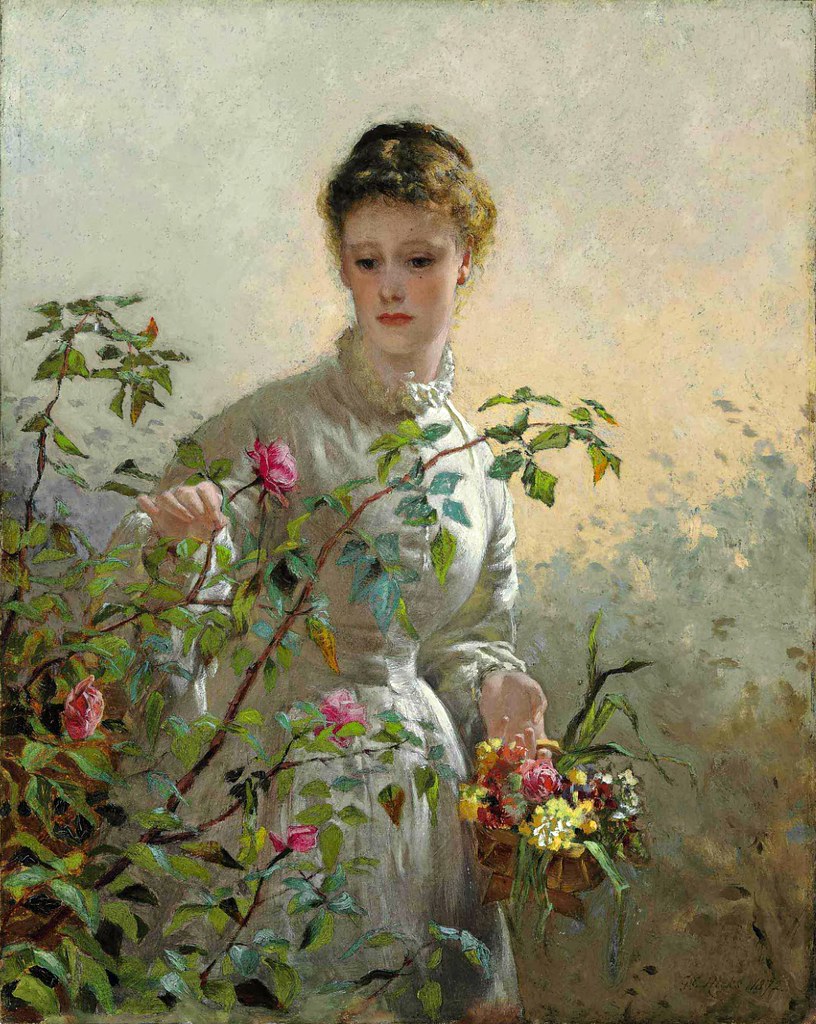
O my Luve’s like a red, red rose that’s newly sprung in June” by Cait Clerin is licensed under CC BY-NC-ND 2.0. The work is ‘A Summer Bouquet’ by George Elgar Hicks, 1878.

Poem into poem: Translating François Villon: Robert Schechter, ‘Ballade of the Ladies’

Would someone kindly tell me please
Where the Roman, Flora, went?
And where is Alcibiades,
Her cousin? In what continent?
And Echo, singing merriment…
Speak up now, someone, if you know,
Is Echo’s lovely timbre spent?
And where did last year’s snowflakes go?

And where on earth is Heloise
Whose lover’s private parts were rent,
The subject of such cruelties
Brought down in such a foul descent?
And where’s the Queen whose heart was bent
Against young Buridan so low
She drowned him in the Seine, poor gent?
And where did last year’s snowflakes go?

And Blanche, the Queen, who sang with ease,
And Siren-like made men content?
And Big Foot Bertha, Beatrice?
And Arembourg, Maine’s resident?
And Joan, who still would not relent
Although the flames attacked her so?
Virgin, my poor ears are bent!
And where did last year’s snowflakes go?

Prince, don’t ask me to invent
Responses that seem apropos.
In this refrain my answer’s pent:
And where did last year’s snowflakes go?

*****

Ballade des dames du temps jadis

Dictes moy où, n’en quel pays,
Est Flora, la belle Romaine ;
Archipiada, ne Thaïs,
Qui fut sa cousine germaine;
Echo, parlant quand bruyt on maine
Dessus rivière ou sus estan,
Qui beauté eut trop plus qu’humaine?
Mais où sont les neiges d’antan!

Où est la très sage Heloïs,
Pour qui fut chastré et puis moyne
Pierre Esbaillart à Sainct-Denys?
Pour son amour eut cest essoyne.
Semblablement, où est la royne
Qui commanda que Buridan
Fust jetté en ung sac en Seine?
Mais où sont les neiges d’antan!

La royne Blanche comme ung lys,
Qui chantoit à voix de sereine;
Berthe au grand pied, Bietris, Allys;
Harembourges qui tint le Mayne,
Et Jehanne, la bonne Lorraine,
Qu’Anglois bruslerent à Rouen;
Où sont-ilz, Vierge souveraine ?
Mais où sont les neiges d’antan!

Prince, n’enquerez de sepmaine
Où elles sont, ne de cest an,
Qu’à ce refrain ne vous remaine:
Mais où sont les neiges d’antan!

*****

Robert Schechter writes: “I wrote this translation of François Villon‘s Ballade several years ago and I don’t remember a whole lot about the process, other than there was a thread at Eratosphere where many people were trying their hand at a translation, and this was my own go at it. I tried to take a breezy tone, almost but not quite humorous, and to my amazement the rhymes I started with didn’t peter out before the ending.” 

The poem is published in the current issue of Eclectica.

Robert Schechter is a past winner of the Willis Barnstone Translation Prize and the X.J. Kennedy Parody Award. His book of children’s poems, The Red Ear Blows Its Nose: Poems for Children and Others, was named one of the best books of 2023 by School Library Journal and Bank Street College, after receiving starred reviews from Kirkus Reviews, Booklist, and School Library Journal. His poems have appeared in The Washington Post, The Spectator, Highlights for Children, Cricket, Spider, Ladybug, The Caterpillar, The School Magazine, The Paris Review Online, Poetry East, Measure, Snakeskin, The Evansville Review, and Light, where he also appeared as a featured poet, as well as in several anthologies such as the Everyman’s Library Villanelles and The National Geographic Book of Nature Poetry.

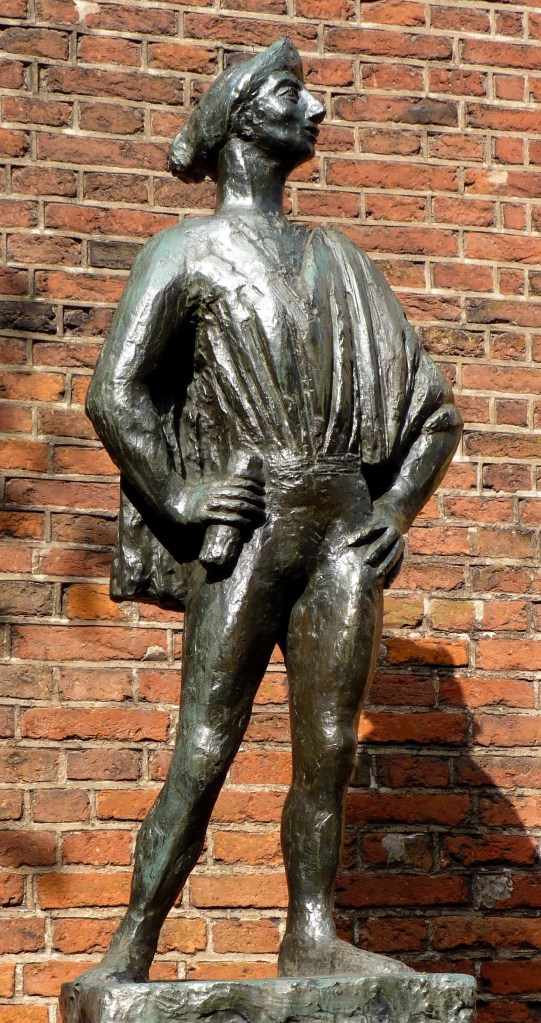
Photo: “Statue of Francois Villon in Utrecht” by Dudva is licensed under CC BY-SA 4.0.

Using form: Parody with a message: Marcus Bales, ‘The Easy Way Taken’

Two friends diverged in a yelling mood
And sorry I could not keep them both
And still maintain one attitude,
I scrolled down through one’s page, and viewed
Some green and gold of writing growth.

Then saw the other was just as good,
With maybe even a better claim
Because so well misunderstood
Within the writing neighborhood,
Though as for that they’re much the same.

And each that morning equally laid
The blame upon the other’s back.
I had no way to tell who’d made
The first or worst move; I’m afraid
I have no feel for clique or claque.

Online I have too many friends
To keep good track, so, nothing loath
To making enemies or ends
Where there are no real dividends,
I shook my head – and blocked them both.

*****

Marcus Bales writes: “Most of the fraught relationships online are due to people not being able to write very well on one end, or read very well on the other. Stuff that in in-person conversation would go completely unnoticed is taken up as deliberate slighting. Mostly its merely awkward phrasing, or one interlocutor is already two comments past when the reply to the third interaction scrolls by and it’s misinterpreted as an instant response to the most recent reply when it was really intended to answer something two or three comments back.

“Now in the case of political disagreements where the polarized sides are already firmly established and one side or the other or both are determined to fight that’s a whole other thing. There it’s got nothing to do with how well or ill something is read or written and everything to do with the sport of online woofing.

“It’s one of those things where over the years people block and get blocked and complain to their friends about either end of it and then it all goes away pretty fast as the opportunity to be triggered — again at either end — fades with the blocking.”

(The original poem on which this parody is based, for those not familiar with it, is Robert Frost’s ‘The Road Not Taken‘. – RHL)

Not much is known about Marcus Bales except that he lives and works in Cleveland, Ohio, and that his work has not been published in Poetry or The New Yorker. However his ‘51 Poems‘ is available from Amazon. He has been published in several of the Potcake Chapbooks (‘Form in Formless Times’).

Photo: “Yotsuba & Tech Support” by Liberty Photos is licensed under CC BY-NC 2.0.

Using form: Rondeau: J.D. Smith, ‘Sans Issue’

What ends with me? A set of genes,
The notion that my slender means
Might turn into a son’s estate,
The hope that, at some distant date,
Beside my grave, my line convenes

To recollect my days’ routines,
My counsels, and the vanished scenes
Whose witnesses would recreate
What ends with me:

The consciousness that struts and preens
In holding that its passing means
An altering of our species’ fate,
My thought possessed of untold weight.
Yet, on that thought, the question leans–
What ends with me?

*****

J.D. Smith writes: “After reaching a certain age and making certain commitments, I found myself coming to grips with never being a parent. As in other instances of following form, the repetitions of the rondeau gave me a way to enclose and develop my response to the situation.”

J.D. Smith has published six books of poetry, most recently the light verse collection Catalogs for Food Loversand he has received a Fellowship in Poetry from the United States National Endowment for the Arts. This poem is from The Killing Tree (Finishing Line Press, 2016). Smith’s first fiction collection, Transit, was published in December 2022. His other books include the essay collection Dowsing and Science, and his seventh collection, The Place That Is Coming to Us, will be published by Broadstone Books in 2025. Smith works in Washington, DC, where he lives with his wife Paula Van Lare and their rescue animals.
X: @Smitroverse

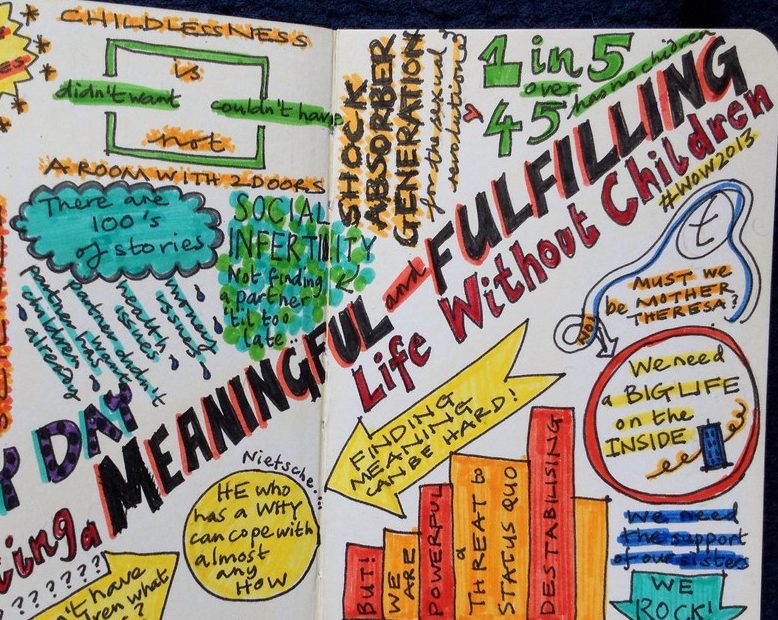
Photo: “Creating a meaningful and fulfilling life without children #sketchnotes #gatewaywomen #jodyday” by etcher67 is licensed under CC BY-NC-ND 2.0.

Sonnets: John Beaton, ‘Wildfire’

It starts with lightning, tinder, and a gust.
Smoke-jumper teams, at this stage, may contain it—
clad in Nomex, ‘chuting down to dust
they rip along the fireline like a bayonet,
swinging pulaskis, cleaving to clearings and creeks,
drip-torching back-fires, containing each hot spot
with counter-tides of flame. They know physiques
honed to sprint with gear may still be caught
by racing fronts and panic, so they pack 
a thin aluminum drape, a fire-shelter.
A flare-up—now they cannot reach the black
by racing through the flame-wall, helter-skelter,
so they deploy before the terra torch
and bake like foiled potatoes in its scorch. 

The fire expands. Its roaring conflagration
finds ladder fuels and candles standing trees.
The incident commander starts to station
resources round the burn’s peripheries—
machinery and hotshot crews assemble
in camps and helibases. Like mirages,
infernos rise to ridgelines, flare, and tremble.
As faller teams and swampers check barrages
of lowland flame, a bucket-swinging Bell
lathers long control-lines with retardant.
The Super Huey heli-crews rappel;
Sikorsky sky-cranes suck and buzz like ardent
mosquitoes, but combustion’s alchemies
still plate the skies with gold. A rising breeze… 

The crowning flames become a firestorm
as fires’ heads combine. Convection columns
shoot limbs and embers upwards where they form
flak for tanker-crews. Smoke overwhelms
visibility. They drop a Mars
and lift great lumps of lake, on every mission
seven thousand gallons salving scars
from summer’s branding-iron. Sudden fission
caused by sap expanding inside trunks
sends frissons of crackling sparks across the blaze 
as fire-cracker trees explode. The thunks
of falling tops spook ground-crews. Flames find ways 
to lope the overstorey under cover
of smoke while dozers doze and choppers hover. 

Although we fight it, such spontaneous heat
kindles inner duff.  Like Icarus
we’re drawn to flame as if it could complete
combustion of some smoldering in us,
a splendor in the trees. With rolls and dips,
like waxwings, flying wax wings to the sun,
we soar. .. And then, as if a flash eclipse
confronts us with the dark side of the moon,
the aftermath appears: black devastation,
burnt poles which yesterday were foliaged.
Cracked pods already seed reforestation
and years will heal what fire so quickly aged
but now, devoid of even twigs and slash,
this moonscape marks where sunlight fell as ash. 

*****

John Beaton writes: “I wrote this one around 2009 not long after Joyce and I had run the gauntlet on a west-east highway through the coast mountains of Northern California. A major fire complex was burning and the road was opened for only a few hours, but we got through. Burning embers lined the roadside and there was smoke and flame on both sides. Each stanza is in Shakespearean sonnet form.”

John Beaton’s metrical poetry has been widely published and has won numerous awards. He recites from memory as a spoken word performer and is author of Leaving Camustianavaig published by Word Galaxy Press. Raised in the Scottish Highlands, John lives in Qualicum Beach on Vancouver Island.
https://www.john-beaton.com/

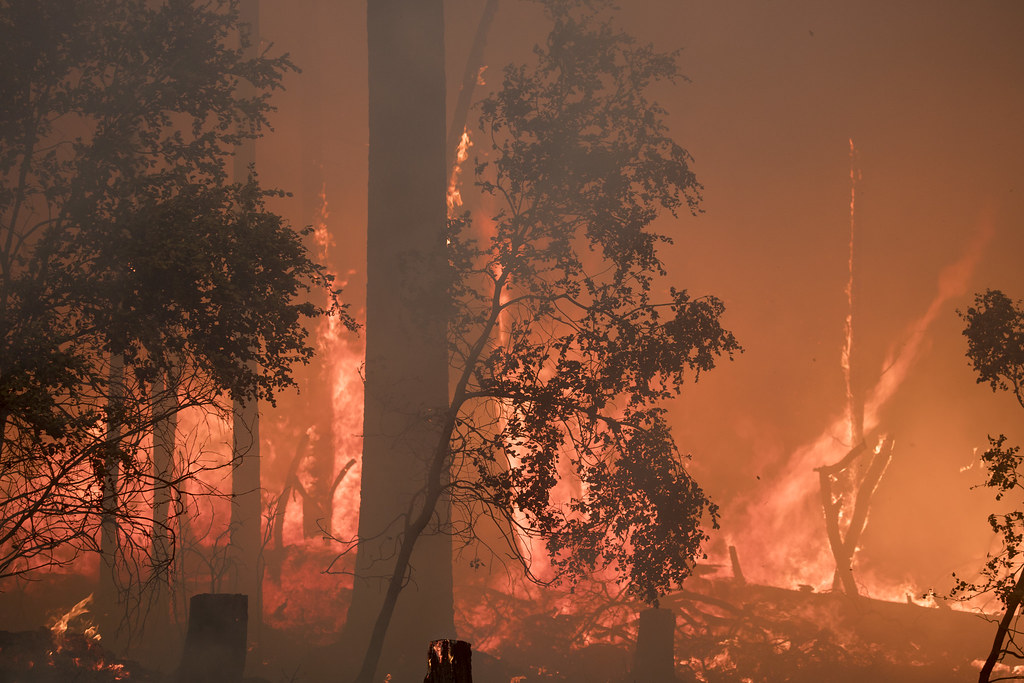
Photo: “20180722_fs_sierra_kg_1081” by Forest Service Photography is marked with Public Domain Mark 1.0.

Richard Fleming, ‘In Grace’

The present is arcane and strange
and any recollection left
of what has happened in the past
is vague and liable to change.
Of future plans, he is bereft,
for nothing now is hard and fast.

They give him multicoloured pens
and paper, as one might a child.
Familiar voices interweave.
He sees, through a distorting lens,
people who wept, people who smiled,
that, one by one, stood up to leave.

He is content. He lives in grace.
What matter if the moments blur,
if his nocturnal thoughts are grim?
He has escaped himself: his face,
a kind of absence in the mirror,
comforts and somehow pleases him.

*****

Richard Fleming writes: “Getting old is like exploring new territory without a map: nothing prepares you for the subtle changes in body and mind. Is a moment of forgetfulness just that, or an early indication of approching dementia? We cannot know what strange highways a decaying brain takes us down but I like to think that they might lead to a place of contentment, where the burdens of age are laid down and replaced by some measure of contentment. That’s what I’ve tried to capture in this poem.”

Richard Fleming is an Irish-born poet (and humorist) currently living in Guernsey, a small island midway between Britain and France. His work has appeared in various magazines, most recently Snakeskin, Bewildering Stories, Lighten Up Online, the Taj Mahal Review and the Potcake Chapbook ‘Lost Love’, and has been broadcast on BBC radio. He has performed at several literary festivals and his latest collection of verse, Stone Witness, features the titular poem commissioned by the BBC for National Poetry Day. He writes in various genres and can be found at www.redhandwriter.blogspot.com or Facebook https://www.facebook.com/richard.fleming.92102564/

Photo: Richard Fleming post

Claudia Gary, ‘Mountain Fire’

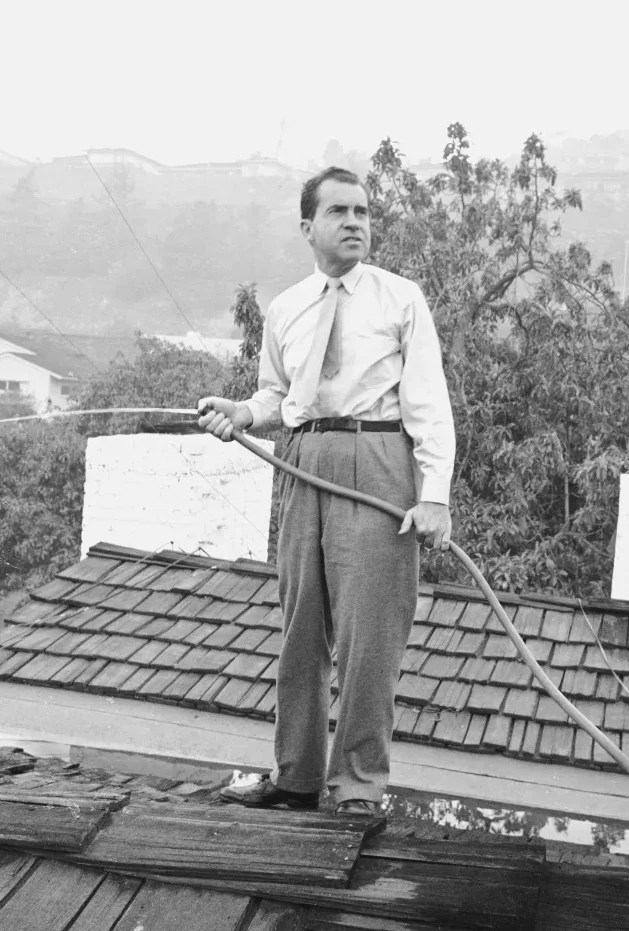
“Sunday, November the 5th, 1961, was hot and windy in Los Angeles…. As dawn approached on Monday the 6th… Fire Station 92 [received] a teletype from headquarters, noting the day would be considered a ‘high hazard’ day in the Santa Monica mountains….” –Los Angeles Fire Department Historical Society

Who is this with a garden hose
on a gravel roof, watering wind,
ignoring pleas from firemen?
Oh yes, he knows,

but can’t stop. Neighbors’ houses broil
to concrete slabs with chimneys,
melted-down pipes, dead brush and trees,
eroded soil.

Wild Santa Ana wind has tossed
burning wood shingles, leveling
castles, condos. Leave everything
or you’ll be lost.

Later in the newsreel,
a mother steers her family’s car
down Roscomare, and there we are,
too scared to feel.

An offer on the radio
says “Stay for free at Disneyland!”
Mother and daughter drive and plan,
deciding No.

Allowed back, they are lucky: See?
Fire has spared their modest home.
The child’s toy bin contains a poem.
Unscathed — or isn’t she?

*****

(First published in Mezzo Cammin)

Claudia Gary writes: “Thinking of today’s residents of Los Angeles, with firsthand knowledge that even if a home is not lost, fire (and evacuation) can be traumatic.”

Claudia lives near Washington DC and teaches workshops on Villanelle, Sonnet, Meter, Poetry vs. Trauma, etc., at The Writer’s Center (writer.org) and privately, currently via Zoom. Author of Humor Me (2006) and chapbooks including Genetic Revisionism (2019), she is also a health/science writer, visual artist, composer of tonal songs and chamber music, and an advisory editor of New Verse Review. Her 2022 article on setting poems to music is online at https://straightlabyrinth.info/conference.html. For more information, see pw.org/content/claudia_gary
@claudiagary

Photo: During the 1961 BelAir-Brentwood fire in Los Angeles, Richard Nixon was among those who tried to save their homes (in Nixon’s case, a rental house) with garden hoses. Finding this photo for this blog post was coincidental; Claudia Gary did not have Nixon in mind when she wrote the poem. – RHL