Monthly Archives: May 2025

Drew Nathaniel Keane, ‘Seventy-Three’

He gave a careless shrug when he had heard
The Delphic Oracle’s prophetic word:
“Beware, my lord, the age of seventy-three”
(For Delphi was renowned for verity).
“I’m thirty now with years to plan for knives
Before the gods’ appointed day arrives.”
Reclining in his litter, bound for home,
Delighted Nero journeyed back to Rome.
 
When he returned, he felt a little drained;
With news like this, how could he be restrained?
Surrendering to pleasure on the way —
To gardens and gymnasia by day,
By night to dance and poetry and drink
In torchlit theatres where bodies slink
Whose dancing ever animates and soothes,
The naked bodies of Achaean youths.
 
Thus Nero rests, while on an arid plain
Far to the west of Rome, in distant Spain,
Old Galba drills his legions secretly,
Old Galba who was spry for seventy-three.

(After C. P. Cavafy’s ‘Η διορία του Νέρωνος’.)

*****

Drew Nathaniel Keane writes: “I’m enchanted by the verse of Constantine Cavafy — ‘a Greek gentleman in a straw hat, standing absolutely motionless at a slight angle to the universe’, as E. M. Forster once described him. In his wry and wistful, gossipy and subtle singing, the Alexandria of Cleopatra feels as immediate as one of his own one-night stands in modern-day Alexandria. It’s quite a contrast to the chest-thumping, hero-worshiping sort of classicism one too often sees on the app formerly known as Twitter. There are already many fine translations of the brief 1915 poem, 
Η διορία του Νέρωνος [‘The Deadline of Nero’], based upon an anecdote in Suetonius’s Life of Nero, of which my favorite is Ian Parks’s paraphrase, published in his little collection The Cavafy Variations (Rack Press, 2013). My paraphrastic version of the poem was inspired by Parks’s, of which one can hear echoes — the “shrug” of line 1, of course, and his turning the punchline into a rhyming couplet gave me the idea to give 
Η διορία του Νέρωνος the Drydenian-Popean treatment I have.

Δεν ανησύχησεν ο Νέρων όταν άκουσε
του Δελφικού Μαντείου τον χρησμό.
«Τα εβδομήντα τρία χρόνια να φοβάται.»
Είχε καιρόν ακόμη να χαρεί.
Τριάντα χρονώ είναι. Πολύ αρκετή
είν’ η διορία που ο θεός τον δίδει
για να φροντίσει για τους μέλλοντας κινδύνους.

Τώρα στην Ρώμη θα επιστρέψει κουρασμένος λίγο,
αλλά εξαίσια κουρασμένος από το ταξίδι αυτό,
που ήταν όλο μέρες απολαύσεως —
στα θέατρα, στους κήπους, στα γυμνάσια…
Των πόλεων της Αχαΐας εσπέρες…
Α των γυμνών σωμάτων η ηδονή προπάντων…

Αυτά ο Νέρων. Και στην Ισπανία ο Γάλβας
κρυφά το στράτευμά του συναθροίζει και το ασκεί,
ο γέροντας ο εβδομήντα τριώ χρονώ.

D. N. Keane (PhD St And) is a Lecturer of English at Georgia Southern University. His verse has been published in Snakeskin (including ‘Seventy-Three’), Spirit Fire ReviewLighten Up OnlineBetter Than StarbucksEarth & Altar, and other venues. More of his work can be found at drewkeane.com

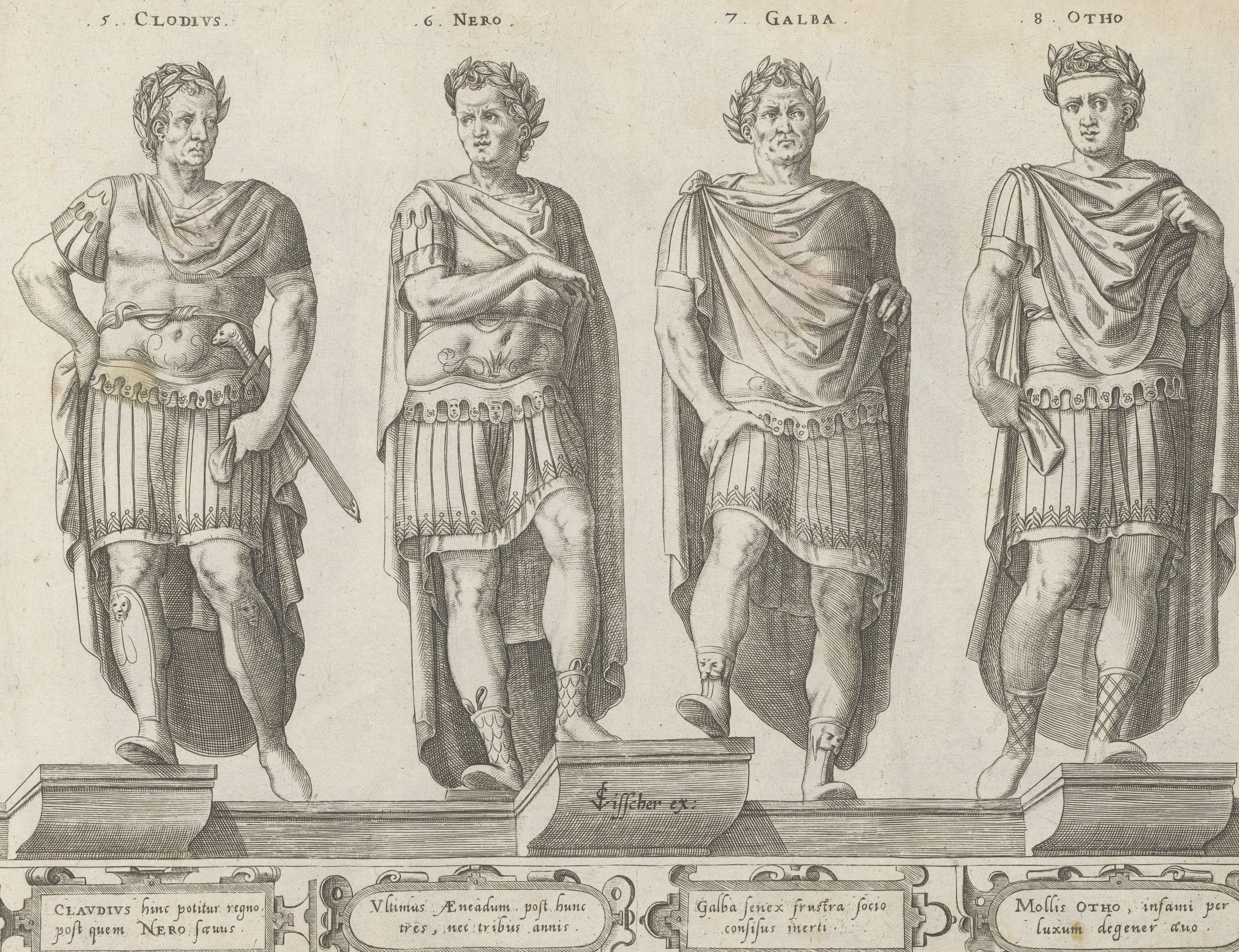
Photo: “Romeinse keizers Claudius I, Nero, Galba en Otho 5. Clodius 6. Nero 7. Galba 8. Otho (titel op object) Van de Roomsche Keyseren en ‘tgevolgh (serietitel) Twaalf Romeinse keizers (serietitel) Den Grooten Figuer-Bibel , RP-P-1982-306-594” by Rijksmuseum is marked with CC0 1.0.

Using form: sonnet variation: Amit Majmudar, ‘List of Demands’

All the twists in all the tongues, all
the zeroes, all the ones, all the arms of all the goddesses, all
the names of the nameless and bodiless, all the ways the all-
one embodies, all at once, the alls there are, all
our alleles and alphabets, all the forms, yes all,
even the sestina, all our alternating lives and deaths, all
the kingdoms, phyla, classes, orders, all
the peoples borderless as breaths, all the altars, all the all,

none of the zealots with knives for minds, none
of the wars, proxy, holy, shadow, cold, none
of the for-profit prophets in pulpits of gold, none
of the land grabs in the names of the long lost, none
of the one true anything, book or way or son, none
of that nonsense, absolutely none.

*****

Amit Majmudar writes: “The monorhymed sonnet (each line of the octet ending with the same word, each line of the sestet ending with another) is a chance to goad one’s creativity with a constraint just light enough. You have to come up with lines that stay interesting to the reader even though the reader knows how each line is going to end. In that, the line resembles, say, a formulaic genre novel where the hero gets the girl and defeats the villain at the end. Or one of Conan Doyle’s detective stories: You know that Holmes is going to solve the mystery. The number of characters is so low in a Holmes short story that the culprit has to be one of the few people introduced. But the delight is all in how he figures it out. Poems can work like that, too. The foregone conclusion of all, all, all, all, all, all, all, all, none, none, none, none, none, none is the equivalent of the certainty that Holmes will crack the case. The internal rhymes and alliteration, the images, the poem’s message exalting pluralism over zealotry—these are, collectively, the equivalent of the mystery and the ingenious solution to the mystery, the Sherlock-unlock, the puzzle (hopefully) satisfyingly worked out.”

‘List of Demands’ was first published in Plume.

Amit Majmudar is a poet, novelist, essayist, and translator. He works as a diagnostic nuclear radiologist in Westerville, Ohio, where he lives with his wife and three children. Recent books include Twin A: A Memoir (Slant Books, 2023), The Great Game: Essays on Poetics (Acre Books, 2024), and the hybrid work Three Metamorphoses (Orison Books, 2025). A new poetry collection, Things My Grandmother Said, is forthcoming in 2026. 
More information at www.amitmajmudar.com

Photo: “Inclusive community (citation needed) (2205859730)” by Matt Mechtley from Heidelberg, Deutschland is licensed under CC BY-SA 2.0.

Using form: Ghazal: Peggy Landsman, ‘In the End’

Accept that everything ends in the end.
Nothing is left to defend in the end.

Whatever happens in this world of ours,
What’s not healed or resolved rends in the end.

We want to believe that time heals all wounds,
But we must make our amends in the end.

Justice delayed is justice denied,
Just as they intend in the end.

Feel the iron fist in the velvet glove.
The least bending of wills bends in the end.

“Kein Mensch muss müssen.” No one’s compelled to be compelled.
“Just following orders” is condemned in the end.

There are plenty of substitutes for the truth;
It is disbelief that suspends in the end.

*****

I think this ghazal speaks for itself, but there’s one thing that I’d like to credit. The German “Kein Mensch muss müssen” is from the play Nathan der Weise (Nathan the Wise) by Gotthold Ephraim Lessing (1729-1781).

Peggy Landsman is the author of the full-length poetry collection, Too Much World, Not Enough Chocolate (Nightingale & Sparrow Press, 2024), in which “In the End” appears. To read more of her work, visit her website: peggylandsman.wordpress.com

FDR Memorial – Washington DC – 00055 – 2012-03-15” by Tim Evanson is licensed under CC BY-SA 2.0: “They (who) seek to establish systems of government based on the regimentation of all human beings by a handful of individual rulers… call this a New Order. It is not new and it is not order.”

Brooke Clark, ‘High Standards’

I hate whatever novel everybody’s praising now,
I hate any café that draws a crowd,
I hate the kind of people who are friends with everyone—
they’re always “dropping by,” always “have to run”—
I hate, in truth, popularity and the eager horde it brings.
I prefer to seek out rarer things,
and beauty—beauty like yours—is vanishingly rare—but then,
you’ve shared it with so many other men.

*****

Brooke Clark writes: “I hate all common things,Callimachus says in the original of this poem, which is the Callimachean aesthetic in a nutshell: the search for the unusual word, the lesser-known version of the famous story, to lend your poetry the interest of the unusual. Like other poets of his time, he was searching for a way to get out of the massive shadow cast by Homer, the Epic Cycle, and the earlier lyric poets. I’ve always found the shift from the literary concerns of the first two thirds of the poem to the personal, romantic concerns at the end fascinating; do literary tendencies become a model for how one conducts one’s personal life? Or were the literary concerns just a metaphor for the personal? In those long-ago days when people criticized poetry on Twitter, I was criticized for repeating the phrase “I hate” when Callimachus uses a different verb for “hate” or “dislike” each time (the Callimachean aesthetic at work). I liked the anaphora, though, and I stuck with it.”

This poem originally appeared in Arion, Boston University’s Journal of Humanities and the Classics.

Brooke Clark is the author of the poetry collection Urbanities and has published work in ArionLiterary ImaginationTHINKThe WalrusLA Review of Books, and other places. He is also the editor of the online epigrams journal The Asses of Parnassus and the book reviews editor at Able Muse.
Twitter: @thatbrookeclark
Bluesky: @brookeclark.bsky.social

Photo: “Getty Museum” by kevin dooley is licensed under CC BY 2.0.

Sonnet: ‘Maz’ Griffiths, ‘Internal Memo’

Dear Stomach,
… Look, we’ve really had enough.
Your job is simply to digest the stuff
supplied by Hands and Tongue, to move it through,
not chuck it up. Spurned food is déjà vu
and hurts Oesophagus; she’s frankly pissed,
and Face says please forget The Exorcist,
because projectile vomits are not fun
and bloody heartburn hacks off everyone.
Lungs say they’re worried by a niggling cough
and Guts say if you won’t perform: Sod off!
That’s not my phrase–I’m mediating here,
but want to stress the general atmosphere.

Please see these hiccups don’t occur again.
I sign myself, sincerely,
… Upper Brain

*****

Margaret Ann “Maz” Griffiths, born in 1947, suffered for years from a stomach ailment which finally killed her in 2009. Her frankness, good humour, range of interests and insights and her technical skill make her one of the very best English language poets of the early 21st century.

I recommend ‘Grasshopper‘, the 350-page compilation of her known verse, to anyone interested in modern poetry. It is one of those rare books that I reread every couple of years. I would be glad to hear of any more of her verse that has turned up since 2011.

Photo: By David Adkins – Scanned photo provided by David Adkins with permission for reuse, CC0, https://commons.wikimedia.org/w/index.php?curid=16997441

David Galef, ‘How to Say “Thank You” Abroad’

Donkey, mercy, grassy ass,
Effin’ Christ, something with God?
Spacey bow and airy ghetto,
Tic-tac-toe—or smile and nod.

Glossary: danke, merci, gracias, efcharisto, deo gratias, spasibo, arigatō, tak.

*****

David Galef comments: “The idea for this short (previously unpublished) poem came to me years ago when I was learning Japanese, and the mnemonic for the phrase “you’re welcome” (dō itashimashite) was explained to me as “don’t touch my mustache.” From there, it was a short step to “airy ghetto” for arigatō or “thank you.” A recent bout of Spanish language instruction yielded “grassy ass,” not that gracias is hard to remember, and the rest, as they say, is hiss Tory. As you can see in the poem, I’ve got eight or so examples, and I’d welcome more.”

David Galef has published over two hundred poems in magazines ranging from Light and Measure to The Yale Review. He’s also published two poetry volumes, Flaws and Kanji Poems, as well as two chapbooks, Lists and Apocalypses. His latest book is the novel Where I Went Wrong. In real life, he directs the creative writing program at Montclair State University.

Photo: “universal thank you note” by woodleywonderworks is licensed under CC BY 2.0.

RHL, ‘In the Spring’

In the spring, an old man’s fancy
ruefully reviews his youth;
thinks of girls both past and present,
wonders can he hide time’s truth.

His always googly gardening eyes
all ever which ways scan and glower
at the bud-bursting blossoming girls
exploding in their flower of power.

What is this green and noisy growth
that’s flourishing, fresh and unkempt?
Old’s good, so’s young… could one be both?
O Fates! from fate make me exempt!

*****

‘In the Spring’ was published in Bewildering Stories, an online weekly of Speculative Fiction, Poetry, Art, etc. Thanks, Don Webb!

at the museum” by derpunk is licensed under CC BY-NC-SA 2.0.