Author Archives: Robin Helweg-Larsen

Unknown's avatar

About Robin Helweg-Larsen

Director, Andromeda Simulations International, Bahamas: a global education company providing online and in-person workshops in business finance. Series Editor, Sampson Low's 'Potcake Chapbooks'. Formal verse about traveling, family, love, etc...

Sonnets: John Beaton, ‘Wildfire’

It starts with lightning, tinder, and a gust.
Smoke-jumper teams, at this stage, may contain it—
clad in Nomex, ‘chuting down to dust
they rip along the fireline like a bayonet,
swinging pulaskis, cleaving to clearings and creeks,
drip-torching back-fires, containing each hot spot
with counter-tides of flame. They know physiques
honed to sprint with gear may still be caught
by racing fronts and panic, so they pack 
a thin aluminum drape, a fire-shelter.
A flare-up—now they cannot reach the black
by racing through the flame-wall, helter-skelter,
so they deploy before the terra torch
and bake like foiled potatoes in its scorch. 

The fire expands. Its roaring conflagration
finds ladder fuels and candles standing trees.
The incident commander starts to station
resources round the burn’s peripheries—
machinery and hotshot crews assemble
in camps and helibases. Like mirages,
infernos rise to ridgelines, flare, and tremble.
As faller teams and swampers check barrages
of lowland flame, a bucket-swinging Bell
lathers long control-lines with retardant.
The Super Huey heli-crews rappel;
Sikorsky sky-cranes suck and buzz like ardent
mosquitoes, but combustion’s alchemies
still plate the skies with gold. A rising breeze… 

The crowning flames become a firestorm
as fires’ heads combine. Convection columns
shoot limbs and embers upwards where they form
flak for tanker-crews. Smoke overwhelms
visibility. They drop a Mars
and lift great lumps of lake, on every mission
seven thousand gallons salving scars
from summer’s branding-iron. Sudden fission
caused by sap expanding inside trunks
sends frissons of crackling sparks across the blaze 
as fire-cracker trees explode. The thunks
of falling tops spook ground-crews. Flames find ways 
to lope the overstorey under cover
of smoke while dozers doze and choppers hover. 

Although we fight it, such spontaneous heat
kindles inner duff.  Like Icarus
we’re drawn to flame as if it could complete
combustion of some smoldering in us,
a splendor in the trees. With rolls and dips,
like waxwings, flying wax wings to the sun,
we soar. .. And then, as if a flash eclipse
confronts us with the dark side of the moon,
the aftermath appears: black devastation,
burnt poles which yesterday were foliaged.
Cracked pods already seed reforestation
and years will heal what fire so quickly aged
but now, devoid of even twigs and slash,
this moonscape marks where sunlight fell as ash. 

*****

John Beaton writes: “I wrote this one around 2009 not long after Joyce and I had run the gauntlet on a west-east highway through the coast mountains of Northern California. A major fire complex was burning and the road was opened for only a few hours, but we got through. Burning embers lined the roadside and there was smoke and flame on both sides. Each stanza is in Shakespearean sonnet form.”

John Beaton’s metrical poetry has been widely published and has won numerous awards. He recites from memory as a spoken word performer and is author of Leaving Camustianavaig published by Word Galaxy Press. Raised in the Scottish Highlands, John lives in Qualicum Beach on Vancouver Island.
https://www.john-beaton.com/

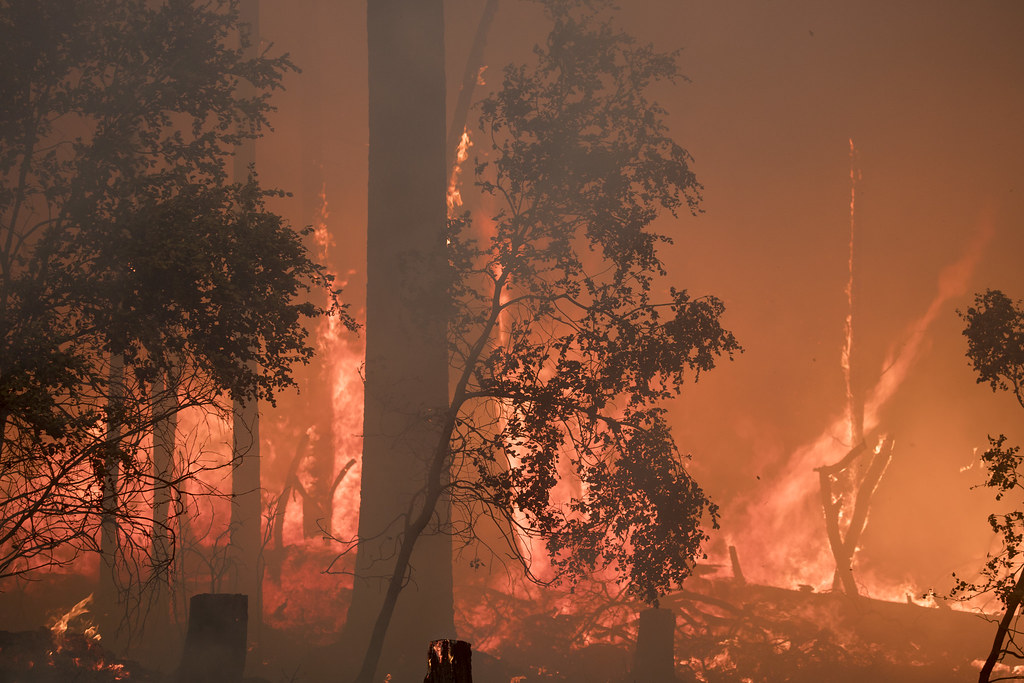
Photo: “20180722_fs_sierra_kg_1081” by Forest Service Photography is marked with Public Domain Mark 1.0.

Richard Fleming, ‘In Grace’

The present is arcane and strange
and any recollection left
of what has happened in the past
is vague and liable to change.
Of future plans, he is bereft,
for nothing now is hard and fast.

They give him multicoloured pens
and paper, as one might a child.
Familiar voices interweave.
He sees, through a distorting lens,
people who wept, people who smiled,
that, one by one, stood up to leave.

He is content. He lives in grace.
What matter if the moments blur,
if his nocturnal thoughts are grim?
He has escaped himself: his face,
a kind of absence in the mirror,
comforts and somehow pleases him.

*****

Richard Fleming writes: “Getting old is like exploring new territory without a map: nothing prepares you for the subtle changes in body and mind. Is a moment of forgetfulness just that, or an early indication of approching dementia? We cannot know what strange highways a decaying brain takes us down but I like to think that they might lead to a place of contentment, where the burdens of age are laid down and replaced by some measure of contentment. That’s what I’ve tried to capture in this poem.”

Richard Fleming is an Irish-born poet (and humorist) currently living in Guernsey, a small island midway between Britain and France. His work has appeared in various magazines, most recently Snakeskin, Bewildering Stories, Lighten Up Online, the Taj Mahal Review and the Potcake Chapbook ‘Lost Love’, and has been broadcast on BBC radio. He has performed at several literary festivals and his latest collection of verse, Stone Witness, features the titular poem commissioned by the BBC for National Poetry Day. He writes in various genres and can be found at www.redhandwriter.blogspot.com or Facebook https://www.facebook.com/richard.fleming.92102564/

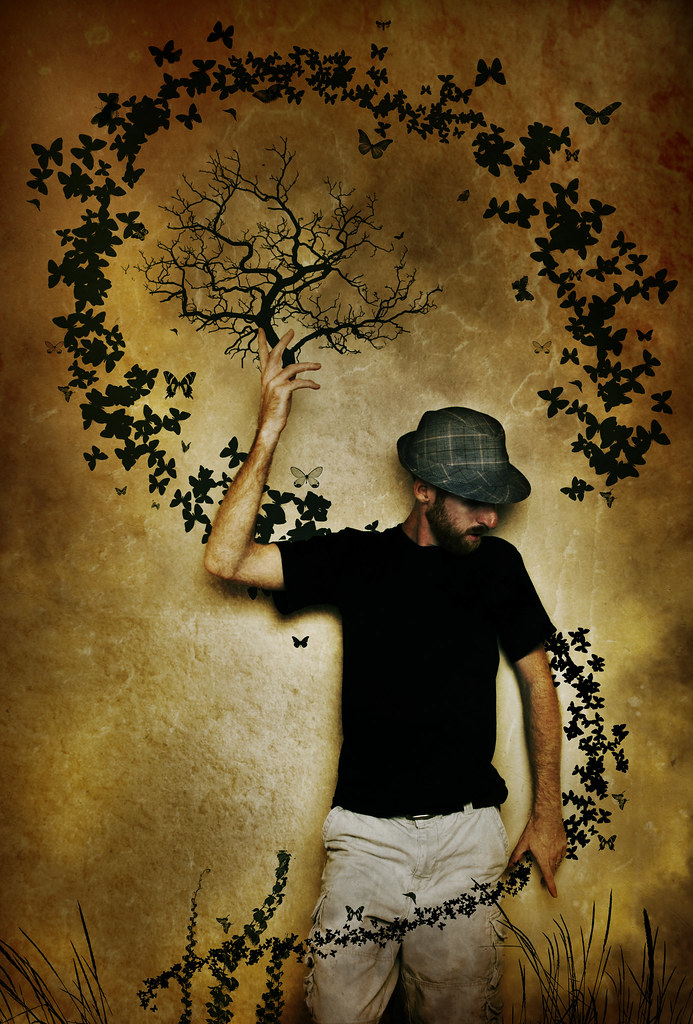
Photo: Richard Fleming post

Claudia Gary, ‘Mountain Fire’

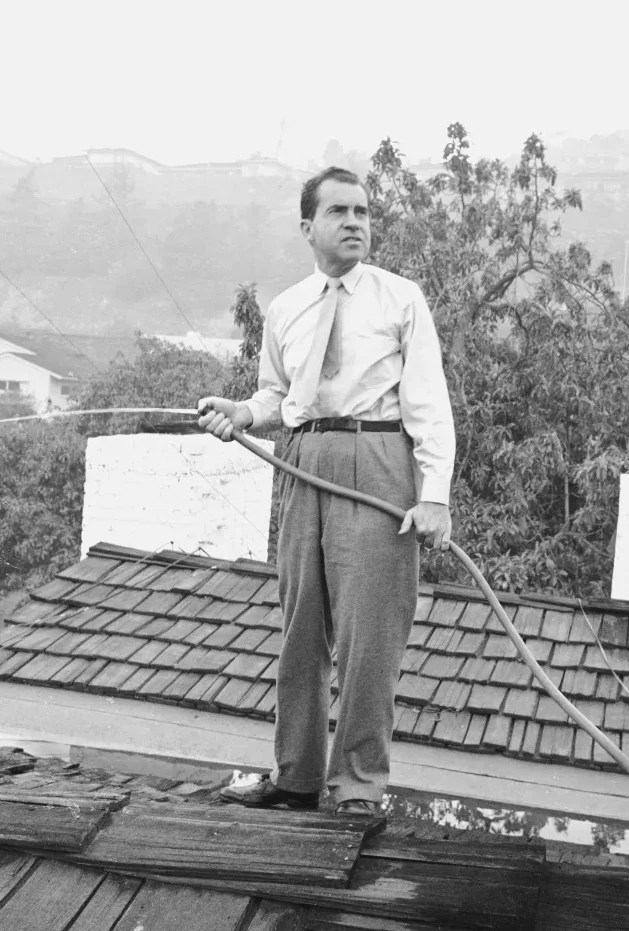
“Sunday, November the 5th, 1961, was hot and windy in Los Angeles…. As dawn approached on Monday the 6th… Fire Station 92 [received] a teletype from headquarters, noting the day would be considered a ‘high hazard’ day in the Santa Monica mountains….” –Los Angeles Fire Department Historical Society

Who is this with a garden hose
on a gravel roof, watering wind,
ignoring pleas from firemen?
Oh yes, he knows,

but can’t stop. Neighbors’ houses broil
to concrete slabs with chimneys,
melted-down pipes, dead brush and trees,
eroded soil.

Wild Santa Ana wind has tossed
burning wood shingles, leveling
castles, condos. Leave everything
or you’ll be lost.

Later in the newsreel,
a mother steers her family’s car
down Roscomare, and there we are,
too scared to feel.

An offer on the radio
says “Stay for free at Disneyland!”
Mother and daughter drive and plan,
deciding No.

Allowed back, they are lucky: See?
Fire has spared their modest home.
The child’s toy bin contains a poem.
Unscathed — or isn’t she?

*****

(First published in Mezzo Cammin)

Claudia Gary writes: “Thinking of today’s residents of Los Angeles, with firsthand knowledge that even if a home is not lost, fire (and evacuation) can be traumatic.”

Claudia lives near Washington DC and teaches workshops on Villanelle, Sonnet, Meter, Poetry vs. Trauma, etc., at The Writer’s Center (writer.org) and privately, currently via Zoom. Author of Humor Me (2006) and chapbooks including Genetic Revisionism (2019), she is also a health/science writer, visual artist, composer of tonal songs and chamber music, and an advisory editor of New Verse Review. Her 2022 article on setting poems to music is online at https://straightlabyrinth.info/conference.html. For more information, see pw.org/content/claudia_gary
@claudiagary

Photo: During the 1961 BelAir-Brentwood fire in Los Angeles, Richard Nixon was among those who tried to save their homes (in Nixon’s case, a rental house) with garden hoses. Finding this photo for this blog post was coincidental; Claudia Gary did not have Nixon in mind when she wrote the poem. – RHL

Using form: Shakespearean sonnet: Susan McLean, ‘Foreshadowing’

You’re a holiday.
—”Holiday,” The Bee Gees

One month from when you met me, when you brought
the first of many gifts, a 45
of plaintive praise and longing, who’d have thought
that forty-five years later we’d survive
on weekends, holidays, and summer breaks,
a foretaste of the end in every start,
anticipation ballasted with aches
as we put love on hold and live apart?

You are a holiday. The working week
unspools like toilet paper from a roll.
My attitude goes airborne when we speak,
and when we meet, my heart swoops like a shoal
of fish. Would we have lost this giddy glow,
living together? Better not to know.

*****

Susan McLean writes: “It makes me feel ancient to realize that for younger readers I will have to explain that a 45 was a record with one song on each side, which played on a record player at 45 revolutions per minute. Love poems themselves tend to feel old-fashioned these days, though this one is about a relatively modern problem, the long-term, long-distance relationship in which both people are employed full time at jobs far apart from one another. The form, a Shakespearean sonnet, mirrors the content, in that the rhymes are separated from one another until the end, when they are reunited. The poem was originally published in the online journal of female formalist poets Mezzo Cammin, and it later appeared in my second book of poetry, The Whetstone Misses the Knife.

Photo: “File:45 record.png” by laurianne is marked with CC0 1.0.

Weekend read: George Simmers, ‘Hymn’

All things dull and ugly, all creatures gross and squat,
All things vile and tedious, the Lord God made the lot.

He made the sly hyena, the hookworm and the slug,
Your moaning Auntie Margaret and pervy Uncle Doug.

He made that dreary Welshman who so often reads the news,
And he made us, the ragtag lot who worship at St. Hugh’s.

We’re far from high achievers, we don’t have gorgeous bods;
At best you’d call us humdrum, a group of odds and sods.

We’re verging on the useless and we have got a hunch
No deity could think we were a preposessing bunch.

That’s why we’re rarely cheerful, but feel a bit less blue
When thinking how the mighty Lord can be ham-fisted too.

‘Cause frankly we’d be daunted by a more efficient chap.
We feel a lot more comfy with a God who’s slightly crap.

*****

George Simmers writes: “This is a poem that would never have existed had it not been for the Spectator magazine, which each week sets a challenge to its readers, demanding produce a short piece of writing (it might be 16 lines of verse or 150 words of prose) on a particular theme. The task is often a silly one. A couple of years ago the demand was for a hymn beginning ‘All things dull and ugly…’

“Competitive light verse is a tradition that stretches back a long way in Britain. In the early years of the twentieth century Naomi Royde-Smith of the Saturday Westminster Gazette set challenges that were responded to by up-and-coming writers like Rupert Brooke and Rose Macaulay, among others. In the thirties the Weekend Review was notable for its literary competitions, and when that magzine was incorporated into the New Statesman, the comp came with it.

“Those New Statesman competitions became a notable feature of English literary life, producing star writers such as Allan M. Laing, Stanley J. Sharpless, Roger Woddis, E.O. Parrott, Martin Fagg, Bill Greenwell and Basil Ransome-Davies.. look in any good anthology of light verse, and you’ll find glittering examples of some of their work. The Spectator and Punch were later in running competitions that attracted many of the same writers.

“I first entered a New Statesman competition in 1981, earning a pound for a one-line joke. Easy money! I entered a few more, mostly prose, and it was a while before I had a verse winner. Before that my verse writing had been a bit modernist and self-indulgent; no more. To succeed in the comps you need to master rhyme and metre. It’s a great training ground. Wendy Cope, one of the best writers of neat epigrammatic verse today began in New Statesman competitions (Much of her first, and arguably best, book, Making Cocoa for Kingsley Amis, is made up of her competition winners.) At about the same time, D.A. Prince began her competition career, which continues in the Spectator today (and I’m proud to have her as regular poet in Snakeskin.)

“From the thirties to the seventies, the New Statesman was a crucial publication in British culture, with a left-wing front-end but back half that was welcoming to all sorts of attitudes and points of view. A couple of dull editors diminished its appeal and importance in the eighties, but the comps continued to flourish, though in the twenty-first century they mostly seemed to welcome only rather predictable political humour. A few years ago the editor, Jason Cowley arbitrarily cancelled them. I’ve not looked at the magazine since then, but I’m told that it has gone from bad to worse.

“The Spectator, meanwhile, has flourished. My first Spectator winner (which imagined Wordsworth doing a snooker commentary) was in 1983. It was the top winner that week, and in addition to a small cash prize I was sent a very good bottle of wine. Those were the days. At that time the competition was run by James Michie, himself a good poet notable for his translations of Horace and Catullus. His was a generous welcoming personality, and many talents flowered under his watch.

“After him, Lucy Vickery ran the comp for many years, showing good judgement Though when she went away on maternity leave for a while, a substitute was brought in who gave prizes to some very inept stuff. It’s not an easy job. At present Victoria Lane is the adjudicator. I like her, because she has awarded me a good few prizes. Others may have grumbled.

“The Spectator competition is today just about the only forum for light verse in Britain. While the respectable poetry outlets have mostly given up on traditional rhyme and metre (Have you ever tried to read the stuff printed in the heavily subsidised Poetry Review?) the Spectator comp still demands well-formed and witty verse. Bill Greenwell and Basil Ransome-Davies are still star turns, and they have been joined by Adrian Fry, Janine Beacham, Sylvia Fairley, Chris O’Carroll and others.

” ‘All things dull and ugly…’ was a task that appealed to me, because I’ve always been struck by the way church congregations can make even sprightly tunes like ‘All Things Bright and Beautiful’ sound really drab and tedious. The ‘dreary Welshman’ is Huw Edwards, a BBC news-reader whom I had always found obnoxious, especially when toadying to the Royals. I’m rather proud of having had a dig at him in this poem, which pre-dates his fall from grace when he was dismissed after his appalling taste in pornography was discovered.”

George Simmers used to be a teacher; when he retired he then amused himself by researching a Ph.D. on the prose literature of the Great War. He now spends his time pottering about, walking his dog and writing a fair bit of verse. He is currently obsessed by the poetry of Catullus, and may be issuing a volume of translations within the next year or so. He has edited Snakeskin since 1995. It is probably the oldest-established poetry zine on the Internet. His work appears in several Potcake Chapbooks, and his recent diverse collection is ‘Old and Bookish‘. ‘

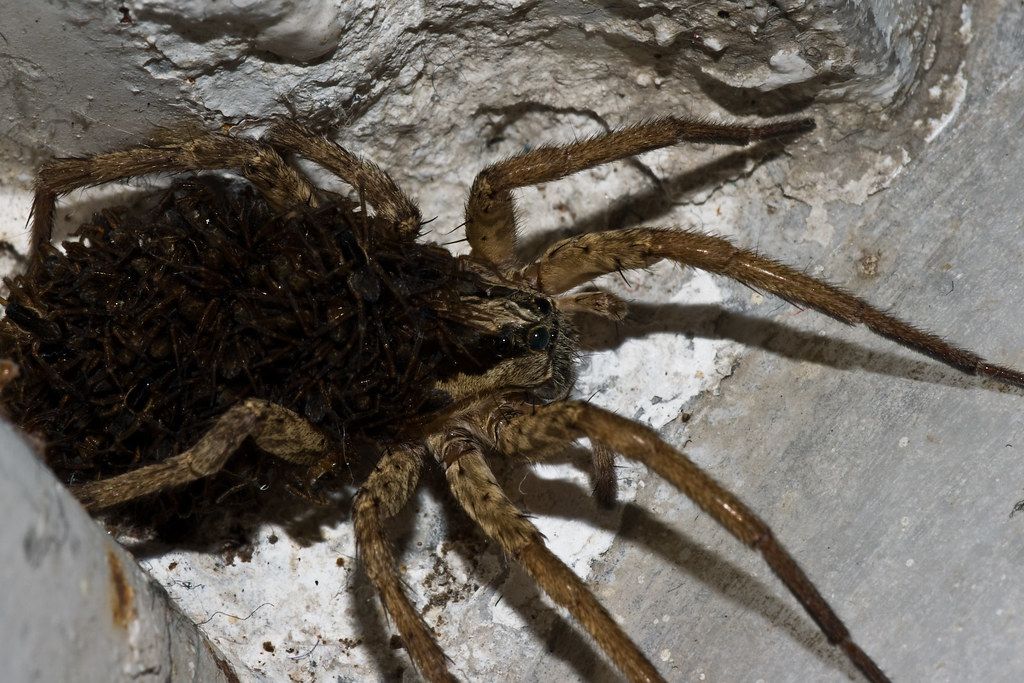
Photo: “Mother Spider” by agelakis is licensed under CC BY-NC-SA 2.0.

Sonnet variation: J.D. Smith, ‘Lullaby for the Bereaved’

Your hours of tears won’t let you follow
Those who’ve left you alone.
Tonight your head lies on a pillow,
Not beneath earth and stone.

The dead won’t be returning,
Not for all of your pleas,
Not for all your candles burning.
Get up off your knees.

The deceased, removed from their rest
Can take up all your hours
Until your mind, denied a fair rest,
Is deprived of its powers.

The road set before you is rocky and steep,
So seize the night’s respite and drift off to sleep.

*****

J.D. Smith writes: “Though I do not sing, play an instrument or read music, I had Brahms’ Lullaby in the back of my mind while attempting to deal with various losses, and the poem roughly follows its tune. In adjusting to a new reality (I hesitate to say “move on” or “get over,” phrases that smack of empathic failure), sometimes all one can do is rest.”

J.D. Smith has published six books of poetry, most recently the light verse collection Catalogs for Food Loversand he has received a Fellowship in Poetry from the United States National Endowment for the Arts. This poem is from The Killing Tree (Finishing Line Press, 2016). Smith’s first fiction collection, Transit, was published in December 2022. His other books include the essay collection Dowsing and Science, and his seventh collection, The Place That Is Coming to Us, will be published by Broadstone Books in 2025. Smith works in Washington, DC, where he lives with his wife Paula Van Lare and their rescue animals.
X: @Smitroverse

Photo: “Grief” by That One Chick Mary is licensed under CC BY-NC-ND 2.0.

Short poem: Richard Fleming, ‘Now’

The future’s inconceivable.
The past is irretrievable.
So all we have is now: that’s it,
yet half the time we miss that bit.

*****

Richard Fleming writes: “Four short lines, two rhyming couplets, succinct, hopefully not preachy, just something that we need to take to heart and not forget.”

Richard Fleming is an Irish-born poet (and humorist) currently living in Guernsey, a small island midway between Britain and France. His work has appeared in various magazines, most recently Snakeskin, Bewildering Stories, Lighten Up Online, the Taj Mahal Review and the Potcake Chapbook ‘Lost Love’, and has been broadcast on BBC radio. He has performed at several literary festivals and his latest collection of verse, Stone Witness, features the titular poem commissioned by the BBC for National Poetry Day. He writes in various genres and can be found at www.redhandwriter.blogspot.com or Facebook https://www.facebook.com/richard.fleming.92102564/

Photo from Richard Fleming

Nonce form: Aaron Poochigian, ‘Reunion Show’

Remember rage the way we used to love it
and what mad masks we wore when we began.
Think of the shrieking eagle on our van,
the decal, with its wings aflame
and our prophetic name,
The Downward Spiral,
the viral
expansion of it,
the perks and packed arenas
before the groupies got between us,
the label dropped us, and the fad wound down.

Boys, since this bar is in a nowhere town
let’s pound out, with our amps cranked up to ten,
sincerer tribute to the angry art
than we could handle at our start.
The blasphemy we hurled
against the world
back then
was out of season.
Now we have damned good reason
to smash things up like ruined men,
and all my lyrics will be from the heart.

*****

Aaron Poochigian writes: “I played in punk bands in high school and college and wrote that poem after I had gone all-in on poetry. I imagined what it would be like to get back together with my former band-mates at a later age. ‘Reunion Show’ is one of the first poems in which I let the nonce form discover itself with various line lengths and rhyme scheme. I tried to just let it all come together. Here is another later one like that: https://newcriterion.com/article/happy-birthday-herod/

‘Reunion Show’ was first published in The Dark Horse.

Aaron Poochigian earned a PhD in Classics from the University of Minnesota and an MFA in Poetry from Columbia University. His latest poetry collection, American Divine, the winner of the Richard Wilbur Award, came out in 2021. He has published numerous translations with Penguin Classics and W.W. Norton. His work has appeared in such publications as Best American Poetry, The Paris Review and Poetry.
aaronpoochigian.com
americandivine.net

Twitter: @Poochigian
Facebook: Aaron Poochigian
Instagram: aaronpoochigian

Photo: “Saxon Blondie 08.03.2019 Fotografías para iRock ______________ #multienfoque #picoftheday #photography #photo #photographer #photooftheday #nofilter #sinfiltro #instapic #instacool #wacken #woa #rock #show #alemania #festival #metal #rock #saxon #nibb” by ISENGARD is licensed under CC BY-NC-ND 2.0.

Sonnet: Jenna Le, ‘Guilty Pleasures’

Half of my favorite works of fanfiction
are stories that anesthetize the pain
produced by the original’s depiction
of harsh events: the person whom the main
character loved who met a tragic end
is resurrected in the fan-made sequel;
the star-crossed couple gets a chance to mend,
and consummate, a bond that has no equal.

The other half are stories that prolong
the pain and also boost its magnitude
deliciously until my nerves all tingle:
near-misses multiply, and roadblocks throng;
epiphanies loom close yet still elude;
misunderstandings keep our heroes single.

*****

Jenna Le writes: “I believe there’s been a fair amount of published scholarship in recent years about fanfiction and fanfiction culture. I admit I’m not up-to-date on any of it, really, and am only really conversant with such aspects of it as I have personally chanced to encounter. I can only say there seems to have been recent movement toward increased legitimization of the field: in 2019, one of the prestigious Hugo Awards for speculative fiction was awarded to a body of fan-work/transformational work, for instance. Just as for other flavors of fiction, there are probably infinitely many ways to classify and subclassify fanfiction. Novelist Naomi Novik‘s work and interviews are maybe a good place to start looking, for people curious to learn more.”

Jenna Le (jennalewriting.com) is the author of three full-length poetry collections, Six Rivers (NYQ Books, 2011), A History of the Cetacean American Diaspora (Indolent Books, 2017), and Manatee Lagoon (Acre Books, 2022), https://press.uchicago.edu/ucp/books/book/distributed/M/bo185843950.html The sonnet ‘Guilty Pleasures’ was first published in Snakeskin.

Photo: “guilty pleasure” by ohmann alianne is licensed under CC BY-NC-ND 2.0.

Barbara Loots, ‘Love Song’

You are the butterfly whose wings
stir up a rainfall in Peru.
The tropic fern unfurled that brings
an earthquake in Tibet is you.

The cry bursting from blackbirds’ throats
that turns the tide on Iceland’s shore
is you, and Sahara’s dusty motes
rosing the sunset in Lahore.

Who is the breath of an infant’s sigh
that sparks the heart of a unicorn?
The rock streaking the moonless sky
that wafts a feather around Cape Horn?

You, the invisible silver thread
between Zanzibar and Amsterdam.
Even by thought unlimited,
whatever the you may be, I am.

*****

Barbara Loots writes: “On my way to copy out the poem I meant to send you, I ran across this one. It has appeared only once in print, so I decided to give it another chance at immortality. Love is too small a word to contain the energy field of creation, evolution, and eternity. But this little verse (published in my second collection Windshift, from Kelsay Books, 2018) helps connect me with ‘whatever the you may be‘ right here and now.”

Barbara Loots resides with her husband, Bill Dickinson, and their boss Bob the Cat in the historic Hyde Park neighborhood of Kansas City, Missouri. Her poems have appeared in literary magazines, anthologies, and textbooks since the 1970s. She is a frequent contributor to lightpoetrymagazine.com. Her three collections are Road Trip (2014), Windshift (2018), and The Beekeeper and other love poems (2020), at Kelsay Books or Amazon. More bio and blog at barbaraloots.com

Photo: “September 1st 2008 – They’re Back” by Stephen Poff is licensed under CC BY-NC-ND 2.0.