Category Archives: limericks

Limericks: Jerome Betts, ‘Jingle Tills, Jingle Tills’

With the annual arrival of Yule,
The world becomes all slop and drool.
    Like that song with the sleigh
    They incessantly play
The points I award it are nul.

Turkey-slaughter is callous and cruel
While the weather turns vile as a rule.
     It is cold, wet, and grey,
     Life becomes pay-pay-pay,
And the thought makes me blanch, puke and mewl.

Who requires the great brain of George Boole
To find lands needing no winter fuel
    And spend Christmas away
    Where the sun shines all day
Sipping drinks beneath palms by a pool?

*****

Jerome Betts writes: “I suppose it’s not the festival itself itself at the darkest point of the northern hemisphere year that provokes a jaundiced reaction but the ever-lengthening relentless commercial run- up to it, almost merging with over-hyped Halloween.”

‘Jingle Tills, Jingle Tills’ was first published in Better Than Starbucks.

Jerome Betts edits Lighten Up Online in Devon, England. His verse appears in Amsterdam Quarterly, Light, The Asses of Parnassus, The New Verse News, The Hypertexts, Snakeskin, and various anthologies.

Photo: “Jingle Bell Bokeh” by aronalison is licensed under CC BY-NC-SA 2.0.

Weekend read: Parody poem: Marcus Bales, ‘Slash Wednesday’

I
Because I do not do the limerick line
Because I do not do
Because I do not do the limerick
Desiring this man’s schtick or that man’s joke
I will stick to knocking out free verse
(If here and there a rhyme so much the worse)
In mournful moans
Presented ragged-right upon the page.

II
There once was a Lady with three
White leopards, a juniper tree,
And a bag full of bones
That sang their sad moans
Of what they had once hoped to be.

III
At every turning of the turning stair,
Your breathing hard, your eyesight edged with dark,
You see the face of hope and of despair.

You breathe the vapor of the fetid air
And toil as if some atmospheric shark
At every turning of the turning stair

Was hunting through the gathering darkness there,
While back and forth across the narrative arc
You see the face of hope and of despair.

At every turning there’s a window where
You contemplate a drop that’s still more stark
At every turning of the turning stair.

Instead you circle upward as you swear
Like you are looking for a place to park.
You see the face of hope and of despair.

You can’t endure the future’s dismal dare
Nor drag yourself to put out your own spark
At every turning of the turning stair.

You’re learning how to care and not to care
And whether you will make or be a mark.
You see the face of hope and of despair
At every turning of the turning stair.

IV
Higgledy piggledy
Here we are all of us
Trudging along where some
Billions have trod

Smelling the flowers and
Trusting religionists’
Tergiversational
Rodomontade.

V
If the word that is lost isn’t lost,
And the word that is spent isn’t spent
Then silence is actually speaking,
And meaning is something unmeant.

If the meaning is what is unheard
And the word is the thing that’s unspoken
Then how do you hear if a word
Has a meaning that hasn’t been broken.

If the unspoken word must be still
And the unheard is what it’s about
To have heard the unhearable meaning
The inside has got to be out.

If the unheard were out of this world
And the light shone in darkness were dark
Then the unlit unheard would be meaning
If the snuffer provided the spark.

If the yadda can yadda its yadda
And the pocus was what hocus took
Then gobble must surely be gobble
Though dee separates it from gook.

VI
Awake! Your hope to turn or not to turn
Is wasting time – but go ahead and yearn
To see the light or hear the word to know
A heaven human beings can’t discern.

There’s nothing there for such as you and me;
We make our meaning up from what we see
And hear and touch and taste and smell and think —
But all there is is fragments and debris.

The steps are just the steps, the stairs the stairs,
The rest is merely human hopes and prayers
That do no more than hopes and prayers can do,
And nothing’s chasing you except your heirs.

No unmoved mover writes upon some slate
That mortals may abate or not abate;
No hope and no despairing of that hope
Reveals what nothing states, or doesn’t state.

Whatever happens happens because of us
We get a muss when we don’t make a fuss
Demanding right from wrong not mere convenience:
We’re all complicit underneath this bus.

Awake! Don’t hope to turn or not to turn,
Don’t pray that this is none of your concern.
Awake! What will it take for you to learn
That if it all burns down you, too, will burn?

*****

Marcus Bales has produced this wonderful set of parodies of the long T.S. Eliot poem ‘Ash Wednesday‘, beginning with a piece in the poem’s style for Part I,
Because I do not hope to turn again
Because I do not hope
Because I do not hope to turn
Desiring this man’s gift and that man’s scope

but then moving into a limerick for Part II’s
Lady, three white leopards sat under a juniper-tree

and a 22-line villanelle for Part III’s
At the first turning of the second stair

and a double dactyl for Part IV’s
Who walked between the violet and the violet

and quatrains for Part V’s
If the lost word is lost, if the spent word is spent
If the unheard, unspoken
Word is unspoken, unheard;

and finally rubaiyat with a strong flavour of FitzGerald’s Omar Khayyam for Part VI’s
Although I do not hope to turn again
Although I do not hope
Although I do not hope to turn

Ash Wednesday‘ has proved one of Eliot’s best-known and most quoted poems, with its signature mixture of Christian mysticism, personal emotion, loose form and scattered rhyme, rich imagery and memorable wordplay. Bales’ ‘Slash Wednesday‘ is an appropriate tour de force of a back-handed homage, mocking Eliot’s ragged rambling with a sampling of forms that could have been used (inappropriately) instead.

Not much is known about Marcus Bales except that he lives and works in Cleveland, Ohio, and that his work has not been published in Poetry or The New Yorker. However his ’51 Poems’ is available from Amazon. He has been published in several of the Potcake Chapbooks (‘form in formless times’).

This is being posted a couple of days late for Ash Wednesday, but as it’s for the already late T.S. Eliot that shouldn’t matter too much…

Photo: “File:T S Eliot Simon Fieldhouse.jpg” by Simon Fieldhouse is licensed under CC BY-SA 3.0.

Using form: Limericks: RHL, ‘Attitudes in the Holy Land’

Moses says God says: (Deuteronomy 20:16-18)

God’s ruthless. Just read Deuteronomy,
believers get zero autonomy:
“You must kill all non-Jews
in this land that I choose.”
Just back then? Or still now? (Love His bonhomie!)

Luke says Jesus says: (Luke 19:27)

Christ was often less peaceful than stormy,
with disciples both pushy and swarmy;
to the rest he made plain
if they’d not have him reign:
“Bring them hither and slay them before me.”

Muhammad says God says: (Qur’an 9:5)

“Polytheists, wherever you find them,
you should ambush and capture and bind them,
and only relax
if they pray and pay tax;
elsewise kill them, and in the dust grind them.”

*****

Given that Jews, Christians and Muslims all claim to be worshipping the same god, the only God, the God of Abraham, it’s somewhat surprising how much time they spend fighting each other. But then, factions within the same religion have been known to slaughter each other. It seems to be something inherent in religions, especially monotheistic ones – if you believe there is only one god, your god, then everyone else’s belief is blasphemy.

Somehow these tribal religions of preliterate herders have continued to the present. They are so illogical and – despite beautiful architecture etc – so frequently violent that the best response I can think of is the mockery of limericks and other forms of light verse. That, and mourning the dead children, and supporting efforts to impose peace.

These limericks were first published in The HyperTexts, Michael R. Burch’s enormous anthology which includes extensive poetry about both the Holocaust and the Nakba, the Palestinian Catastrophe.

Moses causes the Levites to kill the idolators” is marked with Public Domain Mark 1.0.

Political poem: Bono’s St. Patrick’s Day poem on Zelenskyy

Oh, St Patrick he drove out the snakes
With his prayers but that’s not all it takes
For the snake symbolises
An evil that rises
And hides in your heart, as it breaks

And the evil has risen my friends
From the darkness that lives in some men
But in sorrow and fear
That’s when saints can appear
To drive out those old snakes once again

And they struggle for us to be free
From the psycho in this human family
Ireland’s sorrow and pain
Is now the Ukraine
And St Patrick’s name now Zelenskyy

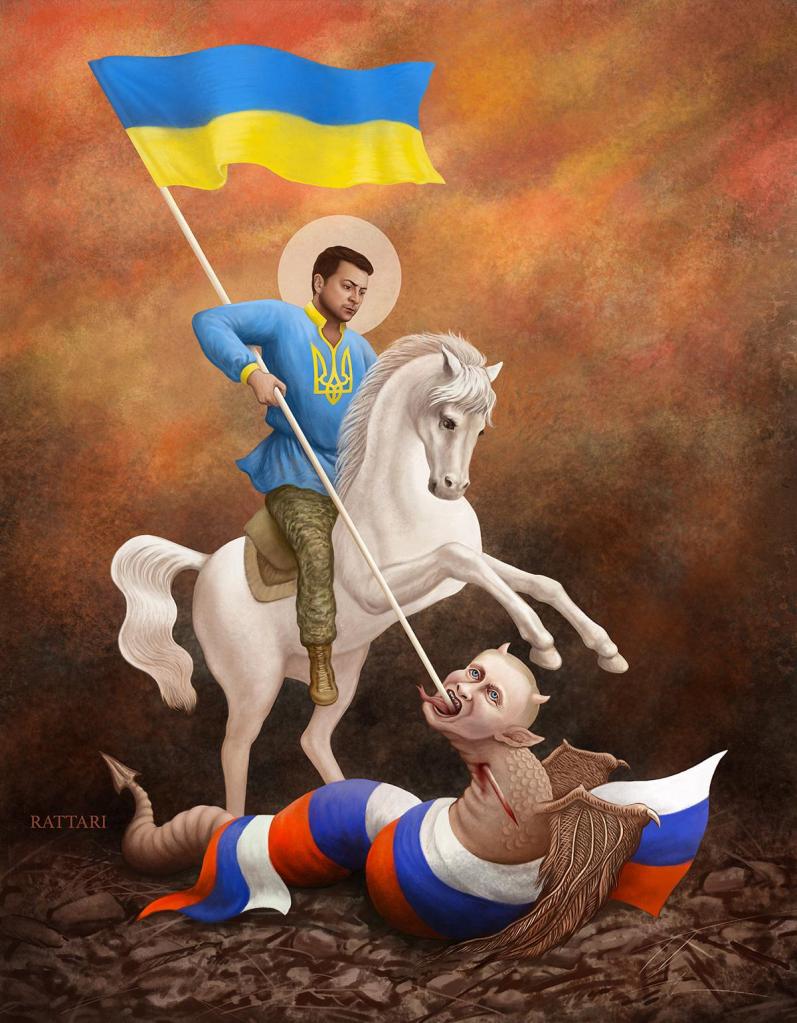
OK, first of all I recognise that the Saint Zelenskyy artwork by Liliya Rattari is a complimentary parody of either St Michael or St George, not St Patrick – but who cares? Putin is a big enough snake to rate as a dragon, and Zelenskyy is heroic enough to be any saint you want.

U2 frontman Bono‘s three-limerick poem was sent by him to Nancy Pelosi for her to use on St Patrick’s Day this year, and she read it at the Annual Friends of Ireland Luncheon in Washington to the assembled guests including the particularly Irish Joe Biden. The poem may not be good enough to be revered eternally, but nor is that snake Putin. Hopefully St Zelenskyy will chase Putin out of the country soon, and the sorrows of Ukraine will become as distant as the sorrows of Ireland.

Short Poem: ‘Cryo Limerick’

The correct thing to do, when you’re dead,
Is have someone take care of your head;
There’s no chance of more drama
Without Futurama –
Don’t say you weren’t warned – act, instead.

Humans have tried to beat death since forever. Chinese herbs, Egyptian mummification, unlikely (but lucrative) promises of Paradise. In the present rapidly-evolving environment, transhumanism thrives on the ideas of physically and genetically modifying us for a longer life, and cryonics suggests being frozen as an “ambulance to the future” when repairs might be possible. The “head in a jar” image captures the wry appreciation that this stuff may work in the future, but won’t be of any use to us. But so what if the chance of success is a fraction of a percent? That still beats the chances of further life after cremation, or after being processed through the bodies of worms…

This limerick was originally published in ‘Transhumanity‘, edited by James Hughes. Both the magazine and the transhumanist movement have gone through changes of name and state, but the ideas are no longer as far on the fringe as they were a couple of decades ago.

“Futurama…?” by Emanuele Rosso is licensed under CC BY-NC-ND 2.0

Review: Max Gutmann, ‘Light and Comic Verse’

Quirkily-workily
Jorge Bergolio,
On a career path with
Quite a steep slope,

Unostentatiously
Worked as a janitor,
Then as a bouncer, and
Then as the Pope.

This elegant double dactyl on the life of Pope Francis is representative of ‘The Hearthside Treasury of Light and Comic Verse’: interesting, witty, technically perfect. The poems include limericks, clerihews, varieties of ballades, and are purported to be written by a variety of poets, several of whom are claimed to be the first-ever winner of the prestigious Blackfrier Prize for Poetry. The book’s veneer of being ‘edited by Max Gutmann’ is worn even thinner with the bio of his least likely poet, Ed Winters… “A devotee of Hemingway, Hart Crane and Sylvia Plath, Winters shot himself in the mouth while diving from a ship with his head in an oven.”

The book includes two pages of riddles in rhyme, of enjoyable difficulty: half were guessable for me, half not. There is also a full-length Poe parody (‘Quoth the Parrot: “Cracker. Now!”); scenes from The Merchant of Venice, King Lear and Titus Andronicus rewritten by W.S. Gilbert; outrage at the Trump presidency, the killing of Jamal Khashoggi, and the US Supreme Court’s appalling excuse for subverting the 2000 Presidential election; a poem appropriately written in the form of a dozen eggs; and various puns, off-colour jokes and random surprises. Many of the poems have previously appeared in Light poetry magazine, many others in a range from Asses of Parnassus to the Washington Post.

As for “The Hearthside Treasury” part of the book’s title… though there was (or is) a Hearthside Press, active from the mid-1950s to mid-70s; and an unrelated Hearthside Books, active from the mid-70s to the present, sort of; this “Hearthside Treasury” appears unconnected to anything. Indeed, it’s not even available on Amazon. It doesn’t have an ISBN. All this is a pity, as it is as enjoyable a book of light and comic verse as you can find anywhere. If you want a copy – and if you enjoy comic verse you really ought to have one – you’re going to have to contact the author directly through his website (which mostly focuses on his plays) at maxgutmann.com

Opposing poems: Ronald Knox on Berkeleyism

There once was a man who said “God
Must think it exceedingly odd
If he finds that this tree
Continues to be
When there’s no one about in the Quad.”

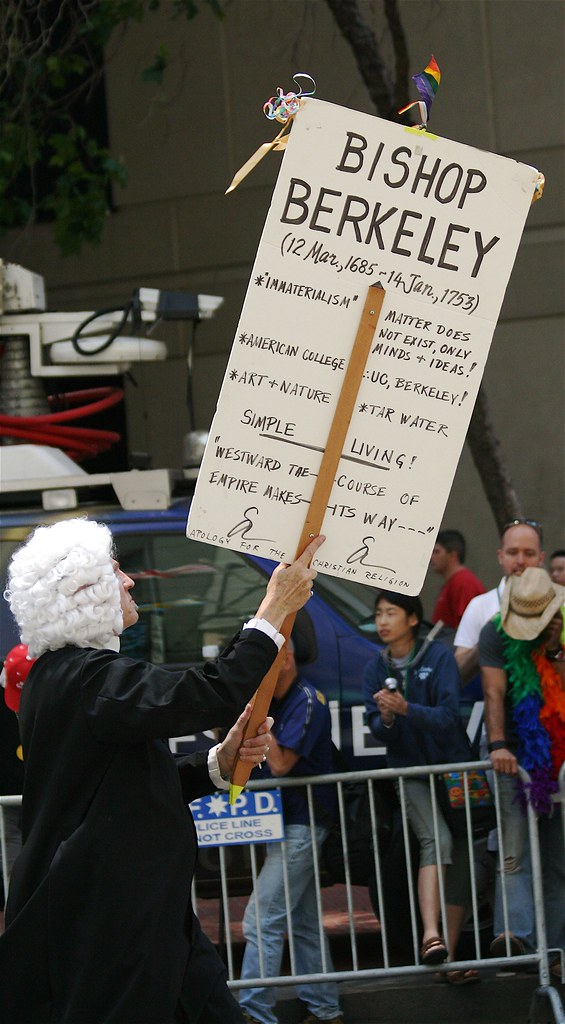
This limerick by the English priest and Sherlock Holmes fanatic Ronald Knox plays with the belief of Bishop George Berkeley that matter doesn’t exist – in the 18th century he wrote and preached that matter is only the product of mind and ideas, and needs to be observed in order to exist. Einstein, quantum physics and Schrodinger’s cat may lead us in that direction these days, but at the time it was radically new in the West. (In the East, ideas about the illusory nature of matter have been around for millennia.) It picked up the derisive name of “immaterialism“. And in his ‘Life of Samuel Johnson’, James Boswell recounts their hearing Berkeley preach:

“After we came out of the church, we stood talking for some time together of Bishop Berkeley’s ingenious sophistry to prove the nonexistence of matter, and that every thing in the universe is merely ideal. I observed, that though we are satisfied his doctrine is not true, it is impossible to refute it. I never shall forget the alacrity with which Johnson answered, striking his foot with mighty force against a large stone, till he rebounded from it — ‘I refute it thus‘.”

Philosophically, Johnson’s response is considered a logical fallacy, now called the “appeal to the stone“.

Ronald Knox, the 20th century priest, limerick author and Sherlockian, is probably also the author of this limerick that opposes the first one:

Dear Sir,
Your astonishment’s odd.
I am always about in the Quad.
And that’s why the tree
Will continue to be
Since observed by
Yours faithfully,
God

Perhaps we can think of the whole issue like this: if you play a strategy game like Civilization on the computer, you can only see part of the world at any one time. You move the cursor up, down or sideways, and you bring other parts of the world to the screen. What’s on the screen exists visually for you because that’s the part of the game world you can see; but the rest of the game world doesn’t exist visually – it exists as pure data in a program, and only materialises when you move the cursor to look at it. Berkeley suggests the physical world behaves similarly and, despite Samuel Johnson, this can’t be disproved. In that case, God would not cause the unobserved world to materialise – God would be the program, the organising principle for the data which would remain immaterial until observed…

Colour me Agnostic.

Photo: “Bishop Berkeley” by Infidelic is licensed under CC BY-NC-SA 2.0

Odd poem: Integral limerick by Betsy Devine and/or Joel E. Cohen, perhaps

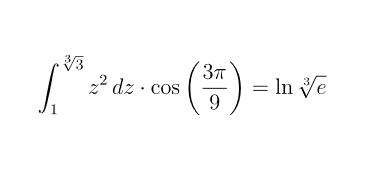
Which should be read as:

Integral z-squared dz
from 1 to the cube root of 3
times the cosine
of three pi over 9
equals log of the cube root of ‘e’.

Note that this limerick relies for its rhyme on the American pronunciation of “z” as “zee”. For the “z = zed” half of the world, you can substitute in another letter such as “t”. What it all means is beyond me… however much I had of this in school is long forgotten. I’m much happier with the Mathematical limerick in an earlier blog post.

This limerick appears in a book by Devine and Cohen, ‘Absolute Zero Gravity‘, but it is not clear that any of the poems, jokes and puzzles collected in it actually originate with the authors, as they are all “collected” but unattributed.

Odd poem: Mathematical limerick by Leigh Mercer

That may not look like a limerick to you, but if you read correctly it can be!

A dozen, a gross, and a score
Plus three times the square root of four
Divided by seven
Plus five times eleven
Is nine squared and not a bit more.

Leigh Mercer was a very odd character. Born the son of a Church of England pastor in 1893, he said “I have been taught to regard myself as the fool of the family, a professional ne’er-do-well.” From 1910 to 1959 he held between 60 and 85 different jobs: in the engineering shops of 30 motor car companies including Rolls-Royce and Ford, as a nurse to a wealthy invalid, as a Post Office Savings Bank clerk, a pavement artist, a carnival sideshow assistant, an English tutor in Paris…

He loved puzzles and wordplay, especially palindromes. He is best known for creating “A man, a plan, a canal – Panama.” There is an 8-page biography of him here, including 100 palindromes. Leigh Mercer died in 1977.

Odd poem: prize-winning limerick by Boris Johnson

There was a young fellow from Ankara,

Who was a terrific wankerer.

Till he sowed his wild oats,

With the help of a goat,

But he didn’t even stop to thankera.

To make sense of this limerick, and why Boris Johnson wrote it, and the various reasons that it won a £1,000 prize, we have to poke around the politics of a few years ago. It started when a German video mildly mocked the authoritarian and repressive President of Turkey, Recep Tayyip Erdoğan. The Turkish government summoned the German ambassador to “explain and justify” the video. As Turkey had become extremely repressive to journalists, German TV comedian Jan Böhmermann then decided to show Erdoğan what free speech meant, by broadcasting a deliberately offensive poem.

On a set with a Turkish flag and portrait of Erdoğan, and with subtitles in Turkish, Böhmermann read his poem of twelve rhyming couplets. Here is a rough translation:

Defamatory Poem, by Jan Böhmermann

Stupid as fuck, cowardly and uptight,
Is Erdoğan, the president,
His gob smells of bad döner,
Even a pig’s fart smells better,
He’s the man who hits girls,
While wearing a rubber mask,
But goat-fucking he likes the best,
And having minorities repressed,

Kicking Kurds and beating Christians
While watching kiddie porn,
And even at night, instead of sleep,
It’s time for fellatio with a hundred sheep,

Yep, Erdoğan is definitely
The president with a tiny dick,
Every Turk will tell you all,
The stupid fool has wrinkly balls,
From Ankara to Istanbul,
They all know the man is gay,
Perverted, louse-infested, a zoophile,
Recep Fritzl Priklopil

Head as empty as his balls,
Of every gang-bang party he’s the star,
Till his cock burns when he has a piss,
That’s Recep Erdoğan, Turkish president.

Erdoğan filed complaints with German prosecutors in a bid to have the poem suppressed, and Chancellor Angela Merkel agreed to investigate, which led to a court injunction, but also to the poem being read out in the German parliament.

Boris Johnson–at the time a backbench Conservative MP as well as former Mayor of London–was interviewed shortly after by The Spectator and a conservative Swiss paper, on immigration, Brexit and related issues. The subject of the poem came up. Johnson–one of whose great-grandfathers was Turkish–called it a scandal that a German court had issued an injunction against the poem being repeated. He said “If somebody wants to make a joke about the love that flowers between the Turkish president and a goat, he should be able to do so, in any European country, including Turkey.” As The Spectator had issued a £1,000 ‘President Erdogan Offensive Poetry’ challenge, Johnson was asked if he had entered. He said no, but when pressed, came up with his apparently spontaneous limerick.

Poetry judge Douglas Murray said the competition received thousands of entries, and he tweeted: “Can I remind entrants that you cannot just make up words. ‘Wankerer’ does indeed rhyme with Turkey’s capital. But it is not a word.” (For non-Brits: “wank” = masturbate, and “wanker” = stupid jerk.) However, Boris Johnson ended up with the £1,000 prize. Perhaps the fact that he is a former editor of The Spectator had something to do with it. (And technically, this is a very poor limerick.)