Rita is in her summer dress. She’s got the mixer out and she is hard at work perfecting home-made mousse au chocolat. I for my part am typing like a clerk
at my computer. Rita’s got cacao and mascarpone and banana, all to form her own concoction. And just now, she brings a spoon to sample it. You’d call
her labor sui generis – you won’t turn up this recipe. And yet, the tongue delights – the eyes close – as the do or don’t of custom pales. The mousse is made. I’ve sung
my wife in her blue dress with its red spots, I’ve sung the kitchen where she takes her ease – the house’s heart, with all its pans and pots. I’ve sung the afternoon. Bring more of these.
*****
John Claiborne Isbell writes: ” ‘Mousse au chocolat’ is a true story inspired by my wife Rita’s taste for improvisation when cooking. The results are invariably delicious. As for the form, it’s just four quatrains of iambic pentameter. My volume Allegrois light verse; I ought really to write more of it.”
‘Mousse au chocolat’ was published in Snakeskin 321, October 2024.
John Claiborne Isbell is a writer and now-retired professor currently living in Paris with his wife Margarita. Their son Aibek lives in California with his wife Stephanie. John’s first book of poetry was Allegro (2018), with a cello on the cover and available on Amazon; he also publishes literary criticism, for instance An Outline of Romanticism in the West (2022) and Destins de femmes: Thirty French Writers, 1750-1850 (2023) both available free online. John spent thirty-five years playing Ultimate Frisbee, representing France in the European Championships in 1991, and finds it difficult not to dive for catches any more.
With walls of work that never wear away my house is halfway hilled above a plain; ghosts of unwritten books moan and complain; I step out on to scree, sloping and grey. I’ve tried for thirty years to build up high, raising five kids free of smog, vice and town; the treacherous slope of scree slips, I fall down, am shown – kids grown and gone – more work’s a lie.
Now I’m spreadeagled on the eager shale, not daring move, gripping at slipping fears of sliding down to sneered-at country vale where poor folk pick, don’t buy, fresh fruit from trees and I could go, unknown, to known warm seas, run barefoot on the beach of my ideas.
They know well when I clock out. Sharp At five, on K.G. Street, They welcome me with every tooth And lead me to their seat.
Five friends—senescent, pyknic, bald, In Khakis—ironed, clean, With brand-new autorickshaws that Are painted taupe and green.
One masticates areca nuts. The shortest one takes khaini. The other two smoke beedis by A tall Mahogany.
They fall in with a mental pact That tells them not to seek To win me, for each one’s assigned A fixed day of the week
To drive me home. “Today’s my turn,” One says and bids me in. While driving he tells stories that Block off the traffic’s din:
The student loan he’s willing to Take for his only daughter; The municipal board has swelled The price of urban water.
Arrived, I ask about the fare. “Ah! Saab“, he shyly says. I take a fifty rupee note— A glow upon his face.
*****
Shamik Banerjee gives the following word meanings: “Khaki: A type of cloth. Khaini: A type of chewable tobacco Beedi: Indian cigarette Saab: Sir K.G. stands for Kasturba Gandhi, the wife of Mahatma Gandhi. Most streets/ lanes/ roads in India are named after famous personalities, especially those who fought for our freedom.” ‘The Auto Drivers of K.G. Street’ was first published by Willow Review.
Shamik Banerjee is a poet from Assam, India, where he resides with his parents. His poems have been published by Sparks of Calliope, The Hypertexts, Snakeskin, Ink Sweat & Tears, Autumn Sky Daily, Ekstasis, among others. He secured second position in the Southern Shakespeare Company Sonnet Contest, 2024.
I remember you some mornings in the midst of getting dressed Surprised that I recall exactly when I wore you last
The paisley patterns spilling over sleeves The Nehru collars nobody believes … were popular The turtlenecks no turtle ever wore Those V-neck disco shirts that dance no more … Spectacular!
Are you lurking in the closet among other clothes I own? I gently touch your shoulder—a brief flash, then you’re gone
The concert souvenir shirts we outgrew The obligation gifts we always knew … were wrapped in haste Thick cotton plaids lost lumberjacks would covet That college T tossed out, but how we loved it … still, such a waste
You promised transformation, but what else did you require The full ensemble led us toward transcendence or desire (Attire of another age, accessories all the rage)
Bell-bottom flares that took flight as we walked Embroidered jeans so tight that people talked … of nothing else Those bomber jackets earthbound boomers froze in Those leather wristlets grunge guitar gods posed in … with death’s head belts
You folded in your fabric everyone I used to be Now that you’re gone, I realize I’m left with only me But if I run across you in some thrift shop bargain rack Or rummaging recycling bins, what else would you bring back? Who else will you bring back?
Some nights I see you in my dreams of places far away I’m wearing you as if I haven’t aged a single day Shirts of the distant past, shirts of the distant past
*****
Ned Balbo writes in Rattle #85, Fall 2024 (where you can hear the song performed): “I’ve played guitar since I was 5, keyboards since I was 13, and ukulele since I was 42, but my time as a ‘professional’ musician—someone paid to play—is scattershot and humble. Ice rinks, a Knights of Columbus Hall, a campers’ convention in Yaphank, a crowd of disco-loving retirees at Montauk’s Atlantic Terrace Motel, company picnics, school dances, private parties, and more—these were where I played guitar, sang, and devised versions of the Beatles, Bowie, et al. in two Long Island cover bands. The Crows’ Nest or Tiffany’s Wine-and-Cheese Café hosted noise-filled solo acoustic gigs, with more receptive listeners for original songs and covers of Elvis Costello or Eno at my undergrad college’s coffeehouse. More recently, I’ve written lyrics to Mark Osteen’s preexisting jazz scores (look for the Cold Spring Jazz Quartet on Spotify, Amazon, CDBaby, and elsewhere) and returned to solo songwriting and recording with ‘ned’s demos’ at Bandcamp. As a relic from the age when lyrics were sometimes scrutinized with poetry’s intensity, I listen closely to the sonics of language, whether sung or spoken, and look up to lyricists whose words come alive both aloud and on the page.”
Balbo: Robin, thanks for posting ‘Shirts from the Distant Past’, my little song-poem hybrid. I’ll be happy to answer any questions you have.
Editor: For myself, I see a continuum from womb heartbeat to dance to music to song to formal verse. I would love to have any additional comments on the subject in general, or on the creation of this poem in particular, related to these elements.
Balbo: I love what you’re saying about womb, heartbeat, and dance. A formative text for me is Donald Hall’s essay on poetic form’s psychic origins, ‘Goatfoot, Milktongue, Twinbird‘. You probably know it. Hall proposes three metaphors for poetry’s deepest sources: Goatfoot, the impulse toward dance, rhythm, movement; Milktongue, the pure pleasure of language, the texture of words when spoken; and Twinbird, our desire for form, symmetry, wholeness, which is complicated and energized by the contradictions it contains and reconciles. To me, Hall’s terms just sound like different ways of envisioning exactly what you’re talking about. They apply as much to song as they do to verse. The meter varies by stanza or section: iambic heptameter (seven iambs) in the couplet verses—not so different, after all, from the tetrameter to trimeter shifts we find in many ballads. The “shirts” title refrain, which doesn’t appear in print till the last line, are two trimeter phrases. It was fun to find surprising rhymes to hold the whole song together.
Editor: Regarding ‘Shirts’, quite apart from the charming idea, I like the work that has gone into the metre, rhyme, idiosyncratic structure.
Balbo: Thank you. I wrote and sung ‘Shirts’ as a poetic song lyric—one that could be read and enjoyed but, ideally, would be heard. I view its structure as that of a call-and-response song in traditional format. (In rock, for example, I think of George Harrison’s ‘Taxman’ with John and Paul harmonizing “Taxman, Mr. Wilson, Taxman, Mr. Heath” in answer George’s lead vocal.) In ‘Shirts’, the call-and-response comes from using the title as a refrain: it explains who the “you” is in each verse (when you hear it, anyway—I cut it from the visual text for fear it would seem repetitious without the music). Sometimes the title refrain answers a statement in the verse: “I gently touch your shoulder—a brief flash, then you’re gone” sounds like I might be talking (or singing) about a person, but it turns out to be those long-lost shirts—a playful fake-out.
Then there are the brief call-and-responses of the bridge sections which comment on the previous line or complete an unfinished thought: “Those V-neck disco shirts that dance no more…spectacular!” or “Embroidered jeans so tight that people talked…of nothing else.” They’re in iambic pentameter, with the second and fourth changing to heptameter if we count the two extra beats (set off on their own line) answering them.
The so-called “middle 8” (usually eight bars used to break up the verse-chorus/verse-chorus model) is delayed till just before the end: “You folded in your fabric everyone I used to be, etc.” That’s meant to set up the payoff: it’s not the shirts but our lost selves— along with loved ones, lost ones, everyone—we’re missing or mourning. But writing or singing about shirts—clothing that shapes and defines us—makes the lyric less depressing, leavens it with wit (I hope) so that what’s more poignant comes at the very end where more dramatic music can counterbalance the mood—the contradictions reconciled, as Donald Hall might have put it.
Of course, the very end is quieter – wistful again.
As I mentioned in Rattle (thanks again to Tim Green for giving both words and music a home), I grew up in the era when lyrics were often analyzed as seriously as poetry (and not just by undergraduates in long-ago dorm rooms under black light posters). Whether I’m writing poetry or songs, I listen closely to the different ways words sound—what works when sung doesn’t always work as well when spoken or encountered on the page—so when I do write lyrics, I try to make them both readable and singable.
Poems and song lyrics operate differently, but there’s lots of overlap between them. I wanted ‘Shirts’ to operate on both levels, even if it tilts more toward song lyric than poem.
*****
Ned Balbo’s six books include The Cylburn Touch-Me-Nots (New Criterion Prize), 3 Nights of the Perseids (Richard Wilbur Award), Lives of the Sleepers (Ernest Sandeen Prize), and The Trials of Edgar Poe and Other Poems (Donald Justice Prize and the Poets’ Prize). He’s received grants or fellowships from the National Endowment for the Arts (translation), the Maryland Arts Council, and the Mid Atlantic Arts Foundation. Balbo has taught at Iowa State University’s MFA program in creative writing and environment and, recently, the Frost Farm and West Chester University poetry conferences. His work appears in Contemporary Catholic Poetry (Paraclete Press), with new poems out or forthcoming in Able Muse, The Common, Interim, Notre Dame Review, and elsewhere. He is married to poet and essayist Jane Satterfield.
His heart is okay (it has been checked) but not far from the top his pace is checked
and he stops. ‘Enough. Let’s go back.’ Mrs Philpott doesn’t want to go back.
If they get to the summit, they’ll see the view. He doesn’t give tuppence about the view.
‘It’s not far,’ she says. ‘Too far,’ he says. She doesn’t care a bit what he says,
she wants to get to the top of the hill. ‘Come on,’ she says. ‘Best foot forward.’ ‘You go on,’
he says. ‘I’ll wait here.’ So she walks on her own and quickly sets up a pace of her own
not pausing and not once looking back until for some reason she stops and looks back
and he’s quite out of sight, could be anywhere and a sort of fear catches her where
head and heart meet. This stupid emotion is love and because of that, because of her love,
if he won’t get to the top of the hill, then she won’t get to the top of the hill
either. Anyway, a few drops of rain fall on her hair and she knows he hates rain.
He might even have turned and gone home without her. She turns
and half-runs down the path. He’s waiting for her, sitting on his coat and waiting for her.
‘About time,’ he says. ‘Where have you been?’ She says, ‘Where do you think I’ve been?’
He doesn’t ask about the view from the top. She doesn’t tell him she didn’t get to the top.
She might think, ‘This is the story of my life,’ but although this is the story of her life
that is not what she thinks. She thinks something else.
*****
This poem comes from midway through Helena Nelson’s 2022 book ‘Pearls – The Complete Mr & Mrs Philpott Poems‘, some 100 poems (I haven’t counted) detailing their years of marriage, starting with a couple of references to their first marriages, through to their own noticeable ageing.
The book’s blurb asks: ‘Where did Mr and Mrs Philpott come from? The author has no idea. They popped into her head over twenty years ago and have refused to go away. Their story is one of ordinary, difficult, everyday love. And yet they themselves aren’t ordinary. Their dreams, anxieties and needs, their separate and difficult pasts, have somehow coalesced into mutual understanding–even sudden spurts of happiness–despite the rainy holidays, arguments and illness. The ordinariness of their love is magical and miraculous. Because ordinary love is a kind of miracle.’
Helena Nelson writes: “I didn’t choose this absorption with the Philpotts. It just happened, and it seems I really have stopped writing them now. But I’m terribly fond of them and often think about them. Probably one of my top favourite Philpott poems is ’The Hill’. Nearly all the poems have some kind of formal pattern underpinning them. Even when they appear to be free, the rhythms are deliberate. I don’t know if I could say any more about them. I feel as though they’ve gone off on their own now, for better or worse, and I’m happy about that.”
Helena Nelson runs HappenStance Press (now winding down) and also writes poems. Her most recent collection is Pearls (The Complete Mr and Mrs Philpott Poems). She reviews widely and is Consulting Editor for The Friday Poem.
From under low clouds spreading from the south The red sun drops slow to night’s waiting mouth. Rush lamps are lit; the guards changed on the walls; Supper will not be served in the Great Halls With Arthur still away. Each in their room, The members of the Court leave books or loom To say their Vespers in the encroaching gloom.
Lancelot, up in his tower, Sees the sunset storm clouds glower, Feels his blood’s full tidal power, Knows he has to go. In her bower, Gwenivere Puts a ruby to her ear, Brushes firelight through her hair, Feels her heartbeat grow.
Guard, guard, watch well: For the daylight thickens And the low cloud blackens And the hot heart quickens To rebel.
From his tower, caring not For consequences, Lancelot Crosses courts of Camelot, Pitying his King. In her bower, Gwenivere Feels his presence coming near, Waits for footfalls on the stair, Lets her will take wing.
Guard, guard, watch well: If attention slackens When the deep bond beckons, Evil knows Pendragon’s In its spell.
And as the storm clouds, rubbing out the stars, Deafened the castle and carved lightning scars, Drenched Arthur rode for flash-lit Camelot Where he, by Queen and Knight, was all forgot.
*****
‘Camelot at Dusk’ was originally published by Candelabrum, a now-defunct poetry magazine in the UK which appeared twice-yearly from April 1970 to October 2010. Candelabrum provided what was, in the 1970s, a very rare platform for British poets working in metrical and rhymed verse.
Technically, the poem uses a variety of forms. The opening and closing passages use iambic pentameter with simple sequential rhyme for a level of detachment (and the only times Arthur is mentioned by name). The passages with Lancelot and Gwenivere use shorter trochaic lines with denser rhymes for more intensity. The passages of warnings to the guards… well, they have a shifting but repeating structure all their own.
Because of the bracketing of the more emotional passages by the more detached opening and closing, the piece feels very complete. As a whole, it is a nonce form. Whether I can ever repeat it successfully, I don’t know. I have tried, but not been satisfied with the result.
I miss believing that I’ll never die, Or is it that there won’t be a tomorrow? Both lines work out about the same: deny The day you’ll have to pay back what you borrow. It used to be I never went to bed A second night with any girl I found. No breakfast in those days–a smoke instead, Then out the door before she came around. Last night I passed a toppled garbage bin, Its liner sagging with a rat’s remains. He sank a little when I squinted in And seemed embarrassed by his greedy pains. And so much like a man, the way he sat Still in his death, and so much like a rat.
*****
Matthew Buckley Smith writes: “I wrote most of Dirge” (his first book of verse, winner of the 2011 Able Muse Book Award. – Ed.) “in a summer. I was wading through a bad depression, and having written almost nothing but free verse to that point, I set myself the challenge of writing one sonnet a day for the rest of the summer. ‘Youth’ is a survivor of that experiment, written while walking late at night through the campus of Johns Hopkins on the way to the apartment of the woman who is now my wife.”
Matthew Buckley Smith is the author of Midlife (Measure, 2024) and Dirge for an Imaginary World (Able Muse, 2012). He hosts the poetry podcast SLEERICKETS and serves as Poetry Editor of Literary Matters. https://www.matthewbuckleysmith.com/
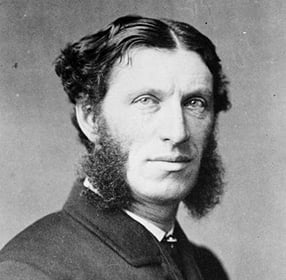
Victoria Moul writes: When I hear or read people — often though not only American “formalists” — discussing “correct” metre in English, and the supposed dominance of accentual-syllabic forms in general and the iambic pentameter in particular, I often think rather impatiently of poets like Arnold and Yeats. Arnold’s verse is musical, highly memorable and — to my ears at least — mostly very straightforward to speak correctly. But it’s often not very iambic at all and he typically uses lines of very varying syllable length. ‘Rugby Chapel’ is a good example of this — its pattern is, technically speaking, more trochaic (rugby) than iambic (endured), the trochaic pattern is established very clearly at the outset (‘Coldly, sadly descends’) and the lines have between six and nine syllables each. If you (inexplicably) wanted to spend an hour “scanning” it you’d find a complex variety of combinations of stressed and unstressed syllables. But its music is easy to hear and read, and very easy to remember, because regardless of the number of the syllables all the lines have three stresses.
Repeated three-stress lines are relatively unusual in English, especially in longer poems, but the four-stress line is very common, perhaps in fact the most natural English line of all, and indeed a lot of so-called iambic pentameter has a tendency to drift towards four rather than five stresses. ‘The Wild Swans at Coole’ establishes an iambic pattern at the outset (‘The trees are in their autumn beauty / The woodland paths are dry’) but is in stanzas of 4/3/4/3/5/3 stresses, with quite varied syllable length and relatively few perfectly iambic lines. Day-Lewis’ poem, by contrast, looks to the eye like it might be iambic pentameter, since the line-length hovers around 10 syllables (ranging from 9 to 12). But most of the lines are spoken naturally with four stresses, not five (‘A sunny day, with leaves just turning’; ‘Wrenched from its orbit, go drifting away’), and only a handful of lines certainly have five.
As far as I know — do comment if you can think of any counter-examples — there are no really good poems about rugby itself, so the poems I discussed today were just those which came into my mind as I watched the practices. None of these English poems are obscure — all are by poets who were considered major in their own lifetime, and all three have been very well-known at some point even if they are not now — and not one of them is in iambic pentameter. In fact, not one of them is obviously in a ‘syllabic’ metre, strictly speaking, at all (as in the familiar statement that traditional English verse is ‘accentual-syllabic’, i.e. where both the number of stresses and the number of syllables are set by the metrical pattern). These poems, like a great deal of English poetry, establish and follow an accentual pattern — of a certain number of stresses in a line, though this too is open to variation — but not, or only very loosely, a syllabic one. Verse of this kind is very common in the English tradition, and the hundred years of poetry between the mid-19th and mid-20th century, even if you set aside the full-blown “modernists” completely, is particularly rich in metrical variety. It is puzzling that this is not better reflected in most discussions of English metre and form. But the best way to get a feel for the actual — rather than imagined — conventions of a literary tradition is, of course, by reading it.
*****
Editor: The passage above is excerpted with permission from a recent Substack post by Victoria Moul in her ‘Horace & friends’ – the full thing is at https://vamoul.substack.com/p/on-rugby-and-metre. In it, with thoughts inspired by watching her nine-year-old son playing rugby, she discusses Cecil Day-Lewis’ ‘Walking Away’, Yeats’ ‘The Wild Swans at Coole’ and Arnold’s ‘Rugby Chapel’. The piece is engaging in several ways, but the point that stands out the most for me is this: “These poems, like a great deal of English poetry, establish and follow an accentual pattern — of a certain number of stresses in a line, though this too is open to variation — but not, or only very loosely, a syllabic one.”
This is much on my mind when I consider the forms that create formal verse. From my school days on, I have felt that analysing English grammar with Latin rules was wrong, just as straightjacketing English verse into syllabic requirements was not always useful, beautiful or appropriate. English is a Germanic language, and plays effectively by looser accentual rules: perhaps harder to define and analyse, but truer to the work of poetry which is to be word-for-word memorisable. Rhythm is one of the essential tricks of memorisation, along with rhyme, alliteration, assonance and a host of rhetorical tricks; and rhythm plays a variety of casual games. Also, accentual pattern corresponds to the continuum that I see at the root of poetry: from womb heartbeat, to dance, to music, to song, to formal verse. Formal verse is at its best when it is rhythmic and rich in musicality as well as in ideas and images and wordplay. Without the music, without the rhythm, it is prose… no matter how well expressed.
So rap and spoken word are inherently more poetic because more memorisable than 99% of what has been published as ‘poetry’ in the past 50 or 60 years. All songwriters are of course genuine poets – not all are good ones, but Bob Dylan certainly deserves his Nobel Prize (and I wish it could have been shared with Leonard Cohen).
Another point is that French too, and other Romance languages, are more accentual than professors often claim. When Françoise Hardy sang Tous les garçons et les filles de mon âge Se promènent dans la rue deux par deux she was following the accentual beat, not giving every syllable equal weight, and completely skipping a couple of unstressed syllables. (Are French professors still teaching that all syllables have equal weight in French verse? Surely not! I hope that died out some time last century…)
Not all poetry is singable – but at its best it has a musicality that both creates enjoyment and enhances its ease of memorisation.
Melissa Balmain writes: “In light-verse workshops, writers are sometimes surprised when I suggest trying forms that weren’t designed for funny stuff (unlike, say, limericks or double dactyls). But comic poets can get a lot of mileage out of “serious” forms, from sonnets to sestinas–especially if their humor tends to skew dark. For anxious or obsessive topics, I’m often drawn to repeating forms like the villanelle, rondeau, or (in this case) the kyrielle. The challenge lies in finding ways to surprise the reader even though they know the line that’s coming.”
Melissa Balmain’s third poetry collection, Satan Talks to His Therapist, is available from Paul Dry Books (and from all the usual retail empires). Balmain is the editor-in-chief of Light, America’s longest-running journal of light verse, and has been a member of the University of Rochester’s English Department since 2010. She is a recovering mime.
Lots of marriage is good – go ahead! We all should… but bigamy sadly‘s illegal. The solution, of course, is: Encourage divorce! And remarry. Kings do it. Be regal!







 Form in Formless Times