Category Archives: Poems

Poem: “Religions”

If it’s Sunday, maybe I should post a religious poem… Of course, the trouble is my
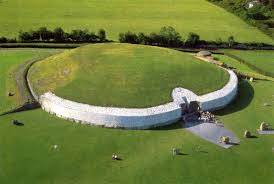
Newgrange

Newgrange – prehistoric Irish site aligned with the winter solstice

ambivalence about religion. I side with US statesman and orator Henry Clay: “All religions united with government are more or less inimical to liberty. All, separated from government, are compatible with liberty.” And if there’s a difference between history and religion, I’ll take history any time.

So this one was originally published in Snakeskin, August 2016…

Religions

Judaism

Genocide in Canaan
Gave God’s land to the Jews;
But genocides in other lands
Are Yahweh’s big taboos.

Buddhism

All life is suffering,
Yes, all our life is pain;
Then I must be a masochist –
I’d love to live again.

Norse religion

The first gods killed a giant,
From his skull to make
The sky, and mountains from his bones –
What lies! No talking snake?!

Christianity

Jesus wasn’t Jewish
And his killers weren’t from Caesar;
At least, so Paul said after
An epileptic seizure.

Islam

There is no God but One,
Perfect in every way;
All creatures do His unknown will –
So there’s no need to pray.

Mormonism

To teenage Joseph Smith
An angel showed gold plates
On which he read ‘Jesus Was Here’ –
It got him lots of dates.

Modern Paganism

Pretentious modern pagans
Confused by mystic spoof
Have got no clue what Stonehenge was
With its old Newgrange roof.

Atheism

I don’t see gods on clouds,
I don’t hear angels sing;
There’s just one question bothers me –
How come there’s anything?

About the use of form here: flippant comments, as in the above poem, are well served by simple quatrains with a bit of bounce to them. Iambics are not in themselves bouncy, but in this pattern of 3 feet, 3 feet, 4 feet, 3 feet they work fine. There’s not a lot of thought in any of the verses, just a set-up and a quick jab. The form works well for its purpose.

New Poem: “Modern Cars”

So, following up on the previous post about Lighten Up Online, I get my own short, light things in there once in a while. Tucked in as one of the Seven Sixes, in the current issue I have “Modern Cars”:

Dealing with the modern automobile
is like a farrier fixing a steering wheel.
Forget your happy thrills
with metal tools, familiar skills.
This is no horse and carriage.
Just take it to a garage.

Yes, my American and Canadian friends, that last word rhymes… at least in the UK… at least to some people. I suspect that’s one of the reasons I wrote the poem (together with expressing the futility of trying to fix modern things oneself). I enjoy hearing all the variations of the word “garage“!

Poetry Resources: “Best Remembered Poems”

578776Perfectly competent, and with interesting trivia and useful background notes by Martin Gardner, this selection of “Best Remembered Poems” is pedestrian almost by definition: these are the ones that are best remembered by Americans, so there will be very little that is new and exciting–and honestly, a lot of the poems best remembered from high school English lessons on the 19th and early 20th century… are downright boring.

But if you’re looking for a book that contains most poems that most non-poets vaguely remember… that contains both ‘The Charge of the Light Brigade’ and ‘Casey at the Bat’… then this is the one for you!

Poems: “Beach and Mountain”, “Now I Know Death”

This month’s edition of Snakeskin has two of my poems in it – and neither is formal. How Linda Ronstadtembarrassing! All the more so as the issue also contains two very nice sonnets by D.A. Prince and Diane Elayne Dees, and a truly excellent transforming poem by Daniel Galef which can be read as either a loose-rhythm 14-line sonnet or, with identical words broken into shorter lines and different rhymes, as five quatrains in the style of Robert Service.

But having given you the links to those, I return to my own poor contributions:

Beach and Mountain

Oh! I said, Look at that Beach!
What! said the Mountain, So go live down there.
See if I care.
Oh Mountain, I said, don’t be so silly,
I choose to live here,
complex and craggy, rich in forests and streams,
here where you rise up, taller than the clouds,
up where the air itself is rarefied
with views over all the world below.
But still… look at that pretty little beach
with its soft white sand,
its smooth clear water…

Now I Know Death

I know how I will die – sadly, slowly,
Regretting all I leave behind
In the spirit of taking a train to school,
Of seeing the holidays pass without a girl,
Of moving out of a good house, leaving the keys
On the table, carefully locking myself out.
Watching the first leaves fall, warning that
The summer comes to an end.
Going to bed only because I am so tired.
Hearing the wind in the pines, hinting at loss.
Feeling without my children, grown,
Transcontinental, unreachable.
The sadness that comes from depths of happiness
And knowing I’m too frail to hold it.

New Poem: “My Eliza”

The latest issue of The Lyric is out – although I won’t get my copy for weeks or months yet, depending on the Bahamas Post Office’s mood and inclination – and apparently “My Eliza” has been awarded the Leslie Mellichamp Prize (with $100, no less!). Judge Michael Ferris wrote: “A smart and charming love poem with island images (I learned some new words) that finishes on the striking picture of two sea otters drifting hand in hand.” Of course I’m delighted! So here it is:

My Eliza

As through Canada I wandered,
Winters cold and summers cool,
Companionship precipitated
Out a girl wild, beautiful.

Come, she said, share games and reading,
Come and play and let’s share beds;
Let’s move south for warmth and business,
Raise our children, use our heads.

Eliza with the hair like lightning,
Hair like ragged moonlit clouds,
Like a cloud of wild mosquitoes,
Junkanoo’s drunk noisy crowds.

Sexy, vital, dogged, honest,
Game designer, engineer,
Eliza: genius aphantasic,
A no-see-um who sees clear.

Now like two strays by the roadside,
Like two potcakes on the beach,
She and I will scrap and forage,
Take the treasures in our reach,

Clean up beaches, plant some flowers,
Read all books and plan things grand,
Roam through cities and through seascapes,
Drift like otters hand in hand.

Sea_otters_holding_hands

Sea Otters holding hands

Poetry Resources: Snakeskin

Probably the oldest continuously published poetry zine on the web – possibly the oldest literary zine of any type – is Snakeskin, published monthly by George Simmers since December 1995.

George Simmers

George Simmers, editor of Snakeskin

There are many unique aspects to Snakeskin, including in the archives:

  • the pervasive wit and humour, tolerantly secular, expressed in the zine’s name from the first issue with Wayne Carvosso’s poem “Credo” – “we are the kindred of the snake.”
  • a long interview of George conducted by Helena Nelson, entirely in iambic pentameter (for George is a skilled and fluent poet, though he rarely publishes in Snakeskin these days)
  • projects and experiments, including various hypertexts
  • and a standard feature for the past several years, Bruce Bentzman’s blog-like soliloquies, or essays – a very sensitive and deeply emotional journey.

But what is particularly nice for poets is that George has no interest in names, reputations or bios – he just reads the poems, and chooses what takes his fancy. Very few of the issues are themed in advance, but they may reflect his mood or the time of year or whatever, and end up with a mood of their own.

And, despite what the Credo states —

“Nor shall we sit to lunch with those
Who moralise in semi-prose.
A poem should be rich as cake,
Say the kindred of the snake” —

George takes any form or lack of form, so long as the piece works for him. This may reflect the tolerance of someone who had a career as a teacher; or it may reflect the Yorkshireman’s well-known preference for the practical over mere theory. In either case, it presents a wonderful opportunity for a new poet to break into publication in an internationally recognised magazine.

Read an issue or two – there’s something for everyone!

Using form to convince: Poem: “Conviction”

Verse has magical powers to engage the minds of its audience and, through that engagement, sway opinions and change attitudes. This is more than the tricks that make it easy to learn verse. It is more than Coleridge’s “Prose: words in their best order; poetry: the best words in the best order.” It is that poets and singers chant, and enchant. The musician chants, the magician chants, if it is well done it creates enchantment. It changes moods, it changes minds. It is used by all religions, all football teams, all angry mobs, and all gentle singers of lullabyes. The fact of the idea being expressed in verse is used as unspoken proof of the idea’s appropriateness.

Chanting

Poetry in motion

In my last post I said that “rhyme can be used to create a sense of inevitability”. Let me explain:

CONVICTION

True verse has a rhythmic twitch
that needs ongoing action.
Rhyme’s an open pattern which
asks for satisfaction.
Give the right words, strong and bright,
and the listener knows “That’s right!”

Conviction carries over, bought
with the words expressed.
The listener believes the thought
because it came well dressed.
Give the right words, strong and bright,
and the listener knows “That’s right!”

In other words, because the words sound right (in meter and in rhyme), our minds are prepared to accept that their meaning is right, their argument is valid. As O’Shaughnessy wrote,

“With wonderful deathless ditties
We build up the world’s great cities
(…)
And three with a new song’s measure
Can trample a kingdom down.”

And that is why Shelley was able to claim that “poets are the unacknowledged legislators of the world”. Poets everywhere agree!

Using form for argument: Poem: “To Myself in 50 Years Time”

Arguing a point has a structure, which tricks of rhetoric can enhance. Additional tricks of reinforcement are possible in verse, where meter can set a tone, rhyme scheme can create a sense of inevitability, and line length can be used to differentiate between premises and conclusion.

Ageing Man in Mirror

TO MYSELF IN 50 YEARS TIME

Old fool! You really think yourself the same
As I who write to you, aged 22?
Ha! All we’ve got in common is my name:
I’ll wear it out, throw it away,
You’ll pick it up some other day….
But who are you?

My life’s before me; can you say the same?
I choose its how and why and when and who.
I’ll choose the rules by which we play the game;
I may choose wrong, it’s not denied,
But by my choice you must abide….
What choice have you?

If, bored, I think one day to see the world
I pack that day and fly out on the next.
My choice to wander, or to sit home-curled;
Each place has friends, good fun, good food,
But you sit toothless, silent, rude….
And undersexed!

Cares and regrets of loss can go to hell:
You sort them out with Reason’s time-worn tool.
Today’s superb; tomorrow looks as well:
The word “tomorrow” is a thrill,
I’ll make of mine just what I will….
What’s yours, old fool?

(First published in Snakeskin No. 147, September 2008)

Each stanza presents an aspect of the superiority of present youth over future age. (Premise and conclusion aren’t necessarily made as statements, many times rhetorical questions are used instead.) The structure of each stanza is to begin with pentameters for a sense of reasonableness in the first three lines, pick up the pace for the next two lines, and end with a short punchline. I find it aggressive and effective.

I admire the chutzpah, the audacity, of the 22-year-old I was. I still have some years–not many–to think of a suitable answer.

Poetry Resources: Better Than Starbucks

BTS logoBetter Than Starbucks (BTS) is a literary magazine that all poets should be aware of because of its enormous and well-structured diversity. Apart from several types of poetry, it also has some short fiction and creative non-fiction.

It has (currently) eight separate poetry sections with a variety of editors, covering such areas as Free Verse, Haiku, African Poetry and, of most interest to me, Formal & Rhyming Poetry edited by Vera Ignatowitsch.

The poets who show up in the formal section vary from issue to issue, but the range of poetry is always impressive: you can expect to find a couple of lighthearted limericks, a couple of serious sonnets, and a few lyrical poems in nonce forms.

Of particular interest to active poets is that BTS will take previously published as well as fresh work. This allows the poet to republish their strongest individual pieces and gain a wider audience for them; and the magazine gets to publish the best of the poet’s work, not necessarily their most recent (or hardest to place). For the reader, too, it means that the standard of work is higher than usual.

My own work has been published or republished in BTS several times, and I was lucky enough with the current (November 2018) edition to have two poems in the Formal & Rhyming section, and one in Free Verse, and two in International Poetry. (I haven’t achieved such a trifecta before, and don’t expect to again. So now is obviously the right time for this blog post… even if I am confessing to writing Free Verse. Sort of.)

Better Than Starbucks is a very good-looking magazine. It now comes out every two months in both hard and soft copy. Strongly recommended.

Poetry Resources: Measure for Measure anthology

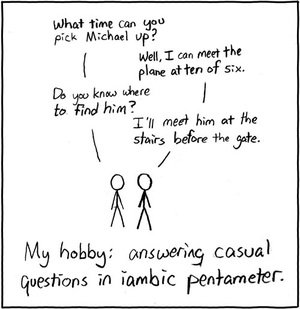
xkcd iambic pentameter

xkcd – another engaging commentator

The ‘Measure for Measure’ anthology clarifies and extols the delights of the variety of metres available to the poet, from the accentual verse of our Anglo-Saxon roots, through the familiar and natural iambs, dactyls and trochees, to the more obscure sapphics and so on based on Greek and Latin forms.

The book is edited by Annie Finch and Alexandra Oliver, two of the most accomplished formal poets of North America writing today. The preface by Annie Finch and the introductions to the various sections include encouraging exercises for developing skills in both reading and writing poetry, and the tone of the anthology is more expository than a mere collection of poems would be.

The selections for each metre are enjoyable in themselves, and by being grouped in that way they drive a fresh awareness and insight into their nature. The only negative for me came towards the very end, where the section on Sapphics and Alcaics confirmed for me that they are not really relevant for English verse.

Overall, an extremely interesting and informative anthology.