Category Archives: short poems

Short poem: John Gallas, ‘Tywyn Promenade – John Longwen (1951-1971)’

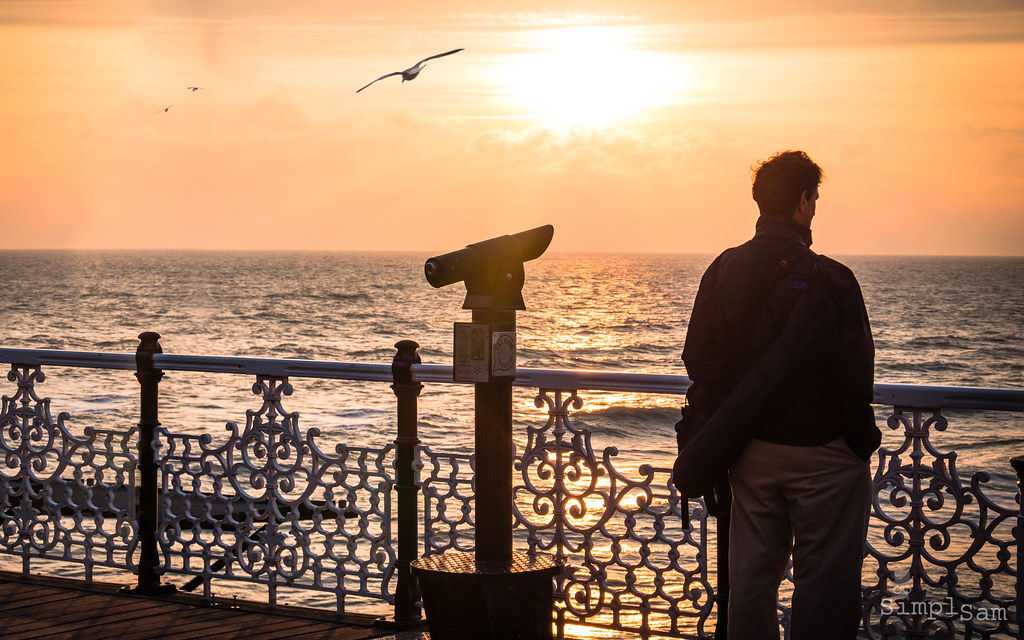
A telescope stands by the railing
its eye turned out to sea
the ocean is there for a sixpence
the Lounges of Dark are free.

A little brass coin can be bought
bickering gulls on the rails
fishingboats ride in the shelters
darkness fills their sails.

John John the wind is wild
I shall keep my sixpence for sweets
strangers hide in their raincoats
rain falls on the streets.

*****

John Gallas writes: “I’ve just completed (draft 10,000, or it feels like it) a collection called ’10X10′ which includes 5 sets of 10 small, 3-verse, rhyming poems (plus 5 sets of Otherwise). This is number 3 from the ‘ffenestri’ set (10 Welsh encounters). These are poems intended to be reader-led as far as any ‘meaning’ goes, and so purposely impressionistic, wobbly and fluid – but tucked into a strict rhythm-and-rhyme form).”

John Gallas, Aotearoa/NZ poet, published mostly by Carcanet. Saxonship Poet (see www.saxonship.org), Fellow of the English Association, St Magnus Festival Orkney Poet, librettist, translator and biker. 2025 Midlands Writing Prize winner. Presently living in Markfield, Leicestershire. Website is www.johngallaspoetry.co.uk which has a featured Poem of the Month, complete book list, links and news.  

Photo: “Lost at Sea” by SimplSam is licensed under CC BY-NC-SA 2.0.

Barbara Loots, ‘A Note to my Old Age’

By now you shall have counted out my fears
on many fingers, and I count them, too,
because I know I am already you
remembering myself from your old years.

How loved you were: your hands, your heavy breasts,
your laughter, and the secret talk of eyes,
the vivid mouth, the spreading lap of thighs
(beloved woman, warm and fully blessed

whose laughter lined our face with troughs for tears!)
I write this down in order to prepare
a kind of perfume for your sallow hair,
a kiss, a love song for your wrinkled ears.

*****

Barbara Loots writes: “Following a form of Yeats (“When you are old and gray and full of sleep…”) I wrote this note to myself in my 30s. Now closing in on my 80s, I feel not in the least wistful or decrepit, still waiting for that imagined “old age”. With the perspective of some fifty years, I can say that old age is not at all as dismal as this poem would suggest. For one thing, my hair turned a rather dazzling white. And love faileth not.”

After decades of publishing her poems, Barbara Loots has laurels to rest on, but keeps climbing.  The recent gathering at Poetry by the Sea in Connecticut inspired fresh enthusiasm. Residing in Kansas City, Missouri, Barbara and her husband Bill Dickinson are pleased to welcome into the household a charming tuxedo kitty named Miss Jane Austen, in honor of the 250th birthday year of that immortal. She has new work coming in The Lyric, in the anthology The Shining Years II, and elsewhere. She serves as the Review editor for Light Poetry Magazine (see the Guidelines at  lightpoetrymagazine.com)

Using form: Odd poem: British Railways toilet sign

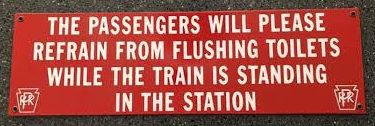
Passengers will please refrain
from flushing toilets while the train
is standing in the station.

*****

It is my (perhaps flawed) understanding that this particular wording originated in the UK. Signs instructing passengers to refrain from flushing toilets while at a station were widely used in the UK throughout the mid-20th century, specifically from the nationalization of British Railways in 1948 through the 1960s. The signs were a standard fixture in passenger carriages, typically made of cast iron or enamel for durability. The signs began to disappear as British Rail modernized its signage in 1965, and gradually replaced older rolling stock with newer models. 

At the time these signs were posted, British trains utilized a “hopper” or “direct discharge” system: toilets consisted of a simple chute or a water-flushed system that emptied human waste directly onto the railway tracks. Because waste dropped straight down, flushing while stationary at a station would deposit raw sewage directly onto the platform-side tracks, creating severe hygiene and odor issues for passengers and staff. Although the first retention tanks (which hold waste for later disposal) were introduced in 1981, the transition away from “hopper” toilets was slow. As recently as 2018, approximately 10% of British train carriages still discharged waste onto tracks, with the practice only largely being eliminated by 2023 after significant government and industry pressure. 

It is not known which railway employee successfully created and implemented the phrasing—”Passengers will please refrain from flushing toilets while the train is standing in the station”. Perhaps they did it surreptitiously, anonymously; but the catchy rhythm and rhyme became so ubiquitous that it was set to the tune of Dvořák’s Humoresque No. 7 and became a popular piece of cultural folklore in both the UK and US.

Supreme Court Justice William O. Douglas and Yale law professor Thurman Arnold take full credit for the “Bawdy Song.” In his autobiography, Go East, Young Man (pp. 171–72), Douglas notes, “Thurman and I got the idea of putting these memorable words to music, and Thurman quickly came up with the musical refrain from Humoresque.” Here is an incomplete version of that work:

“Passengers will please refrain
From flushing toilets while the train
Is in the station. Darling, I love you!
We encourage constipation
While the train is in the station
Moonlight always makes me think of you.
If the woman’s room be taken,
Never feel the least forsaken,
Never show a sign of sad defeat.
Try the men’s room in the hall,
And if some man has had the call,
He’ll courteously relinquish you his seat.
If these efforts all are vain,
Then simply break a window pane-
This novel method used by very few.
We go strolling through the park
Goosing statues in the dark,
If Sherman’s horse can take it, why can’t you?”

Using form: Gwendolyn Brooks, ‘We Real Cool’

The Pool Players.
Seven at the Golden Shovel.

We real cool. We
Left school. We

Lurk late. We
Strike straight. We

Sing sin. We
Thin gin. We

Jazz June. We
Die soon.

*****

Gwendolyn Brooks was one of the greatest 20th century American poets: stylistically creative, with haunting imagery and themes, emotionally engaging, socially engaged. She wrote formal verse, free verse and loosely structured ballads – sometimes all in the same sequence, as in The Womanhood.

Appropriately, ‘We Real Cool’ is her best-known poem: simple, poignant, striking at the heart of America’s structural inequality and moral failures, and presented on the page with a bizarre twist that is both unnecessary and essential: unnecessary because the three-word lines rhyme correctly without having ‘We’ at the end… essential because the reader is forced to emphasize the ‘We’, so that the last line seems (like the youths’ lives) unnaturally shortened, prematurely ended.

A simple poem. Maybe not her greatest, but iconic.

Photo: “Pool Players” by Johnny Silvercloud is licensed under CC BY-SA 2.0.

Vadim Kagan, ‘I Have Never’

I have never in my lives
Met a girl named Arabella –
Captain Blood, the lucky fella,
Took them all to be his wives.

I have never been reborn
As a pirate quartermaster –
Long John Silver, lucky bastard,
Shouldered me aside with scorn.

I had never – strange but true –
Had a chance to rape and pillage;
Takes a crew to burn a village,
Takes much gold to get that crew.

So for now let’s all enjoy
Cold and wet northeastern snow,
How and why – we’ll never know…
Yahrr, my mates, and chips ahoy.

*****

Vadim Kagan writes: “We were visiting BVI, and I had this wonderful morning ritual – walking along the beach to the coffee shop, and then dragging a beack chair to the water so that my feet were in the surf… and coming up with a poem or two watching the sun rise and the clouds change colors. Since childhood I’ve been a huge fan of Rafael Sabatini’s “Captain Blood” novels, so the first two lines just happened, and then the rest kinda followed. I think back home the forecast called for snow that day, so the contrast was again already there for me to make use of.”

Vadim Kagan writes poetry and prose in English and Russian.  Vadim’s poems, bringing together traditions of Russian and English metered verse, have been put to music and performed by local and international artists. His poems have been published in The Lyric, Founders Favorites, The Road Not Taken,  the Lost Love chapbook and recently in the Maryland Bards Poetry Review 2025. Vadim lives in Bethesda, MD, where he runs an AI company providing advanced technology capabilities to Fortune 500 companies and government agencies.

‘I Have Never’ was first published on Vadim Kagan’s Facebook page, where you can find more of his work.

RAYMOND, Alex. ‘Captain Blood’, 1935.” by Halloween HJB is licensed under CC BY-NC-SA 2.0.

R.I.P. Anthony Watkins – untitled poem

Log some star date or another

All systems are failing
shadows flicker around
the darkened room

There is no captain
to report to, I am he.

Lost among the leaves.

*****

Poet, author, editor, publisher and digital creator Anthony Watkins passed away this week after a long illness. I knew him only through his creation of Better Than Starbucks, the wonderfully broad tent poetry-fiction-and-interviews magazine that came out monthly and provided for writers of all styles. It was a generous and inclusive publication, well reflective of its creator.

The poem above is one of the last messages posted by Anthony Watkins on his Facebook page, as everything was winding down.

Photo: “Hubble’s New Eyes: Butterfly Emerges from Stellar Demise in Planetary Nebula NGC 6302” by NASA Goddard Photo and Video is licensed under CC BY 2.0.

Short poem: RHL, ‘Clearing the Cache’

At night we dream to clean our memory,
discard trash from our cache.
Reincarnating after death would be the same;
the past, scraped by death’s emery,
unknown in the new game,
cleansed of our memories, but with a stash
of added skills…
and karma’s unpaid bills.

*****

No, I don’t believe in reincarnation. I don’t believe in anything, or in nothing; I’m an absolute agnostic. “I think therefore I am” is as far as you can go with any certainty – even “who or what I am” is ultimately unknown.

‘Clearing the Cache’ was published in Bewildering Stories. Thanks, Don Webb (if you exist, of course…)

Glitch 183” by mikrosopht [deleted] is licensed under CC BY 2.0.

Short Poem: Andrew Sclater, ‘Dear Mother’

Dear Mother come softly across your grey veil
and onto the path in the dark where the snail
is crossing obliquely and nightjars sing sweetly
and put down your toilet bag quietly, discreetly
on the rim of the cemetery fountain. Now wash
your hair free of this mud and these worms, and squash
those white maggots that gleam in your ears,
then smile as you used to. We’ll have no more tears.

*****

Andrew Sclater writes: “I think everyone who loses a parent probably wants to resurrect them somehow. But memory is a false friend. We can’t see them clearly enough: we know, with vagueness, what they were like, but not who they were. We’d like to go back but we can’t, though this poems attempts to. Then, the realisation that we stand alone, orphaned, comes slowly, painfully and (awkward as it is) angrily as we grieve. This poem was delivered almost complete to me. It simply flowed out of the first line in a rare and rather magical way. I still like it more than almost everything I’ve written, placing my discomfort so tidily into its formal box.”

‘Dear Mother’ first appeared in Poetry Review.

Andrew Sclater is a Scottish poet currently living in Paris. He has published poems in Ambit, Best Scottish Poems, The Dark Horse, Magma, New Writing Scotland, Poetry Review, Shearsman and elsewhere. He co-founded Butcher’s Dog poetry magazine and the National Botanic Garden of Wales. He has been an editor of Charles Darwin’s correspondence and his Dinner at the Blaws-Baxters’ was published in 2016 by HappenStance Press. His newest pamphlet Quite Joyful is from Mariscat Press.

Photo: “.a…d.i.s.t.a.n.t…memory.” by DeeAshley is licensed under CC BY 2.0.

Using form: RHL, ‘Formal vs Free’

Look: formal verse can be china for tea,
a golden goblet, a mug made of clay.
Free verse is putting mouth to stream to drink.
Yes, you could cup your hands… but do you think
museums want to buy that to display
your “memorable skill”, your “artistry”?

*****

‘Formal vs Free’ is published in the current ‘Blue Unicorn‘, in a section loaded, as often, with verse about verse.

Photo: “Red-figured Greek Red-Figure Kantharos (Drinking Vessels) with Female Heads 320-310 BCE Terracotta” by mharrsch is licensed under CC BY-NC-SA 2.0.

Lindsay McLeod, ‘The Swing’

The black dog comes less to me lately
I fight the bait of the Siren’s barbed songs
I’ve tightened my belt to the hunger I’ve felt
scanned the sky for a place to belong.

But I’ve been to this point of the compass before
since we twitched off our vows and our rings
alone in the dark at one end of the arc
where that half-broken pendulum swings.

Still I’ve nothing left here to hold onto
afraid I’ll fall back to the place that I came
where I’ll take up my axe to the rainbow again
and bite deep into bright shining pain.

*****

Lindsay McLeod writes: “Fear not for my current mental health, as I wrote this 20 years ago.”

‘The Swing’ was originally published in Snakeskin.

Lindsay McLeod is an Australian writer who lives quietly on the coast of the great southern penal colony with (yet another ferocious Aussie animal) his cattle dog,  Mary. Lindsay still drives a forklift to support his poetry habit.

Image: “Feeding The Black Dog” by @mich.robinson is licensed under CC BY-NC-ND 2.0.