Category Archives: short poems

Short Poem: ‘The Hitchhiker’

Sometimes you’d sell your soul just to get warm! –
Your clothes are rags in the wind, your skin goes blue,
You doubt your mouth can ever smile again;
The lonely world grows dark before the storm
Whose icy rain’s a mile away… and then,
The sun breaks through!

I used to do a lot of hitchhiking – 25,000 miles is my best estimate, on five continents. It can be miserable, it can be ecstatic, but as a way of exploring the world without plans and preconceptions, it’s hard to beat. It used to be safe, then it became unsafe, but now it’s probably safe again – if you send a picture of the vehicle from your cell phone before you get in. Or if you live on an island with no public transportation, where everyone seems to know everyone and it’s just common courtesy to give people a ride.

The poem was published in the now-defunct Candelabrum, a twice-yearly British publication that championed traditional verse through the darkest days of “free verse” from 1970 to 2010. The magazine has ceased publication, but thank goodness the sun has broken through again!

“Winter Road” by ryanmcgilchrist is licensed under CC BY-SA 2.0

Poem: ‘Spring Sprang’

Spring sprang full force with sudden storms then stopped.
Of which vertu engendred were the floods. We mopped.
Summer so wet dried into humid dank.
Sweat dripped, dried, dripped, and as we worked we stank.

This little poem was published in The Asses of Parnassus, where poems range from the short to the very short. Epigrams translated from the Greek or Latin alternate with modern insults and with odd little observations such as this post’s verse. It is a site for people who enjoy the occasional small random thought.

Why I wrote the poem, I don’t know. It probably started with the evocative sounds of “spring sprang”. Spring rains always bring Chaucer’s Prologue to my mind, whence the “of which vertu engendred” phrase. The whole thing is inconsequential, except that in one very important sense no creative act, not even the most trivial, is inconsequential: your creativity speaks to you, and your decision of whether or not to act on it determines many aspects of your life: not just your creative output, but your sense of satsfaction, your happiness, your mental balance, even your physical health. When the muse speaks, listen and act – the output doesn’t have to be significant, but keeping the lines of communication open to the inner and unconscious (but in several ways wiser and more knowledgeable) parts of yourself is supremely important. Call it the soul, if you want. Call it God, for all I care. There is something essential there: honour it. Your happiness, maybe even your life, depends on it.

OK, rant over. Back to other inconsequentialities.

Photo: “025457:Floods Central Library New Bridge Street Newcastle upon Tyne Unknown 1966” by Newcastle Libraries is marked with CC PDM 1.0

Short poem: ‘Subduction’

All human nature, conflicts, nations, and all races
will be washed as by tides on beaches, all loves and lusts
will with Time disappear, all human traces
washed under as all plates are washed
by the subduction of Earth’s crusts.

This poem was published this month in Lighten Up Online – an excellent place to read light verse on subjects both light and heavy. Every issue has a mixture of longer and shorter poems, and a competition. This March 2021 edition concludes with the results of the eco-crisis competition, headed ‘The Airing of the Green’; ‘Subduction’ was one of the winners. Other sections of the magazine were also focused on the environment. Pollution and climate change are twin disasters, and you can express outrage, despair, or (more usefully) proposals for action. The million-year view of my poem isn’t useful but it’s low-hanging fruit, there to be taken.

I’m delighted to be in a magazine along with poems by fellow Potcake Poets Martin Elster, Michael R. Burch, D.A. Prince, George Simmers, Nina Parmenter, Gail White, Chris O’Carroll, Tom Vaughan, Jane Blanchard, Jerome Betts, Martin Parker and Melissa Balmain, as well as two poets who will be appearing in the next Potcake Chapbook, Bruce McGuffin and Julia Griffin, and the ever-anomalous Max Gutmann. Several of us have more than one poem in this issue.

“File:Tectonic-plates-subduction-zone-17280738.jpg” by Benjilrm is licensed under CC BY-SA 4.0

Review: ‘Short and Sweet – 101 very short poems’

One of a series of short poetry collections that Faber produced in the 1990s, this one features a good introduction by the anthologist (and poet well-known in the UK) Simon Armitage, discussing and justifying the short poem:
“The short poem, at its best, brings about an almost instantaneous surge of both understanding and sensation unavailable elsewhere; its effect should not be underestimated and its design not confused with convenience.”

Of course I love them, they are my children.
This is my daughter and this my son.
And this is my life I give them to please them.
It has never been used. Keep it safe. Pass it on.

– The Mother, by Anne Stevenson

Armitage defines the short poem as no more than 13 lines, thereby ruling out the sonnet as something more than short. Other people define it in other ways: the Shot Glass Journal publishes anything up to 16 lines under its “Brevity is the soul of wit” motto, while another of my favourite collections of verse defines the short poem as ‘Eight Lines or Less’. There is no agreed definition of “short poem”. And as Armitage shows, in 13 lines you can still cover a lot of ground.

She lay a long time as he found her,
Half on her side, askew, her cheek pressed to the floor.
He sat at the table there and watched,
His mind sometimes all over the place,
And then asking over and over
If she were dead: ‘Are you dead, Poll, are you dead?’

For these hours, each one dressed in its figure
On the mantelpiece, love sits with him.
Habit, mutuality, sweetheartedness,
Drop through his body,
And he is not able now to touch her–
A bar of daylight, no more than
Across a table, flows between them.

– As He Found Her, by Jeffrey Wainwright

Some of the poems in the collection were new to me, including both the above. Some of the poems are extremely well-known but always a joy to read: Yeats’ ‘The Lake Isle of Innisfree’, William Carlos Williams’ ‘This is Just to Say’. And others hover half-known:

Where is the grave of Sir Arthur O’Kellyn?
Where may the grave of that good man be?
By the side of a spring, on the breast of Helvellyn,
Under the twigs of a young birch tree!
The oak that in summer was sweet to hear,
And rustled its leaves in the fall of the year,
And whistled and roared in the winter alone,
Is gone, — and the birch in its stead is grown. —
The Knight’s bones are dust,
And his good sword is rust; —
His soul is with the saints, I trust.

– The Knight’s Tomb, by Coleridge

Starting off with the 13-liners, the poems get shorter and shorter as you read on, but without losing their punch–perhaps, as the introduction suggests, condensing their power.
Shakespearean fish swam the sea, far away from land;
Romantic fish swam in nets, coming to the hand;
What are all those fish that lie gasping on the strand?

– Three Movements, by Yeats

… all the way down to the final poem with no text at all, but only its title:
– On Going to Meet a Zen Master in the Kyushu Mountains and Not Finding Him, by Don Paterson.

Most but not all of the 101 poems are formal; most are originally in English, though there are a few translations: Paz, Sappho, Apollinaire, Salamun and – most surprising in its elegant translation from the Polish – this one, ‘Bodybuilders’ Contest’:
From scalp to sole, all muscles in slow motion,
The ocean of his torso drips with lotion.
The king of all is he who preens and wrestles
with sinews twisted into monstrous pretzels.

Onstage, he grapples with a grizzly bear
the deadlier for not really being there.
Three unseen panthers are in turn laid low,
each with one smoothly choreographed blow.

He grunts while showing his poses and paces.
His back alone has twenty different faces.
The mammoth fist he raises as he wins
is tribute to the force of vitamins.

– Bodybuilders’ Contest, by Wislawa Szymborska.

Altogether an excellent and well-rounded collection.

Poem: ‘Hail Deth’

Hail Deth, that from alle Natur’s birth
Hast kept each living thing thy thrall!
Teech me to love thy quiet call,
To rest
Among the blest,
To be at peace with every thing on earth.

Come soft, without impediment;
Let mee slide sleeping to thy armes,
Discover alle thy soothing charmes;
And kill
My every ill,
Leave mee uninterrupted sediment.

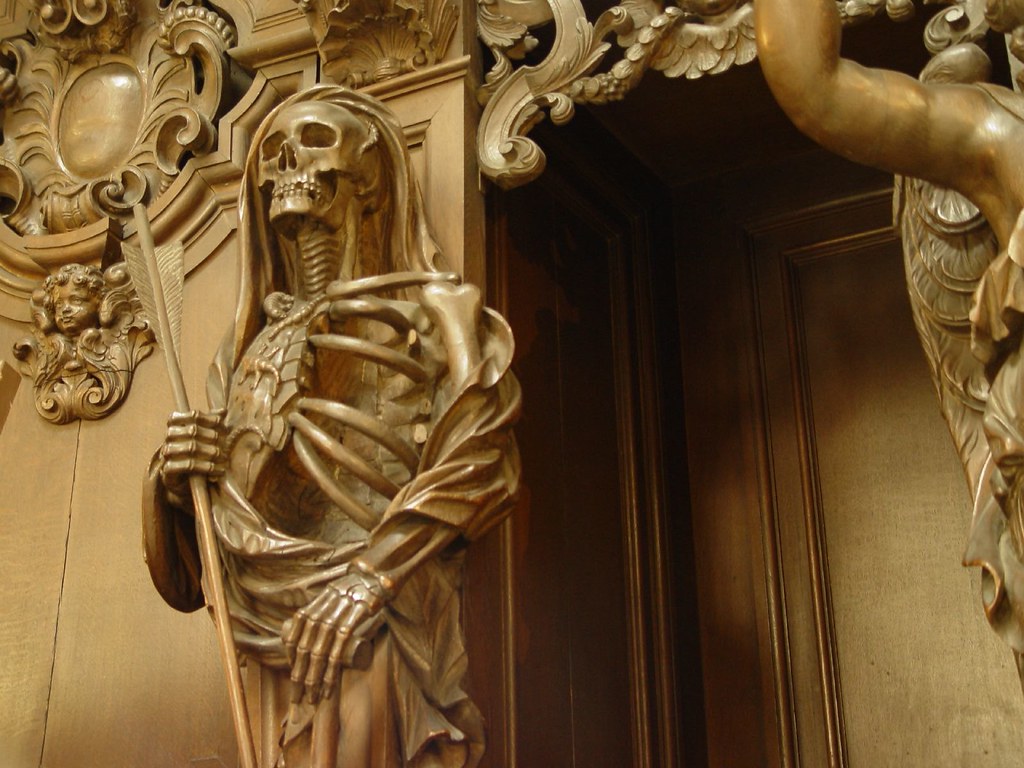
This is one of my very earliest poems, with the form, theme and erratic spelling all obviously influenced by studying the Metaphysical Poets in school. I’ve always been fascinated by death–at least since the time I gave up Christianity, thanks to my excellent Church of England schooling. The poem was written tongue-in-cheek, of course: I’m in no hurry to die.

‘Hail Deth’ has just been published in the Shot Glass Journal which, in accordance with Shakespeare’s “brevity is the soul of wit”, publishes both formal and free verse so long as a poem doesn’t exceed 16 lines. It also divides contributions into American and International groups and lists them separately, which is interesting if not necessarily useful in any functional sense.

Photo: “NS-01023 – Death Head” by archer10 (Dennis) is licensed under CC BY-SA 2.0

Odd Poems: Oxbridge rivalry

The King, observing with judicious eyes
The state of both his universities,
To Oxford sent a troop of horse, and why?
That learned body wanted loyalty;
To Cambridge books, as very well discerning
How much that loyal body wanted learning.

This poem was written by Joseph Trapp in response to events in England in 1714. King George I, to celebrate his coronation, purchased the entire library of the recently deceased bibliophile Bishop of Ely and donated it to Cambridge University, more than tripling the number of books in the university library. Meanwhile Oxford had been having one of its frequent periods of disorder, and the King had had to send in troops to restore calm.

Oxford has a long history of riots, beginning in 1209 with “the hanging of the clerks”. In his 1220s history of England, Roger of Wendover wrote:

“About this time, a certain clerk engaged in the liberal arts at Oxford killed a certain woman by accident and when he found that she was dead he decided to flee.

“But when the mayor of the city and many others who had gathered found the dead woman they began to search for the killer in his house which he had rented together with three of his fellow clerks.

“Not finding the man accused of the deed they seized his three fellow clerks who said they were wholly ignorant of the murder and threw them into prison; then a few days later they were, by order of King John, in contempt of the rights of the church, taken outside the city and hanged.

“When the deed had been done, both masters and pupils, to the number of three thousand clerks, left Oxford so that not one remained out of the whole university; they left Oxford empty, some engaging in liberal studies at Cambridge and some at Reading.”

In effect, Cambridge University was founded by refugee scholars from Oxford–though there is some dispute about the actual timing and the numbers. Then the Pope got involved as part of his disputes with King John, and sent a Papal Legate who, among other things, imposed a payment by the town of Oxford to its University of 52 shillings per year in perpetuity.

The disputes between Town and Gown have continued for centuries, the most severe being the St Scholastica Day riot of 1355. This began with two students complaining about the quality of wine in a pub and ended three days later with 63 University people dead, as well as 30 people from the town and surrounding countryside. And you can read a 1990s anarchist analysis of the continuing conflict in our own time here.

But let’s go back to 1714. George I had been brought in from Hanover to be King with the support of the Whig party; their opposition, the Tories, were on uncertain ground as many of them supported the rival Stuart claim to the throne. George therefore looked favourably on Cambridge with its Whig establishment, while Oxford was a Tory stronghold. Hence the response to Joseph Trapp’s poem by William Browne:

The King to Oxford sent a troop of horse,
For Tories own no argument but force:
With equal skill to Cambridge books he sent,
For Whigs admit no force but argument.

And the rivalry between Oxford and Cambridge continues to this day.

Political poem: Hilaire Belloc, on elections

The accursed power which stands on Privilege
(And goes with Women, and Champagne, and Bridge)
Broke–and Democracy resumed her reign:
(Which goes with Bridge, and Women and Champagne).

The precise phrasing of Hilaire Belloc‘s little squib may have been outdated by the likes of Margaret Thatcher, Angela Merkel and Kamala Harris… but the complaint by the common voter (or disillusioned non-voter) is valid, that professional politicians live in a very comfortable club that takes care of all its members regardless of who actually wins an election; and no fundamental change occurs.

A nice little quatrain, iambic pentameter, the simplicity strengthened by the bite of the repetition contradicting the idea of change. Easy to remember and quote because – of course – it rhymes and scans.

“2009 Five Presidents, President George W. Bush, President Elect Barack Obama, Former Presidents George H W Bush, Bill Clinton & Jimmy Carter, Standing” by Beverly & Pack is marked with CC PDM 1.0

Political poem: Hilaire Belloc’s epitaph on a politician

Here richly, with ridiculous display,
The Politician’s corpse was laid away.
While all of his acquaintance sneered and slanged
I wept: for I had longed to see him hanged.

The US and UK have been so polarised for the past several years that it seems everyone has a politician they would like to see executed–or jailed at the very least. But this is neither a recent phenomenon nor a merely Anglo-American one. All round the world notorious pillagers of their countries go to the grave with great pomp, while most of their countrymen and -women are simply glad that they are finally going.

This sarcastic little poem by Anglo-French writer Hilaire Belloc suggests two things: that all successful political leaders are loathed by a large percentage of the population; and that to make your sarcastic comment truly memorable if it is more than five or six words long, you do well to put it in verse. The rhyme and meter not only make the words easier to remember, they also lend a magical impression of inevitability and authenticity to the idea expressed. Well-constructed verse provides a fraudulent but powerful proof that the idea expressed is valid. Rhetoric and oratory inhabit this area also. Well-expressed ideas have more credibility than badly expressed ones, regardless of the relative merits of the ideas themselves.

Perhaps we should count ourselves lucky that few politicians exhibit much interest in poetry…

November 2023 update: I’ve been quoting this poem with reference to the death of Henry Kissinger.

Photo: “President Cyril Ramaphosa attends former President Robert Mugabé’s State Funeral in Harare” by GovernmentZA is licensed under CC BY-ND 2.0

Poem: ‘Politics’

He played the game and loved its vicious tricks,
deceit, despair, all power-politics;
and made good progress, never in retreat,
with no despair at politics’ deceit…
and now still climbs that endless rain-slick stair
of power-politics, deceit, despair.

If you search for photos of politicians, this is the kind of thing you get… There are (occasionally) really, really good people who devote their lives to trying to improve their part of the world; but… Anyway, it seems like a good time to blog this poem!

This short piece was originally published in Snakeskin. Couplets of iambic pentameter, with politics, deceit and despair in the second line of every couplet and providing the rhymes. But you could see that.

Photo: “President Trump at the Israel Museum. Jerusalem May 23, 2017 President Trump at the Israel Museum. Jerusalem May 23, 2017” by U.S. Embassy Jerusalem is licensed under CC BY 2.0

Poem: ‘Poems Like Mice’

Poems should be concise:
quick, small, like mice.
Then one day you find
they’ve made a nest in your mind.

I seem to be writing shorter, more epigrammatic verse recently. Probably influenced by reading too much FitzGerald/Khayyam.

This little poem was published in the December 2020 issue of Snakeskin–which celebrates 25 years as a monthly online poetry magazine, presumably the oldest (or rather “the most venerable”) such magazine in the world. Congratulations to its creator and sustainer, George Simmers!

Photo: “Look at the cute mouse ^^” by letmehearyousaydeskomdeskom is licensed under CC BY-SA 2.0