Poems should be concise: quick, small, like mice. Then one day you find they’ve made a nest in your mind.
I seem to be writing shorter, more epigrammatic verse recently. Probably influenced by reading too much FitzGerald/Khayyam.
This little poem was published in the December 2020 issue of Snakeskin–which celebrates 25 years as a monthly online poetry magazine, presumably the oldest (or rather “the most venerable”) such magazine in the world. Congratulations to its creator and sustainer, George Simmers!
If my valentine you won’t be, I’ll hang myself on your Christmas tree.
This is the 88th and last poem of the ‘Complete Poems’ of Ernest Hemingway (edited with introduction and notes by Nicholas Gerogiannis). Given that Hemingway ended his life by suicide, this might seem a worrying final poem; but he wrote it five years before his death, and it was truly light-hearted.
He was living with his fourth wife, Mary Welsh Hemingway, at “Finca Vigía” (“Lookout Farm”), a 15-acre property he bought and lived in for 22 years. She writes that he became so fond of the Christmas tree that he wouldn’t allow it to be removed for months after Christmas. This was his 1956 Valentine for her.
Hemingway’s poems are unremarkable at best (despite Eliot having apparently told him that he had promise as a poet). They are not what he won the Nobel Prize for in 1954. But if you like reading biographies, reading his poems is an interesting way of finding out about his thoughts and activities.
The future like an avalanche is roaring down the sky. If you’ve prepared no hiding place then be prepared to die. You never reason why.
The future like a question mark is scything humankind. If you can see, then handle it – you’ll be cut down if blind. The future doesn’t mind.
The future like a giant wave is heading for the shore. If you can ride that wall-like wave it’s no wall, but a door into forever more.
I was looking for one of my poems that might be appropriate for the aftermath of the 2020 US election, regardless of any of the possible outcomes. This is the best I could find: no matter who wins which election in any country in the next couple of decades, the world is going to be struggling to play catch-up with enormous changes happening in the climate, the sea, cyber warfare, space militarisation, A.I., genetic modifications… Trump, Biden, BoJo, Putin, Xi, they are all corks on an ocean with a hurricane coming.
‘The Future as Event’ was originally published in the much-lamented ‘Rotary Dial’, produced in Toronto by award-winning poets Pino Coluccio and Alexandra Oliver. A delightful monthly of formal verse, it ceased without warning. So it goes.
There flows in my veins the most ancient of ardours: not power, or love, nor yet worship of God; the fight that each tiniest baby fights hard as fought earliest man: “Understand!” Pry and prod with unquenchable flame of the world-disregarders for Truth! – be it complex, destructive or odd. If this fire is from Heaven, then Heaven I’ve earned; so write on my grave: “This stone too shall be turned.”
This teasingly paradoxical little poem was originally published in the Shot Glass Journal, a thrice-a-year journal of 20-30 American poems and an equal number of international ones. Why the name? Because this is a journal for short poems, none over 16 lines. Most of the material they publish is free verse, but they like to have a full range of styles in each issue… which is good news for formal poets.
Thomas M. Disch (1940-2008) was a New Wave Science Fiction author, poet, theater critic, computer game designer, and much else. Not surprising, then, that his Grammar is a strange book. Sadly, it’s not really informative for either the grammar-beginner (it’s too obscure) or the grammar-expert (there’s nothing new). It has odd poems, some nice and simple like ‘Either/Or’:
Either and Or came to a door. Either would enter, but not before Or, So still they stand outside that door, But now their names are Neither and Nor.
Some playing little games, as in the explanation of ‘The Indirect Object’:
I have to hand it to you, dear: You’re the indirect object here– Along with Thelma, Hank and Hugh. I tip my hat to all of you. You’ve set a fine example to me– But I don’t get it, and I’m gloomy.
OK, so “to you” is the indirect object… and “I” can’t be an indirect object, it can only be a subject… Cute, but rather spoiled for me by the rhyme of “to me” (which I unthinkingly stress on the last syllable, as with all the previous lines of the poem) but then, having to rhyme it with the next line’s “gloomy”, have to go back and reread to get the rhyme…
And every poem is illustrated with simple cartoons by Dave Morice. If you’re addicted to strange, by all means buy it. To me it’s just an oddity, and without either the visual or verbal charm of other cartoon-illustrated short poetry collections such as Piet Hein’s Grooks. But after all, Disch is best-known for his SF, not his verse.
We’re only children, making castles in the sand. Enjoy the day. Night comes, and tides wash all away.
The northern summer is over. Snowy places have snow. Even in the Bahamas and Florida the water temperature is dropping below what locals will swim in (though it doesn’t bother tourists). The day ages towards dark. The year ages towards winter. And we age too. But we know this when we sign up for morning, for spring, for life–and we sign up for everything because there is so much joy, beauty, discovery and love to be experienced.
In Kipling’s ‘Just So Stories‘ one of my favourite passages is the beginning of the story, ‘The Crab That Played With The Sea’:
Before the High and Far-Off Times, O my Best Beloved, came the Time of the Very Beginnings; and that was in the days when the Eldest Magician was getting Things ready. First he got the Earth ready; then he got the Sea ready; and then he told all the Animals that they could come out and play. And the Animals said, ‘O Eldest Magician, what shall we play at?’ and he said, ‘I will show you.’ He took the Elephant—All-the-Elephant-there-was—and said, ‘Play at being an Elephant,’ and All-the-Elephant-there-was played. He took the Beaver—All-the-Beaver-there-was and said, ‘Play at being a Beaver,’ and All-the Beaver-there-was played. He took the Cow—All-the Cow-there-was—and said, ‘Play at being a Cow,’ and All-the-Cow-there-was played. He took the Turtle—All-the-Turtle there-was and said, ‘Play at being a Turtle,’ and All-the-Turtle-there-was played. One by one he took all the beasts and birds and fishes and told them what to play at.
To me this is one of the great secrets of happiness: Play! Play at being who you are, what you are. That includes all your dreams and aspirations, because they are part of who you are. So play at them, as part of playing at what is to be done today. Just play. Play at being yourself.
‘Sandcastles’ was originally published in The Asses of Parnassus, a Tumblr site of “short, witty, formal poems”. This poem isn’t particularly formal, but it has iambics and a rhyme… and it’s short.
You wake and see dew on the grass in spring But I see futures present changes bring: Global warming replacing dew with drought, Nanotech replacing grass with grout, A.I. replacing people’s minds and thought, Genetic mods replacing us—with what? In other words, our world’s about to pass. Poetry must be more than dew on grass.
I was honestly a little surprised when Light Poetry Magazine told me they would publish this poem. I mostly associate them with their snippy, jokey little poems that appear weekly on topical subjects, Poems Of The Week. Maybe this is unfair, as their full twice-yearly magazine profiles individual poets and has useful book reviews as well as poetry from a couple of dozen formal poets. Be that as it may, I felt this poem might be a little more Dark than Light.
Not that I’m pessimistic about the future. I’m intrigued, and resigned. Just as in William Golding’s ‘The Inheritors’ in which a tribe of early humans finds modern humans moving in and displacing them, so modern humans look like being displaced by something we can’t yet identify. We are like Native Americans when the Europeans started arriving, like White America as the demographic shifts to a more globally representative population, or like every generation that finds the children and grandchildren listening to unrecognisable music and using incomprehensible technology. Is any of this bad? It can be handled well or badly, but it is a natural and unending process.
And now we’re facing a variety of technologies that together can completely remake the human: genetic engineering, A.I., robotics, infinite data-crunching, nanotechnology… Will we casually and irresponsibly start remaking humans? Of course. It’s inevitable. If one country clamps down on it, it will simply happen elsewhere. And what is the likely outcome? I haven’t a clue, but I’m intrigued.
After a billion years of larval hit-and-miss humans emerged, stood up, and fed, and grew, started to build their city chrysalis from which, 3,000 years entombed, now formed anew, they burst in wild bright flight with wings deployed out to the stars. The egg case of this final birth, the Earth, was, naturally, destroyed.
We have good news and bad news. The bad news is that the rate of change is ever-increasing in all aspects of human life–from our bodies to our planet–and we will never return to the old normal. The good news is that this is the process by which life advantages to higher levels of organisation and intelligence.
This poem was originally published in Star*Line, one of the two magazines of the Science Fiction and Fantasy Poetry Association (SFPA). The other magazine is Eye to the Telescope (ETTT).
The poem rhymes and is written in iambics; but the rhymes are not structured to a pattern, and the lines are of uneven length. This casual form is used by Matthew Arnold and T.S. Eliot among others, in some of my favourite poems such asA Summer Night (I have always loved the three paragraphs beginning with:
For most men in a brazen prison live, Where, in the sun’s hot eye, With heads bent o’er their toil, they languidly Their lives to some unmeaning taskwork give, Dreaming of naught beyond their prison wall.)
and The Love Song of J. Alfred Prufrock. The form doesn’t have the musicality of more regular forms like the sonnet or limerick, but it provides all the memorising strength of rhythm and rhyme within a more conversational flow, and facilitates different lengths of thought including, if wanted, a punchline.
We live in difficult times, what with the unprecedented challenges of climate change, mass migration, infectious diseases, unpredictable technological advances in weaponry, and more. And the problems will continue to multiply and get larger, even as we develop solutions to the smaller, simpler ones. And from the inevitable destruction of our form of life will emerge… what? We cannot know, we probably cannot even imagine.
Mosquito bite yuman, Now e full a blood. Lizard eat mosquito Say, man dis is good.
Lizard help hatch mosquito, Raise dem up good. Send dem out like good daddy Fe go find yuman blood.
Mosquito so happy Dem eat plenty blood. Lizard so happy Dem mosquito taste good.
Politician same like dis: Yu clap an yu sing, Yu eleck im an den E tax yu ting an ting.
I don’t normally write dialect verse, but it seemed appropriate for this idea. It was originally published in Snakeskin, republished in both The Hypertexts and Better Than Starbucks. The Bahamian accent can sound impenetrable to foreigners, but the words and grammar are not so different from standard English. By the way, “ting an ting” is just the non-specific plural of “tingum”–unspecified “stuff” rather than a specific “thing”.
Photo: “Brutality against mosquitoes.” by Bobinson K B is licensed under CC BY-NC-SA 2.0
Sure never yet was antelope Could skip so lightly by. Stand off, or else my skipping-rope Will hit you in the eye. How lightly whirls the skipping-rope ! How fairy-like you fly ! Go, get you gone, you muse and mope — I hate that silly sigh. Nay, dearest, teach me how to hope, Or tell me how to die. There, take it, take my skipping-rope, And hang yourself thereby.
This odd little poem appeared in the 1842 ‘Poems by Alfred Tennyson’, and was reprinted in every edition until 1851 when it was suppressed. I’ve italicised one of the two speakers in order to make the poem easier to understand on first reading. There is no visual indication, otherwise, that this is a conversation between an admirer and the irritated rope-skipper.
The very simple structure, very regular iambics, and very repetitive rhyme scheme are perfectly in keeping with the monotonous activity of skipping. I’ve always found the poem charming and amusing in its bizarre way.
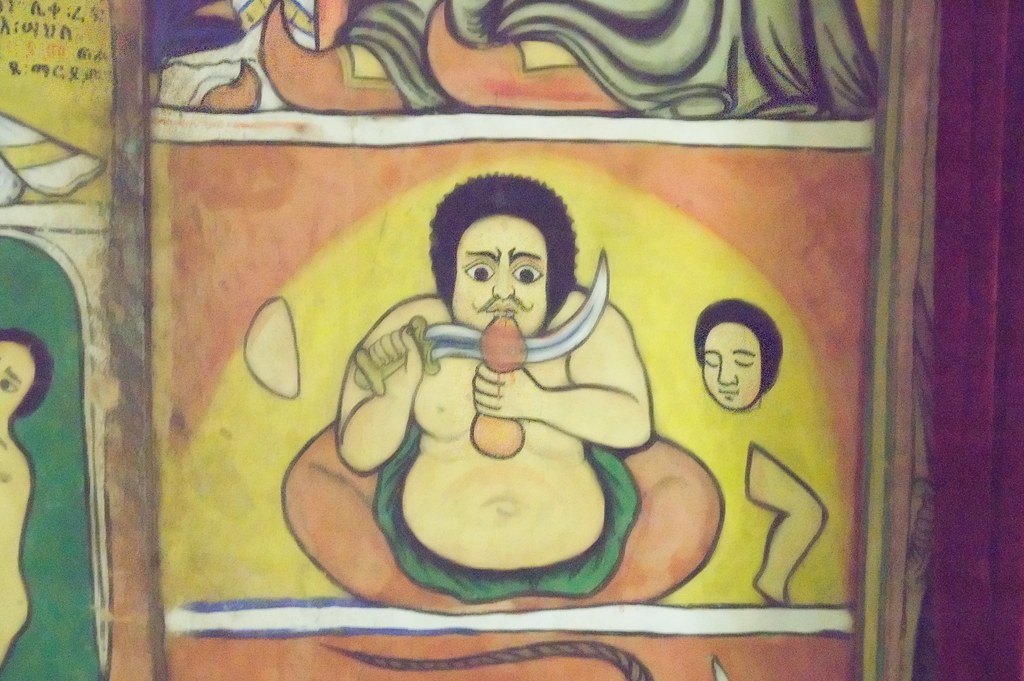
(The photograph is “Girl with skipping rope, Albert Lomer studio, Sydney” by Blue Mountains Library, Local Studies.)