Category Archives: short poems

Semi-formal: RHL, ‘Kinship’

I feel a kinship with those, never met,
who live, uncertain and displaced
in the wrong place on planet earth and sea:
with different languages at home and school,
without a passport from the place they’re raised,
their natural faith despoiled by pointless war,
their sex uncertain, orphaned from themselves,
poets of restlessness, pilots adrift,
obscure, uncertain in their rootlessness,
chameleons of constant camouflage,
and all the little that they know deep down
forever hidden from some foreign frown.

*****

My sense of being displaced is largely one of nationality: in every country I’ve lived in, I feel the closest connection to other expats; and there is no country in which I don’t feel like an expat myself. But that also gives me a sense of commonality with all others in all forms of insecurity and displacement. And maybe it is a natural part of being human… after all, all adults have been displaced from the very different world of childhood.

‘Kinship’ was originally published in the current Shot Glass Journal.

Stand out, don’t blend in!” by partymonstrrrr is licensed under CC BY-NC-ND 2.0.

RHL, ‘The Beat Goes On’

A pounding beat to drug, enhance, enfold –
iambics are the dance floor of the old.

*****

Published in The Asses of Parnassus, home of “short, witty, formal poems”. Thanks, Brooke Clark!

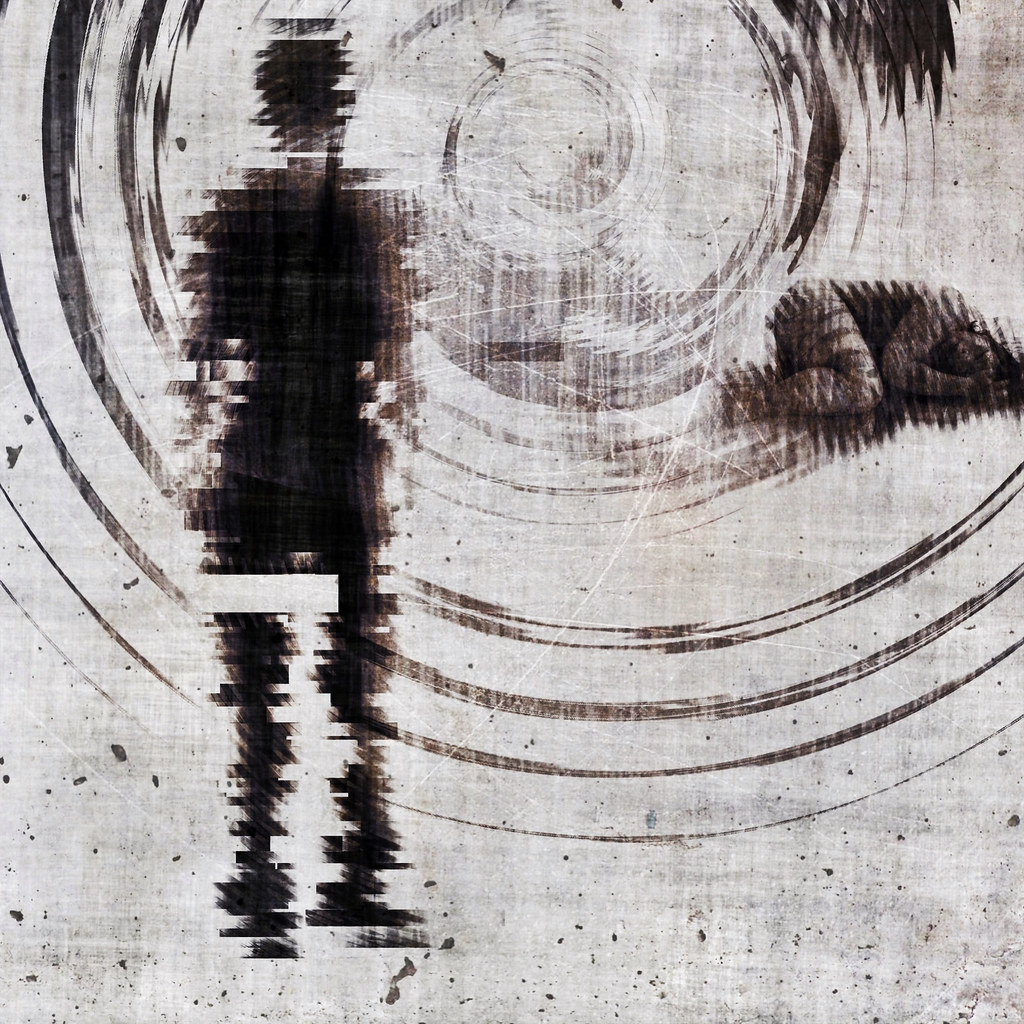
Illustration: ‘Iambics’ by RHL and ChatGPT

Odd poem: Barack Obama, ‘Underground’

Under water grottos, caverns
Filled with apes
That eat figs.
Stepping on the figs
That the apes
Eat, they crunch.
The apes howl, bare
Their fangs, dance,
Tumble in the
Rushing water,
Musty, wet pelts
Glistening in the blue.

*****

A 1981 poem by future President of the United States Barack Obama, originally published in the journal Feast and featured in The New Yorker in 2007. You can forgive a 19- or 20-year-old for a lot of what they wrote… and after all, it’s better than anything we’ve seen from Donald Trump.

Political poem: Melissa Balmain, ‘Evgeny and Evgeniia’s Choice’

“Evgeny and Evgeniia faced an excruciating choice. Immigration and Customs Enforcement officers told the couple they could leave the United States with their child and return to their native Russia, which they had fled seeking political asylum. Or they could remain in immigration detention in the United States — but their 8-year-old son, Maksim, would be taken away and sent to a shelter for unaccompanied children. In the end, they chose the agony of limbo in the United States over a return to a place where they saw no prospect for freedom or any future for their family… The last time Evgeny and Evgeniia saw Maksim was on May 15” The New York TimesAugust 5, 2025. New York Times photo of Evgeny, Evgeniia, and Maksim.

Sophie’s Choice seemed light-years from our time,
a fading tragedy that made us weep
for Streep.

But now with tactics changing on a dime
in brutal ways we thought could not repeat,
sick heat

pervades my belly and begins to climb:
how can we keep denying what it means
when scenes

unspool of parents, guilty of no crime,
compelled to choose the thing that they most fear,
right here?

*****

Melissa Balmain writes: “As the poet Barbara Loots recently put it, what we need right now is a tsunami of truth. I contribute a few drops when I can.”

Evgeny and Evgeniia’s Choice‘ first appeared in New Verse News.

Melissa Balmain’s third poetry collection, Satan Talks to His Therapist, is available from Paul Dry Books (and from all the usual retail empires). Balmain is the editor-in-chief of Light, America’s longest-running journal of comic verse, and has been a member of the University of Rochester’s English Department since 2010.

Photo: New York Times photo of Evgeny, Evgeniia, and Maksim.

Susan Jarvis Bryant, ‘Armadillo’

A hand for the bandit in leathery livery
Advancing through grass to go grubbing in shrubbery –
Escaping the squeal and the squish of the rubbery
To comb and to roam neath the sun.

A bow to the wow of the charmer in armor,
A friend to the poet, a foe to the farmer –
This bug-crunching muncher, this flowerbed harmer,
Is digging up dirt just for fun.

A nod to the plod of this sod-lobbing critter
Whose shovel-shaped nose prods the gardeners bitter –
He begs me to bless him with lexical glitter
Till wittiest ditties are spun.

*****

Susan Jarvis Bryant writes: “When I first arrived in Texas from the UK, I had an overwhelming urge to feast my curious eyes upon an armadillo. I saw plenty of squished unfortunates callously labeled “roadkill”, but there wasn’t a live one in sight… until five years later on a bike ride at the local wildlife refuge, I saw my first wild armadillo (silver armor gleaming in the midday sun) rooting for grubs on the grass verge. Brimming with joy, I leapt off my bicycle and oohed and aahed from as near as I could possibly get. A lady walked towards me. My husband warned me not to get too exciteable about my find, as armadillos weren’t the most charming of Texas critters. I beg to differ, and the lady (from northern parts, apparently) was as excited as I was. To my husband’s undisguised surprise, we simply couldn’t get enough of this fascinating fellow. I had heard many stories (nearly all bad) and simply had to honor him the only way I know how – hence this poem. I love British hedgehogs and the armadillo is most certainly up there with his Kentish-countryside counterpart.”

Susan Jarvis Bryant is originally from the UK and now lives on the coastal plains of Texas. Susan has poetry published on The Society of Classical Poets, Lighten Up Online, Snakeskin, Light, Sparks of Calliope, and Expansive Poetry Online, The Road Not Taken, and New English Review. She also has poetry published in The Lyric, Trinacria, and Beth Houston’s Extreme Formal Poems and Extreme Sonnets II anthologies. Susan is the winner of the 2020 International SCP Poetry Competition and was nominated for the 2022 and 2024 Pushcart Prize. She has published two books – Elephants Unleashed and Fern Feathered Edges.

Photo: “Nine-banded Armadillo” by http://www.birdphotos.com is licensed under CC BY 3.0.

Daniel Brown, ‘Isn’t That The Way’

A river’s winter-silver
Discerned through screening trees
Takes on a certain sorrow
From the barrenness of these;

Of these whose summer glory
Can seem a little sad,
There being not a glimmer
Of river to be had.

*****

Daniel Brown writes: “I used to live in a seventh-story apartment in Manhattan whose kitchen window gave on Riverside Park and the Hudson River beyond. But this prospect had its limitations. I could see the river’s grandeur only in winter, when the intervening trees in the park were bleakly bare.  In the summer the trees were in glorious leaf—thereby blocking my view of the river. I wrote to a friend that this impossibility of having it all, view-wise, was “an emblem of our plight.”  Over the years I’d occasionally think about doing this predicament up as a poem, but my heart would sink at the anticipated tedium of laying out the situation’s physical set-up—the apartment, its location and elevation, its view—so I never attempted the piece. Then, not long ago, I found myself re-interrogating the poem’s possibilities—and recalling the phrase “emblem of our plight.”  It occurred to me that the poem could be cast as, well, emblematic: that laying out the physical set-up needn’t be burdensome because I didn’t have to lay it out; I could leave it out. Suddenly the poem seemed worth a try.”

‘Isn’t That The Way’ was published some years ago in a journal called Parnassus: Poetry in Review.

Daniel Brown’s poems have appeared in Poetry, Partisan Review, PN Review, Raritan, Parnassus, The New Criterion and other journals, as well as in a number of anthologies including Poetry 180 (ed. Billy Collins) and The Swallow Anthology of New American Poets (ed. David Yezzi). His work has been awarded a Pushcart prize, and his collection Taking the Occasion (Ivan R. Dee, 2008) won the New Criterion Poetry Prize. His latest collection is What More?  (Orchises Press, 2015). Brown’s criticism of poets and poetry has appeared in The Harvard Book Review, The New Criterion, PN Review, The Hopkins Review  and other journals, and the LSU Press has published his critical book, Subjects in Poetry. His Why Bach? and Bach, Beethoven, Bartok are audio-visual ebooks available at Amazon.com. His website is danielbrownpoet.com .

Photo: “Riverside Park South, June 2014 – 01” by Ed Yourdon is licensed under CC BY-NC-SA 2.0.

Short poem: RHL, ‘Heart Attack’

Lust –
Thrust –
Bust –
Dust.

*****

One of the things that intrigues me is the way certain word endings fall into groups, evoke a common mood, sometimes seem to tell their own story. Some of these groups seem natural with overall positive “light, bright, flight, height, white” or negative “dusty, musty, fusty, gusty”; “bumble, crumble, grumble, fumble, stumble, tumble” connotations… but I acknowledge that with the first set I’m ignoring “blight, night, shite” and so on. Some seem random, especially perhaps when the different spellings suggest unrelated origins: “beauty, duty, fruity, snooty,” but still lead to a story.

Happily, I’m not alone in these idle thoughts. Melissa Balmain’s Tale of a Relationship in Four Parts comes to mind… and from Maz (Margaret Ann Griffiths) we have ‘The Drowning Gypsy’:

Flamboyant
Clairvoyant
Unbuo
o
o
o
o
y
a
n
t

Maz’s work is collected in ‘Grasshopper‘; Melissa Balmain’s poem is collected in ‘Walking in on People‘ from Able Muse Press; ‘Heart Attack’ was recently in The Asses of Parnassus.

Photo: “heart-attack” by Pixeljuice23 is licensed under CC BY-SA 2.0.

RHL, ‘On a Modern “Poem”’

The thoughts are fresh, the images are good;
the style is clean, the tone both wise and terse;
the whole thing would be memorable, it would…
if only it had been expressed in verse.

*****

I’m always embarrassed if I have an idea for a poem, and I fail to find an expression of it in rhyme as well as rhythm. That’s because, of the hundreds of poems or pieces of poems in my head, all but a tiny handful are remembered because they are expressed in verse. You can remember the gist of an idea on the strength of the idea; but if you want to remember its exact expression, word for word, it’s far easier if it’s in verse. For this purpose, blank verse is better than prose; but rhymed verse is superior.

You may have lots of partial memories of Winnie the Pooh from childhood – the Hundred Acre Wood, Eeyore’s moans and groans – but actual word-for-word memory is likely to attach to the few snippets of verse in the book, such as:
Isn’t it funny
How a bear likes honey.
Buzz! Buzz! Buzz!
I wonder why he does?

My little gripe above was originally published in Light earlier this year.

Photo: “Al declaims” by jovike is licensed under CC BY-NC 2.0.

‘Maz’ Griffiths, ‘Clogs’

The Queen Mum’s gorn and popped her clogs;
the telly’s stuffed with Royal progs.
I’ve heard a thousand epilogues
now the old Queen Mum has popped her clogs.

The Queen Mum’s gorn and popped her clogs
so let’s fish out our mourning togs
and toast her name in small eggnogs.
Our dear old Queen Mum’s popped her clogs.

The Queen Mum’s gorn and popped her clogs.
Oh, Gawd, we’ll all go to the dogs,
and princes will turn into frogs
now the old Queen Mum has popped her clogs.

*****

The always delightful Margaret Ann “Maz” Griffiths published in a huge range of voices: formal sonnets of wildlife and of the illness that finally killed her, blank verse rants against warfare or injustice, sad songs of the female loss of innocence, flippant anti-establishment sarcasm about the British Royal Family…

‘Grasshopper’, her 350-page collection of poetry (and also one of her nicknames) was assembled by fans after her death and published by Arrowhead Press in the UK and Able Muse Press in North America. It is readable and rereadable. I post the occasional poem in this blog.

Photo: “Queen Mum Dead” by Joe Shlabotnik is licensed under CC BY-NC-SA 2.0.

Epigram: Brooke Clark, ‘Still Waiting’

You say your memoirs offer pointed re-evaluations
of countless authors’ puffed-up reputations
so you’ve arranged to have them published once you’re safely dead.
Nestor, it’s time your memoirs were read.

*****

Brooke Clark writes: “The original for this is by Martial: Epigrams IV.33; it’s a good example of the alternating 7-stress, 5-stress lines I finally settled on as the best way to capture the feeling of Martial’s elegiac couplets in English. Martial has a number of these “hurry up and die already” poems; if you read through large chunks of his epigrams at a go you’ll find a lot of themes recur over and over with slight variations. The addressee in the original is a poet, but somehow I found the idea of a writer who has left a “poison pen” memoir revealing what he really thinks of all his contemporaries more interesting. Nestor is one of the recurring “characters” in Urbanities, an idea I picked up from Martial’s treatment of Zoilus and expanded until I had a small cast whose stories developed over the course of the book.”

‘Still Waiting’ was originally published in Literary Imagination.

Brooke Clark is the author of the poetry collection Urbanities and has published work in ArionLiterary ImaginationTHINKThe WalrusLA Review of Books, and other places. He is also the editor of the online epigrams journal The Asses of Parnassus and the book reviews editor at Able Muse.
Twitter: @thatbrookeclark
Bluesky: @brookeclark.bsky.social

Photo: “1701 Martial Epigrams Dekesel M139” by Ahala is licensed under CC BY-NC 2.0.