Category Archives: short poems

Very short poem: RHL, ‘The End is Nigh’

The end is an A.I.

*****

This very short (poem?) was just published in The Asses of Parnassus – thanks, Brooke Clark! I chose this post’s accompanying photo for its enigmatic mixture of futuristic construction and threatening natural conditions – the building is the Globe, or Avicii Arena, in Sweden but that is irrelevant.

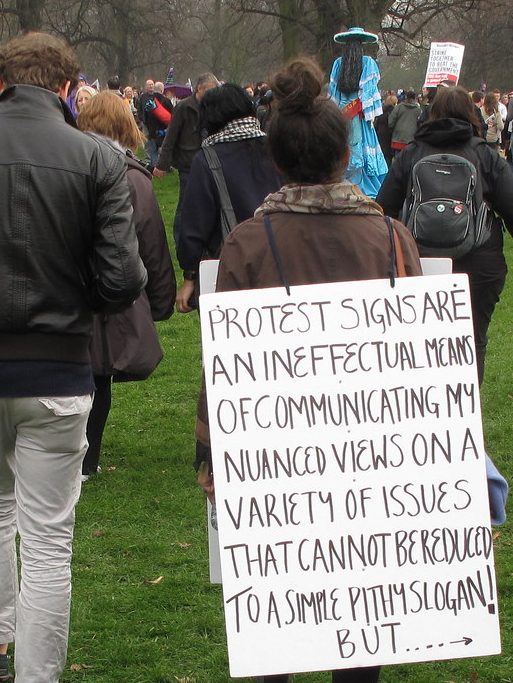
An alternative photo I considered had a doomsday prophet holding a sign saying “The beginning is nigh”, which would be equally true: the end of homo sapiens being the beginning of some unguessable post-humanity. I read Ray Kurzweil and Yuval Noah Harari, and ponder. And then I look back at (others’) 2015 predictions of what the next ten years would bring, and, well, not so fast…

Photo: “the end is nigh” by dan.boss is licensed under CC BY-NC-SA 2.0.

Ed Shacklee, ‘Burn’

I took the way of stone,
not water, air or fire:
one element alone
could complement desire.

Not to quickly flare,
nor to slyly flow –
no fickleness of air
could whisper where to go;

for I was each, in turn,
as years unearthed the soul,
yet found no way to burn
but dark and pressed as coal.

*****

Ed Shacklee writes: “I very seldom know what to say about a poem; the cage opens, and the bird flies away – often not quite finished.”

Ed Shacklee lives on a boat in the Potomac River. His first collection, “The Blind Loon: A Bestiary,” was published by Able Muse Press.

And for those who like odd information and representations of animals, The Blind Loon: A Bestiary Facebook group is worth joining.

Photo: “Glowing Coals” by chrisgintn is licensed under CC BY-NC-SA 2.0.

Barbara Loots, ‘Small Things’

Things have a tendency to lose themselves:
hammer, needle, the necessary spring,
a button, the keys–they disappear like elves,
like roses, wishes, the words for everything.

Dive in. Ransack a drawerful of debris.
Wrestle with irritation, grief, self-doubt.
One earring, that pen, eyesight, dignity:
small things we learn, in time, to do without.

*****
Barbara Loots writes: “The small losses and lapses of memory that happen to everyone seem more vivid and alarming as I grow older. I realize that it isn’t things but myself I must gradually, inevitably let go of. Even so, the vast, abundant universe brings perspective to the human situation, including mine.”

Barbara Loots resides with her husband, Bill Dickinson, and their boss Bob the Cat in the historic Hyde Park neighborhood of Kansas City, Missouri. Her poems have appeared in literary magazines, anthologies, and textbooks since the 1970s. She is a frequent contributor to lightpoetrymagazine.com. Her three collections are Road Trip (2014), Windshift (2018), and The Beekeeper and other love poems (2020), at Kelsay Books or amazon. More bio and blog at barbaraloots.com

Photo: “Things you might lose on the subway” by Hippolyte is licensed under CC BY 2.0.

Richard Fleming, ‘Time 2’

A hamster racing on a wheel,
a movie spinning on a reel,
the clock-hands march inexorably.
What they record, we cannot see
or touch, or hear, or smell, or taste,
yet it diminishes. Make haste.

*****

Richard Fleming writes: “When young, I thought about time in terms of how quickly I could run 200 metres and, later, whether I could dip under 35 minutes in a 10k road race. Yes, I was shallow then but youth and shallowness often go hand in hand: they did in my case. Grown older (let’s be honest, old) , Time has acquired a capital T and seems to have morphed into a rather unnerving companion who demands more and more of my attention every day.”

Richard Fleming is an Irish-born poet (and humorist) currently living in Guernsey, a small island midway between Britain and France. His work has appeared in various magazines, most recently Snakeskin, Bewildering Stories, Lighten Up Online, the Taj Mahal Review and the Potcake Chapbook ‘Lost Love’, and has been broadcast on BBC radio. He has performed at several literary festivals and his latest collection of verse, Stone Witness, features the titular poem commissioned by the BBC for National Poetry Day. He writes in various genres and can be found at www.redhandwriter.blogspot.com or Facebook https://www.facebook.com/richard.fleming.92102564/

Susan McLean, ‘Received Wisdom’

Unpacking it, we wondered who had sent it
and why they felt we needed it. We thought
we’d managed fine without it. Had they meant it
as tribute or rebuke? We had been taught
to view unsought donations with suspicion.
Inspecting it, we found a hairline crack.
It doesn’t suit our taste or disposition.
In short, we must insist they take it back.

*****

Susan McLean writes: “Finding new meanings in old phrases is one of my favorite games. In the case of the poem’s title, I was thinking about how each generation wants to pass along advice to the next generation, which the next generation tends to reject. Advice always feels like criticism, however well intended it may be. Moreover, the world is changing so fast that advice that worked for one generation no longer fits the reality of the next generation.

“The alternating feminine and masculine rhymes in the poem are meant to mimic the interplay between two generations, or any two groups that have differing views. ‘Received Wisdom’ was originally published in Free Inquiry and later appeared in my second book of poems, The Whetstone Misses the Knife.”

Susan McLean has two books of poetry, The Best Disguise and The Whetstone Misses the Knife, and one book of translations of Martial, Selected Epigrams. Her poems have appeared in Light, Lighten Up Online, Measure, Able Muse, and elsewhere. She lives in Iowa City, Iowa.
https://www.pw.org/content/susan_mclean

Photo: “sauce tureen 2, hairline” by pgintx1128 is licensed under CC BY-SA 2.0.

Richard Fleming, ‘Time’

Screenshot 2023-07-30 at 19.15.56.png

He took the time to take the time
and taking it, although a crime,
was what he felt he had to do
so, whilst one might well take the view
that stealing time left others short,
he’d answer with a sharp retort
that time and tide wait for no man
and man must take what time he can.

*****

Richard Fleming writes: “This poem, written in response to a prompt in the form of an image of a man carrying a large clock, is primarily a piece of nonsense-verse and an exercise in word-play, two forms of writing that I particularly enjoy. That it rhymes and scans is something of a bonus.”

Richard Fleming is an Irish-born poet (and humorist) currently living in Guernsey, a small island midway between Britain and France. His work has appeared in various magazines, most recently Snakeskin, Bewildering Stories, Lighten Up Online, the Taj Mahal Review and the Potcake Chapbook ‘Lost Love’, and has been broadcast on BBC radio. He has performed at several literary festivals and his latest collection of verse, Stone Witness, features the titular poem commissioned by the BBC for National Poetry Day. He writes in various genres and can be found at www.redhandwriter.blogspot.com or Facebook https://www.facebook.com/richard.fleming.92102564/

Melissa Balmain, ‘Tale of a Relationship, in Four Parts’

Kissing.
Hissing.
Dissing.
Missing.

*****

Melissa Balmain writes: “Often, monorhymes end up feeling a bit forced, so I’m happy when I manage to write one that feels natural (at least to me). Plus, it’s always nice to have a poem in the love-gone-wrong category. Not only is this a prerequisite when you apply for your poetic license, but it can land you in great company. (See Kiss and Part, a 2005 anthology edited by Gail White, where ‘Tale of a Relationship’ rubs elbows with verse by the likes of Dorothy Parker, Wendy Cope, XJ Kennedy, and many poets whose work has appeared in Form in Formless Times.)”

‘Tale of a Relationship, in Four Parts’ is from Walking in on People © Melissa Balmain, 2014. Used by permission of Able Muse Press.

Melissa Balmain’s third poetry collection, Satan Talks to His Therapist, is available from Paul Dry Books (and from all the usual retail empires). Balmain is the editor-in-chief of Light, America’s longest-running journal of light verse, and has been a member of the University of Rochester’s English Department since 2010. She will teach a three-day workshop on comic poetry at the Poetry by the Sea conference in Madison, CT, in May 2024.

Photo: “Broken Kiss; Love Lost” by angelaathomas is licensed under CC BY 2.0.

Light verse: RHL, ‘Question the Universe’

Odin wrote runey verse
Rumi wrote Sunni verse
Edward Lear? Loony verse.
Question the universe
with your buffoony verse.

*****

Sometimes you jot down a little light piece inspired more by wordplay than anything else, and the more you look at it the more it resonates. This is one such. The characters are diverse, coming from pre-literate Scandinavia, Renaissance-inspiring Islam, and Victorian England – they touch the roots of my cultural identity. They are from the past, but their searches are timeless, fully modern, quintessentially human. And I fully subscribe to the idea that we should question everything, and that the Fool‘s tools of succinct and enigmatic wordplay may be as good an approach as any in trying to formulate – let alone answer – all questions, physical and existential.

It further resonates for me in being published (which I find important); in being published just now in Light (which is a wonderfully reassuring place to be); in having been improved in response to Light’s editorial comments (meaning, yes, I am proud that sometimes I am open to criticism and it’s useful); and in being my 400th poem published (by one of my conflicting counts).

Nothing is definite, not the historical reality of historical and semi-historical figures, not the permanence of printed words, not the definition of a poem, not the count of things hard to define, not the nature of physical reality. So though we have to make prosaic choices based on appearances and best guesses, that should be balanced by questioning everything. Preferably in verse.

TL;DR: Even short poems can be unpacked.

Illustration: DALL-E by RHL, ‘Rumi, Odin and Edward Lear are writing poetry to question the universe’

Light verse: Edmund Conti, ‘Man O’ War’

The men of war
in the man o’ war
(and the many more)
who rode the ship’s bottom
where the admirals put ’em
would often think
this has to stink
If we ever sink
we’re sunk.

At least
that’s what
I think
they thunk.

*****

Edmund Conti writes: “I guess I was thinking if there is a Man O’ War, then there have to be Men O’ War. And where would they be put to be kept out of the way until called on. One idea led to another, one simple rhyme led to more, and voila!”

Edmund Conti has recent poems published in Light, Lighten-Up Online, The Lyric, The Asses of Parnassus, newversenews, Verse-Virtual and Open Arts Forum. His book of poems, Just So You Know, released by Kelsay Books
https://www.amazon.com/Just-You-Know-Edmund-Conti/dp/1947465899/
was followed by That Shakespeherian Rag, also from Kelsay
https://kelsaybooks.com/products/that-shakespeherian-rag

Photo: “The Battle of Trafalgar, 21 October 1805” by lluisribesmateᥩ is licensed under CC BY-NC 2.0.

Short poem: RHL, ‘Friendship, Not Passion’

I had a friendship, more than passionate love, for you;
we could have been so good, easy, together.
But there’s that issue of your strong religious thoughts,
whereas I let my thoughts change with the weather.

I… well, and who’s the I you think that you address?
I ramble, googly-eyed, my arms elastic.
There are so many sweet but sadly firm believers.
I’m – more than atheist – iconoclastic.

*****

If you’re used to iambic pentameter the meter of this poem feels just a little off, with its lines of alternating 12 and 11 syllables, i.e. alternating hexameters and feminine-ending pentameters… not quite comfortable. Which is perfectly in keeping with the relationship described. And I don’t remember precisely which long-ago not-quite-girlfriend I had in mind when I wrote it; I’ve been attracted to more than one charming female, wonderfully calm and sane except for some unfortunate religious orientation or other.

I’m reminded of the 19th century Punch cartoon of the two guests at a dinner party:
She: “And what is your religion, sir?”
He: “Madam, all men of sense are of the same religion.”
She: “And which religion is that, pray tell?”
He: “Madam, men of sense never say.”

Which is all very well for friendship, but hardly a solid basis for a deeper relationship. You’re better off if you hold out for someone philosophically compatible, unless you (and they) really don’t care. In which case, you’re philosophically compatible!

‘Friendship, Not Passion’ was originally published in Lighten Up Online, edited by Jerome Betts.

Illustration: “Friendship” by h.koppdelaney is licensed under CC BY-ND 2.0.