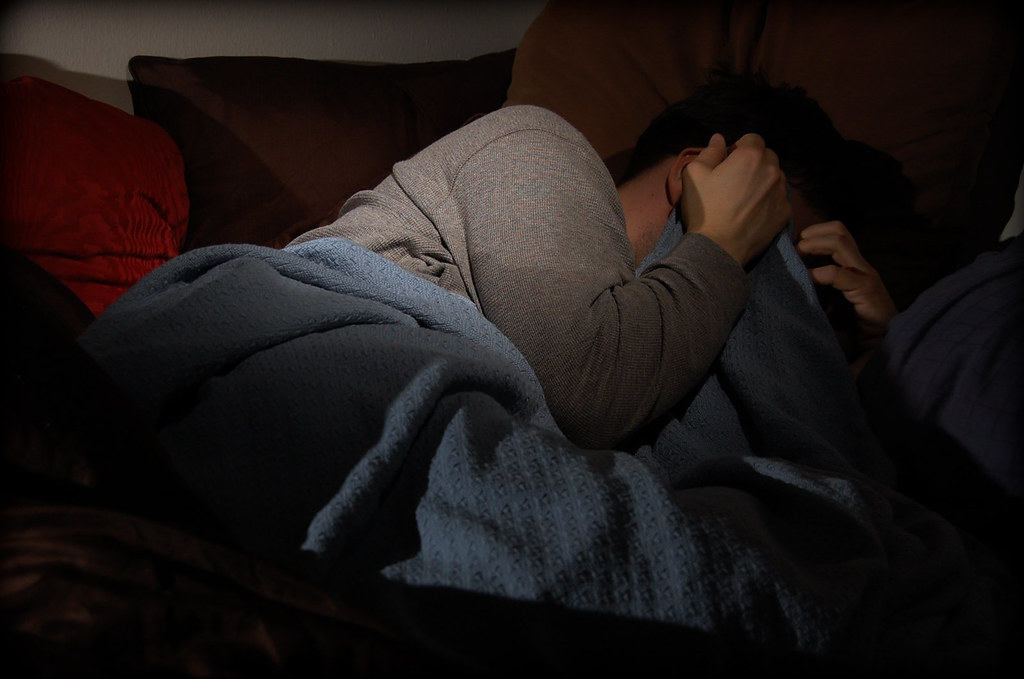
Why the mumbled answers, often feeling weary, staring out the window: bitter, wistful, dreamy, harried — always reeling, not engaging, letting out a titter, mocking laughs or strange and distant crying? But eventually she says it’s cancer, not affairs, not me – then we were trying, talking even if there was no answer. But I would have those awful times again: I whispered her to sleep and once she slept I stroked her scalp and tucked her sheets, and then I ran off to the shower and I wept. We talked. We really talked though it was draining, as one, about the time that was remaining.
*****
Daniel Kemper writes: “This poem is utterly imagination, perhaps of the “O my prophetic soul” variety. Alexandra (that’s her name) and I were out of contact at the time, but it would have been right as she came down with cancer, if I have my timeline right. It’s a multi-meter sonnet of the kind I thought probably the easiest to which I could introduce people. It starts off in trochaic meter and changes to iambic at the volta. This design choice was to have descending meter for the down mood, and when looking at the bright spot, change to ascending meter. The couplet unifies them via iambic meter plus feminine endings, hopefully that accented the coming together of the two at the end, even if unconsciously.”
Daniel Kemper, a former tournament-winning wrestler, black belt in traditional Shotokan karate, and infantryman has earned a BA in English, an MCSE (Systems Engineering), an MBA, and an MA in English and had works accepted for publication at more than a dozen magazines, including a pushcart nomination. He’s been an invited presenter at PAMLA 2024 and presided over the Poetics Panel in 2025 and has been the feature poet at several Sacramento venues.
Inside the shower’s stream the morning blurs, ceremony wakes on white marble tile; brushed steel and shaving brush wait, rituals that ask the rushing mind to pause a while.
The bowl presents the soap, the steam the heat; damp badger bristles swirl, patient and slow. No canned foam, no gelled and fleeting cheat, hands repeating what older barbers know.
The lather builds like weather in the hand, a cloud coaxed up from water, soap, and time; slow turns that ask a man to pause and stand at break of day before its clamors chime.
Hands learned the quiet patience of the bowl, small weather turning slowly in the soul.
*****
Keith Roberts writes: “I’d be remiss if I didn’t give my wife credit for this poem. For my birthday she gave me a bowl, a brush, and a puck of all-natural shave soap from a local artisan. A little whisk into lather, the woody-whiskey scent comes up, and suddenly I swear I can hear modal jazz somewhere in the background. In a world built around consumption, algorithms, and binary takes, it’s important to our humanity to rediscover the transcendent in small, ordinary experiences like this. And maybe more importantly, to listen when other people share theirs. This poem is a thank you to my wife for helping me find one.
“I’m just starting this writing and poetry journey. I’m a recovering math major with graduate degrees in Computer Science and Computational Social Science. Most of my career was spent living in the abstract: programming, modeling, data, systems. When my dad passed away a couple of years ago, something in me shifted. I started writing partly as a way to process the loss and partly to leave my kids something more durable than an Instagram feed. Also, and this is important, it gives me great comfort knowing that dad jokes can, in fact, achieve a kind of immortality…even in sonnet form. If that garners a few more eye rolls from my kids after I’m gone, I’ll consider my work a success.”
a man will cross the world at the smallest hope of love
Beep. Wrrrr. Clickclack. Ssssss. ‘Hello?’ Ssssss. Ssssss. Ssssss. ‘It’s’ – crackle – ‘Geet.’ Crackle. ‘We could’ – buzzzzz. Ssssss – ‘meet.’ Ssssss. Ssssss. ‘If’ – crackle crackle – ‘Joe?’ Umm. ‘I’mchangingtrainsatLeuvenstation halfpastfiveonTuesdaymorning’bye.’ Clickclack. Beep. The Monday midnight sky shuddered like a fridge. Our conversation never matched our love. Too pissed to drive, I took my bike. The roads were swiped with ice. It snowed. My front teeth froze. I fell off twice. ‘The next train‘ – Jesus! Push me! – ‘to arrive…‘ We met – still moving. ‘Kiss me!’ That was it. I biked back home to Mol. The sun shone. Shit.
*****
John Gallas writes: “Romantic Love called upon to go out in the cold on a bike to resurrect its glories, which may never quite have been what they are remembered as. I enjoyed the stop-start challenge of the expression of hesitation, and of producing punctuation of indecision and effort. Perhaps the last word, far from being annoyance, hints at sadness.”
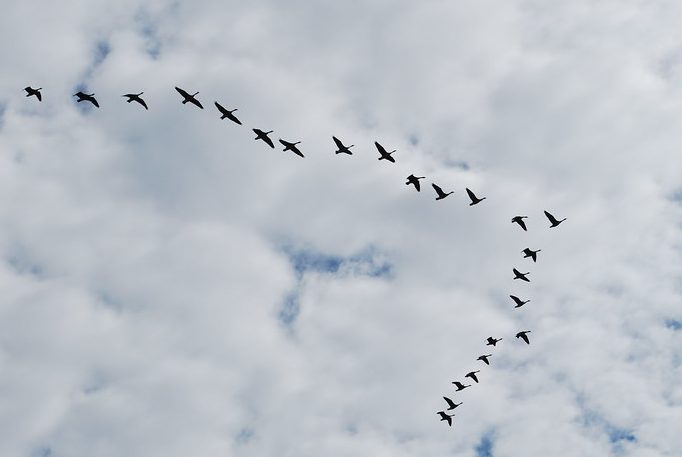
When spring’s ghost joins me on the deck to watch Gilt city lights click on across the bay, Some downtown maid squeaks windows, wipes the splotch Between us. Here, this quiet view. Soft clay And pungent eucalyptus, thick with rain, Exude their essence. Summer’s gloom unwinds, A pane has shattered, and each rampant cane Of luscious juicy blackberries reminds My grief entwining August’s humid air. A wedge of geese pries open autumn, herds Fat purple clouds toward dusk above the glare Of distant offices. Your murdered words Of love on voicemail echo you were dead Before you put that bullet through your head.
*****
Beth Houston writes: “Regarding the sonnet: This is one poem I’d prefer to let the reader chew on without me explaining anything. It does have some tricky time aspects…”
She adds: “I have announced the submission period for the next anthology on the Rhizome Press website. Included are updated guidelines and new emails for submissions and general mail (no longer gmail). Folks will have plenty of time to submit. I just hope I don’t get an avalanche at the last minute. But better loads of poems than not getting them. I’m eager for people to let their poet friends know. I’d love to get LOTS of submissions.
Beth Houston(www.bethhouston.com) has taught writing (mostly creative writing) at ten universities and colleges in California and Florida and has worked as a writer and editor. She has published a couple hundred poems in dozens of literary journals. She writes free verse and formal poetry, mostly sonnets, and has published a novel, two nonfiction books, and six poetry books (out of print). She edits the Extreme formal poetry anthologies via one of her indie presses, Rhizome Press (www.rhizomepress.com).
It’s fallen half apart, a derelict. The gatherings have sprung, the boards detached, The spine perished, folding maps cut out. The title page is splotched with ink and nicked At the edge, the author’s homely portrait scratched— A splash of beer, faint thumbmarks all about— Discarded once, but now it’s yours. It lives, Like you, diminished now by age and loss. And so, it brings the breeze, the autumn sun, The creaking door that with a push still gives The afternoon, the birds and clouds, grass, moss, The world still new, the journey not begun, The path curling from sight in the soft glow Of a fading day—and you, prepared to go.
*****
Ernest Hilbert writes: “I am a rare book dealer, so I spend my days surrounded by books. I love all kinds of books, and I have a particular affection for books no one seems to want but which are, nonetheless, worthwhile. There are, after all, far more books than there are readers. When a book is taken home, adopted, as it were, it finds a new life. Each book one acquires is, in its way, a hedge against the future, a small hope one might some day find the time to read it. When a book is read for the first time, however old it is, however many times it has been read before, it becomes a new book. The structure of the poem is designed to express this sense of renewal and hope, the litany of degradation and wear, the sense of hopelessness, one finds in the octave redeemed, after the volta, in the sestet.
“I intended to communicate that sense of excitement I still feel when I first open a book, but I likely also had in mind Benjamin Franklin’s mock epitaph, written when he was 22, which begins “The Body of B. Franklin Printer / Like the Cover of an old Book / Its Contents torn out . . .” Finally, I must admit that there are few places I find myself happier than at a promising friends of the library book sale.”
*****
‘Friends of the Library Sale’ was originally published in The Sonneteer.
Ernest Hilbert was born in 1970 in the city of Philadelphia and educated at Rutgers and Oxford Universities. He is the author of the poetry collections Sixty Sonnets, All of You on the Good Earth, Caligulan—selected as winner of the 2017 Poets’ Prize—Last One Out, and Storm Swimmer, winner of the 2022 Vassar Miller Prize. He works as a rare book dealer in Philadelphia. Visit him at www.ernesthilbert.com
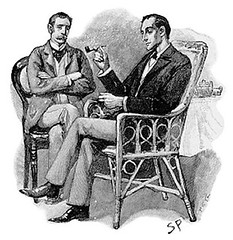
“Have you ever thought, Holmes, all we are Is one long tube around which are attached As very mixed a cluster of bizarre Accessories as ever were mis-matched To move about to gain the wherewithal To hunt and gather what it needs to eat From things that grow or swim or fly or crawl, And change them into matter to excrete?” “Certainly, dear Watson — that’s a trope That humankind has puzzled over, now, And through the eons we’ve had love and hope, And all philosophy’s no more than how, Through grasping and digesting, we can cope With nature’s discontents and discontentery. You’ve heard me say it, Watson — it’s alimentary.”
*****
Marcus Bales writes: The Human Alloy
I’ve heard a lot of other poets say “This poem took me many years to write,” And never understood, until today, What that was like, but now I think I might.
I heard the joke in second grade, or third, And didn’t get it. Nothing there for me Who’d never heard of Sherlock Holmes, absurd As classmates made my ignorance out to be.
I read the books and stories then of course And hated Holmes’s bullying and sneers At poor old Dr. Watson, so the source Of humor there eluded me for years.
Bit by bit, I finally came around To see superiority as fine And feel such arrogance was something sound. You never heard such sneers and snarks as mine.
There’s nothing I would not pretend to know Nothing I had no opinion on No lacerating length I would not go To show that all were ducks but I, a swan.
Until at length I came to read Ayn Rand Whose heroes do and say such nasty scat That even I could finally understand The breach of faith it is to be like that.
And flawed, addicted Holmes no longer seems The snarling height of genius on its throne Pursuing all the best of human dreams, But just another man almost alone.
And it’s by Watson’s decency we gauge Cooperation making common sense Without which Holmes’s self-destructive rage Would flail against the world without defense.
My view of Holmes and Watson rounds at last To my acceptance of the central hoax Of life: it’s only teamwork that can cast The human alloy. That and silly jokes.
*****
Not much is known about Marcus Bales, except he lives and works in Cleveland, Ohio, USA, and his work has not appeared in Poetry or The New Yorker. His latest book is 51 Poems; reviews and information at http://tinyurl.com/jo8ek3r
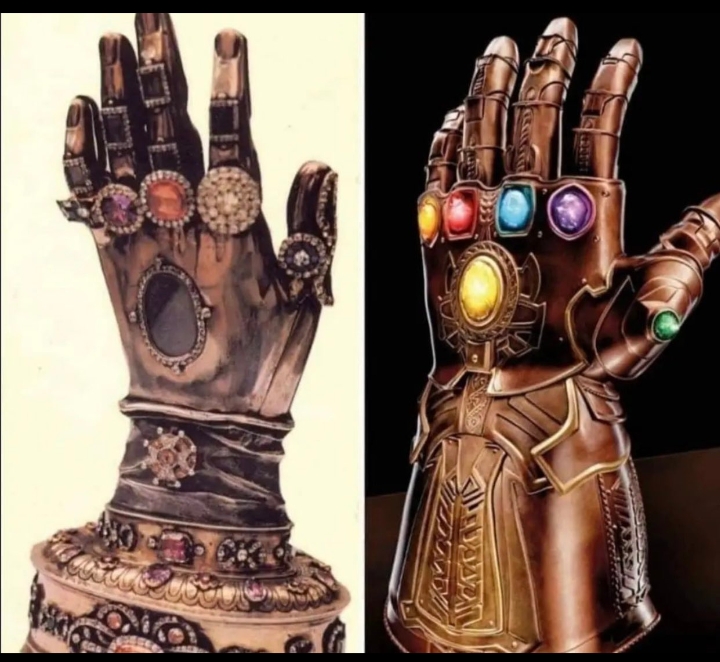
When the saint died, her best friend and confessor cut off her hand. (What are friends for?) The shrine at Ronda keeps it as a sacred treasure, covered with glass and gold. I can’t assign a special magic to those long-dead fingers, lacking the power or the will to bless. But with the faithful some enchantment lingers over the bones, some touch of holiness that once informed a living heart. I know the spell I feel here will not come outside with me, will never cheer me in the dark, but for Teresa’s lovers, every tree breathes miracles, and Ronda’s grassy park abounds in babies whose young mothers planned their nursery colors once they touched her hand.
Gail White writes: “This is one of about 3 poems based on my attraction-repulsion relationship with the cult of holy relics. I’ve seen a number of relics, including Catherine of Siena’s head, which is really a creepy sight. But after all, holiness is in the believer’s heart rather than in the subject’s bones, and that is what I have tried to get across with this poem for St. Teresa.”
Gail White is a widely published Formalist poet and a contributing editor to Light. Her latest chapbook, Paper Cuts, is out on Amazon or from Kelsay Books. She lives in Breaux Bridge, Louisiana, with her husband and cats.
Photo: The Hand of Saint Teresa in the church of Nuestra Señora de la Merced in Ronda, Spain. This piece is traditionally visited & kissed by Christians.
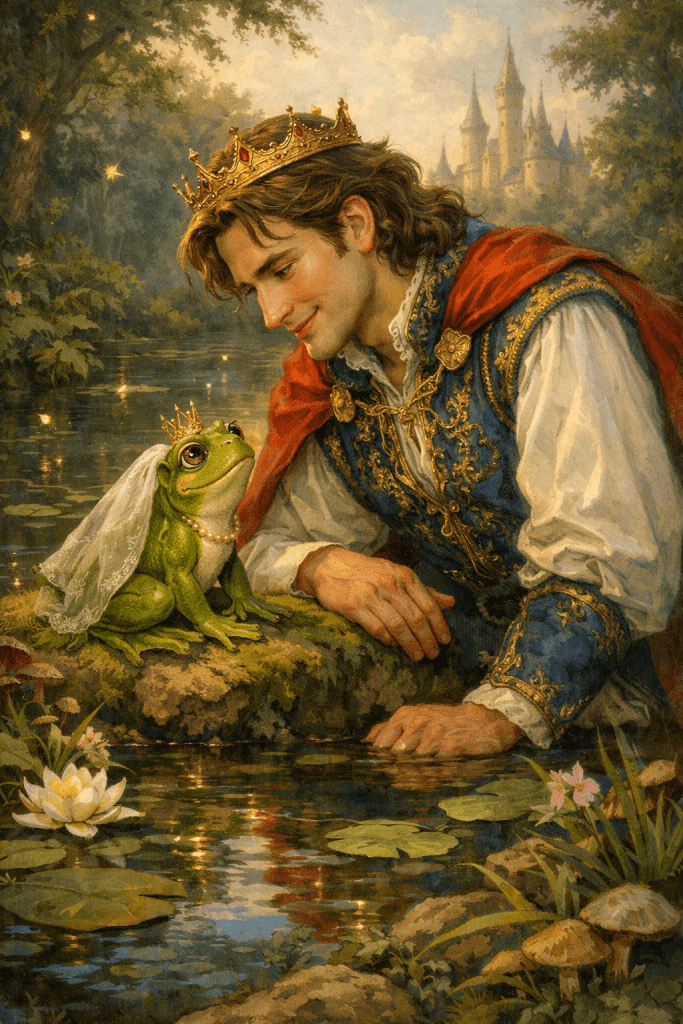
He did not think of love of Her at all frog-plangent nights, as moons engoldened roads through crumbling stonewalled provinces, where toads (nee princes) ruled in chinks and grew so small at last to be invisible. He smiled (the fables erred so curiously), and thought bemusedly of being reconciled to human flesh, because his heart was not incapable of love, but, being cursed a second time, could only love a toad’s . . . and listened as inflated frogs rehearsed cheekbulging tales of anguish from green moats . . . and thought of her soft croak, her skin fine-warted, his anemic flesh, and how true love was thwarted.
*****
Michael R. Burch writes: “Happily Never After (the Second Curse of the Horny Toad)” is perhaps my most mysterious poem, because it wrote itself and I didn’t know the surprise ending until the closing lines came to me “out of blue nothing” to quote my friend the Maltese poet Joe M. Ruggier. Also, the poem decided, without consulting me, to be a sonnet!”
Michael R. Burch’s poems have been published by hundreds of literary journals, taught in high schools and colleges, translated into 23 languages, incorporated into three plays and four operas, and set to music, from swamp blues to classical, 86 times by composers.
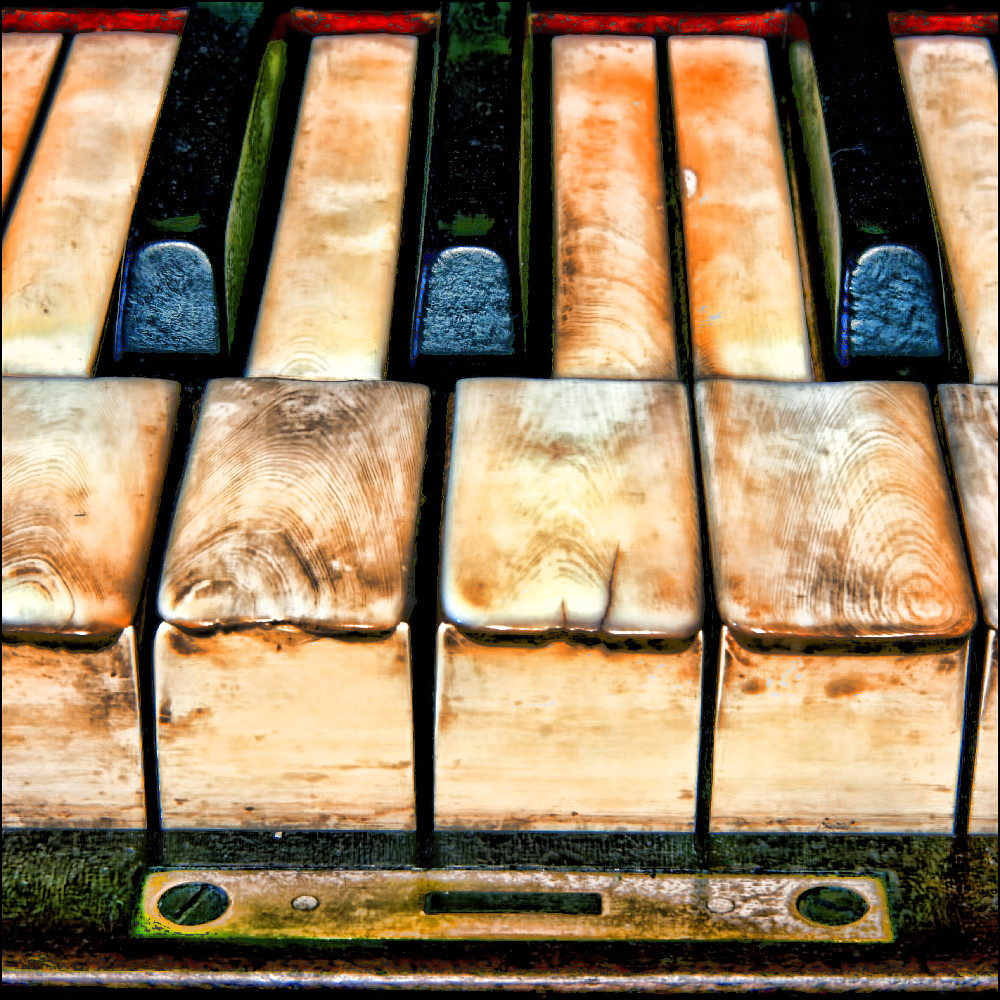
Notes left behind by strangers long since dead entranced my mother—not the squiggles, dots and lines themselves, but what musicians read from them on radio, the sounds ink spots had spelled. In quartets and in Claire de lune, her young ears heard what many can’t discern: enchanting, complex things—beyond the tune— about which she had little chance to learn. When she grew up, her voice was warm and rich as those of many singers who’d been schooled in breath control and quarter notes and pitch. She was as musical as some who’ve ruled the concert stage—but she sang in the car and kitchen; we heard her wide repertoire.
We heard her car and kitchen repertoire of opera arias, concerto themes, and deep regret she never got as far as piano lessons. Her childhood daydreams were seeded by the sagging upright housed at her Aunt Margaret’s—maybe she’d learn there?— and fed by radio: Puccini roused her love of opera, Brahms made her aware of string-sung drama. She pursued her chances to learn and listen—and also to plead for lessons, though her parents’ circumstances made that impossible. But she’d succeed in giving her kids what she’d never had— assisted in that effort by my dad.
It took substantial effort. Mom and Dad lacked wealth, but not love or imagination. Wrong turns became adventures, plans gone bad would show up later in a wry narration. Fun for us kids was low-cost, even free: a paper crown on birthdays, or a game made out of raking leaves, or a decree that it was Ice Cream Tuesday. We became as skilled as they were at composing joy: we heard another music in our days of sibling harmony, learned to deploy exuberance and laughter as one plays an instrument. And then catastrophe and cleverness brought opportunity.
Our clever dad saw opportunity when fire destroyed a nearby school, with all its contents lost—including, doubtlessly, the old piano. But Dad made a call and had the badly damaged upright brought to our garage. It was a rescue mission: the smoky wreck could be revived, he thought. He’d never played, and he had no ambition to do so, but he always had been good at fixing things. And so he scrubbed the keys, patched felts and hammers, and restored the wood of the disfigured case. And by degrees, the sooty hulk became something we prized. Untrained, unmusical, he’d improvised.
With talents of his own, he’d improvised, so we could, too. And he and Mom had planned and saved so we’d have lessons. Though advised to start us at age seven, Mom had grand ambitions for my younger hands. At six, I got to know the keys and clefs with smart, no-nonsense Mrs. Steffen, who would mix high standards and commitment to the art of making music with kid-friendly stuff. I played a little Mozart (simplified), a piece called “Crunchy Flakes” and other fluff, some basic boogie-woogie, drills that tried my patience. And my two sisters and I all played—too loudly—Brahms’s lullaby.
We all played Brahms’s famous lullaby, and argued over which of us would get to practice next; I knew the time would fly when it was my hour. Paired in a duet, two sisters often bickered just as much as we made music, but we learned to work together, synchronize tempo and touch, forget the other could be such a jerk. Years later I made music my profession, and it became both job and joy, a route to self-sufficiency and self-expression— a gift whose worth I never could compute, from parents who would never read a score, but who would give us music and much more.
They gave us music, but a great deal more than just the audible variety. Their well-tuned lives—examples set before us kids—were also music. They taught me to practice patience in both work and play; to face discord and my mistakes with poise; to transpose trouble to keys far away; to find and share the song within the noise. My mother’s dreams, my father’s diligence, and love composed a priceless education. And those gifts all enrich the resonance I hear in Bach and Brahms—in my translation of small black symbols in the scores I’ve read: notes left behind by strangers long since dead.
*****
Jean L. Kreiling writes: “I often find myself reminding readers that poems are not always autobiographical—but ‘Another Music’ is thoroughly autobiographical, and it’s meant to honor my devoted and fun-loving parents. My mother’s love of music and my father’s brilliance did shape much of my life, and my parents gave me (and my siblings) a richly happy and secure childhood. My parents’ legacy has lived on in the lives of all of their children: music has been important in all our lives, and family has been a top priority and a joy for all of us. Mom and Dad supported my work as a poet just as enthusiastically as they supported my musical endeavors, and I’m grateful that they both lived to see my first book of poems published.”
Jean L. Kreiling is the author of four collections of poetry; her work has been awarded the Able Muse Book Award, the Frost Farm Prize, the Rhina Espaillat Poetry Prize, and the Kim Bridgford Memorial Sonnet Prize, among other honors. A Professor Emeritus of Music at Bridgewater State University, she has published articles on the intersections between music and literature in numerous academic journals.
He draws back curtains on a winter’s day. It’s eight a.m. A charcoal sketch of trees confronts him. All the world is grey and unappealing. Nothing guarantees a lowering of spirits as do scenes like these. He peers outside. The thuggish sky scowls back at him. Of all his small routines this is the worst: he knows that, with a sigh, he’ll draw these selfsame curtains yet again in no more than a few hours’ time, when night comes slouching from its prehistoric den and all the birds of fortitude take flight. He is a detainee, his heart in chains. Love is a star long dead whose light remains.
*****
Richard Fleming writes: “Titles are often an afterthought in poetry, with first lines pressed into service as titles. For this writer, titles matter, and Curtains is a case in point. For those who grew up in the 1950s, curtains implied an ending, often death, a sense reinforced by noir cinema. The poem Curtains treats the word both literally and symbolically: the daily opening and closing of curtains in winter becomes a measure of time passing and of life nearing its end.”
Richard Fleming is an Irish-born poet and humorist based in Guernsey, a Channel Island between Britain and France. Widely regarded as one of the island’s foremost literary voices, his versatile work blends lyricism, sharp wit, emotional depth, and a strong sense of place. Drawing from his Northern Irish roots and adopted home, his poetry and prose explore love, loss, nostalgia, identity, and modern life. Collections include Strange Journey (2012), held in the National Poetry Library, and Stone Witness (Blue Ormer) featuring the BBC-commissioned title poem. His work can be found on Facebook https://www.facebook.com richard.fleming.92102564/ or Bard at Bay www.redhandwriter.blogspot.com




 Form in Formless Times