Category Archives: inspiration

Susan McLean, ‘Anagram: A Pallor, An Edge’

Late at night, I saw a glowing,
as if realms beyond our knowing
kindly solace were bestowing.
Could this phantom be my wife?
 
But the gleam, as I drew nearer,
taking form and growing clearer,
was my visage in the mirror,
and the figure held a knife.
 
“Fool,” said I, “your idle dreaming
on some insubstantial seeming
is some demon’s way of scheming
to mislead your soul to hell.

“Melancholy, doom-and-glooming,
pining, horror, guilt, exhuming,
Nevermore and Ulalume-ing –
write your angst out: that could sell.”

*****

Susan McLean writes: “This poem was inspired by a 2019 competition at The Spectator to write a poem in the style of a famous author and to have its title be an anagram of the poet’s name. I was a big fan of the poetry and short stories of Edgar Allan Poe when I was a teen, so I investigated words that I could draw from his name that would have strong associations with his work. Poe married his thirteen-year-old cousin, Virginia Clemm, who died of tuberculosis eleven years later. Many of his poems and stories concern mourning for the death of a beautiful woman, including his most famous poem, “The Raven.” This poem borrows the trochaic meter and some elements of the rhyme scheme of that poem. It also alludes to a number of Poe’s favorite themes, and echoes some of his lines. It was not among the winners at The Spectator, but I later reworked it, and it recently appeared in Lighten Up Online.”

Susan McLean has two books of poetry, The Best Disguise and The Whetstone Misses the Knife, and one book of translations of Martial, Selected Epigrams. Her poems have appeared in Light, Lighten Up Online, Measure, Able Muse, and elsewhere. She lives in Iowa City, Iowa.
https://www.pw.org/content/susan_mclean

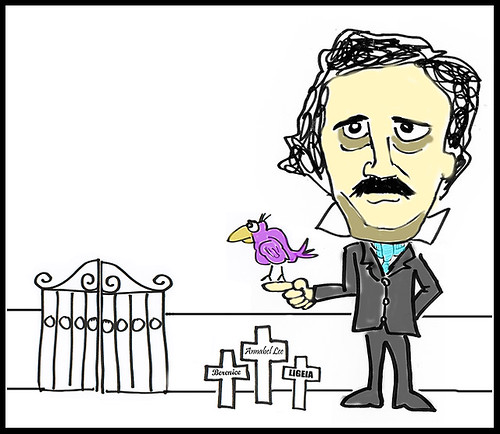
Edgar Allan Poe (ilustración off topic)” by El Humilde Fotero del Pánico is licensed under CC BY-NC 2.0.

Weekend read: Aaron Poochigian, ‘Not Atoms’

When, strolling through the Village, I discover

one lonesome shoe, a jeweled but dogless collar,
the crushed rose of a hitman or a lover,
barf like an offering, a half-burnt dollar,
“Scream” masks holding traffic-light-top vigil,
loose lab rats among the morning glories
or Elmo trapped inside a witch’s sigil,

I love the universe because it’s made of stories.

*****

Aaron Poochigian writes: “I live in the East Village, which is party central, especially on the weekends. The images in this poem are mostly random stuff I saw the mornings after. I didn’t include the people passed out on the sidewalk (just check to make sure they’re still breathing). The structure (one-line beginning, six-line list, one-line ending) came to me from a beautiful Tang-dynasty poem, ‘Visiting the Taoist Priest Chang’, by Liu Changqing.”

Aaron Poochigian’s ‘Not Atoms’ was originally published in New Verse Review. For reference, here is Liu Changqing’s poem in Aaron Poochigian’s translation:

Under the faint trail’s guidance I discover

a footprint in the phosphorescent moss,
a tranquil lake where low clouds love to hover,
a lonesome door relieved by rampant grass,
a pine grown greener since the thundershowers,
a cold springs fed by mountains far away.

Mingling with these truths among the flowers,
I have forgotten what I came to say.


Aaron Poochigian earned a PhD in Classics from the University of Minnesota and an MFA in Poetry from Columbia University. His latest poetry collection, American Divine, the winner of the Richard Wilbur Award, came out in 2021. He has published numerous translations with Penguin Classics and W.W. Norton. His work has appeared in such publications as Best American Poetry, The Paris Review and Poetry.
aaronpoochigian.com
americandivine.net

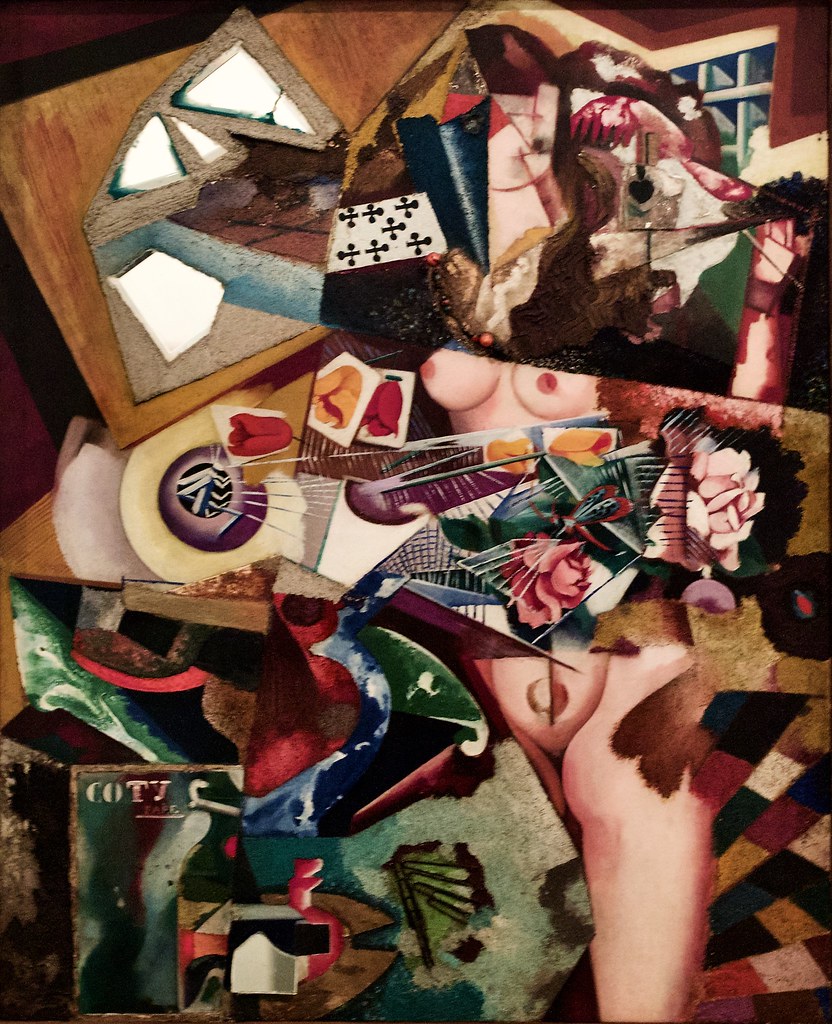
Photo: “Untitled [Coty] (c.1917) – Amadeu de Souza-Cardoso (1897-1918)” by pedrosimoes7 is licensed under CC BY 2.0.

A poem’s origins: Robert Burns, ‘A Red, Red Rose’

O my luve’s like a red, red rose
That’s newly sprung in June:
O my luve’s like the melodie
That’s sweetly play’d in tune.

So fair art thou, my bonnie lass,
So deep in luve am I;
And I will luve thee still, my dear,
Till a’ the seas gang dry.

Till a’ the seas gang dry, my dear,
And the rocks melt wi’ the sun:
And I will love thee still, my dear,
While the sands o’ life shall run.

And fare thee weel, my only luve!
And fare thee weel awhile!
And I will come again, my luve,
Tho’ it were ten thousand mile!

*****

January 25th being the birthday of Robert Burns (and the opportunity for a Burns Night celebration), it seems the right day to post an interesting fact that I was unfamiliar with until reading a 1964 Canadian high school poetry text book: ‘A Red, Red Rose’ was fashioned from three distinct songs that Burns had heard in the Highlands of Scotland. Part of each song was reworked by him into a single poem:

(Song 1)
Her cheeks are like the roses
That blossom fresh in June;
O, she’s like a new-strung instrument
That’s newly put in tune.

(Song 2)
The seas they shall run dry,
And rocks melt into sands
Then I’ll love you still, my dear,
When all these things are done.

(Song 3)
Altho’ I go a thousand miles
I vow thy face to see,
Altho’ I go ten thousand miles,
I’ll come again to thee, dear love,
I’ll come again to thee.

Wikipedia (as often) is a good place to look for more information, and here is an extensive quotation from its article on the poem:

Sources
Burns is best understood as a compiler or a redactor of “A Red, Red Rose” rather than its author. F.B. Snyder wrote that Burns could take “childish, inept” sources and turn them into magic, “The electric magnet is not more unerring in selecting iron from a pile of trash than was Burns in culling the inevitable phrase or haunting cadence from the thousands of mediocre possibilities.”

One source that is often cited for the song is a Lieutenant Hinches’ farewell to his sweetheart, which Ernest Rhys asserts is the source for the central metaphor and some of its best lines. Hinches’ poem, “O fare thee well, my dearest dear”, bears a striking similarity to Burns’s verse, notably the lines which refer to “ten thousand miles” and “Till a’ the seas gang dry, my dear”.

A ballad originating from the same period entitled “The Turtle Dove” also contains similar lines, such as “Though I go ten thousand mile, my dear” and “Oh, the stars will never fall down from the sky/Nor the rocks never melt with the sun”. Of particular note is a collection of verse dating from around 1770, The Horn Fair Garland, which Burns inscribed, “Robine Burns aught this buik and no other”. A poem in this collection, “The loyal Lover’s faithful promise to his Sweet-heart on his going on a long journey” also contains similar verses such as “Althou’ I go a thousand miles” and “The day shall turn to night, dear love/And the rocks melt in the sun”.

An even earlier source is the broadside ballad “The Wanton Wife of Castle-Gate: Or, The Boat-mans Delight”, which dates to the 1690s. Midway through the ballad, Burns’ first stanza can be found almost verbatim: “Her Cheeks are like the Roses, that blossoms fresh in June; O shes like some new-strung Instrument thats newly put in tune.” The provenance for such a song is likely medieval.

Thank you, Wikipedia! Love you!

And everyone: Have a good Rabbie Burns Day!

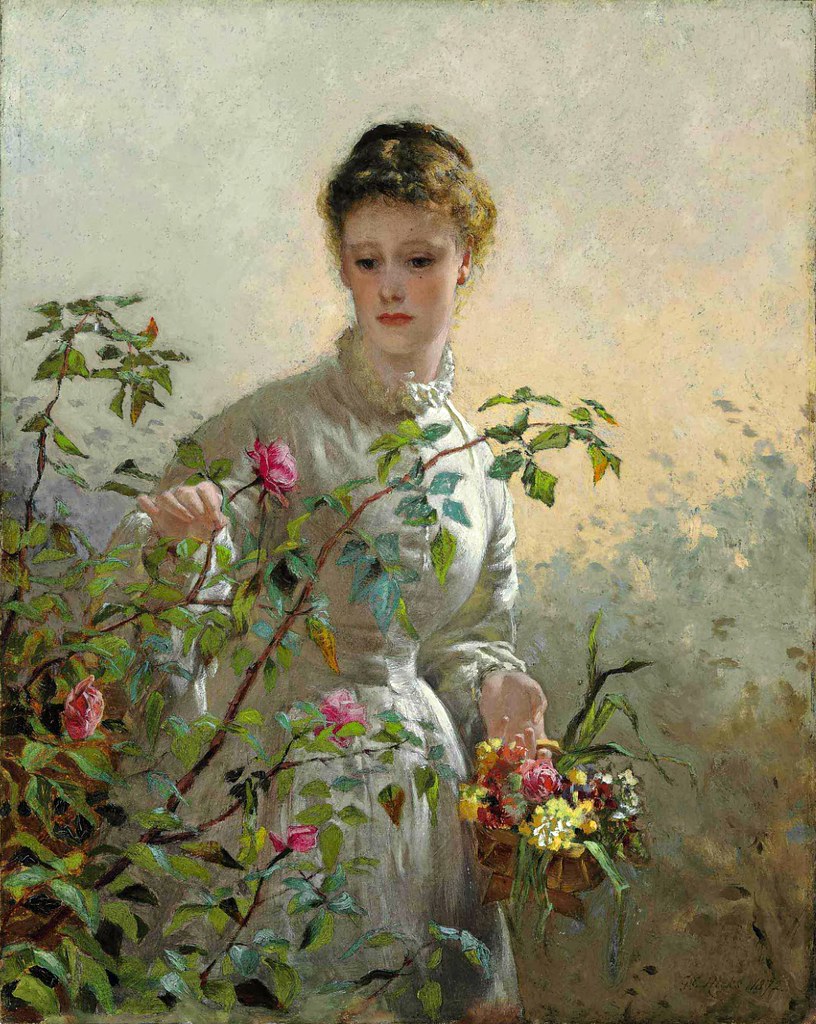
O my Luve’s like a red, red rose that’s newly sprung in June” by Cait Clerin is licensed under CC BY-NC-ND 2.0. The work is ‘A Summer Bouquet’ by George Elgar Hicks, 1878.
Poem on poetry: Sonnet: Marcus Bales, ‘White Water’

A poem is so obdurate and small
Compared to what you wanted it to say
And sometimes isn’t even close at all.
For instance, this. I’ve worked on it all day,
A metaphor for all of love’s affairs.
I failed to ride the energy it gave,
My form and balance gone. Nothing prepares
You for the wildness of the standing wave.
Possessing and possessed and then propelled
Abruptly past the point of no control
To merely peril, having once beheld
The moving stillness of it all, all whole.
Your head’s what every poem wants to split,
While you stroke hard to stay ahead of it.

*****

Marcus Bales writes: “My online pal, the poet Liam Guilar, was a kayak adventurer, sneaking across borders to paddle the most dangerous rivers in the world. I went white water rafting once. You’re stuck in cold, wet, awkward positions that often turn suddenly painful. Why people do it over and over seems not just unreasonable but cold, wet, and painful. There are exhilarating moments, but you’re still cold, wet, and out of control. I could feel in my one experience that the out of controlness might be the point. Still, it was wet and cold. Very wet. Very cold. 

“The confluence of Liam’s many tales, my paltry experience, and he and I both struggling to write poems is the impetus for this poem. I’ve often thought that maybe what it needs is a bucket of ice water suspended over the reader like a, well, like a bucket of Damocles, that sloshes over the head and down the back of the neck in order to make it work.”

Not much is known about Marcus Bales except that he lives and works in Cleveland, Ohio, and that his work has not been published in Poetry or The New Yorker. However his ‘51 Poems‘ is available from Amazon. He has been published in several of the Potcake Chapbooks (‘Form in Formless Times’).

Photo: “Kayaking through the white waters of the Gorge” by Grand River Conservation Authority is licensed under CC BY-NC-ND 2.0.
Morri Creech, ‘Mileage’

The car mechanic’s counting out his bills
behind the E-Z Mart at one a.m.;
he’ll toss rocks at beer bottles just for thrills
until his dealer comes, it’s fine with him.

He draws in a deep breath and sees the light
swerve from the highway, puzzling the back wall
he leans against just to keep out of sight.
A quarter bag and some fentanyl, that’s all.

His phone vibrates again though nothing’s wrong.
For two years he’s been living in a trailer
with a girl who works at Publix. They get along
even if sometimes she says he’s a failure—

what can he say to that? Sure. He lives cheap.
They’ll fight until she forces a decision,
then roll around on the couch. Once she’s asleep
he’ll take a dose and watch some television.

At night he dreams of cylinders and sprockets,
the trucks and cars too busted up to fix;
startled awake, eyes aching in their sockets,
he’ll watch the clock hands grope their way to six.

A car pulls up but he can see it’s not
his hookup. Just kids with nothing else to do
but drink a six-pack in the parking lot
before they head out to the lake to screw.

He had his share of mischief, too, Lord knows.
The girls don’t eye him in the check-out aisle
much anymore, the ones with painted toes.
A few years back, at least, they used to smile.

The boys can see the grease that stains his hands;
they all think, damn, who wants to work that hard?
He spends the day beneath their dads’ sedans
while they play tackle football in the yard.

Chasing a football blew out both his knees
and broke his wrist. That was three years ago.
Customers say, “go Stags,” and toss their keys,
then look at him real close as if they know.

A text says no one’s coming. The BP sign
flickers over the pumps, and though it’s half-
past two now, and he’s tired, he’s feeling fine
enough to think it’s all a bust, and laugh.

And, anyway, it’s good to be alone
with the gas fumes and blinking traffic light
and fifteen missed calls lighting up his phone.
Later, he thinks, once he and his girl fight,

and once she falls asleep on his left arm,
he’ll stare at the divots on the ceiling tile
and wait to hear the clock sound its alarm
while the night’s odometer counts one more mile.

*****

Morri Creech comments: “As Mark Strand once said, I write to find out what I have to say. I don’t start a poem with an idea; I start with a line, an image, a rhetorical stance. Then I write in search of context: how can I situate this in a situation, a narrative moment, an argument, a meditation? The language takes me wherever I end up. This poem was constructed like that. I started with a first line and then wrote toward trying to figure out the context of the line. In this case, it led me to a character sketch. It was fine to discover what this character was about; the decisions I made about his character and circumstances were largely directed by rhymes. They steered me in what I hope was the right direction.”

Morri Creech is the author of five collections of poetry, including the Sleep of Reason, a finalist for the Pulitzer Prize, Blue Rooms, and The Sentence (published by LSU Press, and which includes this poem). A recipient of NEA and Ruth Lilly Fellowships, as well as North Carolina and Louisiana Artists Grants, he teaches at Queens University of Charlotte.
www.morricreech.com

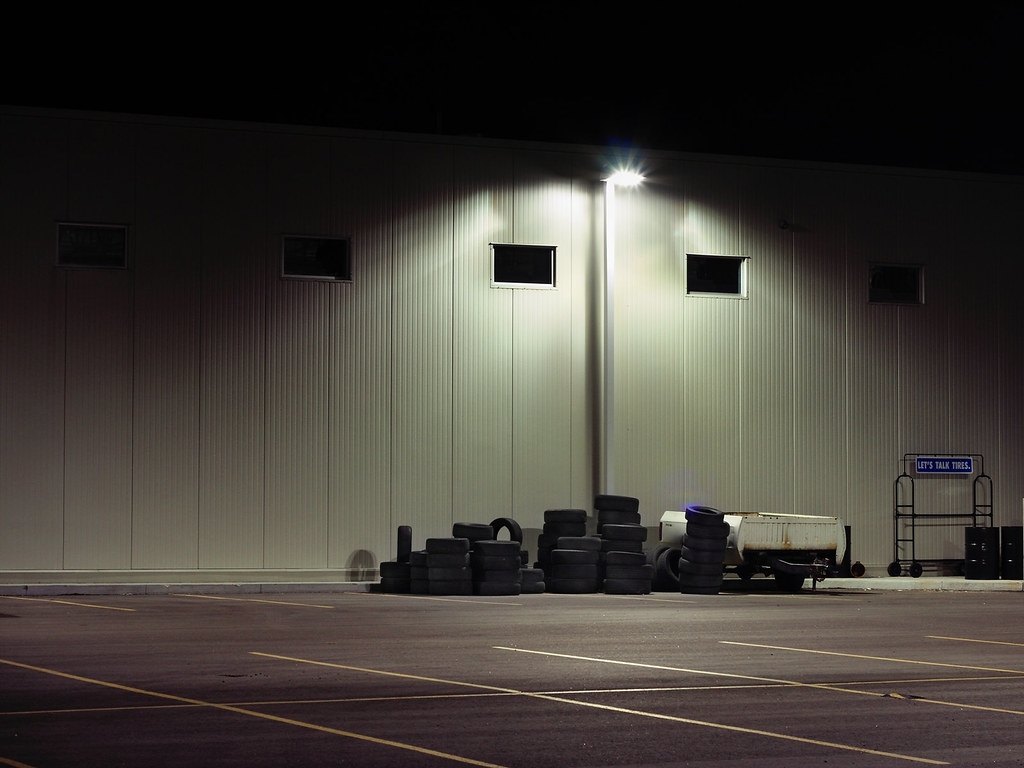
Photo: “Let’s Talk Tires” by gfpeck is licensed under CC BY-ND 2.0.

Using form: continued poem: Conor Kelly, ‘Daffodils’

Those daffodils that I recall
While lying on a bed settee
Are faded now, their petals fall
In nature and in memory.

It’s time to rise, to go outside
And head off for a subway ride.
I’m in New York’s YMCA
Undressing for a midday swim;

A poet could not but be gay
With bodies toned up in the gym.
But I am getting no cheap thrills
From dongs like dangling daffodils.

I twinkled at the twinkies there
Tossing their heads in sprightly dance
Or heading for the sauna where
I might get lucky if, by chance,

One of the bronzed and buffed young men
Is eager for my fountain pen.
But, sadly, no one needs to hear
This exiled poet strut his stuff.

I am an old Romantic queer,
Ignored, unloved. I’ve had enough.
I join the hustling New York crowd
And wander lonely as a cloud.

*****

Conor Kelly writes: “Daffodils was submitted as a prompt poem to Rattle (https://www.rattle.com) and was printed in the Summer 2024 issue of the magazine. The prompt was to continue where another poem left off. So I disturbed Wordsworth on the couch where he lay remembering daffodils and sent him on his gay way to modern New York where he had some dubious adventures. I kept the stanzaic form, the metre, the rhyme scheme and even some of the original lines. I left him where he began, wandering lonely as that singular cloud.”

Conor Kelly was born in Dublin and spent his adult life teaching in a school in the city. He now lives in Western Shore, Nova Scotia from where he runs his twitter (X) site, @poemtoday, dedicated to the short poem. He has had poems printed in Irish, British, American, Canadian and Mexican magazines. He was shortlisted for a Hennessy New Irish Writers award. At the ceremony one of the judges, Fay Weldon, asked him, “Where are you in these poems?”  He is still asking himself that same question.

https://www.instagram.com/conorkelly.poems/

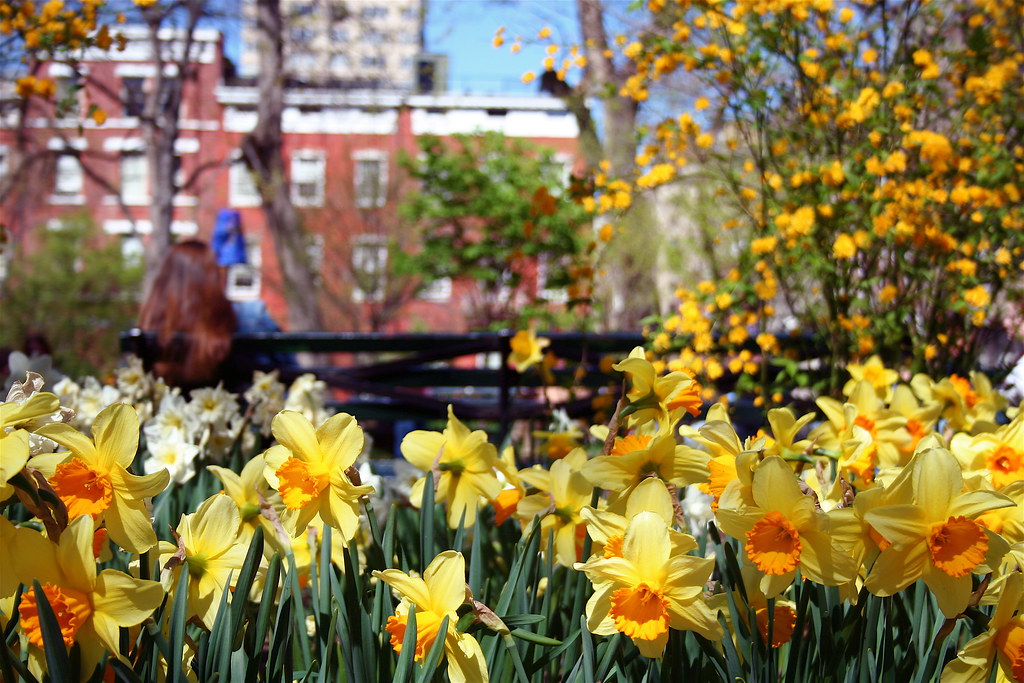
Photo: “park, school” by presta is licensed under CC BY-NC 2.0.

Marcus Bales, ‘This Be The Verse’

Post this, post that, post-modernists –
   Denying narrative’s cabal.
The story that they tell insists
   It’s not a story after all.

New Criticism made them see
   That reading closely what was said
Meant cutting off biography,  
   And authors might as well be dead.

Like raisin oatmeal cookies, picked
   In hopes of chocolate chip, they bust
Your faith in how things seem. You’re tricked
   To only trust in doubting trust.

Without the person or the text,
   No human mind, no human heart,
I guess we know what’s coming next:
   Let the AIs do the art.

*****

Marcus Bales writes: “This is one of what I call my habitual poems. I have a perfectly good stand-alone idea, and start to work on it, but the parody turntable in my head takes over and the needle slides down into the groove and instead of stealing only the world-weary and faintly snarky Larkin tone it turns out I steal the whole poem. 

I have a file of these to be revised away from parody and into something that is less parodic, or at least less immediately noticeable as theft. 

The problem is I’m lazy about this stuff. There is a straightforward tradition of doing these kinds of parodicish things in song, called ‘filks’, and I’ve done some of them. It’s carried over into the same sort of thing in poems. The groove is there, the tonality is familiar, the original is familiar, and like the soap coming out of your hand in the shower, clunk, it hits the floor. 

So, since Robin asked me to write this, I’ve got a revised version for you. It loses some of the immediacy of Larkin’s opening, of course, but I’ll bet if you hadn’t got that in your head associated with this one first, this second version would only have marked a faint echo — and you might not of noticed how Larkinesque it is at all.”

Editor’s note: Bales revised the first and fifth lines; the originals read:
They fuck you up, post-modernists,
(…)
But others fucked them up to see

Hence his Larkin references.

Not much is known about Marcus Bales except that he lives and works in Cleveland, Ohio, and that his work has not been published in Poetry or The New Yorker. However his ‘51 Poems‘ is available from Amazon. He has been published in several of the Potcake Chapbooks (‘Form in Formless Times’).

Photo: “Post-Modern Urinal” by ~MVI~ (warped) is licensed under CC BY 2.0.

Using form: Sonnet: Max Gutmann, ‘How to Inspire a Sonnet – advice from the pros’

Inspire amore first, but molto forte
If in sonetti dolci you’d be sung.
Then see that you stay bella. You’ll support a
Passione deep and long by dying young.
— Laura

If thou upon his stage the Muse’s part
Wouldst play, each act thou study’st must prolong
Thy Poet’s pain. ‘Tis pain shall prompt great Art.
Then con thy lines with style, and do him wrong.
— The Dark Lady

Stay always by her. Never for a day
Be from her cherished side. ‘Tis paramount
To share the highest love. (And, by the way,
It helps to choose a lover who can count.)
— Robert Browning

‘Tis mystery that fires the crucial spark,
So make him wait–and keep him in the dark.
— Milton’s blindness

*****

Max Gutmann writes: “A reader of Light Quarterly (the marvellous Light back in its days as a print journal) was so offended by a poem of mine ridiculing a lousy president that he cancelled his subscription. Beloved editor John Mella forwarded a copy of the note to me. It was a sonnet! I’d never thought I could inspire a sonnet. I had a ways to go before rivaling Laura or the Dark Lady, but I’d taken the first step. That inspired this poem.

“John declined the poem, so it first appeared in a journal that didn’t specialize in light verse, one highly thought of. (Digging it out now, I see that contributors to the issue the poem appeared in included, among others I admire, Updike, Espaillat, Turner, Gioia, and Hadas.) But the journal goofed. They changed sonnetti dolci to sonnetti dolce (plural noun, singular adjective). This must have been a typo, I imagined, but when I asked, the chief editor not only admitted the change had been intentional, but defended the decision. Dolce being the more familiar form, he argued, it was reasonable to make the change without consulting the writer. I never sent them anything again

“This story calls for a shout-out to Jerome Betts, who reprinted ‘How to Inspire a Sonnet’ in Lighten Up Online (LUPO). (To avoid the impression that Jerome is less than meticulous about acknowledgements–or about anything–I should make clear that I asked him not to acknowledge the earlier journal, and I didn’t name it for him.) Jerome, like most editors I’ve worked with, always asks before making changes–and his proposed changes are usually improvements, often big ones!”

Editor’s note: This poem suggests what might be appropriate ways to inspire sonnets, according to the subjects of sonnets: Petrarch’s Laura, Shakespeare’s Dark Lady, Elizabeth Barrett Browning’s Robert and Milton’s blindness. Self-referentially, the poem is itself a Shakespearean sonnet, written in response to being the subject of a sonnet. Gutmann is therefore both sonneteer and sonnetee, and has the credentials to write a “How to –“

Max Gutmann has worked as, among other things, a stage manager, a journalist, a teacher, an editor, a clerk, a factory worker, a community service officer, the business manager of an improv troupe, and a performer in a Daffy Duck costume. Occasionally, he has even earned money writing plays and poems.

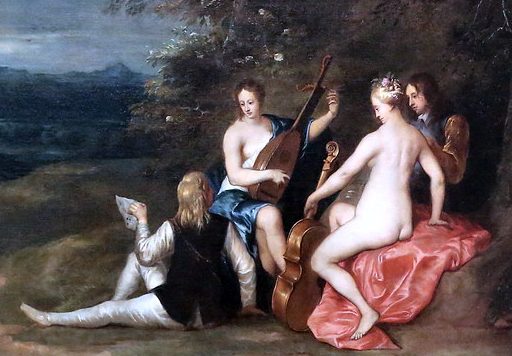
Photo: “IMG_0323C Frans Wouters. 1612-1659. Antwerp. The rural concert. 1654. Dole” by jean louis mazieres is licensed under CC BY-NC-SA 2.0.

Duncan Lawrence, ‘The Poet is the Luckiest of Artists’

There is no struggling with a wayward cello on the train 
Or carting a large canvas through dank cornfields in the rain.

No need to worry chapter sixteen has somehow been deleted 
Or that the woodwind section remains a long way from completed.

No welding burns to speak of, hammered thumbs or calloused palms,
No temperamental band mates whose bad habits raise alarms.

No fearing, that the next plié will surely split these tights 
Or some acerbic, carping critic has got you in their sights.

Just, fingers crossed the last few lines like miracles unfold 
Before the walk is over or the bath become too cold.

Yes, I concede the poet’s lucky, yet still I do despair 
For all the artful artistry the money isn’t there.

*****

Duncan Lawrence writes: “I do not remember any specific incident as a catalysis for this poem. I did see an interview with John Cooper Clarke on the BBC, he said something to the effect that one might splash out on Tap Dance lessons only to discover that you were not that good but a pencil and a bit of paper are always available. That was either the source of the piece or resonated because I had just written it.
As to the form, I understand that it might be “Iambic heptameter with some anapestic
substitutions” but I don’t really know what that means.
I cannot sit down with a blank piece of paper and decide to write about something. The
poem just forms in my head over a few days. I then write it down and clean it up a bit. After I put it aside and continue to mull it over on a walk or in the bath before looking it
over again and, with luck, if it sounds all right, finishing it off.”

Duncan Lawrence is a retired English Teacher. Originally from the United Kingdom, he is a long-term resident in rural Japan. Here he spends an inordinate amount of time walking dogs for the local Guide Dog Association.
He has had three poems (including this one) published by Jerome Betts on his magazine Lighten Up Online.

Photo: “Who says I can’t relax?” by Ed Yourdon is licensed under CC BY-NC-SA 2.0.

Non-traditional sonnet: Marcus Bales, ‘The Durable Rain’

The durable rain was conducting its drumming descent
Without any decent regard for the dawning of day
As if a dim evening was all of the morning it meant
To allow from a sun that was doing a landscape in grey.
Never begin with the weather the boffins have said.
If nature’s as stormy and dark as a novelist’s mind
The reader will sneer at the metaphor. Offer instead
A prose that’s so difficult readers are left far behind.
But back to my tale. Is it cozy inside, or does rain
Express what discursive description would talk past in vain?
Does a cry break a heart when the kettle releases its steam
Or, piping, awaken a lover up out of their dream?
What it will mean will depend on your context and age.
A poem exists in the reader and not on the page.

*****

Marcus Bales writes: “The first four lines rolled out without much trouble. I had let the dogs out after they’d woken me at what they thought was the right time but which to me was five in the a.m. It was cold and grey but not rainy at all. Who can figure how the brain works. I did worry briefly about the alliteration but finally put it off, hoping it would sound like rain on the roof. Sort of. And it seemed portentous and poetry-like, but where to go from that?

“I don’t know where I first heard that you’re not supposed to open with the weather. It sounds like one of those pieces of advice the internet kicks up from time to time purportedly by Elmore Leonard, along the lines of “You know those parts that readers skip over? Don’t write those.” Or “You got to know when to hold ‘em and know when to fold ‘em.” Advice that is absolutely both spot-on and worthless at one and the same time. If you know you don’t need any advice; if you need advice, it’s because you don’t know. It makes sense in that maddening way of all advice, but it is untakeable. However much you may agree that the reader doesn’t care what the weather is, they care what happens and who it happens to, there I still was without anyone there to have something happen to, except the damn rain.

“Sitting at breakfast reading my usual dollop of Wodehouse, I noticed that when things are going well for his characters the weather gets some generous play, and when not, not. Then I reflected that really I don’t have a large supply of written descriptions of the weather from anywhere. There’s ‘Neutral Tones’, of course, where the weather is a metaphor for the breaking relationship, and “Nothing that is not there and the nothing that is.” And ‘Stopping By Woods’ where the weather is the reason for the stopping, or the first lines of ‘Journey of the Magi’. There’s Auden’s ‘In Memory of Yeats’, Housman’s cherries hung like snow, if that even works, though who Snow was and how Housman knew is a mystery. And after that it’s vague references to this or that month or season generally in Keats, Poe, Byron, or Shelley, and the inference that all of Yeats happens in the summer what with swans and people fighting the horses of the sea, and all. And finally, again, all those descriptions of the morning in the Blandings and the golf stories. After that my memory starts to flail about. This isn’t the sort of thing where research is indicated at five in the ack emma. Perhaps you remember more examples of how the weather is used in prose and poetry, but it’s too late now, isn’t it.

“I wasn’t sure how to go on. It seemed as if nearly the whole practice of poetry in English was against me, aside from the sub-genre of song with all those deep and crisp and evens, and sleigh rides that began to echo in the back of my head, along with all those singers who seem to be perpetually crying or dancing or walking in the rain. Then I thought well, why not use that? I might get three or four lines out of it, and then maybe something else would occur to me. Well, I got my four lines and arrived at the volta of the sonnet, if sonnet it turned out to be. What now?

“Turning at the question that had stopped me I trod upon that patch for a few lines, and then I had got to the couplet. Well, I really had nothing, did I, among all this meta- bit, and what I had seemed to call for some digging into the whats and whys of how literature worked. Well, of course no one knows. I worried some about having failed to provide any context for the reader to see me through, and put it aside to eat breakfast.

“After that, and a shower, and a bit of humor watching the dogs return to the scene of the five o’clock crime outside to chase a squirrel in the yard, somehow the notion of context reasserted itself, and I remembered a sort of juicy quote from a professor 50 years ago who was gassing on about how a poem isn’t the sounds or the words or the meanings as the poet meant them, but rather the unpredicatable ways that the people misread poems. I recall he had half a dozen examples right to hand, as scholars so annoyingly seem to do, but I couldn’t bring a single one to mind. Fortunately, I’m a poet, not a scholar, so I don’t have to be able to give good – or any – examples, so I decided to steal his assertion and let it go at that.

“And there it is. A complete mishmash of false starts, interrupted middles, and squishy endings. Enjoy!”

Not much is known about Marcus Bales except that he lives and works in Cleveland, Ohio, and that his work has not been published in Poetry or The New Yorker. However his ‘51 Poems‘ is available from Amazon. He has been published in several of the Potcake Chapbooks (‘Form in Formless Times’).

Photo: “Rainy Day” by SammCox is licensed under CC BY-NC-ND 2.0.