Category Archives: Poetry

Calling the Poem: 11. ‘Inspiration 2’

The poem enters your head as a litter of kittens
brought in by a cat from somewhere hidden,
place of birth unknown.
A word, image, rhyme,
an idea, a tone,
they are brought one at a time
In no order, no preference, no ruling or schooling,
they just need to come in, like refugees at the border.
And they have no order,
they crawl over each other, blind and mewling,
and here comes another, and then here comes another.
So the thoughts enter your head like kittens. Give thanks to the Mother.

*****

Where do ideas come from? No idea. (An oxymoronic observation that is not so different from saying that all the Universe comes from nothing, or that there was no time before the beginning of time.) But simply having ideas is nothing in itself – you can have ideas and ignore them (and generally irritate the Muse that is offering you ideas), and so you will have nothing to show for them. Canadian poet Pino Coluccio recently pointed me at an old piece by British poet Philip Larkin, which begins:

“It is sometimes useful to remind ourselves of the simpler aspects or things normally regarded as complicated. Take, for instance, the writing of a poem. It consists of three stages: the first is when a man becomes obsessed with an emotional concept to such a degree that he is compelled to do something about it. What he does is the second stage, namely, construct a verbal device that will reproduce this emotional concept in anyone who cares to read it, anywhere, any time. The third stage is the recurrent situation of people in different times and places setting off the device and re-creating in themselves what the poet felt when he wrote it. The stages are interdependent and all necessary. If there has been no preliminary feeling, the device has nothing to reproduce and the reader will experience nothing. If the second stage has not been well done, the device will not deliver the goods, or will deliver only a few goods to a few people, or will stop delivering them after an absurdly short while. And if there is no third stage, no successful reading, the poem can hardly be said to exist in a practical sense at all.”

So, 1) become obsessed; 2) construct a verbal device that captures the obsessiveness; 3) have it read by people who thereby experience your obsession.

This series of poems in the ‘Calling the Poem’ chapbook focuses on how to be open to the internal wellspring of ideas, obsessions, emotions, words and images to reach Larkin’s first stage (these first 11 poems); and some thoughts about the construction of the “verbal device” of his second stage (the remaining four poems that are coming up). As for the third stage… well, if the poem is strong enough, it will resonate appropriately with those who read it; but how to get it read–that is a different problem entirely.

Photo: “Newborn kittens” by In dust we trust is licensed under CC BY-NC-SA 2.0.

Calling the Poem: 10. ‘Inspiration 1’

When the god’s in you, you’re not blessed nor raped;
it’s not Zeus in whatever guise he wears,
nor Yahweh taking Mary unawares,
nor anything which could be fought, escaped;
nor is it there where your complete orgasm–
from curling toes to skull-top tingling hair–
meets voodoo god who rides you as nightmare,
meets “therapy” of ECG’s dead spasm.

But winkled from your shell by muse or god
you’re in unmoving time, in time that seems
to Rip Van Winkle ordinary, not odd,
there where True Thomas by fay queen is smitten…
and when you wake from momentary dreams
two hours have gone by, and the first draft’s written.

*****

Even if, as some artists relate, they have been taken over by a god, muse, or supernatural force of inspiration, the feeling is not one of fear or terror as you might expect from being possessed. The process of inspired creation typically gives a feeling of calm, concentration and controlled excitement. The aftereffects can be completely different: exhaustion, exuberance, depression… The connection has been broken, the mind returns to a different state.

This version of the sonnet has been cleaned up from what was originally published as an e-chapbook by Snakeskin in issue 236 (unfortunately Archives are still down at time of writing). I have removed the four-letter words from the first four lines and generally reduced the probable offensiveness to my Christian and Muslim friends. However I think there are two points to be made that are more important than sacrilegious language:

Why is it acceptable to portray the coarseness of other people’s gods to schoolchildren, while it is forbidden to discuss the immorality of one’s own group’s preferred deity, even among adults?

And more importantly, why is it considered acceptable for a god (Yahweh) to impregnate a young female (Mary) without her consent? Isn’t this a Handmaid’s Tale level of thinking about the rights of the male and the insignificance of the female? Isn’t this a dangerously inappropriate story to be telling our children?

Of course the “Immaculate Conception” is just an unscientific fairytale. It is far more likely that, as contemporary Jewish rumour had it, Mary got pregnant by a Roman soldier called Pantera, and that Joseph (through love or pity) took her away to have the child in his home town of Bethlehem rather than have her stoned to death as would have been likely for having sex before marriage, especially with one of the idolatrous, beard-shaving, pig-eating Western soldiers of the Occupation

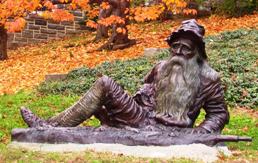
Photo: Life size bronze of Rip Van Winkle sculpted by Richard Masloski, copyright 2000; Photograph by Daryl Samuel

Calls for Submission: formal verse

Of the various publication opportunities specifically for formal/traditional poets, three are taking submissions until July 15, and four other formal-friendly publications have submission deadlines of July 31. There is no submission fee for any of them. Here they are – the links are to the submission requirements:

Able Muse (magazine) Deadline, July 15.
Submit one to five metrical poems (or one long poem), rhymed or unrhymed. (A poem of more than 40 lines is considered a “long” poem.)
All types of formal poetry are welcome, from traditional to boundary-pushing. We want well-crafted poems that use meter skillfully and imaginatively (with rhyme or not), in a contemporary idiom that reads as naturally as free verse.

Able Muse Press (book-length manuscript) Deadline, July 15.
At least 50 pages of poems – same preferences as for the magazine.
There’s NO reading fee.
“We respond within 9 months or so.”

Helen Schaible International Sonnet Contest Deadline, July 15.
Categories:
1 Traditional Sonnet – Shakespearean or Petrarchan
2 Modern Sonnet
Open to All. Free. Enter only one poem in either Category #1 or #2, or one poem in each.
Prizes for both categories: First Prize: $50. Second Prize: $30. Third Prize: $20.

Formal-friendly magazines, themed and with July 31 cut-offs:

Snakeskin (short poem issue, nothing over 10 lines). At the link, read the tabs on the left side for submission details. Submit earlier than the very end of July, as publication is scheduled for August 1st. Editor: George Simmers.

Allegro (theme: Freedom) Four poems max. Editor: Sally Long.

Amsterdam Quarterly (theme: City and/or Country) Two poems max. Editor: Bryan R. Monte.

Rat’s Ass Review (unthemed – the editor publishes whatever he damn well feels like publishing, as you might have guessed.) Five poems max. Editor: Roderick Bates.

In addition:

Rhizome Press (not to be confused with Rhizome Books) publishes anthologies of formal verse. Editor Beth Houston is taking submissions of up to 10 sonnets for Extreme Sonnets III, and up to 10 “extreme formal poems of at least twelve lines” for Extreme Formal Poems II. The submission deadlines are not given on the website, but will presumably follow on the publication of Extreme Sonnets II which is currently in the works.

UPDATE from Beth Houston, 11 July 2022: “At long last Extreme Sonnets II is published and available on Amazon! Will there be an Extreme Sonnets III? Likely, but not for awhile. In the meantime I’ll be putting together an anthology of love sonnets—extreme sonnets, of course. I’ll post submission details on the Rhizome Press website soon. All sonnets included in Extreme Sonnets, Extreme Sonnets II, and Extreme Formal Poems will automatically be considered. Stay tuned for more details.”

Calling the Poem: 8. ‘Sacrificing Yourself’

To bring that tiger you’re desiring, fearing,
You place your own self in the clearing,
Tied to a tree, chained at the throat,
A monk who hopes, hopeless and lowly,
A tethered goat,
You bleat your prayers, and wait.
Your offer (“offer” is an offering,
An animal, coin, weapon, ring…
Even yourself, for you are an oblate…
“Offer” is “sacrifice”, “sacrifice” is “make holy”)
Your offer, your self-sacrifice, is still
“Take me, and pay me what you will.”

Begging for the orgasmic lightning bolt
That gods blast blindly towards heath and holt,
You make yourself into a lightning rod
On some high tower to catch those blasts of god.

*****

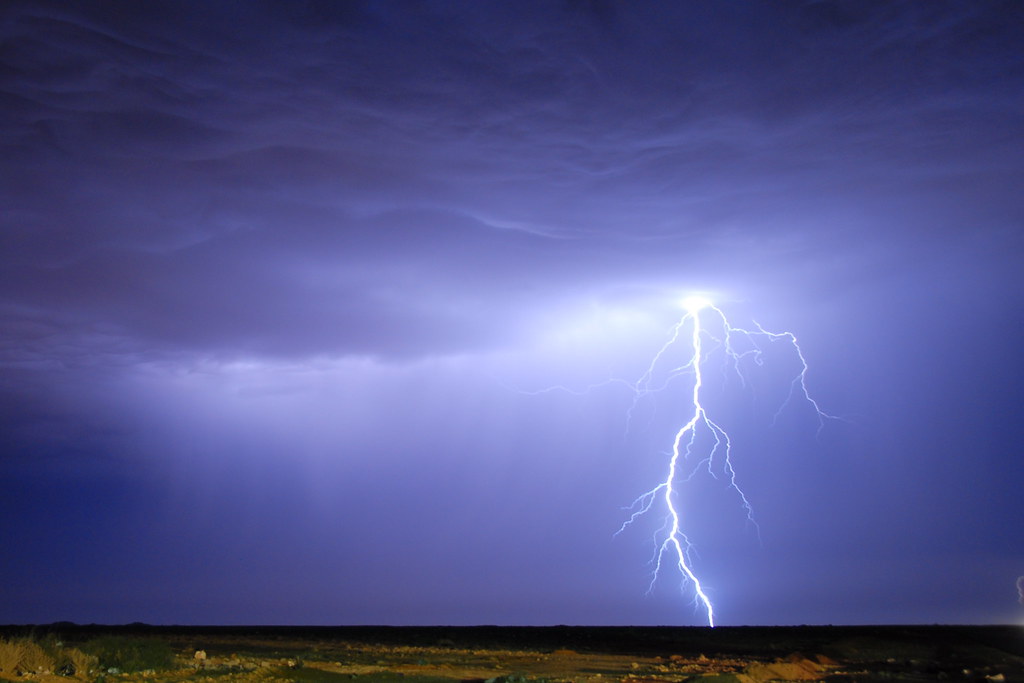
American poet Randall Jarrell defined a poet as “a man who manages, in a lifetime of standing out in thunderstorms, to be struck by lightning five or six times.” Indeed, to be known to posterity for five or six poems is a wonderful achievement – although hopefully you were also doing other worthwhile and fulfilling things with your life. Tennyson, Dickinson, Yeats, Cummings… they may have written hundreds of poems, but very few remain widely known – the average well-read citizen would have a hard time naming more than two or three poems by each.

The artistic sensibility (including the musical, poetic, etc) is very similar to the religious one. For most, the lightning strikes are strictly personal and the payoffs from devotion, openness and sacrifice are largely intangible; but they give a powerful charge, a feeling of the essential within yourself and an understanding of connection to the whole universe.

Photo: ‘Lightning in the Western Sahara’ by Hugo! is licensed under WordPress Openverse.

Calling the Poem: 7. ‘The Tiger’

That wild white wind that whips the world away –
The darkness deep and dread in dazzling day –
The light and dark that fuse with furious force –
The leaping tiger that gives no recourse –
Acknowledge, fear, that lurking tiger’s rage,
The terrifying sense of spring-taut powers,
Menacing, tail-tip twitching while it glowers,
Lethal both to ignore or to engage.
Acknowledge it, succumb: you’ve been rewarded.
And now produce – because the debt’s recorded.

*****

This is the 7th of the 15 poems of the Snakeskin e-chapbook ‘Calling the Poem’. ‘The Tiger’ and the next few poems deal with the difficulties of first begging your Muse for inspiration and then finding that the inspiration is uncomfortable – personally, socially, politically, whatever. Perhaps the inspiration isn’t what you were hoping for… but what are your obligations once you have in effect contracted to receive something unknown?

The Muse, the gods, the unconscious or however you like to think of your source of inspiration is not to be trifled with. It is to be respected if you want to stay on good terms with it and benefit from it.

The word ‘music’, by the way, means Muse-ish, ‘of the Muses’. The following is blended from passages in Wikipedia: According to Pausanias in the later 2nd century AD, there were three original Muses, three original Boeotian muses before the Nine Olympian Muses were founded: Aoidē (“song” or “voice”), Meletē (“thought” or “contemplation”), and Mnēmē (“memory”). Together, these three form the complete picture of the preconditions of poetic art in cult practice.

So song, contemplation and memory are the Muses that together drive poetry. Poetry is totally Muse-ish. Therefore poetry is inherently musical. Its music is essential.

(And it was only after writing this blog that I found that the current Oglaf comic features a tiger…)

Photo: ‘Tiger’ by Captain Chickenpants is licensed under WordPress Openverse.

Potcake Poet’s Choice: Marcus Bales, ‘Cleveland Krater’

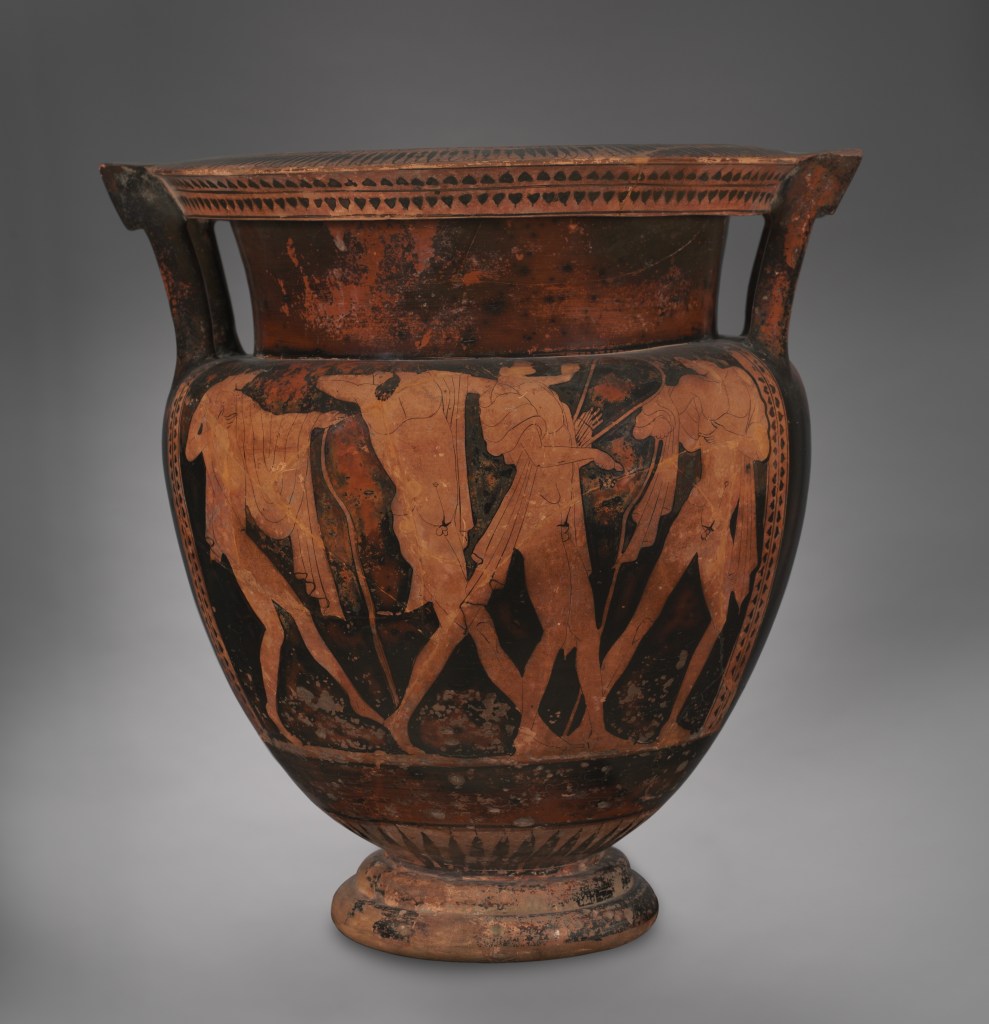
This column krater once held watered wine,
Its figures, red on black, an illustration
Of how it served the daily and divine.
On one side Hera offers a libation
With Artemis, Apollo, and their mother,
While three nude athletes and a bearded man
Are drunk with more than liquor on the other.
I stare through all four panes of glass that ban
All but my eyes from learning every curve,
And I can only dream that luck and nerve
And my own art may earn a chance to feel,
As one of few who cares to understand
That ancient try to make one ideal real,
To feel it push through time with my own hand.

*****

Marcus Bales writes: “A poem is language in meter that evokes emotion in the reader. Those who write to express themselves are doing something other than writing poetry. No reader accomplished enough to be engaged in reading poems is in it for the writer’s blurt. It may be that the writer is trying to evoke the same emotion in the reader that the writer felt in the poem’s circumstances, but the goal remains to evoke that emotion in the reader, not merely recount the writer’s emotion.

Poems that fail to evoke emotion in the reader are failed poems and, alas, every poet has several. They wait patiently like the mythic swordsman in fairytales to keep the protagonist from going through the door behind them. Our hero or heroine arrives in the room, the swordsman puts down Kant’s ‘Critique of Pure Reason’ – in the original German – and smiles, drawing a sword. The writer, however already wounded or tired from the effort of getting there, engages and soon enough, after an elaborate exploration of the waiting swordsman’s skills, is disarmed. The swordsman bows, kicks the writer’s sword back to him, sheathes his own, picks up his book, and sits down again, angles it to the light from the only window, nods goodbye, and resumes his perusal. The writer picks up the disgraced weapon, and trudges back out the way they came in. That poem still does not do what the writer intended to do: evoke emotion in the reader; all it remains as is an account of his or her own emotion.

It is the strength of that felt emotion that keeps the writer coming back to the failed poem, ever hopeful that it is an exception to the unyielding rule that the poem is for the reader, not the poet. Some poets make careers out of performing such things, their agents guaranteeing that the poet will cry during the performance, sure that the promoters are only interested in the performance, not in its effects on the audience. And there are audiences for whom watching the performer fail in their presentation is the point. No one involved in that scenario is there for poetry.

Unfortunately, this poem, ‘Cleveland Krater’ is one of those failed poems. Absent the actual krater, I have finally come to realize, the reader is not going to experience the emotion I did. I have come back and back to this piece, always after having visited the krater again, examining it closely through its Plexiglas box, looking for the clues that moved me and still move me, to try to shove them into words that will bring that impact I felt to the reader. Maybe if I just admit my failure I will get free of the draw of its blade when I arrive at it, again, hoping that this time I’ll do better than the dismissive kick of my sword clattering across the stone floor.”

Not much is known about Marcus Bales except that he lives and works in Cleveland, Ohio, and that his work has not been published in Poetry or The New Yorker. However his ’51 Poems’ is available from Amazon. He has been published in several of the Potcake Chapbooks (‘form in formless times’).

An extensive review of the Cleveland Krater and its creator can be found at https://www.academia.edu/12708103/The_Cleveland_Painter. You don’t need to log in or register, you can simply scroll down to read the entire pdf.

Photo: provided by the Cleveland Museum of Art https://www.clevelandart.org/art/1930.104#

Calling the Poem: 4. ‘Of Gods’

What are the gods? Are they true? Fake? Wild? Tame?
They are in you, and/or you are in them.
They are the joy that apes feel in the storm –
They are the hearth that keeps the caveman warm –
Societies the shaman’s dreams create –
They are Fertility, Love, Hunting, War,
And tools, pots, crops that clutch the god-robe hem,
And Trickster’s tales and lies, the Path, the Door…
Conflicting aspects flesh the human frame,
Demand obedience to some inner Law
To which no individual can conform.
Changing and arguing, they made Rome great
Before the MonoFossilizers came.

*****

It’s difficult for me to express the comfortable balance I have between belief and disbelief. On the one hand, something is the Creator and Sustainer of All the Worlds – in rough numbers, a billion galaxies of a billion stars each, and who knows how many planets with billions of life forms. On the other hand, all the stories of Heaven and Hell, of Odin and Hel, are such simplistic preliterate nonsense that I have to be an atheist. On the third hand, that preliterate sensibility is who we are, how we evolved, and is the key to a holistic understanding of oneself. Therefore I try to pay respectful attention to the simplistic preliterate nonsense that wanders into my consciousness. “Primitive” religion is more useful than “advanced” religion because it is inchoate, formless, shifting, full of alternatives, ambiguous – and that appears closer to the forces that underlie Material Reality than rigid “advanced” religion can manage… and it is also closer to the unconscious that communicates with you through dream and intuition.

But as for exactly what the gods are, and what their relationship to the underlying Creator of the Universe… who knows!

This semi-formal poem is the 4th of 15 in the ‘Calling the Poem’ chapbook from Snakeskin.

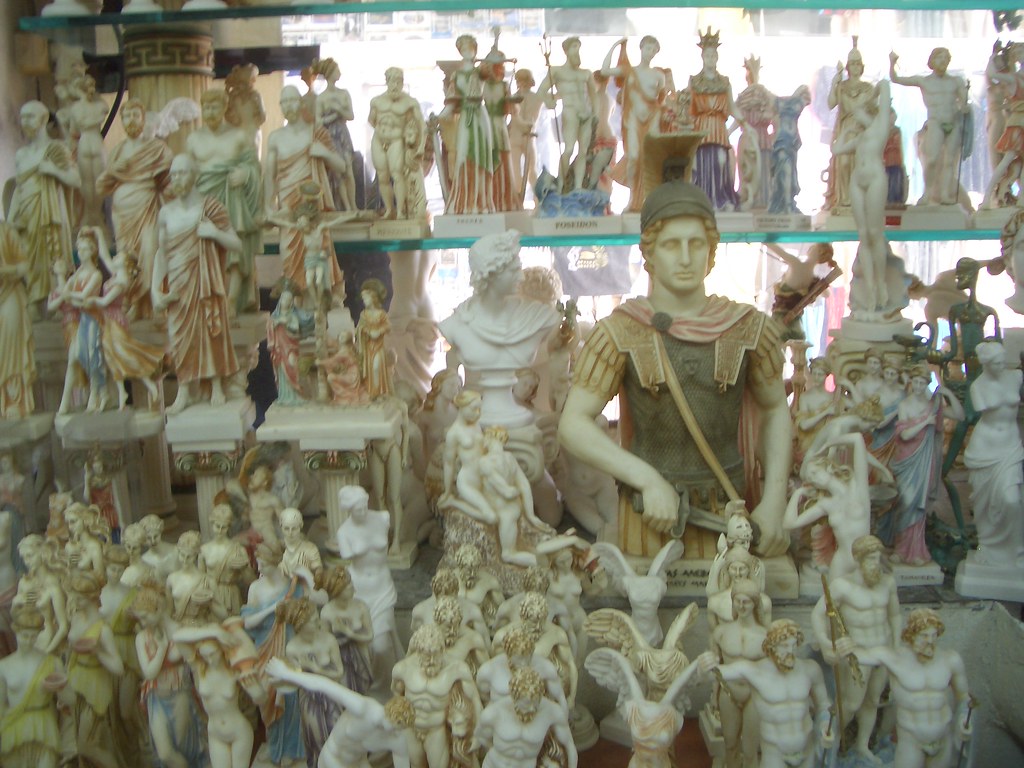
Photo: “Greek Gods, take your pick” by dullhunk is licensed under CC BY 2.0.

Calling the Poem: 3. ‘Self-Belief’

Can you handle the wild poem? Can you tame the thing, or kill?
The certainty, uncertainty, of writing as a skill,
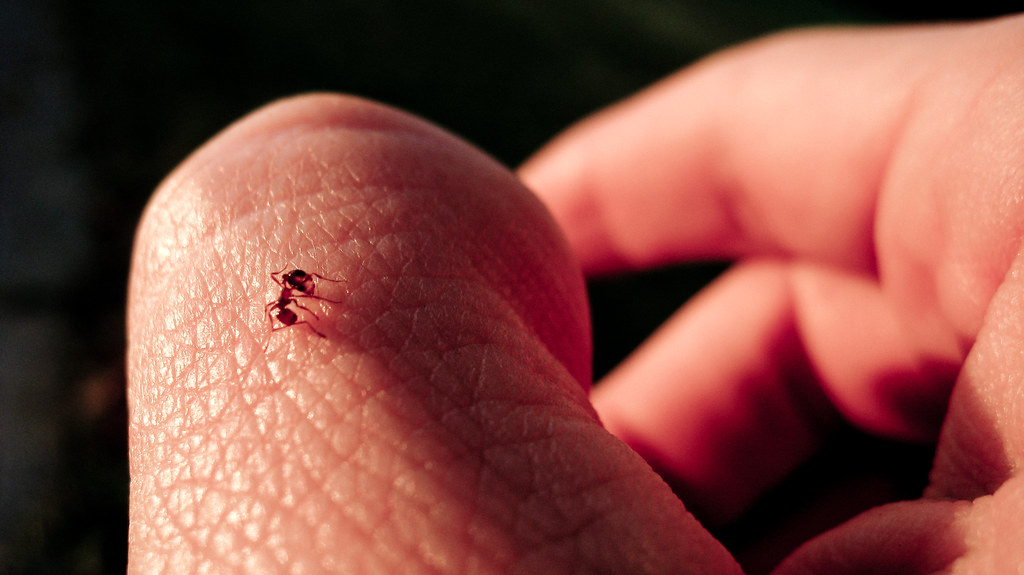
The being told to “find your voice”, the crawling like an ant
Across the skin of Literature, that giant, to implant
Some token of your individuality, some pin
To jab into the giant’s vast and ant-infested skin,
To make your mark by scrawling words, tattoos, to claim a win…
You can’t succeed alone against such odds!
But there are gods…

*****

This is the third poem in the ‘Calling the Poem’ chapbook sequence in Snakeskin. The question of self-belief can be difficult for any artist – given the thousands of years of recorded paintings, sculptures, poems, music, etc, how can you know that your tiny ant-like efforts will be enough to make a mark in the world? Can you hope to succeed? The choice might seem to be between the hubris of Yes and the defeatism of No – but you have a secret ally, if you pay attention: the Muse. If you are self-aware and mindful, if you stay alert for scraps from the unconscious, the dream-world including daydreams, if you are respectful enough to try to capture the little hints you are given, then the Muse (She, or He, or Them, Yourself, your unconscious, God or Gods or Angels, however you visualise this force and process) will provide you with insights and material you never knew you could access.

Your Muse is available to you… if you stop and listen, remain open and respectful of the unexpected. Again, the learning and the workloads imposed by others tend to act against this attitude. Take heart from T.S. Eliot: “a poet ought to know as much as will not encroach upon his necessary receptivity and necessary laziness.” That was not a flippant comment of his: it goes to the heart of learning to work with your Muse.

Photo: 8/17/09 Houston – Fire Ant Bite by stefan.klocek used under OpenVerse license

Calling the Poem: 2. ‘Awareness of the Mood’

The possibility before the poem, the mood,
Is premonition more than vision: loath
To admit, like the repressed and skewed
Response on seeing god-like demon, or young witch…
Not even genitals’ light twitch,
But mere awareness of that energy, potential thrust,
That tightness in the chest,
A heart-tight feeling of both loss and lust.
Then don’t ignore that feeling, for you’re blessed:
A poem is lurking in your undergrowth.

*****

This series of poems, ‘Calling the Poem’, is about the process of writing poetry – an art for which some people appear to have an affinity, an intangible ability. My sense is that such creativity is available to all humans, but requires a certain mindset, an openness to the unconscious, an interest in unplanned internal upwellings and dreams and fortuitous images; in other words, it is not available to those who plan and schedule their lives rigorously, who meticulously follow the teachings imposed from the outside by others.

The process starts before the poem begins to appear. I find it starts with a mood that feels like… like a mixture of curiosity (whether filled with hope or despair), and of awareness of the vastness of the world (whether manifested in a sunset or an ant), and of some small but significant personal power even in the presence of the forces of the universe, and of that formless twitch of yearning desire when glimpsing an unconnected but desirable object for the first time.

My sense is that when you find yourself in this mood – and I trust you’re aware of having experienced it – you are entering a state of receptivity to the messages that your unconscious wishes to share with the conscious you; and those messages will come as creative images, or dreams, or ideas, or words and phrases. But they will only come if you are receptive to them. So honour the mood: relax, listen, observe, and be prepared to express in rough draft whatever occurs to you. The mood is not the creativity; but if you accept the mood, the creative communication of the unconscious can occur.

Photo: “14. Premonition of Concusia 2009” by Anne Marie Grgich is licensed under CC BY-NC-ND 2.0.

Calling the Poem: 1. ‘Invocation’

O Odin,
Living outside me or within,
Share your mead of poetry you earned in night’s delight,
Spare me from the mead you shitted out in flight and fright.
By Thought and Memory, I swear
A poem needs your care,
For poems… magic poems… are nothing,
and come from your nowhere…

A poem comes in flurries:
A phrase that catches, sticks,
A rhyme that matches
With some thought that dog-worries,
And a verse that clicks.

*****

Just to be clear, I’m no more a believer in the Norse gods than I am in Yoruba, Hindu or Christian deities. Also, I’m not a white nationalist. But mythology has a couple of uses for me: pure enjoyment of the tangled tales; a way of looking at historical mindsets; and a tool for trying to communicate with the unconscious, i.e. to let the creative unconscious funnel ideas and images to the conscious mind.

What I do believe is that invoking the Muse, or a god, is a way of telling your unconscious that you are receptive to its comments… it is a fishing expedition, and you never know what you’re going to get. But I believe it is a system that works (sometimes), and I don’t practise another. (Various drugs are alleged to get results, too.)

So a few years ago I set out to describe the process that I follow to try to bring poetry to me. The result was a series of 15 poems, published by Snakeskin as an e-chapbook in January 2017. It was available as a free download from Snakeskin No. 236, and it should be again, when the Snakeskin archives are again operational. I named it ‘Calling the Poem’.

‘Calling the Poem’ starts by invoking the Muse – male, female, human, animal, I think the Muse can be however you choose to imagine it. But the Muse should be a dream-image, for the Muse, the unconscious, is as likely to communicate through dream as anywhere. Odin is a good figure, with his ravens of Thought and Memory who give him the news of the world, his eight-legged horse Sleipnir who can carry him through all the worlds, his ability to shapeshift and prophesy, the sacrifices he made to obtain wisdom such as gouging out an eye to put in Mimir’s well, and of course the mead of poetry that he stole and disburses as he feels.

And so the first poem – somewhat rough-hewn, semi-formal – is the invocation addressed to Odin.

Photo: “Odin on Sleipnir” by Hornbeam Arts is licensed under CC BY-NC 2.0.