I know you have no use for them, poems with their sly quicksilver words that won’t just speak their minds, but carom through your head like startled birds. Is that despair or longing in their cries? Their dolors make no sense. They’ll never buy you larger-screened TVs or seats at sports events.
But someday, as you watch a pair hold hands and leap from a burning tower, as you wait for test results or hear your phone ring at an unaccustomed hour, what you feel will circle wordlessly— tense, accusing, gaunt. You’ll find that you are tested and found wanting, and these are what you’ll want.
*****
Susan McLean writes: “As a professor myself and a person who once worked on writing standardized tests, I am familiar with the complaint of teachers that they are often forced to “teach to the test,” i.e., teach only the sort of knowledge and skills that students need for passing that sort of test. But as a poet, I know that we are tested in life in all sorts of ways. Most people think that they can get through life just fine without poetry. They tend to find poetry annoying and impenetrable, something that needs to be decoded, that has no practical use. Yet in tragedies, when all hope and comfort are gone, there is some comfort in hearing that others who have been in similar situations were able to put into words the feelings that you can’t. And the most memorable and condensed of those responses are often poems. This poem is rhymed and metrical, but the lines are of different lengths in unpredictable patterns, a form called “heterometric,” and the rhymes occur only every other line. That unpredictability is meant to mirror life, in which the bad news always seems to come out of nowhere. The poem originally appeared in Able Muse and later in my second poetry collection, The Whetstone Misses the Knife.”
Susan McLean has two books of poetry, The Best Disguise and The Whetstone Misses the Knife, and one book of translations of Martial, Selected Epigrams. Her poems have appeared in Light, Lighten Up Online, Measure, Able Muse, and elsewhere. She lives in Iowa City, Iowa. https://www.pw.org/content/susan_mclean
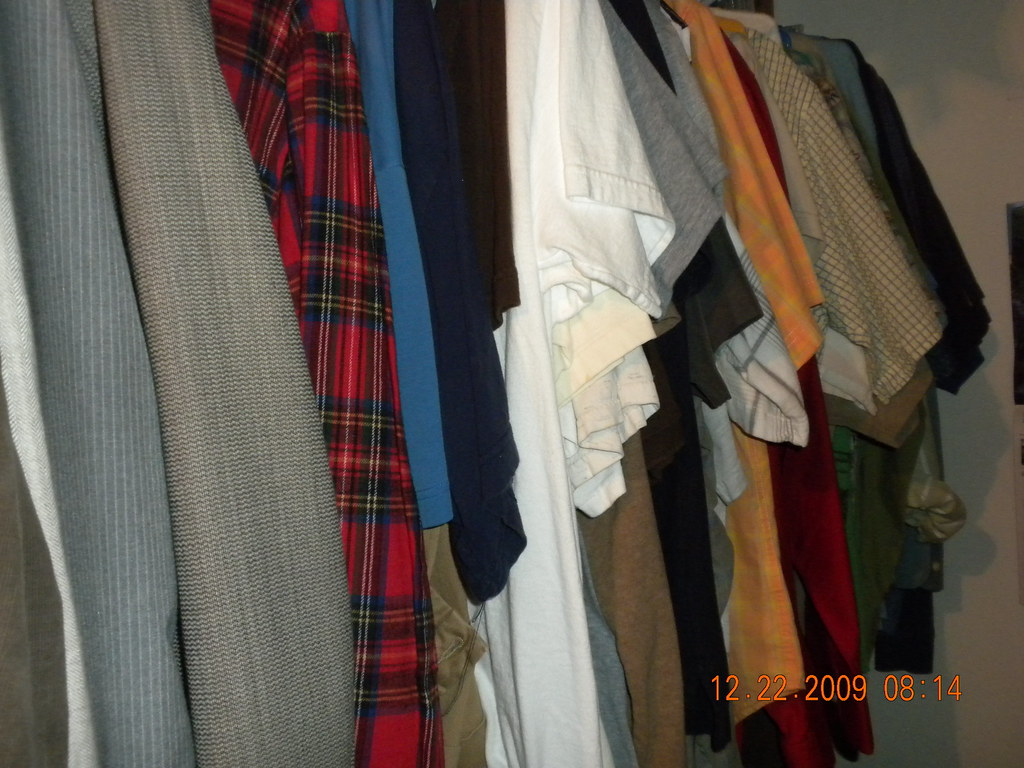
I remember you some mornings in the midst of getting dressed Surprised that I recall exactly when I wore you last
The paisley patterns spilling over sleeves The Nehru collars nobody believes … were popular The turtlenecks no turtle ever wore Those V-neck disco shirts that dance no more … Spectacular!
Are you lurking in the closet among other clothes I own? I gently touch your shoulder—a brief flash, then you’re gone
The concert souvenir shirts we outgrew The obligation gifts we always knew … were wrapped in haste Thick cotton plaids lost lumberjacks would covet That college T tossed out, but how we loved it … still, such a waste
You promised transformation, but what else did you require The full ensemble led us toward transcendence or desire (Attire of another age, accessories all the rage)
Bell-bottom flares that took flight as we walked Embroidered jeans so tight that people talked … of nothing else Those bomber jackets earthbound boomers froze in Those leather wristlets grunge guitar gods posed in … with death’s head belts
You folded in your fabric everyone I used to be Now that you’re gone, I realize I’m left with only me But if I run across you in some thrift shop bargain rack Or rummaging recycling bins, what else would you bring back? Who else will you bring back?
Some nights I see you in my dreams of places far away I’m wearing you as if I haven’t aged a single day Shirts of the distant past, shirts of the distant past
*****
Ned Balbo writes in Rattle #85, Fall 2024 (where you can hear the song performed): “I’ve played guitar since I was 5, keyboards since I was 13, and ukulele since I was 42, but my time as a ‘professional’ musician—someone paid to play—is scattershot and humble. Ice rinks, a Knights of Columbus Hall, a campers’ convention in Yaphank, a crowd of disco-loving retirees at Montauk’s Atlantic Terrace Motel, company picnics, school dances, private parties, and more—these were where I played guitar, sang, and devised versions of the Beatles, Bowie, et al. in two Long Island cover bands. The Crows’ Nest or Tiffany’s Wine-and-Cheese Café hosted noise-filled solo acoustic gigs, with more receptive listeners for original songs and covers of Elvis Costello or Eno at my undergrad college’s coffeehouse. More recently, I’ve written lyrics to Mark Osteen’s preexisting jazz scores (look for the Cold Spring Jazz Quartet on Spotify, Amazon, CDBaby, and elsewhere) and returned to solo songwriting and recording with ‘ned’s demos’ at Bandcamp. As a relic from the age when lyrics were sometimes scrutinized with poetry’s intensity, I listen closely to the sonics of language, whether sung or spoken, and look up to lyricists whose words come alive both aloud and on the page.”
Balbo: Robin, thanks for posting ‘Shirts from the Distant Past’, my little song-poem hybrid. I’ll be happy to answer any questions you have.
Editor: For myself, I see a continuum from womb heartbeat to dance to music to song to formal verse. I would love to have any additional comments on the subject in general, or on the creation of this poem in particular, related to these elements.
Balbo: I love what you’re saying about womb, heartbeat, and dance. A formative text for me is Donald Hall’s essay on poetic form’s psychic origins, ‘Goatfoot, Milktongue, Twinbird‘. You probably know it. Hall proposes three metaphors for poetry’s deepest sources: Goatfoot, the impulse toward dance, rhythm, movement; Milktongue, the pure pleasure of language, the texture of words when spoken; and Twinbird, our desire for form, symmetry, wholeness, which is complicated and energized by the contradictions it contains and reconciles. To me, Hall’s terms just sound like different ways of envisioning exactly what you’re talking about. They apply as much to song as they do to verse. The meter varies by stanza or section: iambic heptameter (seven iambs) in the couplet verses—not so different, after all, from the tetrameter to trimeter shifts we find in many ballads. The “shirts” title refrain, which doesn’t appear in print till the last line, are two trimeter phrases. It was fun to find surprising rhymes to hold the whole song together.
Editor: Regarding ‘Shirts’, quite apart from the charming idea, I like the work that has gone into the metre, rhyme, idiosyncratic structure.
Balbo: Thank you. I wrote and sung ‘Shirts’ as a poetic song lyric—one that could be read and enjoyed but, ideally, would be heard. I view its structure as that of a call-and-response song in traditional format. (In rock, for example, I think of George Harrison’s ‘Taxman’ with John and Paul harmonizing “Taxman, Mr. Wilson, Taxman, Mr. Heath” in answer George’s lead vocal.) In ‘Shirts’, the call-and-response comes from using the title as a refrain: it explains who the “you” is in each verse (when you hear it, anyway—I cut it from the visual text for fear it would seem repetitious without the music). Sometimes the title refrain answers a statement in the verse: “I gently touch your shoulder—a brief flash, then you’re gone” sounds like I might be talking (or singing) about a person, but it turns out to be those long-lost shirts—a playful fake-out.
Then there are the brief call-and-responses of the bridge sections which comment on the previous line or complete an unfinished thought: “Those V-neck disco shirts that dance no more…spectacular!” or “Embroidered jeans so tight that people talked…of nothing else.” They’re in iambic pentameter, with the second and fourth changing to heptameter if we count the two extra beats (set off on their own line) answering them.
The so-called “middle 8” (usually eight bars used to break up the verse-chorus/verse-chorus model) is delayed till just before the end: “You folded in your fabric everyone I used to be, etc.” That’s meant to set up the payoff: it’s not the shirts but our lost selves— along with loved ones, lost ones, everyone—we’re missing or mourning. But writing or singing about shirts—clothing that shapes and defines us—makes the lyric less depressing, leavens it with wit (I hope) so that what’s more poignant comes at the very end where more dramatic music can counterbalance the mood—the contradictions reconciled, as Donald Hall might have put it.
Of course, the very end is quieter – wistful again.
As I mentioned in Rattle (thanks again to Tim Green for giving both words and music a home), I grew up in the era when lyrics were often analyzed as seriously as poetry (and not just by undergraduates in long-ago dorm rooms under black light posters). Whether I’m writing poetry or songs, I listen closely to the different ways words sound—what works when sung doesn’t always work as well when spoken or encountered on the page—so when I do write lyrics, I try to make them both readable and singable.
Poems and song lyrics operate differently, but there’s lots of overlap between them. I wanted ‘Shirts’ to operate on both levels, even if it tilts more toward song lyric than poem.
*****
Ned Balbo’s six books include The Cylburn Touch-Me-Nots (New Criterion Prize), 3 Nights of the Perseids (Richard Wilbur Award), Lives of the Sleepers (Ernest Sandeen Prize), and The Trials of Edgar Poe and Other Poems (Donald Justice Prize and the Poets’ Prize). He’s received grants or fellowships from the National Endowment for the Arts (translation), the Maryland Arts Council, and the Mid Atlantic Arts Foundation. Balbo has taught at Iowa State University’s MFA program in creative writing and environment and, recently, the Frost Farm and West Chester University poetry conferences. His work appears in Contemporary Catholic Poetry (Paraclete Press), with new poems out or forthcoming in Able Muse, The Common, Interim, Notre Dame Review, and elsewhere. He is married to poet and essayist Jane Satterfield.
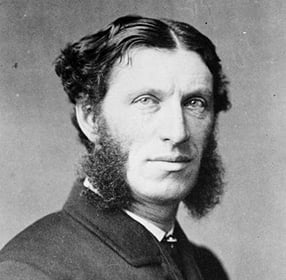
Victoria Moul writes: When I hear or read people — often though not only American “formalists” — discussing “correct” metre in English, and the supposed dominance of accentual-syllabic forms in general and the iambic pentameter in particular, I often think rather impatiently of poets like Arnold and Yeats. Arnold’s verse is musical, highly memorable and — to my ears at least — mostly very straightforward to speak correctly. But it’s often not very iambic at all and he typically uses lines of very varying syllable length. ‘Rugby Chapel’ is a good example of this — its pattern is, technically speaking, more trochaic (rugby) than iambic (endured), the trochaic pattern is established very clearly at the outset (‘Coldly, sadly descends’) and the lines have between six and nine syllables each. If you (inexplicably) wanted to spend an hour “scanning” it you’d find a complex variety of combinations of stressed and unstressed syllables. But its music is easy to hear and read, and very easy to remember, because regardless of the number of the syllables all the lines have three stresses.
Repeated three-stress lines are relatively unusual in English, especially in longer poems, but the four-stress line is very common, perhaps in fact the most natural English line of all, and indeed a lot of so-called iambic pentameter has a tendency to drift towards four rather than five stresses. ‘The Wild Swans at Coole’ establishes an iambic pattern at the outset (‘The trees are in their autumn beauty / The woodland paths are dry’) but is in stanzas of 4/3/4/3/5/3 stresses, with quite varied syllable length and relatively few perfectly iambic lines. Day-Lewis’ poem, by contrast, looks to the eye like it might be iambic pentameter, since the line-length hovers around 10 syllables (ranging from 9 to 12). But most of the lines are spoken naturally with four stresses, not five (‘A sunny day, with leaves just turning’; ‘Wrenched from its orbit, go drifting away’), and only a handful of lines certainly have five.
As far as I know — do comment if you can think of any counter-examples — there are no really good poems about rugby itself, so the poems I discussed today were just those which came into my mind as I watched the practices. None of these English poems are obscure — all are by poets who were considered major in their own lifetime, and all three have been very well-known at some point even if they are not now — and not one of them is in iambic pentameter. In fact, not one of them is obviously in a ‘syllabic’ metre, strictly speaking, at all (as in the familiar statement that traditional English verse is ‘accentual-syllabic’, i.e. where both the number of stresses and the number of syllables are set by the metrical pattern). These poems, like a great deal of English poetry, establish and follow an accentual pattern — of a certain number of stresses in a line, though this too is open to variation — but not, or only very loosely, a syllabic one. Verse of this kind is very common in the English tradition, and the hundred years of poetry between the mid-19th and mid-20th century, even if you set aside the full-blown “modernists” completely, is particularly rich in metrical variety. It is puzzling that this is not better reflected in most discussions of English metre and form. But the best way to get a feel for the actual — rather than imagined — conventions of a literary tradition is, of course, by reading it.
*****
Editor: The passage above is excerpted with permission from a recent Substack post by Victoria Moul in her ‘Horace & friends’ – the full thing is at https://vamoul.substack.com/p/on-rugby-and-metre. In it, with thoughts inspired by watching her nine-year-old son playing rugby, she discusses Cecil Day-Lewis’ ‘Walking Away’, Yeats’ ‘The Wild Swans at Coole’ and Arnold’s ‘Rugby Chapel’. The piece is engaging in several ways, but the point that stands out the most for me is this: “These poems, like a great deal of English poetry, establish and follow an accentual pattern — of a certain number of stresses in a line, though this too is open to variation — but not, or only very loosely, a syllabic one.”
This is much on my mind when I consider the forms that create formal verse. From my school days on, I have felt that analysing English grammar with Latin rules was wrong, just as straightjacketing English verse into syllabic requirements was not always useful, beautiful or appropriate. English is a Germanic language, and plays effectively by looser accentual rules: perhaps harder to define and analyse, but truer to the work of poetry which is to be word-for-word memorisable. Rhythm is one of the essential tricks of memorisation, along with rhyme, alliteration, assonance and a host of rhetorical tricks; and rhythm plays a variety of casual games. Also, accentual pattern corresponds to the continuum that I see at the root of poetry: from womb heartbeat, to dance, to music, to song, to formal verse. Formal verse is at its best when it is rhythmic and rich in musicality as well as in ideas and images and wordplay. Without the music, without the rhythm, it is prose… no matter how well expressed.
So rap and spoken word are inherently more poetic because more memorisable than 99% of what has been published as ‘poetry’ in the past 50 or 60 years. All songwriters are of course genuine poets – not all are good ones, but Bob Dylan certainly deserves his Nobel Prize (and I wish it could have been shared with Leonard Cohen).
Another point is that French too, and other Romance languages, are more accentual than professors often claim. When Françoise Hardy sang Tous les garçons et les filles de mon âge Se promènent dans la rue deux par deux she was following the accentual beat, not giving every syllable equal weight, and completely skipping a couple of unstressed syllables. (Are French professors still teaching that all syllables have equal weight in French verse? Surely not! I hope that died out some time last century…)
Not all poetry is singable – but at its best it has a musicality that both creates enjoyment and enhances its ease of memorisation.
Perhaps it’s true, as Twain implies, statistics are the greatest lies but point for point and size for size, I think they tie for major prize with poets’ modest little ‘i’s.
*****
Margaret Ann Griffiths, aka Maz, aka Grasshopper, was a British poet known almost exclusively for her online work. In his Preface and Personal Recollection, editor Alan Wickes speaks of her “belligerent modesty” and her lack of interest in the preservation of her verse. In 2008, after winning Eratosphere‘s annual Sonnet Bake-off with “Opening a Jar of Dead Sea Mud” and being praised by Richard Wilbur, she was a Guest Poet on the Academy of American Poets website, where she was hailed as “one of the up-and-coming poets of our time”.
Her poem ‘Lies’ speaks volumes (in a brief space) about the different types of modesty available to creative figures. Her reputation for wit, intelligence, astute criticism and kind-heartedness goes well with her wide-ranging subjects and diverse styles of verse. She was the preeminent English-language online poet of the early 21st century.
Her work was posthumously collected by fans and fellow poets in the 2011 ‘Grasshopper‘ from Arrowhead Press and Able Muse Press.
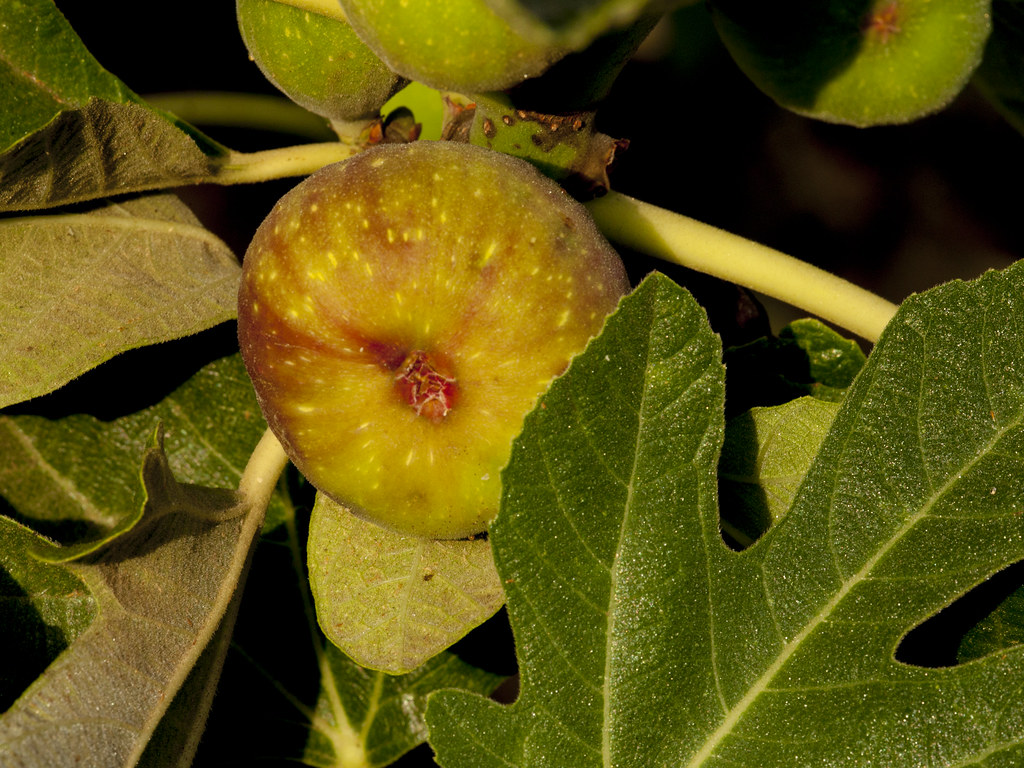
The fig leaf symbol’s one of History’s greats As, inter alia, It hides, discloses and exaggerates Male genitalia. The fruit itself suggests the female form — Dripping with honey The little hole breaks open, pink and warm… The Bible’s funny.
First published in The Asses of Parnassus, this poem was republished in Better Than Starbucks, which earned a “Kudos on your brilliant ‘The Fig Tree'” from Melissa Balmain, editor of Light. And it has now been added by Michael R. Burch to my page in The HyperTexts. That’s a wonderful set of editorial acceptances – it makes me proud, and I have to erase my lingering suspicion that the poem would be thought too rude for publication. Now I rate the poem more highly, as being not just a personal favourite but also acceptable to a wider audience.
It sometimes feels that all I write is iambic pentameter. It is always reassuring when a poem presents itself with half the lines being something else, and the result is a lighter, less sonorous verse. The rhymes are good; the poem’s succinct and easy to memorise. I’m happy with it.
Tradwife? No, thanks. I’m not the type you’ll find exclaiming “Yippee!” “Yesiree!” or “YOLO!” at thoughts of chores I might be doing solo – especially the old-school kitchen kind. Churn butter? Grow a sill of herbs? You’re kidding. Give me boxed broth and Hellman’s mayonnaise and sourdough I didn’t have to raise. Give me technology that does my bidding.
Yet how I love to cook up verse from scratch: to handpick thoughts I planted as a kernel within the fertile pages of a journal, add rhymes (a meaty or a salty batch), then whip them into something that – although it may stink at times – tastes vastly fresher than the glop inside an algorithmic can because you know it comes from me, Tradpoet.
*****
This poem was the lead poem in the latest Lighten Up Online (“LUPO”). Melissa Balmain writes: “Ironically, in the weeks since I wrote this poem, a health condition has forced me to do a lot more tradwifely stuff in the kitchen–making low-acid salad dressing, say. But I still refuse to churn butter.”
Melissa Balmain’s third poetry collection, Satan Talks to His Therapist, is available from Paul Dry Books (and from all the usual retail empires). Balmain is the editor-in-chief of Light, America’s longest-running journal of light verse, and has been a member of the University of Rochester’s English Department since 2010. She is a recovering mime.
Ignore your hand and focus on the pen, which writes without your knowledge of the whole. Do not insert the personal. Avoid translation. The changes made are small and gradual.
Commas herd their letters toward a distant goal of rhymes and metaphors but do not specify a conscious “I” or soul, a bold new vision or a school of thought.
Write like a dancer making small mistakes. What is wrong to you fulfills your friend’s desire. Cuttings and shit are what it takes to grow a garden from a funeral pyre.
A poet will die unless she learns to laugh. Do not hit DELETE. Save everything as DRAFT.
*****
Sue Parman writes: “When I was four years old, my father asked me, ‘When is a door not a door?’ His answer, ‘when it’s ajar,’ infuriated and then intrigued me. I began to keep a journal in which I wrote down sentences such as, ‘If the Devil is evil, God is odd.’ Puns were my intro-duction to poetry, a form of verbal play that taught me that words, rather than being a lifeline to truth, could be slippery and contain many truths at the same time. One of my favorite poets is Kay Ryan, the queen of poetic puns (see her ‘Bestiary’). As an anthropologist, I consider them a vital contributor to mental health, since they satisfy the needs of large-brained mammals to avoid epilepsy by indulging in surprise.”
Sue Parman is an anthropologist and award-winning essayist, short story writer, poet, and playwright. She is the author of two poetry books, “The Thin Monster House” and “Carnivorous Gaze,” and her poems have been published in a variety of journals and anthologies, including the above poem in Rattle. She writes in a number of other genres as well, including anthropological travel memoirs and mysteries. Her most recent publications include a short story, “Gannets and Ghouls,” which appeared in the September/October 2024 issues of Ellery Queen Mystery Magazine; and a nonfiction essay, “You Can’t Get There from Here,” that was awarded the Travelers’ Tales Grand Prize for Best Travel Story of 2024. After teaching anthropology in California for thirty-five years, she moved to Oregon in search of water, and travels frequently in hopes of getting lost. https://www.sueparman.com
Tom Vaughan writes: “For me, rhyme is not just a technical trick to help make poetry memorable. I think the world rhymes in odd ways. I also believe time rhymes, across the centuries but also in our short individual lives, sometimes in irony, but more often – if we listen hard enough to hear it – to point the way to a deeper level of challenge and reflection.”
Editor: I had been planning a rant on the essence of poetry being all the tricks that make it memorisable word-for-word: rhyme, rhythm, alliteration, assonance, etc; and on the fact that the bits of poems an adult remembers are invariably rhymed; and on poetry’s links to dance and song and the prenatal heartbeat. But Tom Vaughan introduces a whole new layer of value of rhyme, obliquely in his poem, incompletely in his comment. There are things to meditate on here.
Tom Vaughan is not the real name of a poet whose previous publications include a novel and three poetry pamphlets (A Sampler, 2010, and Envoy, 2013, both published by HappenStance; and Just a Minute, 2024, from Cyberwit). His poems have been published in a range of poetry magazines, including several of the Potcake Chapbooks and frequently in Snakeskin. He currently lives in Brittany. https://tomvaughan.website
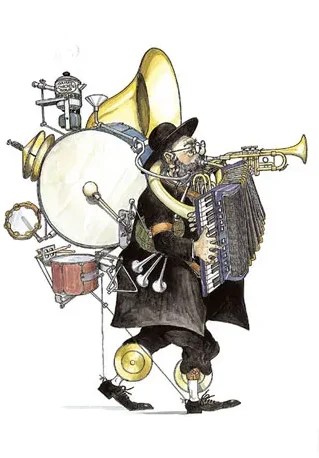
With things like tongs in the palm of his hand Tongue-depressors or langues-de-chat He tappets the rhythm of his one-man-band As he struts in the gutter with a tra-la-la.
He twinkles his fingers and he flicks his wrist Hey-diddle-diddle and fiddle-de-dee And his two tame twiddlesticks jump and twist With a click-click-clackety, one-two-three
For Nifty’s bones are made of wood And they click like sticks with a restless chatter His brass as he passes is loud and good But his rattling bones are a different matter
His drum tum-tums and his trombone groans And his hi-hat cymbal softly sighs But all I can hear is the homely bones That sing out the song in his small sad eyes
He dances a foxtrot, quick-quick-slow And the hi-hat hisses with a whispered yes But the bones, bones, bones with their no-no-no Tick-tock to the tune of uselessness
When Mister Nifty dances by His fingers flicker and his brass bells shine But a part of my heart feels cold and dry As his lonely bones call out to mine.
*****
Ann Drysdale writes “I made this poem because I wanted to see if I could turn words into music, with assonance and dissonance, chiming and clashing like the components of Mr. Nifty’s one man marching band. Laying aside conventional metre and putting boom, boom, boom alongside tum titty tum titty tum. I wanted it to sing and to dance to itself, and for the reader to dance along with it.”
The poem was collected in Miss Jekyll’s Gardening Boots, Shoestring Press, 2015.
Ann Drysdale still lives in South Wales. She has been a hill farmer, water-gypsy, newspaper columnist and single parent – not necessarily in that order. She has written all her life; stories, essays, memoir, and a newspaper column that spanned twenty years of an eventful life. Her eighth volume of poetry – Feeling Unusual – came together during the strange times of Coronavirus and celebrates, among other things, the companionship of a wise cat and an imaginary horse.
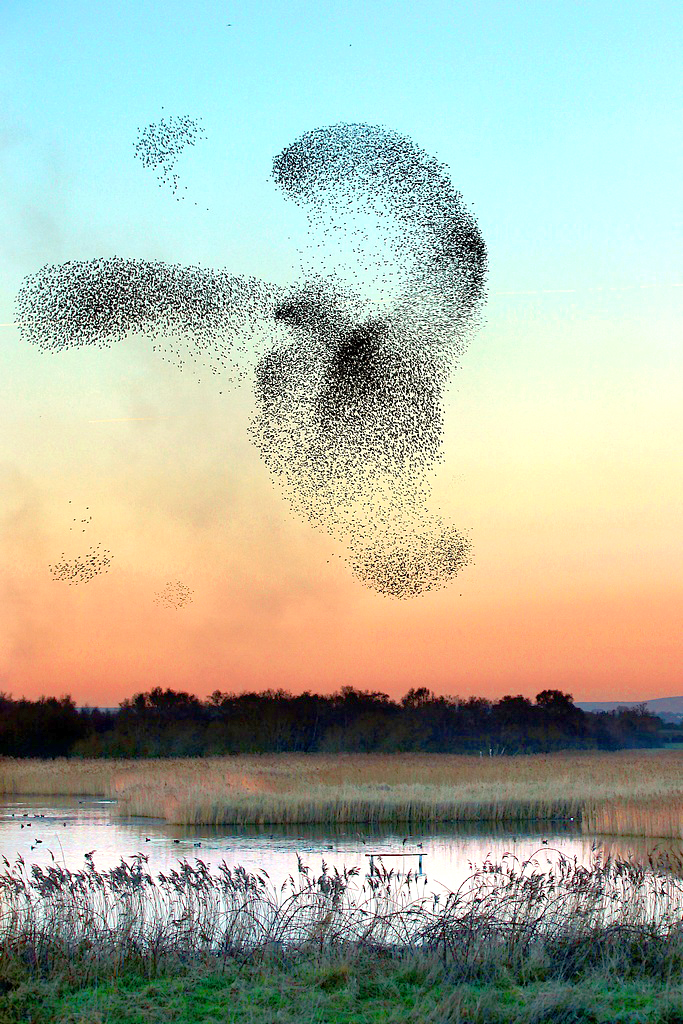
Segmented sets of starlings sharply elevate towards candescent skies, suspend, then circulate in sync. Their wingspans whisper sunset symphonies while manifesting silhouetted symmetries.
With poise, finesse and swiftness, they transform the air into an ever-changing scape; this canvas where each turn and swirl unfolds a painterly display: a moving mural, rendered on a dying day.
The starlings coalesce to make a checkered veil. They crown the clouds and skim across a coastal trail, then separate as if surrendering to gusts, and cover summits like a desert’s storm-flung dust.
With tapered pace, their fevered flights revert to long glissades of shimmering shades; a showy dance along a latent stopgap stage. They stir, careen, decline, retracing what remains of lofty lazuline,
before it all becomes a screen of red-specked gold. The starlings falter in its wake; they cannot hold their elegance in fading light. Their spirals wane in streaming chains. They spill in spates of jet-black rain.
*****
This poem was originally published by the Society of Classical Poets at the start of the year, after being awarded 4th place in their annual competition.
Daniel Moreschi writes: “Through its descriptions of the flights of starlings, this poem is intended to evoke reflections on how moments of beauty can be transient; the starlings’ flight patterns are fleeting and subject to change, much like all beautiful moments in life. I felt that verse written in alexandrines, brimming with fluidity, was an appropriate means to depict such an aerial display.”
Daniel Moreschi is a poet from Neath, South Wales, UK, who experienced a significant turning point when his ongoing battle with severe M.E. upended his life. However, during this period, he also rediscovered his passion for poetry, which had lain dormant since his teenage years. Writing has become a distraction from his struggles. Daniel has been acclaimed by over 80 poetry competitions and published in numerous NFSPS anthologies of prize-winning poetry, as well as by Lunar Codex, The Lyric, Society of Classical Poets, The Dawntreader, Westward Quarterly, Wishbone Words, The Chained Muse, Every Writer Resource, and an array of other journals and publications. Instagram: @daniel.moreschi

 Form in Formless Times