Category Archives: Poetics

Marcus Bales, ‘This Be The Verse’

Post this, post that, post-modernists –
   Denying narrative’s cabal.
The story that they tell insists
   It’s not a story after all.

New Criticism made them see
   That reading closely what was said
Meant cutting off biography,  
   And authors might as well be dead.

Like raisin oatmeal cookies, picked
   In hopes of chocolate chip, they bust
Your faith in how things seem. You’re tricked
   To only trust in doubting trust.

Without the person or the text,
   No human mind, no human heart,
I guess we know what’s coming next:
   Let the AIs do the art.

*****

Marcus Bales writes: “This is one of what I call my habitual poems. I have a perfectly good stand-alone idea, and start to work on it, but the parody turntable in my head takes over and the needle slides down into the groove and instead of stealing only the world-weary and faintly snarky Larkin tone it turns out I steal the whole poem. 

I have a file of these to be revised away from parody and into something that is less parodic, or at least less immediately noticeable as theft. 

The problem is I’m lazy about this stuff. There is a straightforward tradition of doing these kinds of parodicish things in song, called ‘filks’, and I’ve done some of them. It’s carried over into the same sort of thing in poems. The groove is there, the tonality is familiar, the original is familiar, and like the soap coming out of your hand in the shower, clunk, it hits the floor. 

So, since Robin asked me to write this, I’ve got a revised version for you. It loses some of the immediacy of Larkin’s opening, of course, but I’ll bet if you hadn’t got that in your head associated with this one first, this second version would only have marked a faint echo — and you might not of noticed how Larkinesque it is at all.”

Editor’s note: Bales revised the first and fifth lines; the originals read:
They fuck you up, post-modernists,
(…)
But others fucked them up to see

Hence his Larkin references.

Not much is known about Marcus Bales except that he lives and works in Cleveland, Ohio, and that his work has not been published in Poetry or The New Yorker. However his ‘51 Poems‘ is available from Amazon. He has been published in several of the Potcake Chapbooks (‘Form in Formless Times’).

Photo: “Post-Modern Urinal” by ~MVI~ (warped) is licensed under CC BY 2.0.

Using form: SF sonnet: RHL, ‘On a Dead Spaceship’

On a dead spaceship drifting round a star,
the trapped inhabitants are born and die.
The engineers’ broad privileges lie
in engine room and solar panel power.
The fruit and vegetables and protein co-ops
are run by farmers with genetics skills:
the products of their dirt and careful kills
help service trade between the several groups.
Others — musicians, architects — can skip
along the paths of interlinking webs.
Beyond these gated pods that the rich carve
for their own selves (but still within the ship),
in useless parts, are born the lackluck plebs.
Heard but ignored, they just hunt rats or starve.

*****

This sonnet was republished in Bewildering Stories in April 2024 – original publication had been in Star*Line five years previously. I find something very satisfying about using a formal sonnet structure to express science fiction and speculative fiction ideas – the ideas are by nature open-ended, unconstrained, and it feels good to tie them down as in a neat package with a bow on top. Topiary.

As for what political comments can be read into the poem, read away!

Photo: “Deepstar 2071 at Io” by FlyingSinger is licensed under CC BY 2.0.

Melissa Balmain, ‘Notes From a Jaded Traveler’

I dreamed I went to Heaven–
it wasn’t all that great.
The angel choir was tone deaf;
its harps were second rate.
St. Pete was glumly scrubbing
the bird shit off one gate.

I dreamed I went to Hell next–
it wasn’t all that grim.
I’d felt worse heat in Brooklyn,
worse torture at the gym;
Satan and his minions
were belting out a hymn.

I dreamed that neither visit
surprised me much–oh sure,
the Bible promised plenty
that wasn’t on my tour,
but what location ever
lives up to its brochure?

*****

From Walking in on People © Melissa Balmain, 2014. Used by permission of Able Muse Press.

Melissa Balmain writes: “This poem, first published in Light Quarterly (now Light), sparked one of my rare disagreements with LQ‘s founding editor, John Mella. He balked at the term “bird shit.” It might offend older readers, he said, and he asked for a substitute. This led to the following message, which is undoubtedly the sort of high-toned correspondence that poetry readers imagine happening behind the scenes:

Dear John,
Thanks for your latest note on “Notes from a Jaded Traveler.” I think we may have had a communication glitch—my preference is “bird doo,” not “doo-doo.” I agree with you that the latter does smack of the nursery. Plus, it doesn’t make the bird connection clear.
“Bird doo” is a fairly common expression—a Google search of the term yields more references than “bird poop.” But the main reason I prefer it to “bird poop” is that—at least among parents I know—“poop” is the nursery term for diaper contents.
So… if “bird shit” is out, I vote for “bird doo.”
All best,

Melissa

John went with “bird doo.”  When ‘Notes from a Jaded Traveler’ ran in my first collection, I finally got to change it back.”

Melissa Balmain’s third poetry collection, Satan Talks to His Therapist, is available from Paul Dry Books (and from all the usual retail empires). Balmain is the editor-in-chief of Light, America’s longest-running journal of light verse, and has been a member of the University of Rochester’s English Department since 2010. She will teach a three-day workshop on comic poetry at the Poetry by the Sea conference in Madison, CT, in May 21-24, 2024.

Photo: “Life’s Trail” by quinn.anya is licensed under CC BY-SA 2.0.

Using form: biform poem: Daniel Galef, ‘A Poke of Gold to the Lady That’s Known as Lou’

I saw the sigh in your pretty eye
    When you dreamed that I’d be yours,
But those who steal me fast reveal
    My shine is the start of wars.

First I passed through the purse of a miner who nursed
    A chill. He seemed to be
Just a helping of hurt in a flannelette shirt
    From Plumtree, Tennessee.

It’s the goal of gold to be bought and sold
    And melted and poured in a mould.
From the day they scratched me out of that patch
    Of dirt, I’ve been near as cold.

Now again I change hands, and again the sands
    Run out, and men lie dead.
Good chances, I’d rate, that the heftier weight
    Is a couple of rounds of lead.

I’ve been sought by those men—half a dozen or ten—
    Who flash gold in pokes and pounds,
Who begged you for dances and killed for your glances—
    It’s not as nice as it sounds.


I saw the sigh in your pretty eye when you dreamed
That I’d be yours, but those who steal me fast
Reveal in my shine is the start of wars. First I passed
Through the purse of a miner who nursed a chill. He seemed
To be just a helping of hurt in a flannelette shirt
From Plumtree, Tennessee. It’s the goal of gold
To be bought and sold and melted and poured in a mould.
From the day they scratched me out of that patch of dirt,
I’ve been near as cold. Now again I change hands, and again
The sands run out, and men lie dead. Good chances,
I’d rate, that the heftier weight is a couple of rounds
Of lead. I’ve been sought by those men—half a dozen or ten—
Who flash gold in pokes and pounds, who begged you for dances
And killed for your glances—It’s not as nice as it sounds.

*****

Daniel Galef writes: “Last month Robin posted ‘Casey to His Bat,’ a poem which scans as both a sonnet and as fourteeners in ballad meter. The intro mentioned that I’d written a few more of this type of poem after ‘Casey,’ one of which was titled ‘A Poke of Gold to the Lady That’s Known as Lou.’
As much as I loved the challenge of writing the Casey sonnet, I felt the form had to be justified somehow by the subject, and so, just as ‘Casey’ followed Ernest Thayer* in its alternate scheme of iambic heptameter couplets, each of the subsequent convertible sonnets, part of my Imaginary Sonnets series of persona poems, is also a response to or parody of a specific existing poem in a different meter which the sonnet doubles.
The second convertible sonnet, ‘A Poke of Gold to the Lady That’s Known as Lou’, is a riff on the famous narrative poems of Robert Service ‘The Shooting of Dan McGrew’ and ‘The Cremation of Sam McGee’ in his 1907 collection Songs of a Sourdough. (Like Thayer, Service is sometimes scorned as a jingle-writer partly because of his popularity and his populism, writing in the vernacular voice of Yukon prospectors.) Both of these narrative poems are written in a much looser anapestic ballad meter with more inversions and extra syllables than sonnets normally allow. While ‘McGrew’ has the basic ballad rhyme scheme, scanning as heptameter couplets like ‘Casey,’ ‘McGee’ has a much denser scheme, adding on top of these end-rhymes a pattern of dimeter internal rhyme. I loved the much greater challenge of compounding this rhyme scheme with that of a Petrarchan sonnet, but, due to the anapests, the finished product feels less like a sonnet than ‘Casey ‘did.
This poem appeared in Snakeskin Poetry in 2017, and, although it is not included in my book Imaginary Sonnets published this year, you will find, in the poems there, these same immortal threads: gold (p. 41), murder (p. 71), poetic parody (p. 72), and Canada (p. 19). danielgalef.com/book/
*Thayer’s poem, possibly the last American poem to have massive popular appeal to the extent that it was commonly memorized for fun and performed on the vaudeville stage, was published in 1888, the same year as the florid Victorian sonneteer Eugene Lee-Hamilton published Imaginary Sonnets, which inspired my book.”

*****

Daniel Galef’s first book, Imaginary Sonnets, is a collection of persona poems all from the point of view of different historical figures and objects, including Nossis the Epizephyrian, Christopher Smart’s cat, and a breakfast taco. Besides poetry, he has written plays that won the McGill University Drama Festival, flash fiction selected for the Best Small Fictions anthology, and last year he placed second in the New Yorker cartoon caption contest, which doesn’t really mean anything but he’s been telling everyone anyway.

Using form: biform poem: Daniel Galef, ‘Casey to his Bat’

(as a sonnet after Eugene Lee-Hamilton’s 1888 collection “Imaginary Sonnets”)

You’re swell! No wizard’s-wand or Rod of Aaron
With this ease can whack one past the glove
The way a sparrow weaves through trees. No baron
Wields your power—you’re the scepter of
A king, and blood descendent of the club
That Hercules did swing. That bat was blessed!
It knocked the blocks off lions. (Not a cub—
A full-grown beast.) Herc wore its skin, the rest
Cooked up for grub. My point: We’ll stand immobile.
It’s beneath us—just a dud. To swing
At these poor lulus would insult your noble
Blood. One pitch will come—the air will sing—
We’ll know that this is it. We’ll swing. We’ll hit!
The crowd will cheer! We’ll run! We’ll win!—Oh, shit.

~ ~ ~ ~ ~ ~ ~ ~ ~ ~ ~ ~ ~ ~ ~ ~ ~ ~ ~ ~ ~ ~ ~ ~ ~ ~ ~ ~ ~ ~ ~ ~

(in the meter of Ernest Thayer’s 1888 poem “Casey at the Bat”)

You’re swell! No wizard’s-wand or Rod of Aaron with this ease
Can whack one past the glove the way a sparrow weaves through trees.
No baron wields your power—you’re the scepter of a king,
And blood descendent of the club that Hercules did swing.
That bat was blessed! It knocked the blocks off lions. (Not a cub—
A full-grown beast.) Herc wore its skin, the rest cooked up for grub.
My point: We’ll stand immobile. It’s beneath us—just a dud.
To swing at these poor lulus would insult your noble blood.
One pitch will come—the air will sing—we’ll know that this is it.
We’ll swing. We’ll hit! The crowd will cheer! We’ll run! We’ll win!—Oh, shit.

*****

Daniel Galef writes: “I wrote this poem in 2017 while I was a student at McGill University and looking for anything to work on except my work. I have always loved both math and language, as well as making them kiss like two Barbies you mash together, and “Casey” was inspired by a couple of happy arithmetical coincidences: First, that there are exactly 70 metrical feet (or 25.52 imperial metres) in either one sonnet or 20 lines of ballad meter. Second, that both Ernest Thayer’s famous ballad “Casey at the Bat” and Eugene Lee-Hamilton’s not-so-famous collection Imaginary Sonnets were published in 1888.
The speaker of “Casey” is the mighty mock-hero of Ernest Thayer’s poem, subtitled a “Ballad of the Republic,” which is composed of standard ballad meter: rhyming couplets in iambic heptameter or alternating lines of tetrameter and trimeter. Thayer’s was possibly the last American poem to have massive popular appeal to the extent that it was commonly memorized for fun, performed on the vaudeville stage, and adapted into multiple films and even Disney cartoons. I memorized it in college as a party trick, which I’m quite eager to try out if I ever get invited to any parties.
As far as I know, this is the first sonnet* of its kind. I wrote another after, which was published first. Now that my first book is out,** I’ve written a third and fourth, but am still in the process of trying to find them loving homes in some journal or website where they can frolic and play with the other little sonnets. Of course, nothing’s wholly original. When I was a child I read a short poem by Mary Youngquist in a Willard Espy book which was readable as eight lines of six syllables or six lines of eight syllables. Robin informed me when the second of these was first printed (“A Poke of Gold” in Snakeskin Poetry in 2019; “Casey” was published in Able Muse in 2020) that the French surrealist Louis Aragon was toying with similar four-six/six-four patterns in the 1940s. But I think these are the first sonnets!
If you liked these, by all means check out my book, Imaginary Sonnets, available wherever sonnets are sold—but try here first: danielgalef.com/book/

*Sometimes they’re sonnets! I don’t really know what to call these. “Convertible sonnets” makes it sound like the rain will get in if you leave the top down, and “transforming sonnets” are plastic toys that come with a kid’s meal. The inaugural issue of the Journal of Wordplay called it an “equivocal sonnet,” and linked it to the 19th century genre “equivoque.” If you alternate the letters of sonnet and ballad, you get “sboanlnleatd.”*** Or, if you change the lineation of the poem only on a full moon: “were-sonnets”?
**Imaginary Sonnets (Able Muse Press, 2023), inspired by the Lee-Hamilton book—70 persona poems all from the point of view of different historical figures, literary characters, and inanimate objects, including Lucrezia Borgia, Wernher von Braun, and a new brand of breakfast taco.
***Both “sonnet” and “ballad” come from the Old Occitan troubadours; “sonnet” is a diminutive of “song” whereas “ballad,” a cognate with “ballet,” comes from “dance.”

*****

Daniel Galef’s first book, Imaginary Sonnets, is a collection of persona poems all from the point of view of different historical figures and objects, including Nossis the Epizephyrian, Christopher Smart’s cat, and a breakfast taco. Besides poetry, he has written plays that won the McGill University Drama Festival, flash fiction selected for the Best Small Fictions anthology, and last year he placed second in the New Yorker cartoon caption contest, which doesn’t really mean anything but he’s been telling everyone anyway.

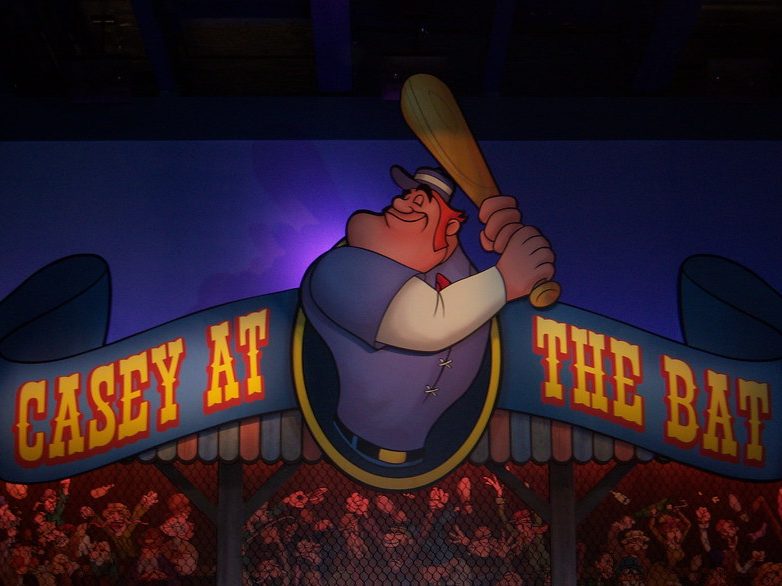
Photo: “Casey At The Bat at Games On The Boardwalk” by Castles, Capes & Clones is licensed under CC BY-ND 2.0.

Brian Gavin, ‘Death Watch at the Nursing Home’

Two rows of heads puffed white for show
are turned to watch the gurney go
parade-like down the hall and through
the double doors, and out of view.

They linger, as the swinging doors
are gazed to stillness, and intercourse
is but the mingling of silhouettes.
Beyond the tumults of regret

and wonder, they are elsewhere, all
their architecture of recall
connecting lives to family plots,
or maybe – further back – in what

may be a keepsake memory – light
parade, perhaps – a child’s delight
in clowns and cotton candy, high
and wispy as puffed hair. Friends die

often, but not in violence –
not here, where death comes to the sense
in not-quite-joy, and not-quite-grief,
but trembling, lightly, like a leaf

that might be blown, or not, or light
as dandelion fields puffed white
and wispy, wavering. In slow surmise
they gaze on quiet with quiet eyes,

filling the hall with noiselessness,
and dreaming but to acquiesce
to dream, and but to linger some
in thrall to stillness yet to come.

*****

Brian Gavin writes: “My poem sort of rips off (shamelessly!) the form and rhyme scheme of the famous A E Housman poem ‘To An Athlete Dying Young‘. It is, however, about a different kind of death – extreme old age – and the gentleness of it. It’s based on something I actually saw in a nursing home, when white heads once leaned out of their rooms to see a friend taken away on a gurney. The image of a parade struck me, and the heads of puffed white hair reminded me of cotton candy at the parades of my youth. Eventually the images of puffed hair and puffed candy morphed into a field of puffed white dandelions wavering in the wind.
I almost left the title at ‘Death Watch‘ – which I kind of preferred for the double meaning – but opted to add the rest of it for the sake of clarity. This piece ran in my collection Burial Grounds.”

Brian Gavin is a retired Distribution Manager who started writing poetry 10 years ago. His poems have appeared in The Journal of Formal Poetry, Peninsula Poets and Snakeskin Magazine, and in the Potcake Chapbook ‘Careers and Other Catastrophes. He lives in Lakeport, Michigan, USA, with his wife Karen. ‘Burial Grounds’ is available from Kelsay Books.
You can see more of his work at briangavinpoetry.com

Photo: “Dandelions Gone to seed, Dandelion puff ball seeds weeds lawn infestation roundup herbicide Pics by Mike Mozart of TheToyChannel and JeepersMedia on YouTube #Dandelions #Weeds #DandelionSeeds #Lawn #DandelionFlowers #Dandelion” by JeepersMedia is licensed under CC BY 2.0.

Poem on Poetry: ‘Poets Do Tricks With Words’

Poets do tricks with words,
play games, weld rhyme,
but we don’t do this nicely all the time–
we’ve also anger at unfairness, anger hot-white
at wasteful power, at greed and spite,
where fear meets selfishness, drives right and left
to persecution, torture, war and theft.

Each trick sticks bricks, fixed and unfixed,
into an apartheid verbal wall
that warbles claims to separate
sense from nonsense–though we appreciate
all’s one, all’s all the same,
word walls are just a Jenga game,
and all bricks fall.

We can play games with words,
thread and unthread them in a silly tangle,
loom and illuminate light warp, dark weft,
wrong them and wring them ringing through a mangle
as sometimes the only way
to find a new way to say
things said ten thousand times before:
how brightness has a rightness,
whether in the sky, the sea, a face or an idea.

So cook with words, mix, bake,
packing in raisins, nuts, half cherries for a cake
with flour just enough for a pretence
that it’ll hold together and make sense.

*****

Formal? Free? The arguments about the appropriate structure for poetry in English never seem to end. The semi-formal compromise has been around for a long time: take the rhythmic, rhyme-rich ramblings of Arnold’s ‘A Summer Night’ from 170 years ago, or Eliot’s ‘Prufrock’, written in 1911. To me, the test of good verse is that it is easy to memorise and recite: the ideas and imagery have to be memorable, but so does the expression, word for word. The tricks may vary by language and culture, but whatever tricks the poet can manage to achieve memorableness are legitimate.

‘A Summer Night’ was in my English A Level curriculum <cough> years ago, and the middle section which I still know by heart encouraged me to run away from school. (I was found trying to sleep in a phone booth while waiting for a morning train, and brought back to school at 2 in the morning.) The poem’s semi-formal structure has always appealed to me with its rhetorical power, and over the years I’ve often used that freedom when writing about poetry, as in ‘Some Who Would Teach‘ and ‘Inspiration 2‘ and ‘Memorableness‘.

‘Poets Do Tricks With Words’ has just been published in Orbis, edited by Carole Baldock.

Photo: “National Fruitcake Day” by outdoorPDK is licensed under CC BY-NC-SA 2.0.

Susan McLean, ‘Morbid Interest’

How unpleasant to meet Mr. Poe.
It gives a young lady a chill
when, just as she’s saying hello,
he asks if she’s lately been ill.

It was mid-afternoon, yet he seemed
to be tipsy or mildly sedated.
How oddly his mournful eyes gleamed
when he heard that we might be related.

He muttered some rhymes for my name,
saying nothing could be more inspiring
to a poet desirous of fame
than the sight of young beauties expiring.

Then he asked if I had a bad cough
or a semi-conversable crow.
I informed him of where to get off.
How unpleasant to meet Mr. Poe.

*****

Susan McLean writes: “In my teens, I was a big fan of Edgar Allan Poe‘s short stories and poetry. I loved his eerie subjects and crooning, incantatory lines. I memorized his poem ‘To Helen,’ and I parodied his iconic ‘The Raven.’ But in grad school, I read his essay ‘The Philosophy of Composition,’ in which he wrote that “the death . . . of a beautiful woman is unquestionably the most poetical topic in the world.” Hmmm. At that moment, it occurred to me that all of those dead women of his stories and poems might be less an outpouring of personal grief and more a product of an agenda. Years later, when responding to a challenge from the British journal The Spectator to write a poem modeled on Edward Lear’s ‘How pleasant to know Mr. Lear‘ but about another author, I imagined how Poe might seem to a young woman being introduced to him.
This poem, which was originally published in Light Quarterly, was later reprinted in Per
Contra
and in my second poetry book, The Whetstone Misses the Knife.”

Susan McLean has two books of poetry, The Best Disguise and The Whetstone Misses the Knife, and one book of translations of Martial, Selected Epigrams. Her poems have appeared in Light, Lighten Up Online, Measure, Able Muse, and elsewhere. She lives in Iowa City, Iowa.
https://www.pw.org/content/susan_mclean

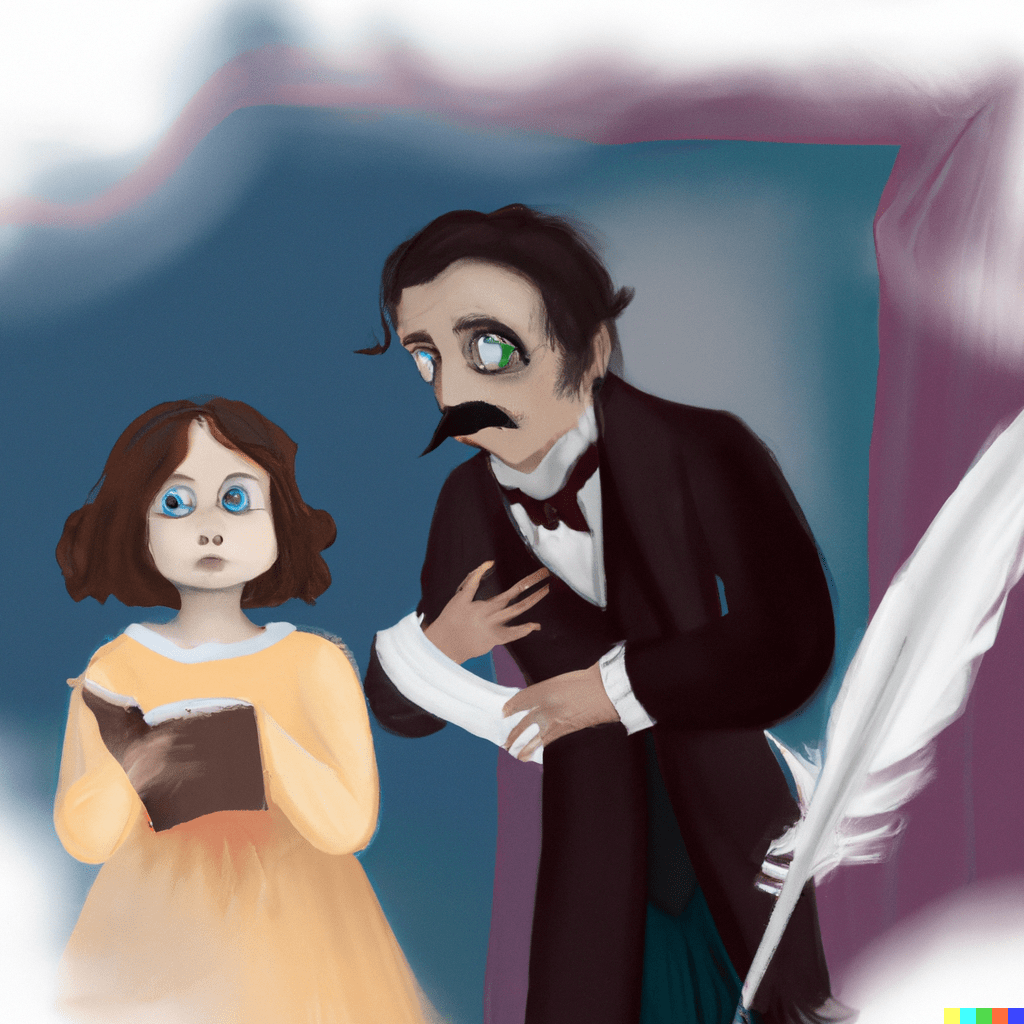
Illustration: DALL-E

Using form: Susan McLean, ‘Cul-de-Sac’

The man who had a perfect lawn
forced his three kids to toil outside
till every dandelion was gone.

His wife, gentle and put-upon,
dusted the trophies of his pride
(for tennis, not his perfect lawn).

His son, advancing like a pawn
to keep his father satisfied,
chose, when his girl and job were gone,

to hit a bridge (or gun) head-on.
The neighbors whispered “suicide”
while walking past that perfect lawn.

The youngest, timid and withdrawn,
lived with her parents till she died
of cancer, but the oldest, gone

for decades, had skipped town one dawn.
When she died too, her parents lied
that she was fine. Their perfect lawn
remains. But all the kids are gone.

*****

Susan McLean writes: “From the ages of six to sixteen, I lived on a suburban cul-de-sac, a more elegant term for a dead end. The neighbors I knew best, whose three children were around the same ages as the oldest three children in my family, came to symbolize for me the dark side of suburbia, the disturbing realities that lie behind the manicured exteriors and are never spoken of. Not until the father of that family died did we learn, from his obituary, that his oldest daughter, the one who was my age, had died several years earlier, of undisclosed causes. The mother, who played bridge weekly with my mother, had always said when asked about that daughter that she was ‘fine’.

I chose to tell this story in a variant on a villanelle in which only the last words of the repeating lines reappear: ‘perfect lawn’ and ‘gone’. That loosening of the form allowed more narrative to fill the lines, but the tolling repetitions of those words encapsulate, for me, the irony and tragedy of keeping up appearances in suburbia. The villanelle itself can be a straitjacket of a form, and the short tetrameter lines tighten it further, till it feels as though there is no way out.”

Susan McLean has two books of poetry, The Best Disguise and The Whetstone Misses the Knife, and one book of translations of Martial, Selected Epigrams. Her poems have appeared in Light, Lighten Up Online, Measure, Able Muse, and elsewhere. She lives in Iowa City, Iowa.
https://www.pw.org/content/susan_mclean

An 8 Bedroom Vacation Rental” by Discount Vacation Rentals Online is licensed under CC BY 2.0.

Quincy R. Lehr, ‘Lines for my father’

I think I owe some kind of explanation
As I grow tired and listless fingers writhe
Above the unpecked keyboard pad. I’m not
Quite out to blame you or your generation
For where I’m at tonight. You paid the tithe
That life exacts. It’s sanctimonious rot
If we deny the pain of paying it–
And our denials never help one bit.

Unlike you, I found myself involved
In protest politics when I was young.
I spouted crap about the working class
While searching for a problem to be solved.
I mocked you then, since stirring tunes are sung
In brayed crescendos, with a blaze of brass
Booming triumphs won against the odds–
Unjust societies and jealous Gods.

You seemed so cautious–tastefully attired
With modest ties and polished wing-tipped shoes,
A cautious, kindly smile that reached your eyes.
A man to be respected, not admired,
Neither adulated nor abused.
Ambitions of an ordinary size
Were often past your reach. A nagging doubt
Set in, and now I know what that’s about.

Tonight, I type these words as it gets late,
And no one calls to beckon me to bed.
I scoffed at what you’d craved–the tenure track,
The slow-accruing pension from the state,
The wife (who left you). Though you’re good and dead
(And at this hour, my eyes are going slack)
And though you cannot answer, I’ll report
–While having to imagine your retort–

That we’re no happier than you, and can’t
Quite seem to sit for tests that you had failed.
Our phones are packed with numbers we won’t call.
The televisions blast a constant rant
That we ignore like letters still unmailed–
Or unconceived. Clichés about a ball
That’s dropped don’t work–or maybe don’t apply.
We never picked it up. I wonder why.

This recognition’s only dawning now
As streetlights speckle glimmers on your urn
Beside my unmade bed, and as I write
These words to you in lieu of sleep. Somehow,
The brays of drunks outside my window turn
Almost comforting, as if the night
Is full of us–insomniac, astray,
And muttering defiance at the day.

*****

Quincy R. Lehr writes: “As for that poem, my father died in 2003, when I was twenty-seven. The content pretty much speaks for itself, I think. I was young, lonely, and frequently drunk when I wrote it.”

Editor’s comment: I admire the technical skill of the poem: the steady iambic pentameter; the abcabcdd rhyme scheme with the final couplet providing a punch; the integrity of the individual stanzas, each patiently laying out a mood, a thought, a situation. And I relate to the young man’s restless, unquiet, unsettled life, and the comparison to his father’s existence, his dismissal of his father’s achievements, his simultaneous recognition of the inevitable connections. It is a satisfying telling of an individual’s unique early life, in the context of the universal discord between generations.

Born in Oklahoma, Quincy R. Lehr is the author of several books of poetry, and his poems and criticism appear widely in venues in North America, Europe, and Australia. His book-length poem ‘Heimat‘ was published in 2014. His most recent books are ‘The Dark Lord of the Tiki Bar‘ (2015) and ‘Near Hits and Lost Classics‘ (2021), a selection of early poems. He lives in Los Angeles.
https://www.amazon.com/Quincy-R.-Lehr/e/B003VMY9AG