Category Archives: Poetics

Review: ‘A Child’s Introduction to Poetry’ by Michael Driscoll

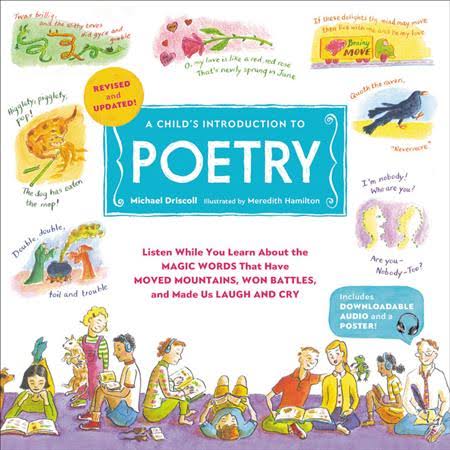
This book, “A Child’s Introduction to Poetry” by Michael Driscoll, illustrated by Meredith Hamilton, is the single best introduction to poetry that I have ever seen. It is part of a series of books aimed at 8 to 10-year-olds, and is divided into two parts: ‘The Rhymes and Their Reasons’, with two to four large pages on topics as diverse as Nonsense Rhymes, The Villanelle, Free Verse and Poems Peculiar; and ‘Poetry’s Greats’ with a couple of pages each on 21 poets such as Homer, Wordsworth, Dickinson, Belloc, Auden, Paz and Angelou. The book is richly illustrated on every page, and is packed with bits of biography, commentary, prosody, explanation and definition. Purely as a book, it is superb.

But wait! There’s more! The original edition came with a CD of all the poems, and the Revised and Updated edition comes with downloadable audio and a poster. These audio aspects are not as brilliant as the book, for two reasons: first, the poems are read “professionally” which unfortunately means without the joy, excitement, teasing, energy or naturalness that I listened for. They are clear, flat and boring, with unnecessarily exaggerated pauses between lines. I listened to the first three poems, and quit. Secondly, the CD version (which is what I have) may have been obsoleted, but the major item of comment in the Amazon reviews is that there are no explanations for downloading the audio, and that it was difficult for reviewers to figure out how to do it.

Ignore the audio, then. If you already have an interest in poetry you will probably do a better job than the unfortunate “professionals” in reading aloud from the book, and your child will have a richer experience anyway from your personal involvement and introduction. The book will soon enough be one for the child to dip into and skip back and forth in, moving from biographies to poems to illustrations to factoids as the mood takes them.

In terms of the variety of poetry–forms, moods, eras, nationalities–I have never seen anything so rich and satisfying for a good young reader as this Introduction. I wish all English-speaking children everywhere could have a copy.
Potcake Poet’s Choice: Max Gutmann, ‘Raindroppings’

Can anyone make out
The quality inherent
In being with an umbrella, that makes people without
Completely transparent?

On the rainiest days,
In the hardest of showers,
People with umbrellas courteously step out of other umbrella’d people’s ways
Right into ours.

Or, if as it starts
To really pour, ya
Dash for the shelter of a little awning, sure as rain’s wet someone with an umbrella darts
Under it before ya.

And you look at the fella
As you stand in the steady
Downpour, but he ain’t gonna budge, ’cause, as any one-eyed idiot could plainly see, his umbrella
Is wet enough already.

Beyond disputation,
We already hear a lot
About the many forms of indiscriminate discrimination
Our world has got.

Still, I wish some teller’d
Deign to tell us
The reasons for the way the umbrellered
Treat the umbrell’less.

Max Gutmann writes: “In ‘Raindroppings,’ a line of OgdenNashian length is part of each otherwise regularly metered quatrain. These lines get longer and longer, and then shorter and shorter. I hope this helps the poem feel both sillily loose, and formally structured: the topic, though it may sound invented, is an actual aspect of human nature, trivial in itself but reflective of more serious attitudes.”

Max Gutmann has worked as, among other things, a stage manager, a journalist, a teacher, an editor, a clerk, a factory worker, a community service officer, the business manager of an improv troupe, and a performer in a Daffy Duck costume. Occasionally, he has even earned money writing plays and poems.

linkmaxgutmann.com

‘Raindroppings’ was first published in Light Quarterly

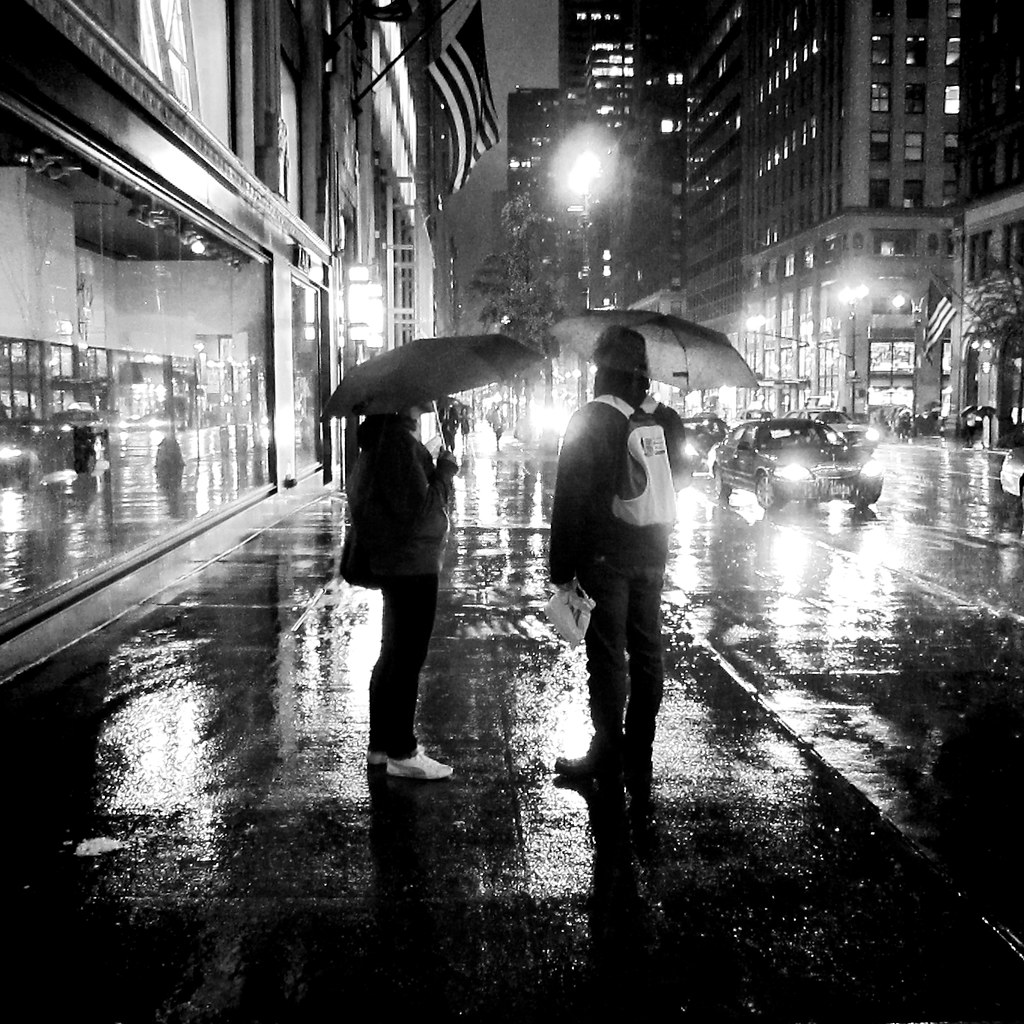
Photo: “Downpour” by roeyahram is marked with CC BY-NC-ND 2.0.

Odd poem: Edward Lear, ‘Imitation of the Olden Poets’

Time is a taper waning fast!
Use it, man, well whilst it doth last:
Lest burning downwards it consume away,
Before thou hast commenced the labour of the day.

Time is a pardon of a goodly soil!
Plenty shall crown thine honest toil:
But if uncultivated, rankest weeds
Shall choke the efforts of the rising seeds.

Time is a leasehold of uncertain date!
Granted to thee by everlasting fate.
Neglect not thou, ere thy short term expire,
To save thy soul from ever-burning fire.

This poem is a gorgeous piece of deliberately bad verse. Edward Lear had a wonderful ear for rhythm, and this appalling piece is a great jab at poets who, even to a Victorian like Lear, were long out of date: meaning, syntax and prosody are all garbled, wrapping around bland but unclear moralising exhortations.

The first line of each stanza ends with an exclamation mark even if, as in verse three, it is in the middle of a sentence.

The very first line has four simple feet in iambic tetrameter, eight syllables.
The second line also has eight syllables but manages to make the rhythm stumble through poor phrasing.
The third line has ten syllables; it can be read as iambic pentameter, but the previous lines encourage an attempt to keep to four slightly crowded feet.
The fourth line goes to twelve syllables, at which point the prosody is collapsing towards Lear’s younger contemporary, William McGonagall–you either cram everything into four feet, or let the stanza dribble out in too many iambics.

The second stanza begins “Time is a pardon of a goodly soil!” Very affirmative, but what does it mean? And are we back to pentameters now? It’s not clear–the second line is definitely tetrameter… so how to read the third and fourth lines?

The last stanza is pure iambic pentameter. The chaos is in the confused understanding of time, “a leasehold of uncertain date”, but is somehow part of “everlasting fate”. Similarly “thy short term” is shadowed by “ever-burning fire”. On balance, time appears to be represented as infinite–events are portrayed as everlasting–but time is also called “a leasehold of uncertain date”; that phrase is merely a poor expression that confuses Time with the time of a human’s life.

The poem has been set to music by Bertram Wooster with a Betty Boop video. They credit Lear, and the poem shows up in PoemHunter and a couple of other places… and I want to believe it is Lear… but I’d be happier if I could find more about the origin of the piece.

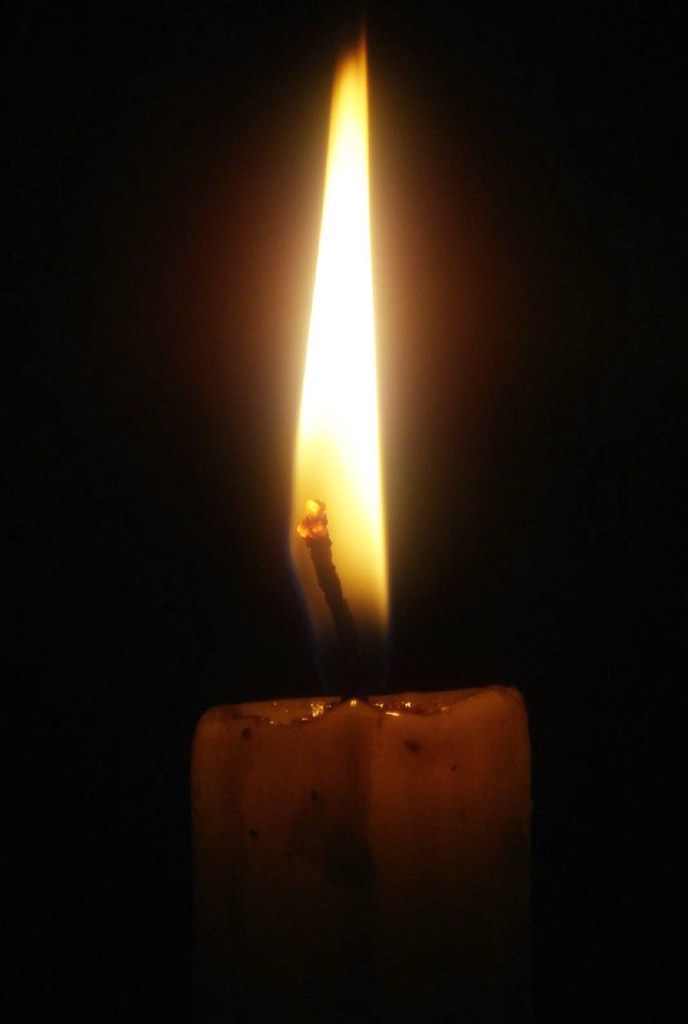
Candle” by kkalyan is marked with CC BY-SA 2.0.

Sonnet: ‘We Know We Will Be Dead’

We know we will be dead, who are alive.
But should some element of us survive –
fragment of consciousness or memory –
what value could it have? What should it be
that the whole universe might benefit?
The atom matters – what’s not made of it?
And we’re not large – not like a conscious star
(if time will let us all evolve that far).
You’re not much different in real magnitude
from an ant crushed for going for your food,
a gnat rubbed out, its tiny consciousness
a dot… but does it build the universe?
If that gnat can’t, I don’t see how you can:
there’s not much difference between gnat and man.

Does a poem of 14 lines, rhymed in pairs, count as a sonnet? Perhaps, but it doesn’t feel quite right. Petrarchan and Shakespearian sonnet structures, with more complex structures of rhyme, produce a much greater impact with the final line–a sense of revelation, inevitability, an impression of absolute truth–purely by the successful rounding out of the pattern. I like this poem’s ending couplet… but it would be stronger if the previous 12 lines were better structured.

‘We Know We Will Be Dead’ was published in the most recent Allegro, edited by British poet Sally Long.

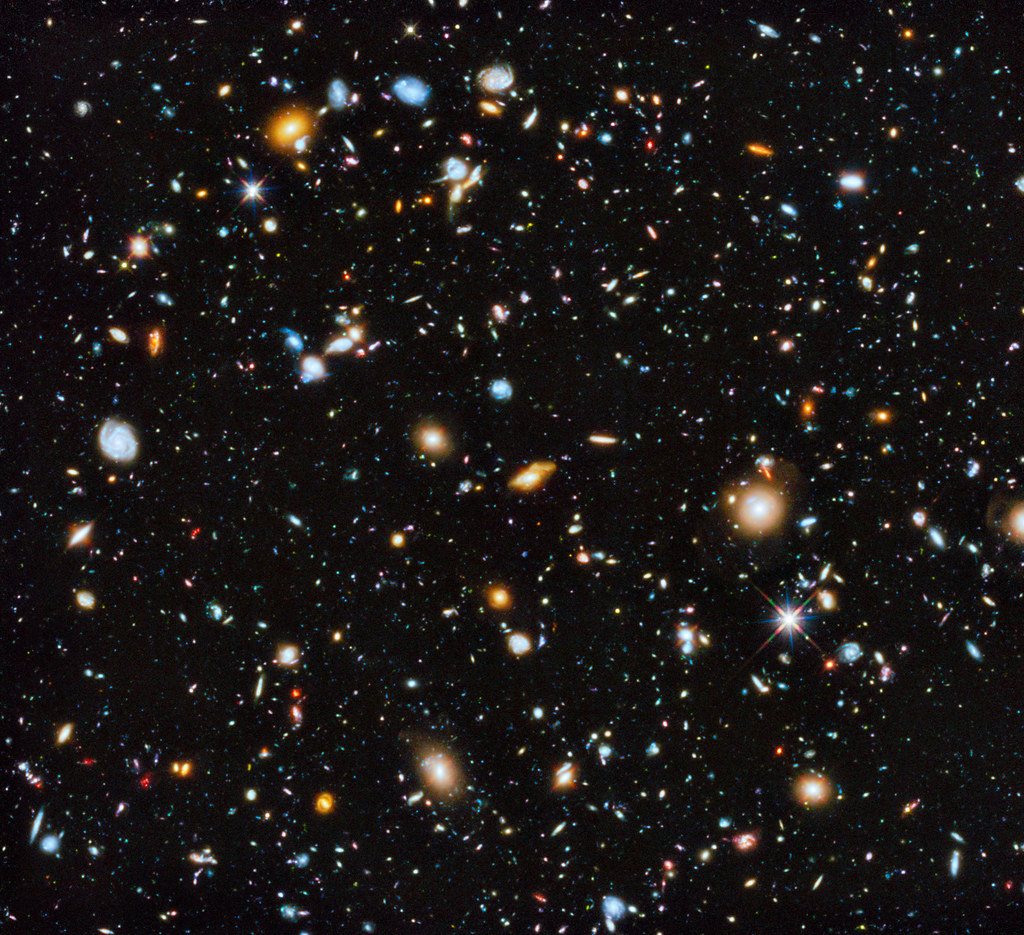
Hubble’s colourful view of the Universe” by Hubble Space Telescope / ESA is marked with CC BY 2.0.

Poem on poetry: ‘Diatribe Against Unversed Poets’

Ignoring clockwork towns and fertile farms
Tied to the sun-swing as the seas to moon,
They searched for verse in deserts without rhyme,
Lifted erratic rocks nonrhythmically
In search of poetry, then through the slough
Of their emotions hunted for a trail:

“The scent is cold. Its Spirit must have fled;
The body of its work, though dead,
Has been translated to some higher plane.
Look how the world’s translated verse
Comes to us plain—why can’t we emulate?
Then if the words themselves are unimportant,
If poetry in essence is idea,
And song is wrong,
Rhyme a superfluous flamboyance
(Like colour in Van Gogh),
Rhythm a distraction to the memoring mind,
Then we determine poetry’s true form is mime!”

While in the air the deafening blare
Confounds their silence everywhere:
Before our hearts began to beat
We were conceived in rhythmic heat;
So, billions strong, we sing along
For all the time, in time, our time, the song
Goes rocking on in rhythmic rhyme. Rock on!

“Unversed” means “not experienced, skilled, or knowledgeable”. Poetry takes different forms in different languages, but the forms all have the same desirable outcome: to make it easier to memorise and recite word-for-word. Alliteration, assonance, rhyme, metre – these are all useful tools for achieving this, along with less tangible tools such as fresh or startling imagery. Metre/beat/rhythm is viscerally important to us, because the mother’s heartbeat is the background to sensory development in the womb, and our own heartbeat and breathing rhythms continue throughout life. As humans we drum, we dance, we sing, just as we walk and run rhythmically, tap our fingers rhythmically when we are bored, teach small children to clap and sing, teach older children clapping and skipping games. Rhythm is built into us from before birth.

Rhythmic poetry didn’t die when it almost stopped being publishable. It just went into folk songs, blues, rock, country-and-western, musicals, rap, hip hop… Popular music let teenagers and adults continue to thrive with what they were not given by schools: rhythm and rhyme. This drive to make words memorable and recitable is part of who we humans are. So schools do best when they leaven “creative self-expression” with getting kids to learn things by heart, and getting them to pay attention to the qualities that make it easy to memorise and recite.

Photo: “Lost in desert” by Rojs Rozentāls is licensed under CC BY-SA 2.0

Review: ‘101 Sonnets’ edited by Don Paterson

This has to rank as one of the all-time great poetry anthologies. Yes, it contains only sonnets. Yes, several of them are dense in structure or in language (several are in Scots, with words and phrases translated in footnotes). Yes, there is only one sonnet per poet. It is very rich material, and took me a couple of weeks for a first read because there is a lot of absorb. And it has a fabulous Introduction by the British editor Don Paterson – a well-respected poet who avoided including any sonnet of his own.

The sonnets are not put into any formal grouping, but rather flow conversationally from one to the next, the themes often shifting through unexpected juxtaposition. So the first nine run through an amazing sequence of idealised love, woman as muse, kissing, sensual religiosity, obscenity, and charm. It starts with Robert Frost’s
She is as in a field a silken tent
and progresses to Robert Graves’ woman/muse
This they know well: the Goddess yet abides.
Though each new lovely woman whom She rides

to Jo Shapcott’s ‘Muse’
When I kiss you in all the folding places
to Alexander Montgomerie’s
So swete a kis yistrene fra thee I reft
to Wilfred Owen’s
Between the brown hands of a server-lad
The silver cross was offered to be kissed

John Donne’s
Batter my heart, three-personed God
William Alabaster’s ‘Upon the Crucifix’
Feed greedy eyes and from hence never rove,
Suck hungry soul of this eternal store,
Issue my heart from thy two-leaved door,
And let my lips from kissing not remove.

Craig Raine’s ‘Arsehole’
I dreamed your body was an instrument
and this was the worn mouthpiece
to which my breathing lips were bent.

to Robert Herrick
A sweet disorder in the dress
Kindles in clothes a wantonness

The 101 Sonnets provide a wild ride. The next in the book are Poe’s ‘An Enigma’, Wordsworth’s
The world is too much with us; late and soon,
Getting and spending, we lay waste our powers

(incidentally the first sonnet I learnt by heart, one that helped shape my life) and J.K. Stephens’ parody critique of Wordsworth
Two voices are there: one is of the deep (…)
And one is of the old half-witted sheep (…)
And, Wordsworth, both are thine
.

And so on through all aspects of life and death, English landscapes, Irish history, real parents, imaginary children, mythology, poetry, the seasons, the close observation of small everyday items… Wendy Cope paired with Edmund Spenser, Gwendolyn Brooks with John Milton… A very rich and rewarding collection.

And the 17-page Introduction is the single best essay on poetry that I’ve ever read. Naturally it is focused on the sonnet, covering its definition, its history, its structure; but in so doing it talks about wider issues such as the nature of iambic pentameter, and in a couple of places it goes into the nature of poetry itself: it mentions one of the advantages of the sonnet being that it is small enough
to be easily memorised, which is the whole point of the poem–that it should lodge itself permanently in our brains. We should never forget that of all the art forms, only the poem can be carried around in the brain perfectly intact. The poem is no more or less than a little machine for remembering itself: every device or trope, whether rhyme or metre, metaphor or anaphora, or any one of the thousand others, can be said to have a mnemonic function in addtion to its structural or musical one. Poetry is therefore primarily a commemorative act–one of committing worthwhile events and thoughts and stories to memory.

Later Paterson states
Poetic arguments appear to cohere simply because they rhyme. Rhyme always unifies sense, and can make sense out of nonsense; it can trick a logic from the shadows where one would not have otherwise existed. This is one of the great poetic mysteries.

All in all a brilliant book, and highly rereadable.

Sonnet: ‘One True Religions’

No vision brings the whole world to its knees.
Jains, Hindus, Buddhists, Mithraists, Parsees,
Moses, Muhammad, Jesus or St. Paul,
One True Religions never conquer all.
Humans are simply too cantankerous
for any one belief to anchor us.

Success at once leads into sects and schisms:
the One Pure Ray of Light hits human prisms,
and egos, power grabs, love of dispute,
traditions, curiosity, all loot
the intellectual wealth of strong belief.
This year’s great guru’s merely last year’s thief.

Control’s maintained by sword and flame, not thought.
In failure, drink the Kool Aid or get shot.

Well, maybe 14 lines rhymed in pairs isn’t really a sonnet, even if it’s in iambic pentameter. But when you’ve got a structure that works for a poem, I don’t think it’s worth trying to hammer it into a different shape just to try to reach a “higher” standard. Anyway, sonnet or not this poem was published in Rat’s Ass Review – as you could guess from the journal’s name, editor Roderick Bates publishes whatever appeals to him, with no apologies for treading on other people’s sensibilities, religious, poetic or anything else. It’s a good place to submit a poem that other journals might be squeamish about, and a good place to read a wide range of outspoken poetry.

“Jonestown massacre” by johndavison883 is marked with CC PDM 1.0

Evocative Fragments: from Arnold’s ‘A Summer Night’ (1)

For most men in a brazen prison live,
Where, in the sun’s hot eye,
With heads bent o’er their toil, they languidly
Their lives to some unmeaning taskwork give,
Dreaming of naught beyond their prison wall.
And as, year after year,
Fresh products of their barren labor fall
From their tired hands, and rest
Never yet comes more near,
Gloom settles slowly down over their breast.
And while they try to stem
The waves of mournful thought by which they are prest,
Death in their prison reaches them,
Unfreed, having seen nothing, still unblest.

I’m very grateful to my schooling for putting Matthew Arnold on the curriculum – this subversive little passage seems designed to undermine the office and factory culture which has flourished since his time, to undermine even the student writing endless essays. Arnold was an inspector of schools as well as a poet and social critic, so we can assume he knew what he was doing. But isn’t it suggesting that a dissatisfied person should just drop out? More on that in the next fragment.

The other thing I like about the piece is its easy, flowing style. Every line rhymes, but without pattern. The lines are iambic, mostly pentameter, but a scattering of them are shorter. It feels very conversational, and it is certainly very easy to learn by heart (which is one of the reasons that poetry evolved in the first place). The only hiccup to natural speech are the displacement of ‘live’ and ‘give’ to the ends of their lines for the sake of the rhyme and even that, though artificial, is done conventionally enough to read smoothly. The rest of it is in normal speech. When T.S. Eliot came out with ‘Prufrock’ some decades later, though it had a different, Imagist sensibility, the only real difference in style was in dropping the thou’s and thee’s that Arnold still clung to.

Photo: “Office workers in Executive Building Room No. 123 prior to alterations, Brisbane” by Queensland State Archives is marked with CC PDM 1.0

Short poem: ‘Golden Childhood’

Golden girl on a sunset beach
With a dog and a horse,
Golden boy spears a silver shark
Under the sea;

Is such a dream forever in reach
Or forever false?
We stumble, emotional, through the warm dark
Back to the sea.

I wrote this in my 20s when I was saying goodbye to the Bahamas – my father had died, my mother had sold the house and moved back to Europe. For the next few decades I lived in Denmark, Canada, the US… but eventually came back to the sea.

The poem was originally published in Candelabrum. I always had difficulty with that seventh line. Originally it had “emotionally”, and I sort of justified it with the line itself being a stumble… but it’s a bad line, too many syllables, too many consonants. Sometimes when I submit a poem to a magazine, the editor points out a flaw, and more rarely, offers a useful alternative. Poems can always be tinkered with.

Photo cropped from “Girl riding a horse at sunset on Bali” by Jimmy McIntyre – Editor HDR One Magazine is licensed under CC BY-SA 2.0

Poem: ‘Here Come the Old Gods’

Here come the old gods,
laughing in their sleeves
At all the foolishness
humankind believes.
Vishnu and Odin say
Prayers are in vain.
Loki and Shiva say
All goes down the drain.
Jesus and Buddha say
All will rise again.
Dig into the molecule,
the atom you disclose–
Search into the atom and
its particles expose–
Then to string and quantum,
to things that no one knows,
But downward still and downward
the endless staircase goes.
What yet smaller pieces
make up the smallest part?
What is outside everything?
What’s before the start?
The answer’s in the searching
through human gods and sin,
The answer’s in the clicking
of the wheel’s endless spin,
The answer’s in the angels
dancing on a pin,
The answer is the journey
you begin, begin, begin.

This poem was published this month in Snakeskin. It is rhythmic without being precise in its metre: this, together with the rhymes, means it is easy to chant (if you like chanting poetry). Philosophically it is a good expression of my personal beliefs (or lack thereof). I’m a Militant Agnostic: “I don’t know, and neither do you.” Which creates a lot of space for us all to enjoy life.

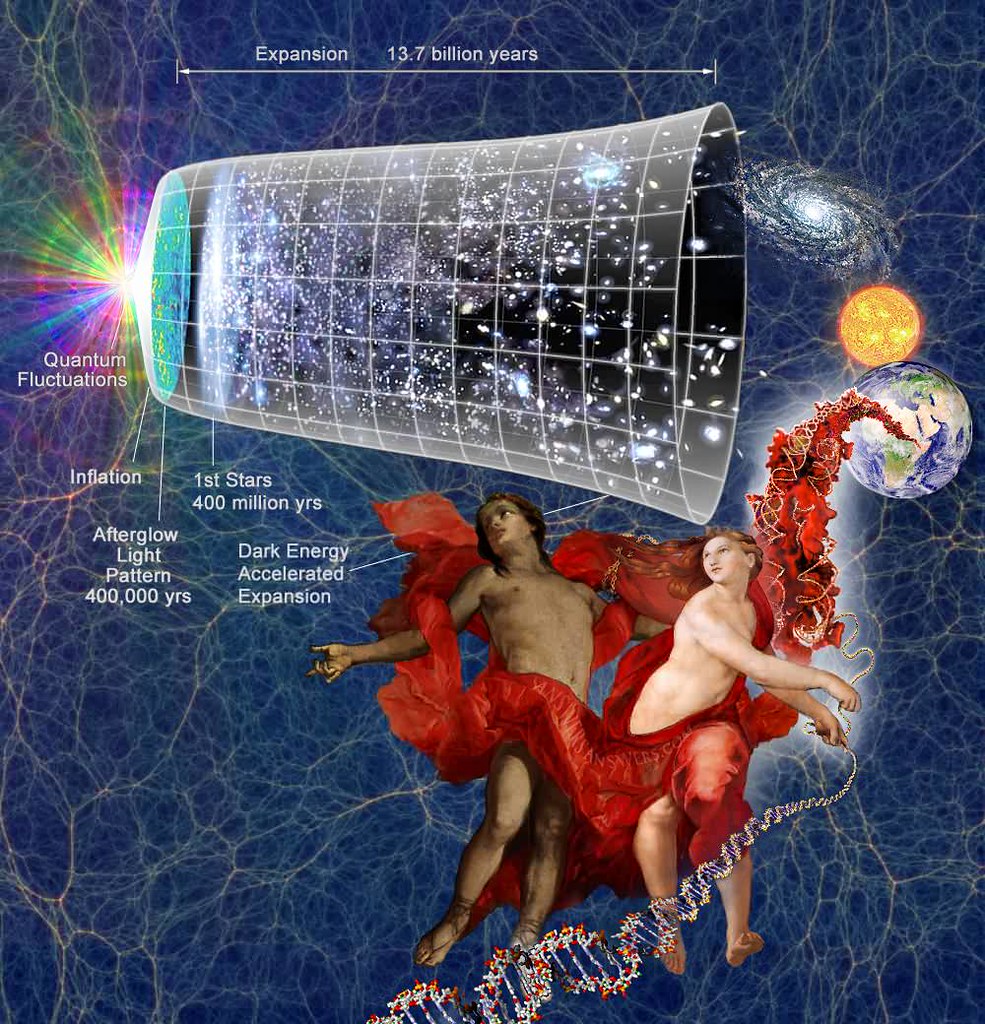
Photo: “universe” by tolworthy is licensed under CC BY 2.0