Category Archives: using form

Using form: Nonce form, riddles: Aaron Poochigian, ‘The New New Amsterdam’

I am the scam
you go in for, the diamonds in the pavement,
ecstatic evenings caught on traffic cam,
rare toilets and consensual enslavement.

Scholars and brawlers are inside of me.
What could I be?

I am
the new New Amsterdam.

I am those glam
high-rises and the derelicts’ despair,
graffiti worthy of the Met, and sham
Versace hawked to chumps in Union Square.

Purists and tourists are inside of me.
What could I be?

I am
the new New Amsterdam.

I am the ham
ironist, the perverse poobah of shock,
the firetruck stranded in a rush-hour jam
while conflagration rages round the block.

Birders and murders are inside of me.
What could I be?

I am
the new New Amsterdam.

I am the slam
Where Subway Ends, a scrum of mad musicians,
Sunday phone calls with a far-off fam,
Halal street food, and infinite ambitions.

Shoo-ins and ruins are inside of me.
What could I be?

I am
the new New Amsterdam.

*****

Aaron Poochigian writes: “Riddles go back to a time before ‘English’ was our English, before Shakespeare and Chaucer, the time of bards and Beowulf. The Anglo-Saxon riddles have the rhythms of poetry. They tell it slant like poetry does sometimes. The tantalizing, first-person self-description that defines the genre gave me a ‘way in’ to talk about a subject that would have been too vast otherwise—New York City.”

‘The New New Amsterdam’ was first published in The Rising Phoenix Review.

Aaron Poochigian earned a PhD in Classics from the University of Minnesota and an MFA in Poetry from Columbia University. His latest poetry collection, American Divine, the winner of the Richard Wilbur Award, came out in 2021. He has published numerous translations with Penguin Classics and W.W. Norton. His work has appeared in such publications as Best American Poetry, The Paris Review and Poetry.
aaronpoochigian.com
americandivine.net

Twitter: @Poochigian
Facebook: Aaron Poochigian
Instagram: aaronpoochigian

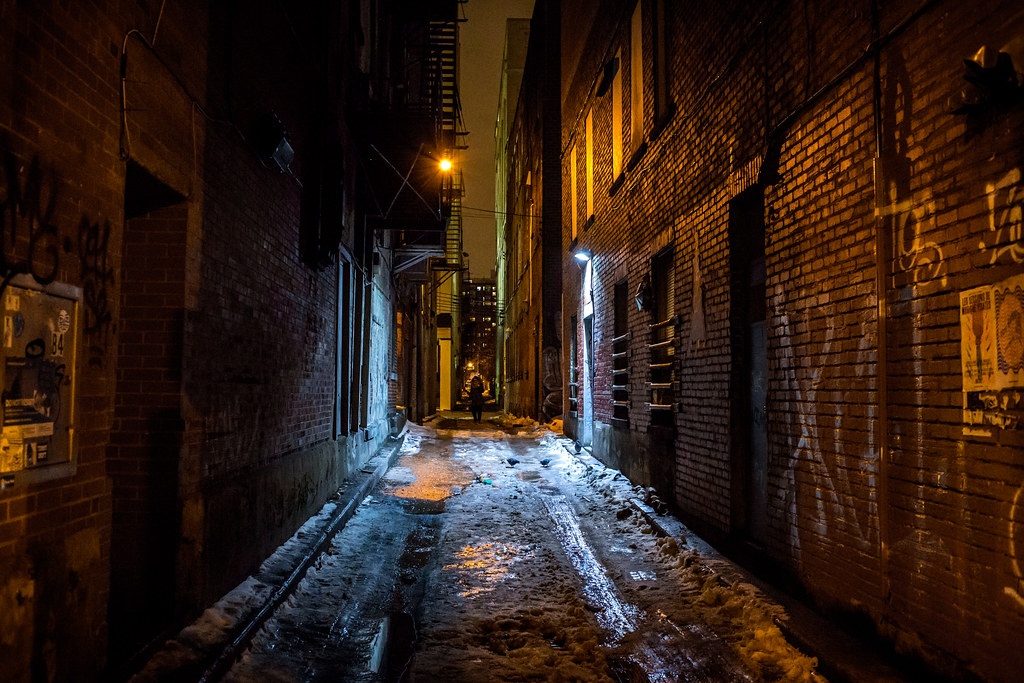
Photo: “NYC Night Life” by Tom Roeleveld is licensed under CC BY-NC-ND 2.0.

Using form: Susan Jarvis Bryant, ‘To Autumn’

Your flare of red turns Winter’s hoary head
To gaze upon your blaze and feel the heat
      And fever of your beat.
Your spice and sizzle catch his breath and spread
Through icy sighs to melt the lick of frost
      That dusts the dawn
With hints of chill intent. His plot is lost
In honeyed-apple charm and plummy balm.

You temper smitten Winter’s bitter breeze.
Your foxy bronze and lush rufescent blush;
      Your gold and ruby rush
 Ignite the leaves that shiver on the trees.
You burn through thickest wisps of morning mist.
      Birds laud your glow.
The granite skies grow blue as clouds are kissed
By dreams so hot they thaw all thoughts of snow.

When it’s your time to go you’ll fade with grace
As branches shed their tawny tears of grief –
      Each crisp and crinkled leaf
Will pool and pile. As Winter shows his face
Your fluffy, brush-tailed fans will slump and sleep.
      They’ll hit the sack
Until they spy the coyest crocus peep –
Spring’s message to the world that you’ll be back!

*****

Susan Jarvis Bryant writes: “My poem is a quirky nod to Keats’ timeless and beautiful ode with a much louder and sassier version of the fall with not a mellow trait in sight.  There is no time for mourning loss in this poem. Autumn vows (in true Terminator style) she’ll be back! The form I chose is a nod to the traditional but with two short lines in each stanza – an act of rebellion in keeping with this fiery season.”

‘To Autumn’ was originally published in Snakeskin 321.

Susan Jarvis Bryant is originally from the U.K., but now lives on the coastal plains of Texas. Susan has poetry published on The Society of Classical Poets, Lighten Up Online, Snakeskin, Light, Sparks of Calliope, and Expansive Poetry Online. She also has poetry published in The Lyric, Trinacria, and Beth Houston’s Extreme Formal Poems and Extreme Sonnets II anthologies. Susan is the winner of the 2020 International SCP Poetry Competition and has been nominated for the 2024 Pushcart Prize. She has just published her first two books, Elephants Unleashed and Fern Feathered Edges.

Photo: “Fall Color on the Pond” by fossiled is licensed under CC BY-NC-SA 2.0.

The Two-State Dissolution: Yankevich, Kenny, Helweg-Larsen, Foster, Vaughan, Jackson, Bales, Burch

Leo Yankevich: ‘The Terrorist’

Only six, she stands before a tank,
looking at its armour, while inside
soldiers heed orders from a higher rank.
There isn’t any place for her to hide,
no door to head for, no abandoned car
to slide beneath. Pure terror rules her land.
When finally crushed, she rises past the star
of David, with a stone clutched in her hand.

Janet Kenny: ‘Didn’t They Know?’
(In memory of a lost poem by Robert Mezey)

Didn’t they know that when they swarmed
and slashed and slaughtered what they saw
as an oppressor’s nest, the rage
that they aroused would turn and pour
with molten heat back on their house?

Their captive children now must pay,
small targets in a concrete cage.
No treaty, pact, no peace no truce.
Didn’t they know? Didn’t they know?

No map to show another way.
Olive farmers pay for crimes
of other nations, other times.
No mercy here, no one is just.
Two agonies, two brains concussed.

Nothing to see here. False alarm.
Police not needed to disarm
two weeping peoples each aware
that no solution slumbers there.
Hearth and cradle now makes clear
an ancient poem brought them here.

Where is the psalm that both can share?

Robin Helweg-Larsen: ‘Both Sides Justify Their Terrorism’

When pleas for justice are of no avail,
when governments praise death and theft,
and courts say you’re in error;
when the UN is blocked to fail,
the only recourse left
is terror.

When no one cares that Yahweh willed
that Jews alone should have this land
(and God’s never in error)
and prior residents must be killed,
yet they won’t leave, they force your hand:
to terror.

Gail Foster: ‘On The Occasion of Benjamin Netanyahu Quoting Dylan Thomas’

Don’t tell me that you fight a righteous fight
How many children have you killed today
I’ll give you rage. I’ll give you rage alright

Your anger and your ego burning bright
Are razing all that’s standing in your way
Don’t tell me that you fight a righteous fight

How many have you sent into the light
Before they even had the time to pray
I’ll give you rage. I’ll give you rage alright

How many have you saved or sent in spite
Up to the sky in ashen clouds of grey
Don’t tell me that you fight a righteous fight

In clouds as those who in the fog and night
Were put in trains and disappeared away
I’ll give you rage. I’ll give you rage alright

You speak as if your soul was white as white
Yet deep inside you darkness holds its sway
Don’t tell me that you fight a righteous fight
I’ll give you rage. I’ll give you rage alright

Tom Vaughan: ‘The Land’

Let’s pretend that the war
could be over, and peace
reigned even if only
this evening. O please

pick up your anger
and soak it with mine
in six large barrels
of miracle wine

and then let us dance
like lovers, as though
this land’s many meanings
didn’t all signal no

and we could make ploughshares
out of our swords
and translate the past
into one shared world

and even if dawn
will scatter the night
and send us both stumbling
into the light

where smooth olives glisten
in the warm sun
like belts of bright bullets
ripe for a gun.

Jean MacKay Jackson: ‘War’

Some say that war is bright flares and drama,
A glory of fireworks illumining skies.
This is all lies.
War is a child calling out for his mama
And getting no answer.
War is a merchant of hatred and grief:
War is a thief,
War is a cancer.
Some say that war is hell. Perhaps that is so.
Yet hell has a lack
Of innocent bystanders, hell has no
Collateral damage, no accidental black
Body-bags for old women and babies.
Hell has no maybes;
Everything makes sense.
In hell there is no defense:
You belong there. You chose your path.
Hell has a cold, hard justice drained of wrath.
War is the horrified look in the eye
Of a young person dying without knowing why.

Tom Vaughan: ‘Aleppo’

Never again we say, each time
never, never again,
and every time we mean it so
when it happens again

we watch it on our screens, and say
never, never again

we meet and vote and all agree
never, never again.

Marcus Bales: ‘Genocide is Genocide’

Genocide is genocide. There’s no
Legitimacy on the table. None.
Your killing and your maiming only show
What horrors piled on horrors you have done.

The US taught the method to the Germans
The Trail of Tears leads to the Holocaust.
And now Israeli policy determines
They’ll do the same in Gaza. That boundary’s crossed.

Why not, instead, a reconciliation,
Where all the old and evil wounds can be
Accepted by each side without probation?
With zealotry forgiven, all are free.

Until that happens, hate corrupts you all,
With “Ams Yisrael Chai” the new decree —
Unless it turns out that the final call
That wins is “From the river to the sea.”

And that’s the choice: that each side does the worst
That it can do to keep the hatreds growing,
Shouting slogans of revenge, and cursed
To trade atrocities that keep the business going.

The other choice is reconciliation.
Yes, all the old and evil wounds will be
Accepted by each side without probation,
And zealotry forgiven, to be free.

If “Look at what they did to us!” is your
Refrain, then all you’ve done is to condemn
Your children to a world where they’ll endure
Their children’s gloat: “Look what we did to them!”

There’s always someone left to live resenting
The evils your revenges made you do —
And they will spend their hearts and souls inventing
A suitable revenge to take on you.

Be strong enough for reconciliation
Where all the old and evil wounds must be
Accepted by each side without probation.
With zealotry forgiven, all are free.

Michael R. Burch: ‘Epitaph for a Palestinian Child’

I lived as best I could, and then I died.
Be careful where you step: the grave is wide.

*****

Acknowledgements:

Leo Yankevich: ‘The Terrorist’, collected in ‘Tikkun Olam & other poems’, Counter Currents, 2012
Tom Vaughan: ‘The Land’, published on Hull University Middle East Study Centre website, 2022, and in Professor Raphael Cohen-Almagor’s December 2022 Politics Newsletter
Tom Vaughan: ‘Aleppo’, published in Snakeskin 233, October 2016
Michael R. Burch: ‘Epitaph for a Palestinian Child’, first published in Romantics Quarterly, and many places since. Michael R. Burch is the founder and editor-in-chief of The HyperTexts, and its extensive collections of poetry include ones on both the Holocaust and the Nakba.

Photo: “Gaza war Nov2012” by EU Civil Protection and Humanitarian Aid is licensed under CC BY-NC-ND 2.0.

Using form: Heterometric verse: Susan McLean, ‘Teaching to the Test’

I know you have no use for them,
poems with their sly quicksilver words
that won’t just speak their minds,
but carom through your head like startled birds.
Is that despair or longing in their cries?
Their dolors make no sense.
They’ll never buy you larger-screened TVs
or seats at sports events.

But someday, as you watch a pair hold hands
and leap from a burning tower,
as you wait for test results or hear
your phone ring at an unaccustomed hour,
what you feel will circle wordlessly—
tense, accusing, gaunt.
You’ll find that you are tested and found wanting,
and these are what you’ll want.

*****

Susan McLean writes: “As a professor myself and a person who once worked on writing standardized tests, I am familiar with the complaint of teachers that they are often forced to “teach to the test,” i.e., teach only the sort of knowledge and skills that students need for passing that sort of test. But as a poet, I know that we are tested in life in all sorts of ways. Most people think that they can get through life just fine without poetry. They tend to find poetry annoying and impenetrable, something that needs to be decoded, that has no practical use. Yet in tragedies, when all hope and comfort are gone, there is some comfort in hearing that others who have been in similar situations were able to put into words the feelings that you can’t. And the most memorable and condensed of those responses are often poems.
This poem is rhymed and metrical, but the lines are of different lengths in unpredictable patterns, a form called “heterometric,” and the rhymes occur only every other line. That unpredictability is meant to mirror life, in which the bad news always seems to come out of nowhere. The poem originally appeared in Able Muse and later in my second poetry collection, The Whetstone Misses the Knife.”

Susan McLean has two books of poetry, The Best Disguise and The Whetstone Misses the Knife, and one book of translations of Martial, Selected Epigrams. Her poems have appeared in Light, Lighten Up Online, Measure, Able Muse, and elsewhere. She lives in Iowa City, Iowa.
https://www.pw.org/content/susan_mclean

Photo: “When Young Children ‘Hate’ School” by wecometolearn is licensed under CC BY 2.0.

Weekend read: Songs as poems: Ned Balbo, ‘Shirts of the Distant Past’

I remember you some mornings in the midst of getting dressed
Surprised that I recall exactly when I wore you last

The paisley patterns spilling over sleeves
The Nehru collars nobody believes
… were popular
The turtlenecks no turtle ever wore
Those V-neck disco shirts that dance no more
… Spectacular!

Are you lurking in the closet among other clothes I own?
I gently touch your shoulder—a brief flash, then you’re gone

The concert souvenir shirts we outgrew
The obligation gifts we always knew
… were wrapped in haste
Thick cotton plaids lost lumberjacks would covet
That college T tossed out, but how we loved it
… still, such a waste

You promised transformation, but what else did you require
The full ensemble led us toward transcendence or desire
(Attire of another age, accessories all the rage)

Bell-bottom flares that took flight as we walked
Embroidered jeans so tight that people talked
… of nothing else
Those bomber jackets earthbound boomers froze in
Those leather wristlets grunge guitar gods posed in
… with death’s head belts

You folded in your fabric everyone I used to be
Now that you’re gone, I realize I’m left with only me
But if I run across you in some thrift shop bargain rack
Or rummaging recycling bins, what else would you bring back?
Who else will you bring back?

Some nights I see you in my dreams of places far away
I’m wearing you as if I haven’t aged a single day
Shirts of the distant past, shirts of the distant past

*****

Ned Balbo writes in Rattle #85, Fall 2024 (where you can hear the song performed): “I’ve played guitar since I was 5, keyboards since I was 13, and ukulele since I was 42, but my time as a ‘professional’ musician—someone paid to play—is scattershot and humble. Ice rinks, a Knights of Columbus Hall, a campers’ convention in Yaphank, a crowd of disco-loving retirees at Montauk’s Atlantic Terrace Motel, company picnics, school dances, private parties, and more—these were where I played guitar, sang, and devised versions of the Beatles, Bowie, et al. in two Long Island cover bands. The Crows’ Nest or Tiffany’s Wine-and-Cheese Café hosted noise-filled solo acoustic gigs, with more receptive listeners for original songs and covers of Elvis Costello or Eno at my undergrad college’s coffeehouse. More recently, I’ve written lyrics to Mark Osteen’s preexisting jazz scores (look for the Cold Spring Jazz Quartet on Spotify, Amazon, CDBaby, and elsewhere) and returned to solo songwriting and recording with ‘ned’s demos’ at Bandcamp. As a relic from the age when lyrics were sometimes scrutinized with poetry’s intensity, I listen closely to the sonics of language, whether sung or spoken, and look up to lyricists whose words come alive both aloud and on the page.”

Balbo: Robin, thanks for posting ‘Shirts from the Distant Past’, my little song-poem hybrid. I’ll be happy to answer any questions you have. 

Editor: For myself, I see a continuum from womb heartbeat to dance to music to song to formal verse.  I would love to have any additional comments on the subject in general, or on the creation of this poem in particular, related to these elements.

Balbo: I love what you’re saying about womb, heartbeat, and dance. A formative text for me is Donald Hall’s essay on poetic form’s psychic origins, ‘Goatfoot, Milktongue, Twinbird‘. You probably know it. Hall proposes three metaphors for poetry’s deepest sources: Goatfoot, the impulse toward dance, rhythm, movement; Milktongue, the pure pleasure of language, the texture of words when spoken; and Twinbird, our desire for form, symmetry, wholeness, which is complicated and energized by the contradictions it contains and reconciles. To me, Hall’s terms just sound like different ways of envisioning exactly what you’re talking about. They apply as much to song as they do to verse. The meter varies by stanza or section: iambic heptameter (seven iambs) in the couplet verses—not so different, after all, from the tetrameter to trimeter shifts we find in many ballads. The “shirts” title refrain, which doesn’t appear in print till the last line, are two trimeter phrases. It was fun to find surprising rhymes to hold the whole song together. 

Editor:  Regarding ‘Shirts’, quite apart from the charming idea, I like the work that has gone into the metre, rhyme, idiosyncratic structure.

Balbo: Thank you. I wrote and sung ‘Shirts’ as a poetic song lyric—one that could be read and enjoyed but, ideally, would be heard. I view its structure as that of a call-and-response song in traditional format.  (In rock, for example, I think of George Harrison’s ‘Taxman’ with John and Paul harmonizing “Taxman, Mr. Wilson, Taxman, Mr. Heath” in answer George’s lead vocal.) In ‘Shirts’, the call-and-response comes from using the title as a refrain: it explains who the “you” is in each verse (when you hear it, anyway—I cut it from the visual text for fear it would seem repetitious without the music). Sometimes the title refrain answers a statement in the verse: “I gently touch your shoulder—a brief flash, then you’re gone” sounds like I might be talking (or singing) about a person, but it turns out to be those long-lost shirts—a playful fake-out.

Then there are the brief call-and-responses of the bridge sections which comment on the previous line or complete an unfinished thought: “Those V-neck disco shirts that dance no more…spectacular!” or “Embroidered jeans so tight that people talked…of nothing else.” They’re in iambic pentameter, with the second and fourth changing to heptameter if we count the two extra beats (set off on their own line) answering them.

The so-called “middle 8” (usually eight bars used to break up the verse-chorus/verse-chorus model) is delayed till just before the end: “You folded in your fabric everyone I used to be, etc.”  That’s meant to set up the payoff: it’s not the shirts but our lost selves— along with loved ones, lost ones, everyone—we’re missing or mourning. But writing or singing about shirts—clothing that shapes and defines us—makes the lyric less depressing, leavens it with wit (I hope) so that what’s more poignant comes at the very end where more dramatic music can counterbalance the mood—the contradictions reconciled, as Donald Hall might have put it.  

Of course, the very end is quieter – wistful again.

As I mentioned in Rattle (thanks again to Tim Green for giving both words and music a home), I grew up in the era when lyrics were often analyzed as seriously as poetry (and not just by undergraduates in long-ago dorm rooms under black light posters). Whether I’m writing poetry or songs, I listen closely to the different ways words sound—what works when sung doesn’t always work as well when spoken or encountered on the page—so when I do write lyrics, I try to make them both readable and singable. 

Poems and song lyrics operate differently, but there’s lots of overlap between them. I wanted ‘Shirts’ to operate on both levels, even if it tilts more toward song lyric than poem. 

*****

Ned Balbo’s six books include The Cylburn Touch-Me-Nots (New Criterion Prize), 3 Nights of the Perseids (Richard Wilbur Award), Lives of the Sleepers (Ernest Sandeen Prize), and The Trials of Edgar Poe and Other Poems (Donald Justice Prize and the Poets’ Prize). He’s received grants or fellowships from the National Endowment for the Arts (translation), the Maryland Arts Council, and the Mid Atlantic Arts Foundation. Balbo has taught at Iowa State University’s MFA program in creative writing and environment and, recently, the Frost Farm and West Chester University poetry conferences. His work appears in Contemporary Catholic Poetry (Paraclete Press), with new poems out or forthcoming in Able Muse, The Common, Interim, Notre Dame Review, and elsewhere. He is married to poet and essayist Jane Satterfield.

Literary: https://nedbalbo.com
Music: https://nedsdemos.bandcamp.com
‘Fluent Phrases in a Silver Chain: on finding poetry in song and song in poetry’ (essay in Literary Matters): https://www.literarymatters.org/14-2-fluent-phrases-in-a-silver-chain-on-finding-poetry-in-song-and-song-in-poetry/

Latest book: The Cylburn Touch-Me-Nots (Criterion Books): https://www.amazon.com/exec/obidos/ASIN/1641770821/thenewcriterio

Photo: “December 22-31, 2009” by osseous is licensed under CC BY 2.0.

Using form: Nonce form: RHL, ‘Camelot at Dusk’

From under low clouds spreading from the south
The red sun drops slow to night’s waiting mouth.
Rush lamps are lit; the guards changed on the walls;
Supper will not be served in the Great Halls
With Arthur still away. Each in their room,
The members of the Court leave books or loom
To say their Vespers in the encroaching gloom.

Lancelot, up in his tower,
Sees the sunset storm clouds glower,
Feels his blood’s full tidal power,
Knows he has to go.
In her bower, Gwenivere
Puts a ruby to her ear,
Brushes firelight through her hair,
Feels her heartbeat grow.

Guard, guard, watch well:
For the daylight thickens
And the low cloud blackens
And the hot heart quickens
To rebel.

From his tower, caring not
For consequences, Lancelot
Crosses courts of Camelot,
Pitying his King.
In her bower, Gwenivere
Feels his presence coming near,
Waits for footfalls on the stair,
Lets her will take wing.

Guard, guard, watch well:
If attention slackens
When the deep bond beckons,
Evil knows Pendragon’s
In its spell.

And as the storm clouds, rubbing out the stars,
Deafened the castle and carved lightning scars,
Drenched Arthur rode for flash-lit Camelot
Where he, by Queen and Knight, was all forgot.

*****

‘Camelot at Dusk’ was originally published by Candelabrum, a now-defunct poetry magazine in the UK which appeared twice-yearly from April 1970 to October 2010. Candelabrum provided what was, in the 1970s, a very rare platform for British poets working in metrical and rhymed verse.

Technically, the poem uses a variety of forms. The opening and closing passages use iambic pentameter with simple sequential rhyme for a level of detachment (and the only times Arthur is mentioned by name). The passages with Lancelot and Gwenivere use shorter trochaic lines with denser rhymes for more intensity. The passages of warnings to the guards… well, they have a shifting but repeating structure all their own.

Because of the bracketing of the more emotional passages by the more detached opening and closing, the piece feels very complete. As a whole, it is a nonce form. Whether I can ever repeat it successfully, I don’t know. I have tried, but not been satisfied with the result.

‘Camelot at Dusk’ can also now be found in The Hypertexts, which gives it a very respectable Seal of Approval. And it features in the Potcake Chapbook ‘Lost Love’.

Photo: “Eilean Donan Castle at Dusk” by Bruce MacRae is licensed under CC BY-NC-SA 2.0.

Weekend read: Essay: Victoria Moul, ‘On rugby and metre’ (excerpt)

Victoria Moul writes: When I hear or read people — often though not only American “formalists” — discussing “correct” metre in English, and the supposed dominance of accentual-syllabic forms in general and the iambic pentameter in particular, I often think rather impatiently of poets like Arnold and Yeats. Arnold’s verse is musical, highly memorable and — to my ears at least — mostly very straightforward to speak correctly. But it’s often not very iambic at all and he typically uses lines of very varying syllable length. ‘Rugby Chapel’ is a good example of this — its pattern is, technically speaking, more trochaic (rugby) than iambic (endured), the trochaic pattern is established very clearly at the outset (‘Coldly, sadly descends’) and the lines have between six and nine syllables each. If you (inexplicably) wanted to spend an hour “scanning” it you’d find a complex variety of combinations of stressed and unstressed syllables. But its music is easy to hear and read, and very easy to remember, because regardless of the number of the syllables all the lines have three stresses.

Repeated three-stress lines are relatively unusual in English, especially in longer poems, but the four-stress line is very common, perhaps in fact the most natural English line of all, and indeed a lot of so-called iambic pentameter has a tendency to drift towards four rather than five stresses. ‘The Wild Swans at Coole’ establishes an iambic pattern at the outset (‘The trees are in their autumn beauty / The woodland paths are dry’) but is in stanzas of 4/3/4/3/5/3 stresses, with quite varied syllable length and relatively few perfectly iambic lines. Day-Lewis’ poem, by contrast, looks to the eye like it might be iambic pentameter, since the line-length hovers around 10 syllables (ranging from 9 to 12). But most of the lines are spoken naturally with four stresses, not five (‘A sunny day, with leaves just turning’; ‘Wrenched from its orbit, go drifting away’), and only a handful of lines certainly have five.

As far as I know — do comment if you can think of any counter-examples — there are no really good poems about rugby itself, so the poems I discussed today were just those which came into my mind as I watched the practices. None of these English poems are obscure — all are by poets who were considered major in their own lifetime, and all three have been very well-known at some point even if they are not now — and not one of them is in iambic pentameter. In fact, not one of them is obviously in a ‘syllabic’ metre, strictly speaking, at all (as in the familiar statement that traditional English verse is ‘accentual-syllabic’, i.e. where both the number of stresses and the number of syllables are set by the metrical pattern). These poems, like a great deal of English poetry, establish and follow an accentual pattern — of a certain number of stresses in a line, though this too is open to variation — but not, or only very loosely, a syllabic one. Verse of this kind is very common in the English tradition, and the hundred years of poetry between the mid-19th and mid-20th century, even if you set aside the full-blown “modernists” completely, is particularly rich in metrical variety. It is puzzling that this is not better reflected in most discussions of English metre and form. But the best way to get a feel for the actual — rather than imagined — conventions of a literary tradition is, of course, by reading it.

*****

Editor: The passage above is excerpted with permission from a recent Substack post by Victoria Moul in her ‘Horace & friends’ – the full thing is at https://vamoul.substack.com/p/on-rugby-and-metre. In it, with thoughts inspired by watching her nine-year-old son playing rugby, she discusses Cecil Day-Lewis’ ‘Walking Away’, Yeats’ ‘The Wild Swans at Coole’ and Arnold’s ‘Rugby Chapel’. The piece is engaging in several ways, but the point that stands out the most for me is this:
“These poems, like a great deal of English poetry, establish and follow an accentual pattern — of a certain number of stresses in a line, though this too is open to variation — but not, or only very loosely, a syllabic one.”

This is much on my mind when I consider the forms that create formal verse. From my school days on, I have felt that analysing English grammar with Latin rules was wrong, just as straightjacketing English verse into syllabic requirements was not always useful, beautiful or appropriate. English is a Germanic language, and plays effectively by looser accentual rules: perhaps harder to define and analyse, but truer to the work of poetry which is to be word-for-word memorisable. Rhythm is one of the essential tricks of memorisation, along with rhyme, alliteration, assonance and a host of rhetorical tricks; and rhythm plays a variety of casual games. Also, accentual pattern corresponds to the continuum that I see at the root of poetry: from womb heartbeat, to dance, to music, to song, to formal verse. Formal verse is at its best when it is rhythmic and rich in musicality as well as in ideas and images and wordplay. Without the music, without the rhythm, it is prose… no matter how well expressed.

So rap and spoken word are inherently more poetic because more memorisable than 99% of what has been published as ‘poetry’ in the past 50 or 60 years. All songwriters are of course genuine poets – not all are good ones, but Bob Dylan certainly deserves his Nobel Prize (and I wish it could have been shared with Leonard Cohen).

Another point is that French too, and other Romance languages, are more accentual than professors often claim. When Françoise Hardy sang
Tous les garçons et les filles de mon âge
Se promènent dans la rue deux par deux
she was following the accentual beat, not giving every syllable equal weight, and completely skipping a couple of unstressed syllables. (Are French professors still teaching that all syllables have equal weight in French verse? Surely not! I hope that died out some time last century…)

Not all poetry is singable – but at its best it has a musicality that both creates enjoyment and enhances its ease of memorisation.

Photo: Matthew Arnold

Weekend read: David Galef, ‘A Question of Emphasis’ or ‘Wanna Make Something of It?’

“poetry makes nothing happen . . . .”
—W. H. Auden, “In Memory of W. B. Yeats”

Poetry makes nothing happen.
Song lyrics, on the other hand,
Wedge into people’s hearts
When sung by a heartthrob band.

Poetry makes nothing happen.
It doesn’t enforce a cause.
That’s the way of propaganda,
With all its fixed applause.

Poetry makes nothing happen.
But I’ve seen something sublime
In the eyes of a student reading
Eliot’s Prufrock the first time.

Poetry makes nothing happen.
But must events take place
For poems to be eventful—
To make a normal pulse race?

*****

David Galef writes: “This poem was inspired by the memory of a graduate seminar taught by Edward Mendelson, a professor at Columbia University and the executor of the Auden estate. What Mendelson doesn’t know about Auden probably isn’t worth knowing, and what he brought to the study of Auden’s poetry was a deep knowledge of technique, context, and Auden’s modus cogitandi. Tired of those who quoted Auden’s famous line from “In Memory of W. B. Yeats” to indicate the inutility of poetry, Mendelson pointed out that the significance of “For poetry makes nothing happen” is more a point about art versus propaganda. The emphasis shouldn’t be on “nothing” but on “makes.” The aim of agitprop is to make all minds bend in one direction. True art, on the other hand, doesn’t force one meaning on the audience, though it may be powerfully suggestive. As Auden continues (and people who quote often omit surrounding words),
“it survives
In the valley of its making where executives
Would never want to tamper, flows on south
From ranches of isolation and the busy griefs,
Raw towns that we believe and die in; it survives,
A way of happening, a mouth.

Poetry does indeed enjoy a special, immortal status, but those who want it to be a crowd-controlling megaphone will probably be disappointed.
What I wanted to accomplish in ‘A Question of Emphasis’ is just what stressing the right
word can do, and how poetry can change lives, in its own way.”

David Galef has published over two hundred poems in magazines ranging from Light and Measure to The Yale Review. He’s also published two poetry volumes, Flaws and Kanji Poems, as well as two chapbooks, Lists and Apocalypses. In real life, he directs the creative writing program at Montclair State University.
www.davidgalef.com

Editor: I can’t help adding this 6-minute exposition of emphasis from Hamlet: https://vk.com/video17165_456239062 with its star-studded cast… Enjoy!

Photo: “Nothing happened” by Graham Ó Síodhacháin is licensed under CC BY-SA 2.0.

Using form: Villanelle with a limp: Susan McLean, ‘Instructions for Climbing and Descending’

Good foot goes to heaven; bad foot goes to hell.
When every step torments and pain is chronic,
you can’t do as you did before you fell

and sprained your ankle. As the tendons swell,
don’t make things even worse. Learn this mnemonic:
good foot goes to heaven; bad foot goes to hell.

Take one step at a time. Do not rebel
or grumble that restrictions are moronic.
You can’t do as you did. Before you fell,

you bounded up the stairs like a gazelle,
but now your gait is nearly catatonic:
good foot goes to heaven; bad foot goes to hell.

You’ve always known it doesn’t help to dwell
on loss. You should let go, but (how ironic!)
you can’t. Do as you did before you fell,

but try to play it safe while getting well.
The best advice is simple, yet Miltonic:
good foot goes to heaven; bad foot goes to hell.
You can’t do as you did before. You fell.

*****

Susan McLean writes: “I love villanelles. I like them partly because they are songlike and partly because they present interesting challenges for rhyming and for varying the repeating lines, known as repetends. I thought at first that I had set myself an impossible task with my “-onic” rhymes, but they kept surprising me and leading me in new directions. I was not planning to refer to Milton when I started, for example, but when I stumbled on “Miltonic,” it fit perfectly with the metaphors in the first line. When I started, I also didn’t realize how many ways the second repetend could be varied while still making literal sense.
“The idea behind the poem came from real-life experiences. I had sprained my right ankle once, and after I wrote this poem, I broke it twice. However, the first line, which is literally the mnemonic device offered by a physical therapist as a reminder of which foot to step on when going up or down stairs, was one I heard secondhand. My partner John was told it by his therapist when he had a painful foot. The rest of the poem is in lines with five beats (iambic pentameter), but that line has six. I decided to use it, nevertheless, because the extra beat in that repetend slows the line down, mimicking the slow gait of the person with the sprain. It also makes the line itself seem to limp.
The poem was originally published in First Things and later appeared in my second poetry book, The Whetstone Misses the Knife.”

Susan McLean has two books of poetry, The Best Disguise and The Whetstone Misses the Knife, and one book of translations of Martial, Selected Epigrams. Her poems have appeared in Light, Lighten Up Online, Measure, Able Muse, and elsewhere. She lives in Iowa City, Iowa.
https://www.pw.org/content/susan_mclean

Photo: “How Many Times Do You Have to Fall Before You End Up Walking” by Thomas Hawk is licensed under CC BY-NC 2.0.

Weekend read: long poem: ‘Catullus LXIII’ translated by George Simmers

Across the sea goes Attis in his ship of sleek rapidity,
To Phrygia, and its forest, which he rushes into eagerly,
The great goddess’s territory, her tree-dark sanctuary.
There he grabs a flint; he jabs and savages his genitals,
Stabs until he’s sure he’s lost the burden of virility;
His blood spills its darkness on the sacred ground surrounding him.
SHE now, never he, SHE reaches for a tambourine,
The tympanum, Cybele, that is used by your initiates,
She beats out her message on the leather of the instrument;
Up she rises, and calls out to all her followers:

        My she-priests hurry, to these woods of our divinity.
        Hurry all you wanderers, all great Cybele’s worshippers,
        You searchers for an otherwise, you riskers and adventurers
        You voyagers who’ve dared the seas that match you in your truculence,
        You like me whose dream has been self-immolated genitals,
        Like me detesting Venus with the utmost of ferocity,
        Set free your minds with the liberty of ecstasy.
        Gladden our goddess, hurry here to worship her,
        Hurry to this Phrygian domain of femininity,
        Hurry to the cymbals, to the gentle flute’s seductiveness,
        Towards the fevered drums and the Maenads’ ululations
        There we must hurry for the celebration ritual.

Attis thus addressed them; she had all the look of womanhood;
Tongues lisped lovingly and cymbals clashed resoundingly.
Attis led on frenziedly, her wild breath labouring
Free as a heifer who’s escaped the yoke of drudgery,
Weary in her lungs, she through the woods leads rhythmically
The Gallae, who are following behind her storming leadership.

They reach the home of Cybele, wearied out and staggering,
Hungry, over-stretched, exhausted by excessiveness.
Sleep commands their eyelids to slide down sluggishly
Excitement leaves their bodies; rage gives way to drowsiness.

Dawn comes. Sunlight. The golden face that radiates
Alike above the firm soil and the great sea’s turbulence,
Which drives away darkness and banishes the weariness
Even from Attis, who is gradually awakening.
(For the goddess Pasithea’s taking Somnus to her bosom now.)
Attis, pseudo-woman, is freed now from delirium
Remembers what she did before, and sees herself now lucidly,
And knows what she has lost, and now her heart weighs heavily.
It labours in her body as she turns and walks back steadfastly,
Steadfastly and sadly, heading back towards her landing-place.
Her tearful eyes look out to sea; she renders this soliloquy
Remembering her birthplace despairingly, lamentingly.

        My motherland, my origin, the one place that created me,
        I must shun you like a thief now, like some dishonest runaway.
        Deserting you for Ida, for a bleak and chilly wilderness,
        Where brute beasts lurk, fired by hunger and rapacity.
        Freed now from my madness by the shock of the reality,
        My eyes weep with a longing for the home that was my nourisher.
        Must life be now this wilderness, with only fading memories
        Of when I was a man – but I have severed that identity –
        A young man, supple, and the flower of the gymnasium,
        A champion of champions among the oily combatants
        Who wrestled for the glory – one who won the admiration
        And the friendship of so many – how my home was garlanded!
        But nevermore now I’ve become Cybele’s mere serving-wench,
        Now that I’m a Maenad, a half-man, whose sterility
        Must sentence me to exile, to a life of pointless wandering,
        Neighbour to the boar and the wild deer in its solitude.
        On these wild slopes of Ida, shadowed by the peaks of Phrygia.
        How I hate my rashness; my regret becomes an agony,

Her words flying upward reached the ears of a deity,
They reached the ears of Cybele, who unleashed from their harnesses
The lions of her anger, with instructions to the left-hand one:
‘Go seek out Attis, be my agent of ferocity,
Pursue him till he’s overtaken by insanity,
Make him regret attempting to escape from my supremacy,
Lash your flanks with your tail, whip up your aggressiveness
Let the place re-echo with untamed outlandish bellowing,
Toss your long red mane in anger,’ so ordered Cybele,
Loosening the brute, who charged away unstoppably,
Raging, careering, crashing through the undergrowth,
Till it reached the white shore, where the sea was opalescent,
And that is where it saw him, Attis, solitary, delicate.
The lion charged and Attis, in a terrified delirium,
Fled towards the forest, to a destiny of hopelessness,
To existence as a slave there, the property of Cybele.

Great Goddess Cybele, Lady of Dindymus,
Vent your anger, I beseech you, far from my place of residence.
May only others feel your goad to madness and to ecstasy.

*****

George Simmers writes: “I’m not normally one for explaining poems, but my Englished version of Catullus’s poem LXIII in the current Snakeskin might be fairly mystifying to anyone coming to it unprepared.

“This is a poem that is over two thousand years old, and a remarkable one. The Victorian critic W.Y. Sellar described the ‘Attis’ as the most original of all Catullus’s poems: ‘As a work of pure imagination, it is the most remarkable poetical creation in the Latin language.’

“First – to deal with a possible misconception; the Attis of this poem is not the god of that name, but a young Greek man who sails to Phrygia, the home of the Great Mother, the goddess Cybele (pronounce the C hard, like a K). In homage to her he castrates himself, to become like one of her Galli, or attendant priests. Attis celebrates jubilantly, but next morning wakes up and registers the finality of what he has done, and the irrecoverable loss of his previous identity. The poem ends with Cybele setting her lions onto him, to drive him into the forest of madness.

“Summarising the story bluntly makes it sound like a simple fable of self-harm and regret, but Catullus is not a simple poet. The poem is made more complex by the intensity of his identification both with the exultant castrated Attis, and with his later regret. Another way of looking at the poem is as a tragedy – Attis’s desire to reshape himself is a hubris that leads to his destruction. Yet although Attis is labelled a pseudo-woman (‘notha mulier’) the reality of his desire to become a woman, and the intensity of his joy when he has liberated himself from maleness, are never in doubt. Significantly, when he later expresses regret, it is not for the loss of his sexual identity, but for his social one. It is possible to see the poem as an expression of the conflict within the poet himself, between his wayward hedonistic urges and his strict Roman ethic; he imagines an extreme case of abandoning a Roman (upright male) identity and discovering the consequences.

“The poem’s intensity is in part created by the metre – galliambic. There may be Greek precedents – scholars disagree, I think – but this poem has no known fore-runner in Latin verse. It seems to be based on the rhythms of the Galli’s ceremonial music (at the Roman Megalesian festivals, presumably, where the Great Mother was celebrated, by priests carrying tambourines and castrating-knives). It is an insistent, forward-driving metre, with a unique line ending, a pattering of three short syllables. English versification is different from Roman, and direct imitation of the galliambic metre in English does not work (although Tennyson had a go in his poem Boadicea). I have tried to find an equivalent that produces a similar forward-driving rhythm. It is based on a line of two halves; before the caesura I have allowed myself some freedom, to avoid predictability, but the second half of every line hammers with dactyls, always ending with a three-syllable word or phrase. This is the best solution I’ve found to the poem’s challenge. I’ve looked at various free-verse translations, but they all seem rather slack, lacking the energy of the original. Translations into blank verse or heroic couplets make the poem too staid. The prosody of the original was unique, controlled, purposeful, and a translation needs to be equally unexpected and distinctive.

“I suspect that my version may work better spoken aloud than on the page – but then I’m attracted to T.J. Wiseman’s theory that the original poem was originally written for performance (perhaps as accompaniment to a dance, perhaps at a Megalesian festival). Elena Theodorakopoulos agrees, and in a rather good essay available on the Internet, has written:

I am convinced that the poem must have been written with performance at or around the Megalesia in mind. My suggestion is that it was written for one of the gatherings patrician families held at their homes during the Megalesia [….] It makes sense to imagine the poem performed at such an event: the thrill of the violence and the orgiastic frenzy, the mystery of who exactly Attis was, and the sexual ambivalence of the performance, would all have provided the perfect ambience for such a gathering. And when the final lines are spoken, asking the great goddess to visit others with her fury and to keep away from the speaker’s house (domus), they are spoken by the poet himself, whose identification with Attis’ frenzy during the reading must help to appease the goddess and to keep the noble domus in which the performance has taken place safe from harm.

“Catullus LXIII is a poem full of subtleties and mysteries (I keep on finding new things in it, and new ways to tweak my version,and you can expect the translation in Snakeskin to be updated from time to time). Like most readers I was first attracted to Catullus by his short poems of love and hate. I am gradually discovering that there was so much more to him. I’m now looking at poem 64…”

*****

George Simmers used to be a teacher; now he spends much of his time researching literature written during and after the First World War. He has edited Snakeskin since 1995. It is probably the oldest-established poetry zine on the Internet. His work appears in several Potcake Chapbooks, and his recent diverse collection is ‘Old and Bookish’. ‘Catullus LXIII’ is from Snakeskin 320, and the explanation is from the Snakeskin blog.

Photo: from Snakeskin 320 (August/September 2024)