Category Archives: poets

Weekend read: Essay: Victoria Moul, ‘On rugby and metre’ (excerpt)

Victoria Moul writes: When I hear or read people — often though not only American “formalists” — discussing “correct” metre in English, and the supposed dominance of accentual-syllabic forms in general and the iambic pentameter in particular, I often think rather impatiently of poets like Arnold and Yeats. Arnold’s verse is musical, highly memorable and — to my ears at least — mostly very straightforward to speak correctly. But it’s often not very iambic at all and he typically uses lines of very varying syllable length. ‘Rugby Chapel’ is a good example of this — its pattern is, technically speaking, more trochaic (rugby) than iambic (endured), the trochaic pattern is established very clearly at the outset (‘Coldly, sadly descends’) and the lines have between six and nine syllables each. If you (inexplicably) wanted to spend an hour “scanning” it you’d find a complex variety of combinations of stressed and unstressed syllables. But its music is easy to hear and read, and very easy to remember, because regardless of the number of the syllables all the lines have three stresses.

Repeated three-stress lines are relatively unusual in English, especially in longer poems, but the four-stress line is very common, perhaps in fact the most natural English line of all, and indeed a lot of so-called iambic pentameter has a tendency to drift towards four rather than five stresses. ‘The Wild Swans at Coole’ establishes an iambic pattern at the outset (‘The trees are in their autumn beauty / The woodland paths are dry’) but is in stanzas of 4/3/4/3/5/3 stresses, with quite varied syllable length and relatively few perfectly iambic lines. Day-Lewis’ poem, by contrast, looks to the eye like it might be iambic pentameter, since the line-length hovers around 10 syllables (ranging from 9 to 12). But most of the lines are spoken naturally with four stresses, not five (‘A sunny day, with leaves just turning’; ‘Wrenched from its orbit, go drifting away’), and only a handful of lines certainly have five.

As far as I know — do comment if you can think of any counter-examples — there are no really good poems about rugby itself, so the poems I discussed today were just those which came into my mind as I watched the practices. None of these English poems are obscure — all are by poets who were considered major in their own lifetime, and all three have been very well-known at some point even if they are not now — and not one of them is in iambic pentameter. In fact, not one of them is obviously in a ‘syllabic’ metre, strictly speaking, at all (as in the familiar statement that traditional English verse is ‘accentual-syllabic’, i.e. where both the number of stresses and the number of syllables are set by the metrical pattern). These poems, like a great deal of English poetry, establish and follow an accentual pattern — of a certain number of stresses in a line, though this too is open to variation — but not, or only very loosely, a syllabic one. Verse of this kind is very common in the English tradition, and the hundred years of poetry between the mid-19th and mid-20th century, even if you set aside the full-blown “modernists” completely, is particularly rich in metrical variety. It is puzzling that this is not better reflected in most discussions of English metre and form. But the best way to get a feel for the actual — rather than imagined — conventions of a literary tradition is, of course, by reading it.

*****

Editor: The passage above is excerpted with permission from a recent Substack post by Victoria Moul in her ‘Horace & friends’ – the full thing is at https://vamoul.substack.com/p/on-rugby-and-metre. In it, with thoughts inspired by watching her nine-year-old son playing rugby, she discusses Cecil Day-Lewis’ ‘Walking Away’, Yeats’ ‘The Wild Swans at Coole’ and Arnold’s ‘Rugby Chapel’. The piece is engaging in several ways, but the point that stands out the most for me is this:
“These poems, like a great deal of English poetry, establish and follow an accentual pattern — of a certain number of stresses in a line, though this too is open to variation — but not, or only very loosely, a syllabic one.”

This is much on my mind when I consider the forms that create formal verse. From my school days on, I have felt that analysing English grammar with Latin rules was wrong, just as straightjacketing English verse into syllabic requirements was not always useful, beautiful or appropriate. English is a Germanic language, and plays effectively by looser accentual rules: perhaps harder to define and analyse, but truer to the work of poetry which is to be word-for-word memorisable. Rhythm is one of the essential tricks of memorisation, along with rhyme, alliteration, assonance and a host of rhetorical tricks; and rhythm plays a variety of casual games. Also, accentual pattern corresponds to the continuum that I see at the root of poetry: from womb heartbeat, to dance, to music, to song, to formal verse. Formal verse is at its best when it is rhythmic and rich in musicality as well as in ideas and images and wordplay. Without the music, without the rhythm, it is prose… no matter how well expressed.

So rap and spoken word are inherently more poetic because more memorisable than 99% of what has been published as ‘poetry’ in the past 50 or 60 years. All songwriters are of course genuine poets – not all are good ones, but Bob Dylan certainly deserves his Nobel Prize (and I wish it could have been shared with Leonard Cohen).

Another point is that French too, and other Romance languages, are more accentual than professors often claim. When Françoise Hardy sang
Tous les garçons et les filles de mon âge
Se promènent dans la rue deux par deux
she was following the accentual beat, not giving every syllable equal weight, and completely skipping a couple of unstressed syllables. (Are French professors still teaching that all syllables have equal weight in French verse? Surely not! I hope that died out some time last century…)

Not all poetry is singable – but at its best it has a musicality that both creates enjoyment and enhances its ease of memorisation.

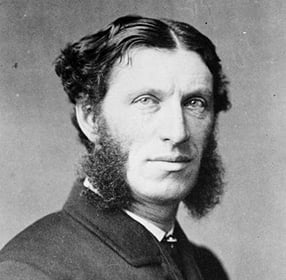
Photo: Matthew Arnold

Poems on poets: ‘Maz’ Griffiths, ‘Lies’

Perhaps it’s true, as Twain implies,
statistics are the greatest lies
but point for point and size for size,
I think they tie for major prize
with poets’ modest little ‘i’s.

*****

Margaret Ann Griffiths, aka Maz, aka Grasshopper, was a British poet known almost exclusively for her online work. In his Preface and Personal Recollection, editor Alan Wickes speaks of her “belligerent modesty” and her lack of interest in the preservation of her verse. In 2008, after winning Eratosphere‘s annual Sonnet Bake-off with “Opening a Jar of Dead Sea Mud” and being praised by Richard Wilbur, she was a Guest Poet on the Academy of American Poets website, where she was hailed as “one of the up-and-coming poets of our time”.

Her poem ‘Lies’ speaks volumes (in a brief space) about the different types of modesty available to creative figures. Her reputation for wit, intelligence, astute criticism and kind-heartedness goes well with her wide-ranging subjects and diverse styles of verse. She was the preeminent English-language online poet of the early 21st century.

Her work was posthumously collected by fans and fellow poets in the 2011 ‘Grasshopper‘ from Arrowhead Press and Able Muse Press.

Photo: “Anjo da Vila, Vila Madalena, São Paulo, Brazil.” by ER’s Eyes – Our planet is beautiful. is licensed under CC BY-NC-SA 2.0.

R.I.P. Ann Drysdale… ‘Weirdness Observed’

What is she doing, the mad old bat,
Down on her knees in the garden?
In her busted boots and her happiness hat
She doesn’t know and she wouldn’t care
That the size of the arse sticking up in the air
Is shading so much of the garden.

She pulls out a weed, the mad old bat,
Out of the face of the garden.
She tuts at the trauma and fusses it flat
While the waste-not weed she will put to use
By turning it into salubrious juice
And giving it back to the garden.

What is she up to, the mad old bat
As she struts, stiff-kneed in the garden
With her doo-dah dog and her galloping cat?
Spreading compost and scattering seed
So one may sprout and the other may feed
In the windmill world of the garden.

She’s a cruel cartoon, is the mad old bat
As she talks to herself in the garden.
What on earth is this? and Good Lord, look at that!
And she squats and she mutters and giggles out loud
And informs her potatoes they’re doing her proud
As she creeps like a crone in the garden.

Where is she going, the mad old bat
As the sunset blesses the garden?
She is going nowhere, and that is that.
She will dig in the dark till the dawn sky pales
And the damp on her knees and the dirt in her nails
Go singing the song of the garden.

*****

Ann Drysdale, who died unexpectedly on August 16th (apparently in her sleep) was a superb poet and self-aware, self-directed, life-rich eccentric lover of the natural world, of gardens, of animals and birds, of unpretentious people in all walks of life. I knew her only through her poetry and our correspondence – which is to say, well enough to deeply regret that I never got to meet her in person.

The poem above was collected in Miss Jekyll’s Gardening Boots, Shoestring Press, 2015; as was the poem that I put up on this blog earlier this month, ‘When Mister Nifty Plays the Bones‘. Here is the bio that she chose to represent herself with:

Ann Drysdale still lives in South Wales. She has been a hill farmer, water-gypsy, newspaper columnist and single parent – not necessarily in that order. She has written all her life; stories, essays, memoir, and a newspaper column that spanned twenty years of an eventful life. Her eighth volume of poetry – Feeling Unusual – came together during the strange times of Coronavirus and celebrates, among other things, the companionship of a wise cat and an imaginary horse.”

She was a much-loved member of the world of (especially formalist) poetry. George Simmers posted her ‘Song of Wandering Annie’ in the Snakeskin blog, and there is a tribute (and an enormous selection of her verse) in The HyperTexts. She was a truly good person.

Odd poem: Parody of a Self-Parody of a Self-Parody: Melissa Balmain, ‘How Unpleasant to Meet Mrs. Hughes’

From the files of Sylvia Plath

How unpleasant to meet Mrs. Hughes,
Who’s so thoroughly, willfully odd.
It’s a wonder Ted happened to choose
Such a creature. (He’s rather a god.)

Her lipstick is always a mess.
She’ll go on for an hour or three
About Nazis or bees—as you’d guess,
This does not get her asked out to tea.

Her headbands aren’t quite comme il faut.
(They’re a match for her queer Yankee frocks.)
She knows more than a lady should know
Of low-voltage electrical shocks.

Come to think of it, lately she’s been
More appalling than ever before.
She looks sullen and terribly thin;
If you knock, she won’t answer the door.

Her complexion grows whiter and whiter.
She wears the most horrible shoes.
You can certainly tell she’s a writer.
How unpleasant to meet Mrs. Hughes!

*****

Melissa Balmain writes: “I believe this one started when a contest—probably in The Spectator—called for poems riffing on Edward Lear’s self-mocking ‘How Pleasant to Know Mr. Lear’ (and T.S. Eliot’s equally self-mocking parody of it). I found it funny and sad to imagine Sylvia Plath writing about how her English neighbors might see her. The poem was published in Mezzo Cammin.”

Melissa Balmain’s third poetry collection, Satan Talks to His Therapist, is available from Paul Dry Books (and from all the usual retail empires). Balmain is the editor-in-chief of Light, America’s longest-running journal of light verse, and has been a member of the University of Rochester’s English Department since 2010.

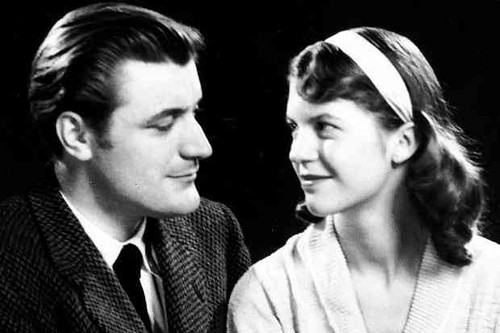
Photo: “TED HUGHES AND SYLVIA PLATH” by summonedbyfells is licensed under CC BY 2.0.

Using form: continued poem: Conor Kelly, ‘Daffodils’

Those daffodils that I recall
While lying on a bed settee
Are faded now, their petals fall
In nature and in memory.

It’s time to rise, to go outside
And head off for a subway ride.
I’m in New York’s YMCA
Undressing for a midday swim;

A poet could not but be gay
With bodies toned up in the gym.
But I am getting no cheap thrills
From dongs like dangling daffodils.

I twinkled at the twinkies there
Tossing their heads in sprightly dance
Or heading for the sauna where
I might get lucky if, by chance,

One of the bronzed and buffed young men
Is eager for my fountain pen.
But, sadly, no one needs to hear
This exiled poet strut his stuff.

I am an old Romantic queer,
Ignored, unloved. I’ve had enough.
I join the hustling New York crowd
And wander lonely as a cloud.

*****

Conor Kelly writes: “Daffodils was submitted as a prompt poem to Rattle (https://www.rattle.com) and was printed in the Summer 2024 issue of the magazine. The prompt was to continue where another poem left off. So I disturbed Wordsworth on the couch where he lay remembering daffodils and sent him on his gay way to modern New York where he had some dubious adventures. I kept the stanzaic form, the metre, the rhyme scheme and even some of the original lines. I left him where he began, wandering lonely as that singular cloud.”

Conor Kelly was born in Dublin and spent his adult life teaching in a school in the city. He now lives in Western Shore, Nova Scotia from where he runs his twitter (X) site, @poemtoday, dedicated to the short poem. He has had poems printed in Irish, British, American, Canadian and Mexican magazines. He was shortlisted for a Hennessy New Irish Writers award. At the ceremony one of the judges, Fay Weldon, asked him, “Where are you in these poems?”  He is still asking himself that same question.

https://www.instagram.com/conorkelly.poems/

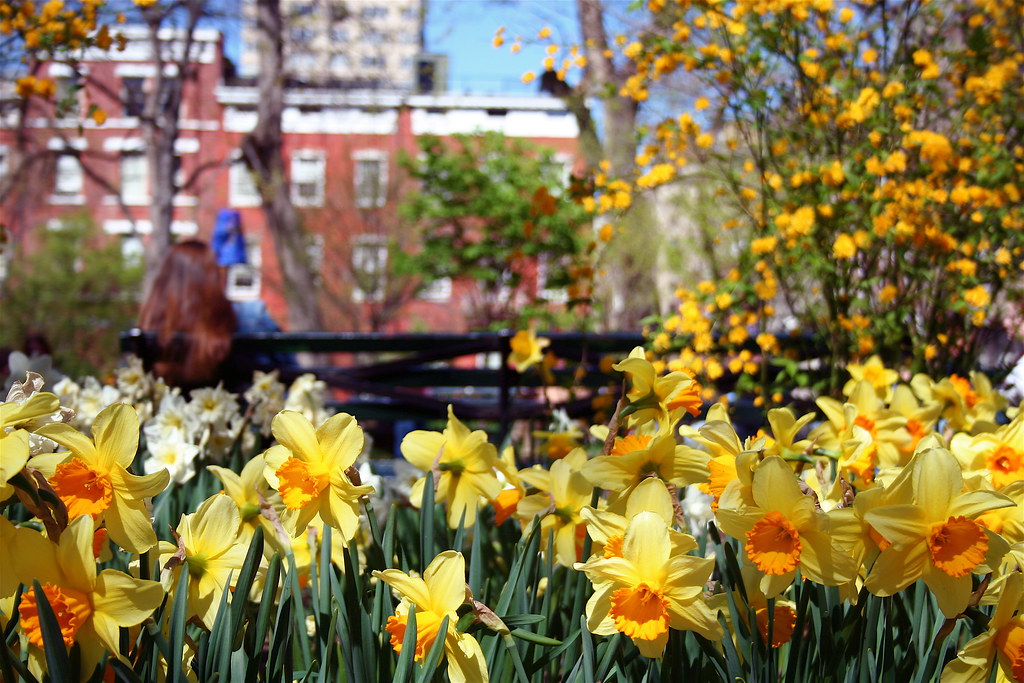
Photo: “park, school” by presta is licensed under CC BY-NC 2.0.

Using form: Sonnet: Max Gutmann, ‘How to Inspire a Sonnet – advice from the pros’

Inspire amore first, but molto forte
If in sonetti dolci you’d be sung.
Then see that you stay bella. You’ll support a
Passione deep and long by dying young.
— Laura

If thou upon his stage the Muse’s part
Wouldst play, each act thou study’st must prolong
Thy Poet’s pain. ‘Tis pain shall prompt great Art.
Then con thy lines with style, and do him wrong.
— The Dark Lady

Stay always by her. Never for a day
Be from her cherished side. ‘Tis paramount
To share the highest love. (And, by the way,
It helps to choose a lover who can count.)
— Robert Browning

‘Tis mystery that fires the crucial spark,
So make him wait–and keep him in the dark.
— Milton’s blindness

*****

Max Gutmann writes: “A reader of Light Quarterly (the marvellous Light back in its days as a print journal) was so offended by a poem of mine ridiculing a lousy president that he cancelled his subscription. Beloved editor John Mella forwarded a copy of the note to me. It was a sonnet! I’d never thought I could inspire a sonnet. I had a ways to go before rivaling Laura or the Dark Lady, but I’d taken the first step. That inspired this poem.

“John declined the poem, so it first appeared in a journal that didn’t specialize in light verse, one highly thought of. (Digging it out now, I see that contributors to the issue the poem appeared in included, among others I admire, Updike, Espaillat, Turner, Gioia, and Hadas.) But the journal goofed. They changed sonnetti dolci to sonnetti dolce (plural noun, singular adjective). This must have been a typo, I imagined, but when I asked, the chief editor not only admitted the change had been intentional, but defended the decision. Dolce being the more familiar form, he argued, it was reasonable to make the change without consulting the writer. I never sent them anything again

“This story calls for a shout-out to Jerome Betts, who reprinted ‘How to Inspire a Sonnet’ in Lighten Up Online (LUPO). (To avoid the impression that Jerome is less than meticulous about acknowledgements–or about anything–I should make clear that I asked him not to acknowledge the earlier journal, and I didn’t name it for him.) Jerome, like most editors I’ve worked with, always asks before making changes–and his proposed changes are usually improvements, often big ones!”

Editor’s note: This poem suggests what might be appropriate ways to inspire sonnets, according to the subjects of sonnets: Petrarch’s Laura, Shakespeare’s Dark Lady, Elizabeth Barrett Browning’s Robert and Milton’s blindness. Self-referentially, the poem is itself a Shakespearean sonnet, written in response to being the subject of a sonnet. Gutmann is therefore both sonneteer and sonnetee, and has the credentials to write a “How to –“

Max Gutmann has worked as, among other things, a stage manager, a journalist, a teacher, an editor, a clerk, a factory worker, a community service officer, the business manager of an improv troupe, and a performer in a Daffy Duck costume. Occasionally, he has even earned money writing plays and poems.

Photo: “IMG_0323C Frans Wouters. 1612-1659. Antwerp. The rural concert. 1654. Dole” by jean louis mazieres is licensed under CC BY-NC-SA 2.0.

Amit Majmudar, ‘Nocturne’

“A healthy man can expect to get hard three to five times per night….Doctors call these erections while you sleep “nocturnal penile tumescence.” — Men’s Health

Why do they happen at all, much less
five times a futile night—
nested, within the circadian, their
sprung rhythm of delight?

Unless delight misreads the message.
Unless they choke and strain
against their loneliness like starved
Rottweilers on a chain.

Who visits in the witching hour
as REM begins
and slides her darkling mouth around
his hardening and grins?

Lascivious sylph or cocktease yakshi
or ex from some past life,
coaxing a husband into sin
at arm’s length from his wife.

Or else someone that when awake
he would not dare to daydream,
verboten body, evanescent
pelvis figure-eighting,

or maybe all his fantasies
since age twelve coalesce,
voluptuous ghosts that flash him their
aurora borealis.

A hundred mayflies in his blood
take wing at once above
the hushed and shingled houses, seeking
the ones they shied to love,

desperately swooping down and left,
back up, around, and right,
a minute to mate, then drift and fade
on a humid summer’s night.

*****

Editor’s note: I see this poem, which was first published in Only Poems, as existing where one’s various worlds overlap: the body, the mind, work (Amit Majmudar is a medical doctor), family… Amit Majmudar wisely provides no comment on his poem.

Amit Majmudar is a poet, novelist, essayist, translator, and the former first Poet Laureate of Ohio. He works as a diagnostic and nuclear radiologist and lives in Westerville, Ohio, with his wife and three children. He is the author of twenty books so far in a variety of categories, with different bodies of work published in the United States and in India.
His poetry collections include 0’, 0’ (Northwestern, 2009), shortlisted for the Norma Faber First Book Award, and Heaven and Earth (2011, Storyline Press), which won the Donald Justice Prize. These volumes were followed by Dothead (Knopf, 2016) and What He Did in Solitary (Knopf, 2020). His poems have won the Pushcart Prize and have appeared in the Norton Introduction to LiteratureThe New Yorker, and numerous Best American Poetry anthologies as well as journals and magazines across the United States, UK, India, and Australia. Majmudar also edited, at Knopf’s invitation, a political poetry anthology entitled Resistance, Rebellion, Life: 50 Poems Now.
One of Majmudar’s forthcoming volumes is a hybrid of prose, drama, and poetry, entitled Three Metamorphoses (Orison Books, 2024). A new poetry collection is forthcoming from Knopf in 2026.

For links to Majmudar’s Nonfiction, Fiction, Mythology and Translations, please see his website.

Photo: “I Dream Of Love” by toddwshaffer is licensed under CC BY-NC-ND 2.0.

Amit Majmudar, ‘To the Hyphenated Poets’

Richer than mother’s milk
is half-and-half.
Friends of two minds,
redouble your craft.

Our shelves our hives, our selves
a royal jelly,
may we at Benares and Boston,
Philly and Delhi

collect our birthright nectar.
No swarm our own,
we must be industrious, both
queen and drone.

Being two beings requires
a rage for rigor,
rewritable memory,
hybrid vigor.

English herself is a crossbred
mother mutt,
primly promiscuous
and hot to rut.

Oneness? Pure chimera.
Splendor is spliced.
Make your halves into something
twice your size,

your tongue a hyphen joining
nation to nation.
Recombine, become a thing
of your own creation,

a many-minded mongrel,
the line’s renewal,
self-made and twofold,
soul and dual.

*****

Editor’s comments: Being Anglo-Danish from birth and with the subsequent acquisition of other passports, I am naturally biased in favour of multiculturalism. It was interesting a couple of months ago to hear Britain’s Home Secretary Suella Braverman say “Multiculturalism has failed.” As one commentator noted, “She’s descended from Goan Indians from Mauritius and Kenya, married to a Jewish husband, and is in a senior cabinet position in a government headed by Britain’s first Hindu PM, himself the son of immigrants… Hello???” Suella Braverman left the cabinet shortly after.

Indians in particular, having been invaded and occupied by the Portuguese, French and British in the past couple of centuries, have used those connections to move out into the world – not just as entrepreneurs, but also in the arts, sciences… and politics. In mid-2023 the Prime Ministers of Ireland, Mauritius, Portugal and the UK, and the Presidents of Guyana, Mauritius, Seychelles, Singapore, Suriname and Trinidad & Tobago, all had Indian origins.

Amit Majmudar is a poet, novelist, essayist, translator, and the former first Poet Laureate of Ohio. He works as a diagnostic and nuclear radiologist and lives in Westerville, Ohio, with his wife and three children. He is the author of twenty books so far in a variety of categories, with different bodies of work published in the United States and in India.
His poetry collections include 0’, 0’ (Northwestern, 2009), shortlisted for the Norma Faber First Book Award, and Heaven and Earth (2011, Storyline Press), which won the Donald Justice Prize. These volumes were followed by Dothead (Knopf, 2016) and What He Did in Solitary (Knopf, 2020). His poems have won the Pushcart Prize and have appeared in the Norton Introduction to LiteratureThe New Yorker, and numerous Best American Poetry anthologies as well as journals and magazines across the United States, UK, India, and Australia. Majmudar also edited, at Knopf’s invitation, a political poetry anthology entitled Resistance, Rebellion, Life: 50 Poems Now.
One of Majmudar’s forthcoming volumes is a hybrid of prose, drama, and poetry, entitled Three Metamorphoses (Orison Books, 2024). A new poetry collection is forthcoming from Knopf in 2026.

For links to Majmudar’s Nonfiction, Fiction, Mythology and Translations, please see his website.

Photo by Ami Buch Majmudar.

Evocative fragment: W.H. Auden, ‘On the Circuit’

Another morning comes: I see,
Dwindling below me on the plane,
The roofs of one more audience
I will not see again.

God bless the lot of them, although
I don’t remember which was which:
God bless the U.S.A., so large,
So friendly, and so rich.

*****

Auden emigrated from the UK to the US in 1939, and lived as an Anglo-American academic who lectured all over the country. A left-wing poet, his ‘On the Circuit’ shows his amusement at living well in the United States. His wry reflections are built on a simple ABCB rhyme scheme in iambic tetrameter, with the last line of each stanza shortened to a trimeter for the stanza’s punchline. I’ve quoted the last two of 16 stanzas.

Speaking as a foreigner who lived in the US for 25 years, teaching business seminars across the continent to corporate audiences, I confirm the resonance of Auden’s general attitude. Parenthetically I note that despite his approval of the US as a place to live and work, it’s not where he chose to vacation each year, or where he bought a house, or where he ended his days.

Photo: “From yesterday: @southwestair #flight 2500 #DAL-#SAT with #downtown #dallas behind the #winglet. I’m doing the opposite route later today heading back to #KC for the night before another trip. #latergram #swapic #city #texas #plane #airplane #instaplane #” by JL Johnson // User47.com is licensed under CC BY-SA 2.0.

Brian Gavin, ‘Death Watch at the Nursing Home’

Two rows of heads puffed white for show
are turned to watch the gurney go
parade-like down the hall and through
the double doors, and out of view.

They linger, as the swinging doors
are gazed to stillness, and intercourse
is but the mingling of silhouettes.
Beyond the tumults of regret

and wonder, they are elsewhere, all
their architecture of recall
connecting lives to family plots,
or maybe – further back – in what

may be a keepsake memory – light
parade, perhaps – a child’s delight
in clowns and cotton candy, high
and wispy as puffed hair. Friends die

often, but not in violence –
not here, where death comes to the sense
in not-quite-joy, and not-quite-grief,
but trembling, lightly, like a leaf

that might be blown, or not, or light
as dandelion fields puffed white
and wispy, wavering. In slow surmise
they gaze on quiet with quiet eyes,

filling the hall with noiselessness,
and dreaming but to acquiesce
to dream, and but to linger some
in thrall to stillness yet to come.

*****

Brian Gavin writes: “My poem sort of rips off (shamelessly!) the form and rhyme scheme of the famous A E Housman poem ‘To An Athlete Dying Young‘. It is, however, about a different kind of death – extreme old age – and the gentleness of it. It’s based on something I actually saw in a nursing home, when white heads once leaned out of their rooms to see a friend taken away on a gurney. The image of a parade struck me, and the heads of puffed white hair reminded me of cotton candy at the parades of my youth. Eventually the images of puffed hair and puffed candy morphed into a field of puffed white dandelions wavering in the wind.
I almost left the title at ‘Death Watch‘ – which I kind of preferred for the double meaning – but opted to add the rest of it for the sake of clarity. This piece ran in my collection Burial Grounds.”

Brian Gavin is a retired Distribution Manager who started writing poetry 10 years ago. His poems have appeared in The Journal of Formal Poetry, Peninsula Poets and Snakeskin Magazine, and in the Potcake Chapbook ‘Careers and Other Catastrophes. He lives in Lakeport, Michigan, USA, with his wife Karen. ‘Burial Grounds’ is available from Kelsay Books.
You can see more of his work at briangavinpoetry.com

Photo: “Dandelions Gone to seed, Dandelion puff ball seeds weeds lawn infestation roundup herbicide Pics by Mike Mozart of TheToyChannel and JeepersMedia on YouTube #Dandelions #Weeds #DandelionSeeds #Lawn #DandelionFlowers #Dandelion” by JeepersMedia is licensed under CC BY 2.0.