Category Archives: poets

Marcus Bales, ‘Sailing to Margaritaville’

That is the country we go to, all of us
Made young again by music, smooth with oil
And lust, all generations generous
With youth and laughter. Couples coil
And uncoil, casually amorous,
With booze in the blender and shrimp beginning to boil.
Everybody dreams they have the chance
To chase the charms and challenge of romance.

A laughing bard is the essential thing.
A patterned shirt, an old six-string guitar,
Who urges us to sing and louder sing
And clap and dance and order from the bar,
And thank hard-working servers as they bring
The stuff that lubricates this whole bazaar.
And though the bard is covering the bill,
Tip well when you’re in Margaritaville.

Oh, parrotheads — imagination’s fire
Illuminates the marvel of it all,
And conjures every sorcery we require,
The call to the response, response to call,
A consummation fevered with desire,
Beatified by the local alcohol.
The song creates the dream. The dream creates
Another song the dreamer celebrates.

And once reality is far away,
Our youth returned, our stamina restored,
We eat and drink and sing and dance and play
And manifest ourselves within each chord
As if we might entrance ourselves to stay
Within this reverie we’ve found aboard
The magic vessel Margaritaville,
Distilling what distillers can’t distill.

*****

Marcus Bales writes: “Someone immediately floated a raft of shit my way over this poem, claiming, in a local Cleveland group generally given to local music, that I’m normalizing alcoholism. I know — it’s an astonishing misinterpretation, but there it is. And in spite of my protestations, he insisted on shouting that I was a lush, a drunk, and an idiot for promoting and approving a disease. Well, it’s not as if poets aren’t used to being misunderstood.

The odd thing to me about this is that I work hard to trigger people through poetry. That’s what art does, in my view, confront us with our frauds and foibles, and makes us look at them in detail. If, of course, we read poetry at all. There must be some corollary to Murphy’s Law that states that when a poem can be misinterpreted it will be misinterpreted. Normally I’m delighted by responses to my poems that are outraged and offended, because normally those responses are from the people I’m trying to outrage and offend. But this blindsided me. The entire Jimmy Buffett phenomenon was built on the fantasy of sun and sand and sea, which is only tangentially alcohol-fueled. No doubt alcohol plays a role in lubricating the enchantment, but it’s the enchantment people go for, not alcoholism.

And that enchantment is powerful. It makes people wear loud clothes and play loud music. But the central lure is that we can think of ourselves as all multi-talented and tanned, slim and young and horny. It’s not the lure of tales of drunkenness and cruelty on a summer afternoon, but rather the opposite: tales of slightly disreputable fun, but tales of the lure of the freedoms from regimentation for the freedoms of a more relaxed like-minded culture where everyone is youthfully attractive and eagerly lascivious.

And what a lure! Even those of us whose only encounter with youthfully attractive and eagerly lascivious were our own dreams had those dreams. And with Jimmy Buffett the price of admission was a seducing tune and a clever lyric. You didn’t need a white sportcoat, much less a pink crustacean. All you needed was a sense of lockstepness of the modern bourgeoisie and a desire to escape it. The whole thing is all in your mind. You create your own sensitive young poet self in a lubricious setting among the young and eager to love you. It’s thrilling, it’s fulfilling, it’s art.”

*****

(Editor’s note: From the title, to the ottava rima form, to the themes, ‘Sailing to Margaritaville’ pays homage to Jimmy Buffett by riffing on W.B. Yeats’ ‘Sailing to Byzantium‘. Beginning with Yeats’ opening words, “That is no country for old men” and all the way through, Bales echoes and plays with Yeats’ words, bringing everything to Buffett’s Margaritaville.)

Not much is known about Marcus Bales except that he lives and works in Cleveland, Ohio, and that his work has not been published in Poetry or The New Yorker. However his ‘51 Poems‘ is available from Amazon. He has been published in several of the Potcake Chapbooks (‘Form in Formless Times’).

Photo: “Wasting away again in Margaritaville……..” by efleming is licensed under CC BY 2.0.

Using form: Ottava Rima: Max Gutmann, ‘Life, That Hack!’ (from Don Juan Finish’d)

If we could but instill in Life–that hack!–
The element’ry rules of composition,
Prevent the crude and sloppy maniac
From spoiling every scene with his tradition
Of shouting in our faces like a pack
Of drunken sailors wailing their rendition
Of “Captown Races” or “My Drawlin’ Clementime,”
Their rhythmic belching almost keeping them in time.

For Life to utilize the art of Art
Could help in many ways that we could mention.
Some structure and suspense would be a start.
To get us upright in our seats, fists clenchin’,
A little rising action would be smart
(Or something that would help us pay attention,
Instead of simply zoning out a lot
And missing half the details of the plot).

But Life, I fear, shall never learn to craft
A decent tale. (It hasn’t that ambition.)
It uses characters extremely daft,
And wastes far too much time in exposition.
It never bothers to revise a draft,
Too taken with its own first thoughts. Perdition!
Each aspect of the story is a shame–
And worst, the ending’s always just the same.

Max Gutmann writes: “Don Juan Finish’d fancifully completes Lord Byron’s unfinished comic epic. Excerpts have been contributed to Light, Lighten Up Online, Orbis, Slant, Think, the website of the Byron Society, and Pulsebeat, where ‘Life, That Hack!’ is among the excerpts to have appeared. The complete poem is still unpublished, though I privately printed some copies to share with friends and colleagues.
Like Byron’s poem, Don Juan Finish’d is often philosophical, at times facetiously, as here.”

Editor’s note: As with Byron’s original, Gutmann’s Don Juan Finish’d is written in ottava rima: eight-line stanzas in iambic pentameter rhyming ABABABCC, with the final line or two typically used to humorously deflate whatever more high-sounding statements were made earlier in the stanza.

Max Gutmann has worked as, among other things, a stage manager, a journalist, a teacher, an editor, a clerk, a factory worker, a community service officer, the business manager of an improv troupe, and a performer in a Daffy Duck costume. Occasionally, he has even earned money writing plays and poems.

Photo: “comedy/tragedy masks, waterfall” by milagroswaid is licensed under CC BY-SA 2.0.

Marcus Bales, ‘Labor Day 2023 – RIP Jimmy Buffett’

He died on Labor Day, the end of summer,
And left us going back to work or school.
The days are shorter, now, the parties glummer,
Less heat and light, less beat and life, less cool.
We fall back on our favorite expressions
Of what it means to be young, tan, and free,
And weigh the anchors of adult discretions
Imagining we sail a sapphire sea.
The songs he sang, those figurative vacations,
Have turned our water into stronger stuff.
We toast each other, changing our frustrations
With dailiness to fantasizing fluff,
And drink the happy liquor we distil
From metaphoric Margaritaville.

*****

Marcus Bales writes: “My favorite Jimmy Buffett songs are ‘A Pirate Looks At Forty‘ and ‘Tin Cup Chalice‘, but I think his best song is ‘Margaritaville.’ I’m not as fond of ‘He Went To Paris‘ or ‘Death of an Unpopular Poet‘ as other celebrants of his work, and ‘Why Don’t We Get Drunk and Screw‘ is certainly the best of the more raucous end of his oeuvre.

Like many other singer-songwriters Buffett seemed to me to work without an editor, possibly because the music business is such that even when you find a peer-group that you trust to say this or that just ain’t right, it’s hard to get the group together often enough, and for long enough, for the trust to re-blossom so that real reflection and re-working of lyrics can happen.

Those circumstances lead a lot of singer-songwriters, I think, to something that is not exactly laziness, and not quite smugness, but rather perhaps more like a sense that they’re the only ones whose taste they trust to judge their own work. Then they slide into a state where they are not themselves as critical of their own work as they once were. They get a good idea and a good line or two in the chorus, and the rest of it gets sort of clamped and glued together without a final planing, sanding, and paint job. The music is well-arranged and well-performed because you can’t fool musicians about music, but the lyrics tend to seem a little hasty, a little down-at-heels, a little scratch-and-dent. It’s too bad because their early work is almost always lyrically inventive and musically simple, while their later work is musically slick and lyrically spotty.

When I first heard A1A in 1978 I was entranced. No one else that I knew of was trying to sketch people and places from the point of view of a sort of scruffily aimless charmer. Oh, there was Tom Waits, but that was more noir and Bukowski than charming. Buffett’s work was entrancing, a refreshing way to write songs and perform them. A lot gets forgiven in the enchantment of the charm, but eventually the clanker lines and the narratives that don’t quite hold together accumulated, and I started to notice the tarnish more than the shine.

So the later work did not grip me as the early work had, and for most of the last 40 years, as the work drifted into crowd-pleasing medium-tempo rockers with a cheery tale told by a richer, more self-congratulatory narrator offering a smoother sail in a bigger boat crewed by professionals, I became less and less interested in what I had come to view as a pervasive sloppiness in the contemporary singer-songwriter tradition. It seemed to affect them all as they worked longer in the business, except perhaps for Paul Simon. But Buffett, Diamond, Prine, Browne, just to name a few, seemed all to become more facile than artful And Buffett in particular seemed to have decided to pursue sing-along music for the car instead of headphone music for the chair, and it started him on the path to wealth. And good for him.

But what I celebrate overall, and I hope in this poem, is the work that tried to be more than a pop song, that was striving, even if slyly and beneath the listener’s first perceptions, to be art. That’s what entranced me at the beginning, and that’s what I want to remember most fondly.”

Editor’s note: Jimmy Buffett died on the night of September 1st, and the news came out over the Labor Day weekend.

Not much is known about Marcus Bales except that he lives and works in Cleveland, Ohio, and that his work has not been published in Poetry or The New Yorker. However his ‘51 Poems‘ is available from Amazon. He has been published in several of the Potcake Chapbooks (‘Form in Formless Times’).

Quincy R. Lehr, ‘As if by chance’

When I looked at her, and when her lips
Pulled back to show her teeth, and when her voice
Broke into laughter, I could only think
Of moments that I’d pissed away, each choice
I’d left to others, and the careless slips
That landed me beside an empty drink.
That afternoon, I could have sworn I saw
A thinner, hopeful version of my face
Staring from behind her retinas–
Familiar, yes, the eyes, the skin, the jaw,
But in that instant somehow out of place.
It cast a knowing frown. The gravitas
Was overbearing. Nonetheless, we filled
The void with gossip, anecdotes and smut,
Comparing chatty journals–note by note.
Like poets, we dissembled in the rut
That each of us was in, our chances killed
By loss of nerve or failure to emote.
But still, a sneer could not have hurt me more
Than her clear laugh that sang of expectations
So long forgotten from a distant day
When youth still spread before me, and the poor
And pitiful attempts at explanations
Still lay in ambush, only years away.

*****

Quincy R. Lehr writes: “This poem was literally about running into a high school friend of mine by chance on the day I defended my doctoral dissertation (though that’s not in the poem). It’s funny how old I thought I was at twenty-nine.”

Born in Oklahoma, Quincy R. Lehr is the author of several books of poetry, and his poems and criticism appear widely in venues in North America, Europe, and Australia. His book-length poem ‘Heimat‘ was published in 2014. His most recent books are ‘The Dark Lord of the Tiki Bar‘ (2015) and ‘Near Hits and Lost Classics‘ (2021), a selection of early poems. He lives in Los Angeles.
https://www.amazon.com/Quincy-R.-Lehr/e/B003VMY9AG

Photo: “Young woman laughing” by Snapshooter46 is licensed under CC BY-NC-SA 2.0.

Gail White, ‘The Girls Who Got Ahead’

When all the bright young women studied law
and medicine, I thought a PhD
in Women and the Novel would unthaw
the frozen heart of Academe for me.
When all the bright girls married, where was I?
Still shacking up with poets that I met
in bars, convinced that genius and rye
would write us into fame and out of debt.
The bright girls made investments by the rules.
I kept on writing novels in my mind.
They sent their handsome kids to private schools
and I became the girl they left behind.
Bright girls got married and ahead and rich,
while I’m in debt again, and life’s a bitch.

*****

Gail White writes: “The Girls Who Got Ahead is a poem from the 90’s. Yes, everyone was in the professions or in graduate school but me. I was a poet and that means taking a vow of poverty. I thought I might as well make a sonnet out of it.”

Gail White is the resident poet and cat lady of Breaux Bridge, Louisiana. Her books ASPERITY STREET and CATECHISM are available on Amazon. She is a contributing editor to Light Poetry Magazine. “Tourist in India” won the Howard Nemerov Sonnet Award for 2013. Her poems have appeared in the Potcake Chapbooks ‘Tourists and Cannibals’, ‘Rogues and Roses’, ‘Families and Other Fiascoes’, ‘Strip Down’ and ‘Lost Love’. ‘Money Song’ is collected in ‘Asperity Street‘. Her new light verse chapbook, ‘Paper Cuts‘, is now available on Amazon.

Photo: “Women Entrepreneurs Blazing Trails” by World Economic Forum is licensed under CC BY-NC-SA 2.0.

Richard Fleming, ‘The Railway Line – in memory of John Simpson’

We walked together side by side,
at dusk along the disused line,
restless and glad to be outside.
I had Woodbines, you brought cheap wine.
Fifteen, unthinkingly alive,
truants from our suburban drive,
we talked excitedly of life
how we had cracked it, knew the score.
We worked the cork out with your knife
then drank sweet wine and wanted more.
We smoked our fags, ignored the cold,
could not imagine being old.

*****

Richard Fleming writes: “The Railway Line is an old poem, rescued from the archives, that remains dear to me. In it, I’ve attempted to recapture the heady recklessness of my early teenage years when the world seemed full mysteries, and friendships were more intense than those I later formed in adulthood. John didn’t make it past his early twenties so he remains, in my memories of him, forever rebellious and young.”

Richard Fleming is an Irish-born poet currently living in Guernsey, a small island midway between Britain and France. His work has appeared in various magazines, most recently Snakeskin, Bewildering Stories, Lighten Up Online, the Taj Mahal Review and the Potcake Chapbook ‘Lost Love’, and has been broadcast on BBC radio. He has performed at several literary festivals and his latest collection of verse, Stone Witness, features the titular poem commissioned by the BBC for National Poetry Day. He writes in various genres and can be found at www.redhandwriter.blogspot.com or Facebook https://www.facebook.com/richard.fleming.92102564/

railway lines” by apdk is licensed under CC BY 2.0.

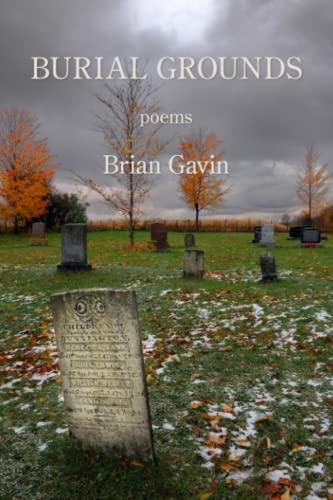
Review: ‘Burial Grounds’ by Brian Gavin

Gavin’s poems are quiet, elegant reflections on people—alive and dead—in danger of being forgotten, in towns not in the mainstream of modern life. His verse is quietly formal, usually rhymed, always rhythmic. Sometimes as brief as a sonnet, as with my personal favourite ‘Grand Opening’: an ex-serviceman, mopping floors and putting the coffee on at 4 a.m., running a business at which (apparently) four previous owners have failed, but simply doing what has to be done…

It isn’t so much hope behind these doors
as work to do. (…) He reaches for the light.
He sets his OPEN sign against the night.

There is an inherent mournfulness in these stories of people in places which once thrived but are now hanging on without major farming or industrial or commercial opportunities. Many poems are about people towards the end of their lives, or even later as the title suggests. And even when youth is included it shows up as a teen alone on a swing on a November evening, working her phone:

and nothing moves, but for the falling dark
and the quiver of her thumbs at work.

Railway stations close, businesses relocate, fires happen, towns empty out… but people are still there, poorer, aging, their prospects reduced. The overall tone is an almost religious attitude of accepting where you are, fighting the good fight, doing what must be done… moving, as we all must, into life’s inevitable landscape of burial grounds.

*****

Brian Gavin is a retired Distribution Manager who started writing poetry 10 years ago. His poems have appeared in The Journal of Formal Poetry, Peninsula Poets and Snakeskin Magazine, and in the Potcake Chapbook ‘Careers and Other Catastrophes. He lives in Lakeport, Michigan, USA, with his wife Karen. ‘Burial Grounds’ is available from Kelsay Books.

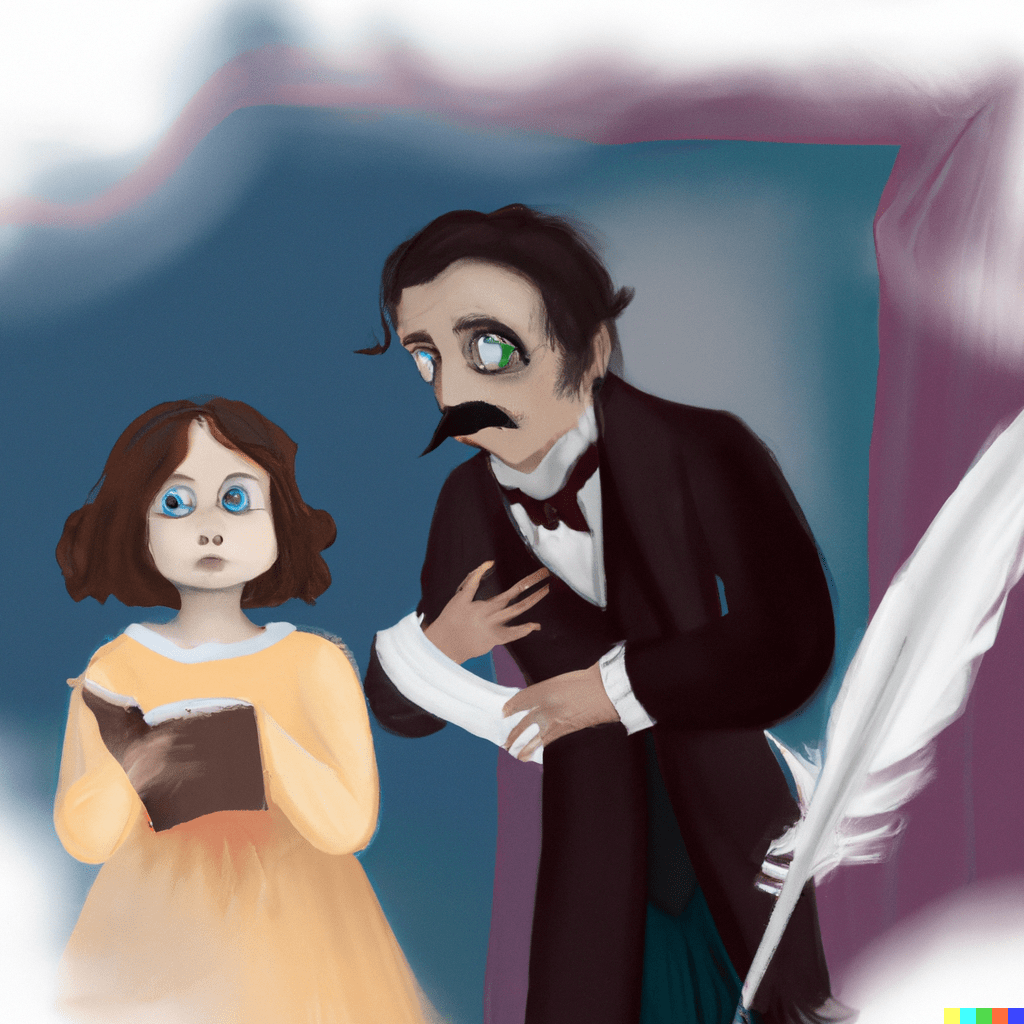
Susan McLean, ‘Morbid Interest’

How unpleasant to meet Mr. Poe.
It gives a young lady a chill
when, just as she’s saying hello,
he asks if she’s lately been ill.

It was mid-afternoon, yet he seemed
to be tipsy or mildly sedated.
How oddly his mournful eyes gleamed
when he heard that we might be related.

He muttered some rhymes for my name,
saying nothing could be more inspiring
to a poet desirous of fame
than the sight of young beauties expiring.

Then he asked if I had a bad cough
or a semi-conversable crow.
I informed him of where to get off.
How unpleasant to meet Mr. Poe.

*****

Susan McLean writes: “In my teens, I was a big fan of Edgar Allan Poe‘s short stories and poetry. I loved his eerie subjects and crooning, incantatory lines. I memorized his poem ‘To Helen,’ and I parodied his iconic ‘The Raven.’ But in grad school, I read his essay ‘The Philosophy of Composition,’ in which he wrote that “the death . . . of a beautiful woman is unquestionably the most poetical topic in the world.” Hmmm. At that moment, it occurred to me that all of those dead women of his stories and poems might be less an outpouring of personal grief and more a product of an agenda. Years later, when responding to a challenge from the British journal The Spectator to write a poem modeled on Edward Lear’s ‘How pleasant to know Mr. Lear‘ but about another author, I imagined how Poe might seem to a young woman being introduced to him.
This poem, which was originally published in Light Quarterly, was later reprinted in Per
Contra
and in my second poetry book, The Whetstone Misses the Knife.”

Susan McLean has two books of poetry, The Best Disguise and The Whetstone Misses the Knife, and one book of translations of Martial, Selected Epigrams. Her poems have appeared in Light, Lighten Up Online, Measure, Able Muse, and elsewhere. She lives in Iowa City, Iowa.
https://www.pw.org/content/susan_mclean

Illustration: DALL-E

Formalist poet A.E. Stallings elected the next Oxford Professor of Poetry

Congratulations to Alicia Stallings on winning election to one of the most prestigious poetry positions on the planet – the Oxford Professorship of Poetry! A thoroughly deserved success for one of the absolute best poets writing today. And how nice for all of us, that a formalist is recognised as the best choice. Her term of office begins in October and runs for four years.

Here is the University’s report on it: https://www.ox.ac.uk/about/oxford-people/professor-of-poetry

Marcus Bales, ‘Lighthouse’

She needed constant, searching light
And some firm continent
From which to dive into the night
To find what darkness meant.

She fought the horses of the tides
And they her urgency.
She caught their lunar reins and rides
Triumphant out to sea.

And now she knows the powers of
The dark sea’s character,
And scorns the note her former love
Moans out, moans out to her.

*****

Marcus Bales writes: “Probably poets ought not tell this sort of story about their work. I found a stash of very old poems, carefully typed out on now-yellowed paper in a metal file box amid 5” Tandy floppy discs, and printed on a dot-matrix printer, a little faded, some months ago, and have started the often painful task of retyping them into my little electronic library of my work. Many of them are obviously student stuff, but this one seemed a little less studious than the rest. It brought back its context in my mind pretty clearly.
This is a very early poem, maybe sophomore year. I’d read someone’s comment that Yeats wrote about his friends as if they were characters in a Greek myth, and it had struck me as a sudden truth — to me, anyway. Nothing would do, of course, except to try the thing on my friends. Then a woman I knew gave me a copy of Adrienne Rich’s ‘Transformations’, which tells the stories of ancient myths about women, mostly, as if they had much more contemporary attitudes, and that seemed like a much better model than the Yeats tone and manner — and besides, Yeats had already done that tone and manner. So though the idea originated in Yeats, it is really Rich’s idea that I tried to follow, trying for the tone of metaphor in a contemporary voice. And Larkin was in there somewhere too, as I recall, having discovered him when asked to write a paper contrasting and comparing one of his poems to one of Wilbur’s. The Larkin was the one starting:
Sometimes you hear, fifth-hand,
As epitaph:
He chucked up everything
And just cleared off,

And that led me to many others, notably ‘The Trees’, with its amazingly unlarkinish  repetition at the end.
Steal from the best has long been my motto.”

Not much is known about Marcus Bales except that he lives and works in Cleveland, Ohio, and that his work has not been published in Poetry or The New Yorker. However his ’51 Poems’ is available from Amazon. He has been published in several of the Potcake Chapbooks (‘Form in Formless Times’).

Photo: “my father was the keeper of the eddystone light” by sammydavisdog is licensed under CC BY 2.0.