Category Archives: poets

The Two-State Dissolution: Yankevich, Kenny, Helweg-Larsen, Foster, Vaughan, Jackson, Bales, Burch

Leo Yankevich: ‘The Terrorist’

Only six, she stands before a tank,
looking at its armour, while inside
soldiers heed orders from a higher rank.
There isn’t any place for her to hide,
no door to head for, no abandoned car
to slide beneath. Pure terror rules her land.
When finally crushed, she rises past the star
of David, with a stone clutched in her hand.

Janet Kenny: ‘Didn’t They Know?’
(In memory of a lost poem by Robert Mezey)

Didn’t they know that when they swarmed
and slashed and slaughtered what they saw
as an oppressor’s nest, the rage
that they aroused would turn and pour
with molten heat back on their house?

Their captive children now must pay,
small targets in a concrete cage.
No treaty, pact, no peace no truce.
Didn’t they know? Didn’t they know?

No map to show another way.
Olive farmers pay for crimes
of other nations, other times.
No mercy here, no one is just.
Two agonies, two brains concussed.

Nothing to see here. False alarm.
Police not needed to disarm
two weeping peoples each aware
that no solution slumbers there.
Hearth and cradle now makes clear
an ancient poem brought them here.

Where is the psalm that both can share?

Robin Helweg-Larsen: ‘Both Sides Justify Their Terrorism’

When pleas for justice are of no avail,
when governments praise death and theft,
and courts say you’re in error;
when the UN is blocked to fail,
the only recourse left
is terror.

When no one cares that Yahweh willed
that Jews alone should have this land
(and God’s never in error)
and prior residents must be killed,
yet they won’t leave, they force your hand:
to terror.

Gail Foster: ‘On The Occasion of Benjamin Netanyahu Quoting Dylan Thomas’

Don’t tell me that you fight a righteous fight
How many children have you killed today
I’ll give you rage. I’ll give you rage alright

Your anger and your ego burning bright
Are razing all that’s standing in your way
Don’t tell me that you fight a righteous fight

How many have you sent into the light
Before they even had the time to pray
I’ll give you rage. I’ll give you rage alright

How many have you saved or sent in spite
Up to the sky in ashen clouds of grey
Don’t tell me that you fight a righteous fight

In clouds as those who in the fog and night
Were put in trains and disappeared away
I’ll give you rage. I’ll give you rage alright

You speak as if your soul was white as white
Yet deep inside you darkness holds its sway
Don’t tell me that you fight a righteous fight
I’ll give you rage. I’ll give you rage alright

Tom Vaughan: ‘The Land’

Let’s pretend that the war
could be over, and peace
reigned even if only
this evening. O please

pick up your anger
and soak it with mine
in six large barrels
of miracle wine

and then let us dance
like lovers, as though
this land’s many meanings
didn’t all signal no

and we could make ploughshares
out of our swords
and translate the past
into one shared world

and even if dawn
will scatter the night
and send us both stumbling
into the light

where smooth olives glisten
in the warm sun
like belts of bright bullets
ripe for a gun.

Jean MacKay Jackson: ‘War’

Some say that war is bright flares and drama,
A glory of fireworks illumining skies.
This is all lies.
War is a child calling out for his mama
And getting no answer.
War is a merchant of hatred and grief:
War is a thief,
War is a cancer.
Some say that war is hell. Perhaps that is so.
Yet hell has a lack
Of innocent bystanders, hell has no
Collateral damage, no accidental black
Body-bags for old women and babies.
Hell has no maybes;
Everything makes sense.
In hell there is no defense:
You belong there. You chose your path.
Hell has a cold, hard justice drained of wrath.
War is the horrified look in the eye
Of a young person dying without knowing why.

Tom Vaughan: ‘Aleppo’

Never again we say, each time
never, never again,
and every time we mean it so
when it happens again

we watch it on our screens, and say
never, never again

we meet and vote and all agree
never, never again.

Marcus Bales: ‘Genocide is Genocide’

Genocide is genocide. There’s no
Legitimacy on the table. None.
Your killing and your maiming only show
What horrors piled on horrors you have done.

The US taught the method to the Germans
The Trail of Tears leads to the Holocaust.
And now Israeli policy determines
They’ll do the same in Gaza. That boundary’s crossed.

Why not, instead, a reconciliation,
Where all the old and evil wounds can be
Accepted by each side without probation?
With zealotry forgiven, all are free.

Until that happens, hate corrupts you all,
With “Ams Yisrael Chai” the new decree —
Unless it turns out that the final call
That wins is “From the river to the sea.”

And that’s the choice: that each side does the worst
That it can do to keep the hatreds growing,
Shouting slogans of revenge, and cursed
To trade atrocities that keep the business going.

The other choice is reconciliation.
Yes, all the old and evil wounds will be
Accepted by each side without probation,
And zealotry forgiven, to be free.

If “Look at what they did to us!” is your
Refrain, then all you’ve done is to condemn
Your children to a world where they’ll endure
Their children’s gloat: “Look what we did to them!”

There’s always someone left to live resenting
The evils your revenges made you do —
And they will spend their hearts and souls inventing
A suitable revenge to take on you.

Be strong enough for reconciliation
Where all the old and evil wounds must be
Accepted by each side without probation.
With zealotry forgiven, all are free.

Michael R. Burch: ‘Epitaph for a Palestinian Child’

I lived as best I could, and then I died.
Be careful where you step: the grave is wide.

*****

Acknowledgements:

Leo Yankevich: ‘The Terrorist’, collected in ‘Tikkun Olam & other poems’, Counter Currents, 2012
Tom Vaughan: ‘The Land’, published on Hull University Middle East Study Centre website, 2022, and in Professor Raphael Cohen-Almagor’s December 2022 Politics Newsletter
Tom Vaughan: ‘Aleppo’, published in Snakeskin 233, October 2016
Michael R. Burch: ‘Epitaph for a Palestinian Child’, first published in Romantics Quarterly, and many places since. Michael R. Burch is the founder and editor-in-chief of The HyperTexts, and its extensive collections of poetry include ones on both the Holocaust and the Nakba.

Photo: “Gaza war Nov2012” by EU Civil Protection and Humanitarian Aid is licensed under CC BY-NC-ND 2.0.

Short poem: RHL, ‘The Self-Aware’

Most insecure are those, the self-aware:
for all their acts are pointless and they know it,
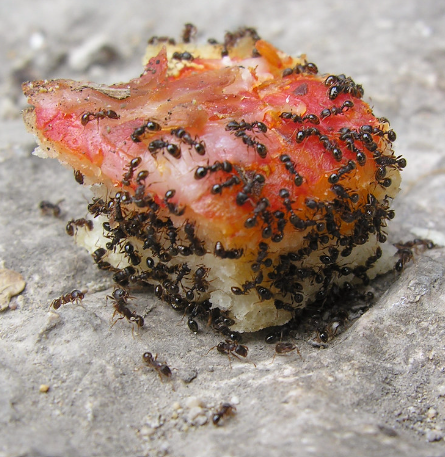
scurrying like ants on an eclair…
the universe, indifferent, looks askance.

This insecure mode breeds defensiveness
and therefore arrogance, not least in poets
who know their work especially valueless…
even to other ants.

*****

I think we poets, who can be so rude about other people, need to be rude about ourselves occasionally. Not that the universe cares one way or the other.

This poem was originally published in The Road Not Taken – A Journal of Formal Poetry – in Fall 2016. Thanks, Dr. Kathryn Jacobs!

Photo: “Ant picnic” by dmcneil is licensed under CC BY-NC-ND 2.0.
Weekend read: Songs as poems: Ned Balbo, ‘Shirts of the Distant Past’

I remember you some mornings in the midst of getting dressed
Surprised that I recall exactly when I wore you last

The paisley patterns spilling over sleeves
The Nehru collars nobody believes
… were popular
The turtlenecks no turtle ever wore
Those V-neck disco shirts that dance no more
… Spectacular!

Are you lurking in the closet among other clothes I own?
I gently touch your shoulder—a brief flash, then you’re gone

The concert souvenir shirts we outgrew
The obligation gifts we always knew
… were wrapped in haste
Thick cotton plaids lost lumberjacks would covet
That college T tossed out, but how we loved it
… still, such a waste

You promised transformation, but what else did you require
The full ensemble led us toward transcendence or desire
(Attire of another age, accessories all the rage)

Bell-bottom flares that took flight as we walked
Embroidered jeans so tight that people talked
… of nothing else
Those bomber jackets earthbound boomers froze in
Those leather wristlets grunge guitar gods posed in
… with death’s head belts

You folded in your fabric everyone I used to be
Now that you’re gone, I realize I’m left with only me
But if I run across you in some thrift shop bargain rack
Or rummaging recycling bins, what else would you bring back?
Who else will you bring back?

Some nights I see you in my dreams of places far away
I’m wearing you as if I haven’t aged a single day
Shirts of the distant past, shirts of the distant past

*****

Ned Balbo writes in Rattle #85, Fall 2024 (where you can hear the song performed): “I’ve played guitar since I was 5, keyboards since I was 13, and ukulele since I was 42, but my time as a ‘professional’ musician—someone paid to play—is scattershot and humble. Ice rinks, a Knights of Columbus Hall, a campers’ convention in Yaphank, a crowd of disco-loving retirees at Montauk’s Atlantic Terrace Motel, company picnics, school dances, private parties, and more—these were where I played guitar, sang, and devised versions of the Beatles, Bowie, et al. in two Long Island cover bands. The Crows’ Nest or Tiffany’s Wine-and-Cheese Café hosted noise-filled solo acoustic gigs, with more receptive listeners for original songs and covers of Elvis Costello or Eno at my undergrad college’s coffeehouse. More recently, I’ve written lyrics to Mark Osteen’s preexisting jazz scores (look for the Cold Spring Jazz Quartet on Spotify, Amazon, CDBaby, and elsewhere) and returned to solo songwriting and recording with ‘ned’s demos’ at Bandcamp. As a relic from the age when lyrics were sometimes scrutinized with poetry’s intensity, I listen closely to the sonics of language, whether sung or spoken, and look up to lyricists whose words come alive both aloud and on the page.”

Balbo: Robin, thanks for posting ‘Shirts from the Distant Past’, my little song-poem hybrid. I’ll be happy to answer any questions you have. 

Editor: For myself, I see a continuum from womb heartbeat to dance to music to song to formal verse.  I would love to have any additional comments on the subject in general, or on the creation of this poem in particular, related to these elements.

Balbo: I love what you’re saying about womb, heartbeat, and dance. A formative text for me is Donald Hall’s essay on poetic form’s psychic origins, ‘Goatfoot, Milktongue, Twinbird‘. You probably know it. Hall proposes three metaphors for poetry’s deepest sources: Goatfoot, the impulse toward dance, rhythm, movement; Milktongue, the pure pleasure of language, the texture of words when spoken; and Twinbird, our desire for form, symmetry, wholeness, which is complicated and energized by the contradictions it contains and reconciles. To me, Hall’s terms just sound like different ways of envisioning exactly what you’re talking about. They apply as much to song as they do to verse. The meter varies by stanza or section: iambic heptameter (seven iambs) in the couplet verses—not so different, after all, from the tetrameter to trimeter shifts we find in many ballads. The “shirts” title refrain, which doesn’t appear in print till the last line, are two trimeter phrases. It was fun to find surprising rhymes to hold the whole song together. 

Editor:  Regarding ‘Shirts’, quite apart from the charming idea, I like the work that has gone into the metre, rhyme, idiosyncratic structure.

Balbo: Thank you. I wrote and sung ‘Shirts’ as a poetic song lyric—one that could be read and enjoyed but, ideally, would be heard. I view its structure as that of a call-and-response song in traditional format.  (In rock, for example, I think of George Harrison’s ‘Taxman’ with John and Paul harmonizing “Taxman, Mr. Wilson, Taxman, Mr. Heath” in answer George’s lead vocal.) In ‘Shirts’, the call-and-response comes from using the title as a refrain: it explains who the “you” is in each verse (when you hear it, anyway—I cut it from the visual text for fear it would seem repetitious without the music). Sometimes the title refrain answers a statement in the verse: “I gently touch your shoulder—a brief flash, then you’re gone” sounds like I might be talking (or singing) about a person, but it turns out to be those long-lost shirts—a playful fake-out.

Then there are the brief call-and-responses of the bridge sections which comment on the previous line or complete an unfinished thought: “Those V-neck disco shirts that dance no more…spectacular!” or “Embroidered jeans so tight that people talked…of nothing else.” They’re in iambic pentameter, with the second and fourth changing to heptameter if we count the two extra beats (set off on their own line) answering them.

The so-called “middle 8” (usually eight bars used to break up the verse-chorus/verse-chorus model) is delayed till just before the end: “You folded in your fabric everyone I used to be, etc.”  That’s meant to set up the payoff: it’s not the shirts but our lost selves— along with loved ones, lost ones, everyone—we’re missing or mourning. But writing or singing about shirts—clothing that shapes and defines us—makes the lyric less depressing, leavens it with wit (I hope) so that what’s more poignant comes at the very end where more dramatic music can counterbalance the mood—the contradictions reconciled, as Donald Hall might have put it.  

Of course, the very end is quieter – wistful again.

As I mentioned in Rattle (thanks again to Tim Green for giving both words and music a home), I grew up in the era when lyrics were often analyzed as seriously as poetry (and not just by undergraduates in long-ago dorm rooms under black light posters). Whether I’m writing poetry or songs, I listen closely to the different ways words sound—what works when sung doesn’t always work as well when spoken or encountered on the page—so when I do write lyrics, I try to make them both readable and singable. 

Poems and song lyrics operate differently, but there’s lots of overlap between them. I wanted ‘Shirts’ to operate on both levels, even if it tilts more toward song lyric than poem. 

*****

Ned Balbo’s six books include The Cylburn Touch-Me-Nots (New Criterion Prize), 3 Nights of the Perseids (Richard Wilbur Award), Lives of the Sleepers (Ernest Sandeen Prize), and The Trials of Edgar Poe and Other Poems (Donald Justice Prize and the Poets’ Prize). He’s received grants or fellowships from the National Endowment for the Arts (translation), the Maryland Arts Council, and the Mid Atlantic Arts Foundation. Balbo has taught at Iowa State University’s MFA program in creative writing and environment and, recently, the Frost Farm and West Chester University poetry conferences. His work appears in Contemporary Catholic Poetry (Paraclete Press), with new poems out or forthcoming in Able Muse, The Common, Interim, Notre Dame Review, and elsewhere. He is married to poet and essayist Jane Satterfield.

Literary: https://nedbalbo.com
Music: https://nedsdemos.bandcamp.com
‘Fluent Phrases in a Silver Chain: on finding poetry in song and song in poetry’ (essay in Literary Matters): https://www.literarymatters.org/14-2-fluent-phrases-in-a-silver-chain-on-finding-poetry-in-song-and-song-in-poetry/

Latest book: The Cylburn Touch-Me-Nots (Criterion Books): https://www.amazon.com/exec/obidos/ASIN/1641770821/thenewcriterio

Photo: “December 22-31, 2009” by osseous is licensed under CC BY 2.0.

Weekend read: Essay: Victoria Moul, ‘On rugby and metre’ (excerpt)

Victoria Moul writes: When I hear or read people — often though not only American “formalists” — discussing “correct” metre in English, and the supposed dominance of accentual-syllabic forms in general and the iambic pentameter in particular, I often think rather impatiently of poets like Arnold and Yeats. Arnold’s verse is musical, highly memorable and — to my ears at least — mostly very straightforward to speak correctly. But it’s often not very iambic at all and he typically uses lines of very varying syllable length. ‘Rugby Chapel’ is a good example of this — its pattern is, technically speaking, more trochaic (rugby) than iambic (endured), the trochaic pattern is established very clearly at the outset (‘Coldly, sadly descends’) and the lines have between six and nine syllables each. If you (inexplicably) wanted to spend an hour “scanning” it you’d find a complex variety of combinations of stressed and unstressed syllables. But its music is easy to hear and read, and very easy to remember, because regardless of the number of the syllables all the lines have three stresses.

Repeated three-stress lines are relatively unusual in English, especially in longer poems, but the four-stress line is very common, perhaps in fact the most natural English line of all, and indeed a lot of so-called iambic pentameter has a tendency to drift towards four rather than five stresses. ‘The Wild Swans at Coole’ establishes an iambic pattern at the outset (‘The trees are in their autumn beauty / The woodland paths are dry’) but is in stanzas of 4/3/4/3/5/3 stresses, with quite varied syllable length and relatively few perfectly iambic lines. Day-Lewis’ poem, by contrast, looks to the eye like it might be iambic pentameter, since the line-length hovers around 10 syllables (ranging from 9 to 12). But most of the lines are spoken naturally with four stresses, not five (‘A sunny day, with leaves just turning’; ‘Wrenched from its orbit, go drifting away’), and only a handful of lines certainly have five.

As far as I know — do comment if you can think of any counter-examples — there are no really good poems about rugby itself, so the poems I discussed today were just those which came into my mind as I watched the practices. None of these English poems are obscure — all are by poets who were considered major in their own lifetime, and all three have been very well-known at some point even if they are not now — and not one of them is in iambic pentameter. In fact, not one of them is obviously in a ‘syllabic’ metre, strictly speaking, at all (as in the familiar statement that traditional English verse is ‘accentual-syllabic’, i.e. where both the number of stresses and the number of syllables are set by the metrical pattern). These poems, like a great deal of English poetry, establish and follow an accentual pattern — of a certain number of stresses in a line, though this too is open to variation — but not, or only very loosely, a syllabic one. Verse of this kind is very common in the English tradition, and the hundred years of poetry between the mid-19th and mid-20th century, even if you set aside the full-blown “modernists” completely, is particularly rich in metrical variety. It is puzzling that this is not better reflected in most discussions of English metre and form. But the best way to get a feel for the actual — rather than imagined — conventions of a literary tradition is, of course, by reading it.

*****

Editor: The passage above is excerpted with permission from a recent Substack post by Victoria Moul in her ‘Horace & friends’ – the full thing is at https://vamoul.substack.com/p/on-rugby-and-metre. In it, with thoughts inspired by watching her nine-year-old son playing rugby, she discusses Cecil Day-Lewis’ ‘Walking Away’, Yeats’ ‘The Wild Swans at Coole’ and Arnold’s ‘Rugby Chapel’. The piece is engaging in several ways, but the point that stands out the most for me is this:
“These poems, like a great deal of English poetry, establish and follow an accentual pattern — of a certain number of stresses in a line, though this too is open to variation — but not, or only very loosely, a syllabic one.”

This is much on my mind when I consider the forms that create formal verse. From my school days on, I have felt that analysing English grammar with Latin rules was wrong, just as straightjacketing English verse into syllabic requirements was not always useful, beautiful or appropriate. English is a Germanic language, and plays effectively by looser accentual rules: perhaps harder to define and analyse, but truer to the work of poetry which is to be word-for-word memorisable. Rhythm is one of the essential tricks of memorisation, along with rhyme, alliteration, assonance and a host of rhetorical tricks; and rhythm plays a variety of casual games. Also, accentual pattern corresponds to the continuum that I see at the root of poetry: from womb heartbeat, to dance, to music, to song, to formal verse. Formal verse is at its best when it is rhythmic and rich in musicality as well as in ideas and images and wordplay. Without the music, without the rhythm, it is prose… no matter how well expressed.

So rap and spoken word are inherently more poetic because more memorisable than 99% of what has been published as ‘poetry’ in the past 50 or 60 years. All songwriters are of course genuine poets – not all are good ones, but Bob Dylan certainly deserves his Nobel Prize (and I wish it could have been shared with Leonard Cohen).

Another point is that French too, and other Romance languages, are more accentual than professors often claim. When Françoise Hardy sang
Tous les garçons et les filles de mon âge
Se promènent dans la rue deux par deux
she was following the accentual beat, not giving every syllable equal weight, and completely skipping a couple of unstressed syllables. (Are French professors still teaching that all syllables have equal weight in French verse? Surely not! I hope that died out some time last century…)

Not all poetry is singable – but at its best it has a musicality that both creates enjoyment and enhances its ease of memorisation.

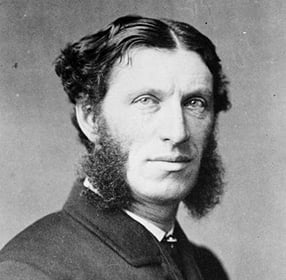
Photo: Matthew Arnold

Poems on poets: ‘Maz’ Griffiths, ‘Lies’

Perhaps it’s true, as Twain implies,
statistics are the greatest lies
but point for point and size for size,
I think they tie for major prize
with poets’ modest little ‘i’s.

*****

Margaret Ann Griffiths, aka Maz, aka Grasshopper, was a British poet known almost exclusively for her online work. In his Preface and Personal Recollection, editor Alan Wickes speaks of her “belligerent modesty” and her lack of interest in the preservation of her verse. In 2008, after winning Eratosphere‘s annual Sonnet Bake-off with “Opening a Jar of Dead Sea Mud” and being praised by Richard Wilbur, she was a Guest Poet on the Academy of American Poets website, where she was hailed as “one of the up-and-coming poets of our time”.

Her poem ‘Lies’ speaks volumes (in a brief space) about the different types of modesty available to creative figures. Her reputation for wit, intelligence, astute criticism and kind-heartedness goes well with her wide-ranging subjects and diverse styles of verse. She was the preeminent English-language online poet of the early 21st century.

Her work was posthumously collected by fans and fellow poets in the 2011 ‘Grasshopper‘ from Arrowhead Press and Able Muse Press.

Photo: “Anjo da Vila, Vila Madalena, São Paulo, Brazil.” by ER’s Eyes – Our planet is beautiful. is licensed under CC BY-NC-SA 2.0.

R.I.P. Ann Drysdale… ‘Weirdness Observed’

What is she doing, the mad old bat,
Down on her knees in the garden?
In her busted boots and her happiness hat
She doesn’t know and she wouldn’t care
That the size of the arse sticking up in the air
Is shading so much of the garden.

She pulls out a weed, the mad old bat,
Out of the face of the garden.
She tuts at the trauma and fusses it flat
While the waste-not weed she will put to use
By turning it into salubrious juice
And giving it back to the garden.

What is she up to, the mad old bat
As she struts, stiff-kneed in the garden
With her doo-dah dog and her galloping cat?
Spreading compost and scattering seed
So one may sprout and the other may feed
In the windmill world of the garden.

She’s a cruel cartoon, is the mad old bat
As she talks to herself in the garden.
What on earth is this? and Good Lord, look at that!
And she squats and she mutters and giggles out loud
And informs her potatoes they’re doing her proud
As she creeps like a crone in the garden.

Where is she going, the mad old bat
As the sunset blesses the garden?
She is going nowhere, and that is that.
She will dig in the dark till the dawn sky pales
And the damp on her knees and the dirt in her nails
Go singing the song of the garden.

*****

Ann Drysdale, who died unexpectedly on August 16th (apparently in her sleep) was a superb poet and self-aware, self-directed, life-rich eccentric lover of the natural world, of gardens, of animals and birds, of unpretentious people in all walks of life. I knew her only through her poetry and our correspondence – which is to say, well enough to deeply regret that I never got to meet her in person.

The poem above was collected in Miss Jekyll’s Gardening Boots, Shoestring Press, 2015; as was the poem that I put up on this blog earlier this month, ‘When Mister Nifty Plays the Bones‘. Here is the bio that she chose to represent herself with:

Ann Drysdale still lives in South Wales. She has been a hill farmer, water-gypsy, newspaper columnist and single parent – not necessarily in that order. She has written all her life; stories, essays, memoir, and a newspaper column that spanned twenty years of an eventful life. Her eighth volume of poetry – Feeling Unusual – came together during the strange times of Coronavirus and celebrates, among other things, the companionship of a wise cat and an imaginary horse.”

She was a much-loved member of the world of (especially formalist) poetry. George Simmers posted her ‘Song of Wandering Annie’ in the Snakeskin blog, and there is a tribute (and an enormous selection of her verse) in The HyperTexts. She was a truly good person.

Odd poem: Parody of a Self-Parody of a Self-Parody: Melissa Balmain, ‘How Unpleasant to Meet Mrs. Hughes’

From the files of Sylvia Plath

How unpleasant to meet Mrs. Hughes,
Who’s so thoroughly, willfully odd.
It’s a wonder Ted happened to choose
Such a creature. (He’s rather a god.)

Her lipstick is always a mess.
She’ll go on for an hour or three
About Nazis or bees—as you’d guess,
This does not get her asked out to tea.

Her headbands aren’t quite comme il faut.
(They’re a match for her queer Yankee frocks.)
She knows more than a lady should know
Of low-voltage electrical shocks.

Come to think of it, lately she’s been
More appalling than ever before.
She looks sullen and terribly thin;
If you knock, she won’t answer the door.

Her complexion grows whiter and whiter.
She wears the most horrible shoes.
You can certainly tell she’s a writer.
How unpleasant to meet Mrs. Hughes!

*****

Melissa Balmain writes: “I believe this one started when a contest—probably in The Spectator—called for poems riffing on Edward Lear’s self-mocking ‘How Pleasant to Know Mr. Lear’ (and T.S. Eliot’s equally self-mocking parody of it). I found it funny and sad to imagine Sylvia Plath writing about how her English neighbors might see her. The poem was published in Mezzo Cammin.”

Melissa Balmain’s third poetry collection, Satan Talks to His Therapist, is available from Paul Dry Books (and from all the usual retail empires). Balmain is the editor-in-chief of Light, America’s longest-running journal of light verse, and has been a member of the University of Rochester’s English Department since 2010.

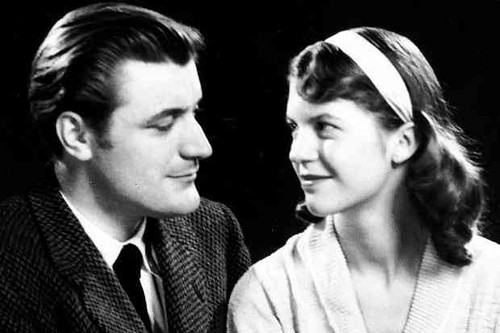
Photo: “TED HUGHES AND SYLVIA PLATH” by summonedbyfells is licensed under CC BY 2.0.

Using form: continued poem: Conor Kelly, ‘Daffodils’

Those daffodils that I recall
While lying on a bed settee
Are faded now, their petals fall
In nature and in memory.

It’s time to rise, to go outside
And head off for a subway ride.
I’m in New York’s YMCA
Undressing for a midday swim;

A poet could not but be gay
With bodies toned up in the gym.
But I am getting no cheap thrills
From dongs like dangling daffodils.

I twinkled at the twinkies there
Tossing their heads in sprightly dance
Or heading for the sauna where
I might get lucky if, by chance,

One of the bronzed and buffed young men
Is eager for my fountain pen.
But, sadly, no one needs to hear
This exiled poet strut his stuff.

I am an old Romantic queer,
Ignored, unloved. I’ve had enough.
I join the hustling New York crowd
And wander lonely as a cloud.

*****

Conor Kelly writes: “Daffodils was submitted as a prompt poem to Rattle (https://www.rattle.com) and was printed in the Summer 2024 issue of the magazine. The prompt was to continue where another poem left off. So I disturbed Wordsworth on the couch where he lay remembering daffodils and sent him on his gay way to modern New York where he had some dubious adventures. I kept the stanzaic form, the metre, the rhyme scheme and even some of the original lines. I left him where he began, wandering lonely as that singular cloud.”

Conor Kelly was born in Dublin and spent his adult life teaching in a school in the city. He now lives in Western Shore, Nova Scotia from where he runs his twitter (X) site, @poemtoday, dedicated to the short poem. He has had poems printed in Irish, British, American, Canadian and Mexican magazines. He was shortlisted for a Hennessy New Irish Writers award. At the ceremony one of the judges, Fay Weldon, asked him, “Where are you in these poems?”  He is still asking himself that same question.

https://www.instagram.com/conorkelly.poems/

Photo: “park, school” by presta is licensed under CC BY-NC 2.0.

Using form: Sonnet: Max Gutmann, ‘How to Inspire a Sonnet – advice from the pros’

Inspire amore first, but molto forte
If in sonetti dolci you’d be sung.
Then see that you stay bella. You’ll support a
Passione deep and long by dying young.
— Laura

If thou upon his stage the Muse’s part
Wouldst play, each act thou study’st must prolong
Thy Poet’s pain. ‘Tis pain shall prompt great Art.
Then con thy lines with style, and do him wrong.
— The Dark Lady

Stay always by her. Never for a day
Be from her cherished side. ‘Tis paramount
To share the highest love. (And, by the way,
It helps to choose a lover who can count.)
— Robert Browning

‘Tis mystery that fires the crucial spark,
So make him wait–and keep him in the dark.
— Milton’s blindness

*****

Max Gutmann writes: “A reader of Light Quarterly (the marvellous Light back in its days as a print journal) was so offended by a poem of mine ridiculing a lousy president that he cancelled his subscription. Beloved editor John Mella forwarded a copy of the note to me. It was a sonnet! I’d never thought I could inspire a sonnet. I had a ways to go before rivaling Laura or the Dark Lady, but I’d taken the first step. That inspired this poem.

“John declined the poem, so it first appeared in a journal that didn’t specialize in light verse, one highly thought of. (Digging it out now, I see that contributors to the issue the poem appeared in included, among others I admire, Updike, Espaillat, Turner, Gioia, and Hadas.) But the journal goofed. They changed sonnetti dolci to sonnetti dolce (plural noun, singular adjective). This must have been a typo, I imagined, but when I asked, the chief editor not only admitted the change had been intentional, but defended the decision. Dolce being the more familiar form, he argued, it was reasonable to make the change without consulting the writer. I never sent them anything again

“This story calls for a shout-out to Jerome Betts, who reprinted ‘How to Inspire a Sonnet’ in Lighten Up Online (LUPO). (To avoid the impression that Jerome is less than meticulous about acknowledgements–or about anything–I should make clear that I asked him not to acknowledge the earlier journal, and I didn’t name it for him.) Jerome, like most editors I’ve worked with, always asks before making changes–and his proposed changes are usually improvements, often big ones!”

Editor’s note: This poem suggests what might be appropriate ways to inspire sonnets, according to the subjects of sonnets: Petrarch’s Laura, Shakespeare’s Dark Lady, Elizabeth Barrett Browning’s Robert and Milton’s blindness. Self-referentially, the poem is itself a Shakespearean sonnet, written in response to being the subject of a sonnet. Gutmann is therefore both sonneteer and sonnetee, and has the credentials to write a “How to –“

Max Gutmann has worked as, among other things, a stage manager, a journalist, a teacher, an editor, a clerk, a factory worker, a community service officer, the business manager of an improv troupe, and a performer in a Daffy Duck costume. Occasionally, he has even earned money writing plays and poems.

Photo: “IMG_0323C Frans Wouters. 1612-1659. Antwerp. The rural concert. 1654. Dole” by jean louis mazieres is licensed under CC BY-NC-SA 2.0.

Amit Majmudar, ‘Nocturne’

“A healthy man can expect to get hard three to five times per night….Doctors call these erections while you sleep “nocturnal penile tumescence.” — Men’s Health

Why do they happen at all, much less
five times a futile night—
nested, within the circadian, their
sprung rhythm of delight?

Unless delight misreads the message.
Unless they choke and strain
against their loneliness like starved
Rottweilers on a chain.

Who visits in the witching hour
as REM begins
and slides her darkling mouth around
his hardening and grins?

Lascivious sylph or cocktease yakshi
or ex from some past life,
coaxing a husband into sin
at arm’s length from his wife.

Or else someone that when awake
he would not dare to daydream,
verboten body, evanescent
pelvis figure-eighting,

or maybe all his fantasies
since age twelve coalesce,
voluptuous ghosts that flash him their
aurora borealis.

A hundred mayflies in his blood
take wing at once above
the hushed and shingled houses, seeking
the ones they shied to love,

desperately swooping down and left,
back up, around, and right,
a minute to mate, then drift and fade
on a humid summer’s night.

*****

Editor’s note: I see this poem, which was first published in Only Poems, as existing where one’s various worlds overlap: the body, the mind, work (Amit Majmudar is a medical doctor), family… Amit Majmudar wisely provides no comment on his poem.

Amit Majmudar is a poet, novelist, essayist, translator, and the former first Poet Laureate of Ohio. He works as a diagnostic and nuclear radiologist and lives in Westerville, Ohio, with his wife and three children. He is the author of twenty books so far in a variety of categories, with different bodies of work published in the United States and in India.
His poetry collections include 0’, 0’ (Northwestern, 2009), shortlisted for the Norma Faber First Book Award, and Heaven and Earth (2011, Storyline Press), which won the Donald Justice Prize. These volumes were followed by Dothead (Knopf, 2016) and What He Did in Solitary (Knopf, 2020). His poems have won the Pushcart Prize and have appeared in the Norton Introduction to LiteratureThe New Yorker, and numerous Best American Poetry anthologies as well as journals and magazines across the United States, UK, India, and Australia. Majmudar also edited, at Knopf’s invitation, a political poetry anthology entitled Resistance, Rebellion, Life: 50 Poems Now.
One of Majmudar’s forthcoming volumes is a hybrid of prose, drama, and poetry, entitled Three Metamorphoses (Orison Books, 2024). A new poetry collection is forthcoming from Knopf in 2026.

For links to Majmudar’s Nonfiction, Fiction, Mythology and Translations, please see his website.

Photo: “I Dream Of Love” by toddwshaffer is licensed under CC BY-NC-ND 2.0.