Jerome Betts, ‘Lines On A Lady In Bronze’

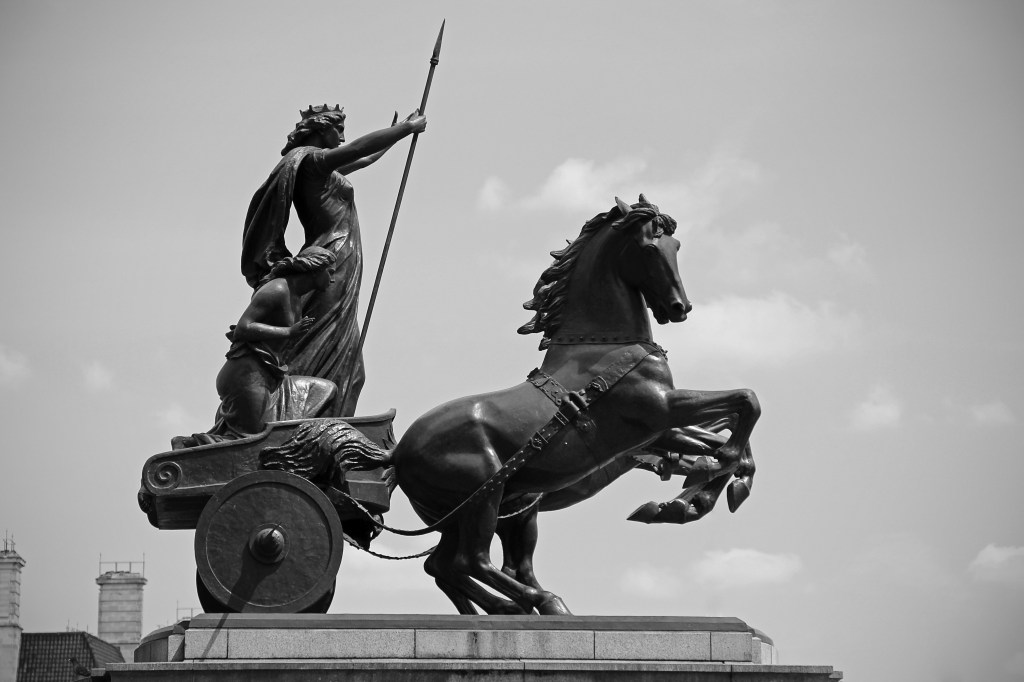
(The statue of Boadicea and her Daughters by Thomas Thornycroft was erected in 1902 near Westminster Bridge London.)

Set up, the civic skyline Shardless,
A proxy late Victoria then,
She charges, rein-free, grim, regardless,
Towards the Gothic giant, Big Ben.

Just what is known about this fiery
And long ago wronged ruler’s life?
Such fields for scholarly enquiry
Are now churned up by toxic strife.

For some, her Roman power rejection
Makes for a memory well kept green,
While others mock as myth-confection
Their proto-Brexit British queen.

Remainers, Leavers, play Have at you!
That chariot and rearing pair
Of  horses make a super statue.
Whoever wins, she’ll still be there.

*****

Jerome Betts writes: “I find statues fascinating with their largely unchanging nature as the people and scenes around them change and they make an obvious target for revolutionaries, rowdies and rhymers. Boadicea, unveiled without ceremony in 1902 because of Edward the 7th’s appendicitis, strikes me as a splendid piece of slightly unhistorical sculpture and useful landmark for visitors. Amusement at her lack of reins and apparent charge towards the Palace of Westminster blended with the Brexit debate when the piece was published in Better Than Starbucks. Whether this dooms the last two stanzas to the archives remains to be seen.”

Jerome Betts lives in Devon, England, where he edits the quarterly Lighten Up Online. Pushcart-nominated twice, his verse has appeared in a wide variety of UK publications and in anthologies such as Love Affairs At The Villa NelleLimerick Nation, The Potcake Chapbooks 1, 2 and 12, and Beth Houston’s three Extreme collections. British, European, and North American web venues include Amsterdam QuarterlyBetter Than StarbucksLightThe Asses of ParnassusThe HypertextsThe New Verse News, and Snakeskin.

Photo: “Boadicea Statuary Group” by Rafesmar is licensed under CC BY-SA 3.0.

Using form: RHL, ‘(on the value of learning languages when) Roughing It In Europe’

One two three four
Is OK, but you need more:

Un deux trois quat’
If you want a welcome mat

En to tre fire
With the krone getting dearer,

Bir iki uç dirt
Selling off your jeans or shirt

Wahid zoozh teleta arba
In a cafe by the harbour

Üks kaks kolm neli
For some food to fill your belly;

Jeden dwa trzy cztery
Language may be shaky, very,

Uno dos tres cuatro
But they’ll love you if you’re up to

Eins zwei drei vier
Trying freely, laughing freer.

*****

This is one of my youthful hitchhiking days poems… It has just been republished in Firewords Campfire, but was originally in Unsplendid (and then in Better Than Starbucks, and Orchards Poetry Journal).

Firewords paired it with a short story, and commented they were “very different adventures, both centred on the art of connection: one through clumsy but charming attempts to bridge language gaps abroad, the other via a game that becomes a quiet battleground for attention, memory, and something close to intimacy. In both, every word counts.” It is always interesting to hear other people’s takes.

Artwork by Jay Carter, an illustrator from Lancashire who enjoys creating bold, colourful images, often finding inspiration in books, films, history, nature and travel. jaycarterillustrator.com

RHL, ‘Raised by Expatriates’

When I was young, best thing I’d seen
was Morgan’s fort gone under green
in jungled Panama.
The only flags in forests there
were what leaf-cutting ants could bear:
for planet’s anima.

I touched skulls resting in plain view
in empty deserts in Peru:
mud walls stood rainlessly.
I sailed on seas beyond all land,
stood with a sloth, yes, hand in hand,
saw men drink sugared sea.

I learned to bodysurf in waves;
I climbed cliffs, and saw bats in caves,
saw beaches of pink sand.
Result? I always loved to roam
but nowhere lets me call it home,
All lands are not my land.

Some places I’m a citizen
but never been a denizen;
with others, the reverse:
the places that I’ve lived in most
ignore me like an unseen ghost,
foreign, vague-skinned, perverse.

The wind has blown me since my birth,
my home is nowhere on the earth,
from place to place I roam.
My parentage determined that
my citizenship’s “Expatriate”…
so… everywhere is home.

*****

Not all my poems are autobiographical, even if first-person. This one is. It was published recently in the Amsterdam Quarterly (thanks, Bryan R. Monte!)

A.E. Stallings, ‘Anosmia’

Without it, what is lemon, what is mint? –
Coffee and chocolate, caffeinated brown.
Ghosted by a sense that takes no hint,
I feel let down.

It’s hardly tragedy that I can’t tell
The milk’s gone off, eggs rotten. It’s no joke
With other things though – no internal bell
That signals smoke

(The toast burned or the house on fire). Sweet
I have, and bitter, I have sour and salt,
But without smell, no flavour is complete.
There’s no … gestalt.

It’s something I’d predict of old, old age,
This weaning from the welter of the world
The better, perhaps, to leave it. I’m no sage,
I’d rather the impearled

Jasmine flowers – fragrance of the stars –
Light up the brain’s grey matter, and the hurt
Of memory, the human musk of ours
In an unwashed shirt.

‘To have a nose for’– isn’t it a skill,
A wry intelligence, a kind of knack?
What thought trails do I lose, untraceable,
What wisdom lack?

I miss the laundry scent they call ‘unscented’.
Like a depression, it makes it hard to write.
What is is less, less there, half uninvented,
And I, not quite.

But there are days I almost have a whiff:
I slice a lemon open for the crisp
Sun-saturated redolence, and sniff
And stand in the eclipse.

*****

A.E. Stallings writes: “My sense of smell is coming back gradually, but it was completely wiped out for about six months! Unnerving.”

‘Anosmia’ was first published in the London Review of Books.

A.E. Stallings is the current Oxford Professor of Poetry. This Afterlife: Selected Poems was published in 2022. Her forthcoming book is Frieze Frame: How Poets, Painters, and their Friends Framed the Debate Around Elgin and the Marbles of the Parthenon

Smell” by Dennis Wong is licensed under CC BY 2.0.

Political poem: Michael R. Burch, ‘Not Elves, Exactly’

after Robert Frost’s “Mending Wall”

Something there is that likes a wall,
that likes it spiked and likes it tall,

that likes its pikes’ sharp rows of teeth
and doesn’t mind its victims’ grief

(wherever they come from, far or wide)
as long as they fall on the other side.

*****

Michael R. Burch writes: “Many people misunderstand the most famous phrase in Robert Frost’s poem ‘Mending Wall.’ In the poem Frost’s neighbor quotes his father’s adage that “Good fences make good neighbors” as they work together to repair an unnecessary wall on the border of their properties. Talk about a misunderstanding: this phrase has even been used by politicians to justify apartheid walls and similar barriers! But Frost did not share his neighbor’s belief and compared him to a stone-armed savage who moved in primitive darkness and could not go beyond his father’s saying. Frost’s own belief about such walls was expressed in the poem: “Before I built a wall I’d ask to know / What I was walling in or walling out / And to whom I was like to give offense.” At the end of the poem, Frost considers teasing his neighbor with the idea that mischievous elves are responsible for the wall falling down, but decides to hold his peace. My title questions who builds such walls: ‘Not Elves, Exactly’ but something much darker and more ominous.”

Michael R. Burch’s poems have been published by hundreds of literary journals, taught in high schools and colleges, translated into 22 languages, incorporated into three plays and four operas, and set to music, from swamp blues to classical, 61 times by 32 composers. He is also the founder and editor-in-chief of The HyperTexts.

The Wall Has Spikes” by Kevan is licensed under CC BY 2.0.

Max Gutmann: Planet of Love

Venus, our neighbor that lies toward the sun,
    Is a sultry and amorous spot;
The astrologers tell us our passion and fun
   Are engendered right there, where it’s hot.

She’s the brightest of stars yet she’s hidden in cloud,
  So her pull on our psyches is double,
An enticing enigma concealed in her shroud
  And, like all such allurements, big trouble.

To the faithfully married, the word from above
  About passionate partnership stings.
There’s a planet we’re told governs all earthly love,
   And it isn’t the one with the rings.

*****

Max Gutmann writes: “I’m afraid I can’t think of anything interesting to say about ‘Planet of Love,’ which exists to support its punchline. The joke popped into my mind, so I wrote the poem.”

‘Planet of Love’ was published in the March 2025 issue of Lighten Up Online.

Max Gutmann has contributed to New StatesmanAble MuseCricket, and other publications. His plays have appeared throughout the U.S. (see maxgutmann.com). His book There Was a Young Girl from Verona sold several copies.

Photo: “Venus” by katmary is licensed under CC BY 2.0.

Michael R. Burch, ‘Funding Fundamentals’

“I found out that I was a Christian for revenue only and I could not bear the thought of that, it was so ignoble.” — Mark Twain

Making sense from nonsense is quite sensible! Suppose
you’re running low on moolah, need some cash to paint your toes …
Just invent a new religion; claim it saves lost souls from hell;
have the converts write you checks; take major debit cards as well;
take MasterCard and Visa and good-as-gold Amex;
hell, lend and charge them interest, whether payday loan or flex.
Thus out of perfect nonsense, glittery ores of this great mine,
you’ll earn an easy living and your toes will truly shine!

*****

Originally published by Lighten Up Online. NOTE: A flex loan is a payday loan with a “personal line of credit” that makes it even harder to pay off than traditional payday loans. Caveat emptor.

Michael R. Burch writes: “Living in allegedly ‘Christian America’ where 80% of evangelicals voted for the Antichrist Trump, I am forced to resort to foxhole humor. ‘Funding Fundamentals’ is tongue-in-cheek foxhole humor, but I think we would be better off forming our own religions than donating money to false profits like the bible-hawking Trump and his cronies.”

Michael R. Burch’s poems have been published by hundreds of literary journals, taught in high schools and colleges, translated into 22 languages, incorporated into three plays and four operas, and set to music, from swamp blues to classical, 61 times by 32 composers. He is also the founder and editor-in-chief of The HyperTexts.

Ruth S. Baker, ‘Moneykind’

That kind of money is swishy and flashy.
That kind of money’s a bore, I find;
That kind of money is fishy and splashy.
That kind of money is not my kind.

My kind of money is somewhat quieter.
My kind of money won’t hog the stage.
My kind of money’s a long-term dieter:
My kind of money is slim for its age.

That kind of money is horribly tethering.
That kind of money one’s better without.
My kind of money’s enough for anything.
(Anything more I’ve forgotten about.)  

*****

‘Moneykind’ was originally published in The Asses of Parnassus. Ruth S. Baker writes: “It was triggered really just by catching myself out trying to feel superior to people with that kind of money!  As for bio, I’ve published in a few journals on line, mostly on animals and visual art.”

Photo: “Cooperate game companies have too much money and control of the market” by The People Speak is licensed under CC BY-NC 2.0.

Brooke Clark, ‘Letter from an Unknown Writer’

We met one night at a book launch,
we drank, we talked, we laughed,
I said, “I’m writing a novel,”
and you said, “Send me a draft.”

So I sent it to your address
hoping a well-placed word
from you would get me started;
I waited, but never heard.

Now you’ve published your latest
and the critics fellate you in print,
it’s a runaway bestseller
and Hollywood’s taken the hint.

I read it myself last weekend
and my entrails turned to stone—
my book, but so badly rewritten
you’d almost made it your own.

*****

Brooke Clark writes: “This two-liner by Martial (Epigrams I.38) is the basis of my poem:
quem recitas meus est, o Fidentine, libellus:
sed male cum recitas, incipit esse tuus.
(The book you’re reciting is mine, Fidentinus; but when you recite it badly, it begins to be yours.)
Originally read in Wheelock’s Latin, I think, when I was learning the language, this was one of the first versions of Martial I did that I was happy with. I obviously expanded it greatly (I hadn’t learned to appreciate Martial’s concision) but I liked the swingy rhythm and the treatment of it as a mini-narrative that I landed on. Also one of the first epigrams I published, in Light, which gave me some confidence that the project of turning ancient epigrams into contemporary poems might be worth pursuing.”

Brooke Clark is the author of the poetry collection Urbanities and has published work in ArionLiterary ImaginationTHINKThe WalrusLA Review of Books, and other places. He is also the editor of the online epigrams journal The Asses of Parnassus and the book reviews editor at Able Muse.
Twitter: @thatbrookeclark
Bluesky: @brookeclark.bsky.social

Photo: “Treasures of Ushaw Book Launch in Westminster” by Catholic Church (England and Wales) is licensed under CC BY-NC-SA 2.0.

Political poem: Janet Kenny, ‘Broken’

The pig smashed the music
and turned off the sun.
As the pig couldn’t use it
nor should anyone.

O remember the time when the violins played
and the meadows were blooming and we, unafraid
dared to splash in the river and lie in the grass.
But they’re mowing the field now and scattering glass.

The mother in China,
the daughter in Spain,
must learn to design a
new habit again.

The athletes are anxious, the singers are dumb,
the children are fractious and calling for Mum.
Now Dad is in futures and selling his shares
and his foreign computers are yesterday’s wares.

Who let the pig loose
in the garden? and why
have we cooked our own goose?
I await a reply.

*****

This poem was originally published on Facebook. Concerning the trigger for creating it, Janet Kenny writes: “The only event was the world economy being interfered with by the folly of one awful man. One ignorant bully can dismantle the world.”

Janet Kenny left New Zealand to pursue a career as an operatic and concert singer in London, then settled in Sydney, Australia, where she worked in the anti-nuclear movement and jointly compiled, wrote and edited a book about the nuclear industry, Beyond Chernobyl, published by Envirobook in 1993.

Her poems have been published in printed and online journals, including AvatarThe ChimaeraFolly14 by 14Iambs & TrocheesThe Literary ReviewMi PoesiasThe GuardianThe SpectatorThe New FormalistThe Barefoot MuseThe Raintown ReviewThe Shit Creek ReviewSnakeskinLavender ReviewSoundz ineVictorian Violet PressThe Susquehanna Quarterly and Umbrella. Her work is in the collections The Book of Hope and Filled With Breath: 30 sonnets by 30 poets and in the Outer Space anthology, Cambridge University Press. She shared an anthology of bird poems, Passing Through, with Jerry H. Jenkins. She has received three Pushcart nominations.

Her latest book, Whistling in the Dark (2016, Kelsay Books) can be ordered from https://www.amazon.com/Whistling-Dark-Janet-Kenny/dp/1945752092. Her previous book, This Way to the Exit (White Violet Press), can be ordered from http://www.amazon.com/This-Way-Exit-Janet-Kenny/dp/0615615937. You can read several poems from her books at https://janetkenny.netpublish.net/

Photo: “Pig-hog” by Kusukhtak is licensed under CC BY 3.0.