Poem: ‘The Divine Moon’

Do you remember when we used the Moon
To measure menses, measure time by month?
We’d found the Moon determined tides and blood,
So planted crops and children by its tides.

From tribal gods of weather, waves and war
We groped, pre-Science, through theology,
Trying to grasp the world and life and death,
Leaving the worship of the moon behind.

The atheist Gagarin, first to heaven,
Noted he didn’t see a God up there.
American believers, first to the Moon,
Quietly said nothing, and moved on.

Now city kids may never have seen stars…
Soon satellites will blanket the night sky…
With skyless nights, why should we still use months?
And when in space, why months? Or days? Why years?

Not knowing where we’re headed, all we know:
That god or goddess Moon’s left far behind.

This poem was published in the latest issue of Sally Long’s biannual Allegro Poetry Magazine. The issue has a theme of ‘Geography’, so the subjects range from the gardens at Stowe to the aftermath of Hiroshima. Perhaps the moon is in itself a little outside the Earth-bound definition of geography, but as it has always been such a big part of our lives on this planet I think it’s fair to include it. And people have been there, and will go again. And our attitudes to the Moon and Heaven and Earth will keep on evolving as humans themselves will change, moving forward in unknowable time and space.

The poem is in iambic pentameter, but lacks the rhyme and wordplay that I advocate for poetry. I thought of trying to shrink it down from 18 lines to a sonnet’s 14, which is a trick I’ve used before to make myself find rhymes and generally tighten up a poem; but in this case I couldn’t see which blocks of four lines I could combine, eliminate or otherwise reduce – they all seemed necessary, and hard to shrink. I hadn’t thought of going for four blocks of three lines each, with a concluding couplet… but that might provide a solution, if I feel up to attempting it for a couple of hours.

Meanwhile, if you’ve never seen Georges Melies’ 12-minute 1902 movie ‘Le Voyage dans la Lune’, here it is with an electronic soundtrack by Andreas Brink. Yes, our ideas about the moon keep changing…
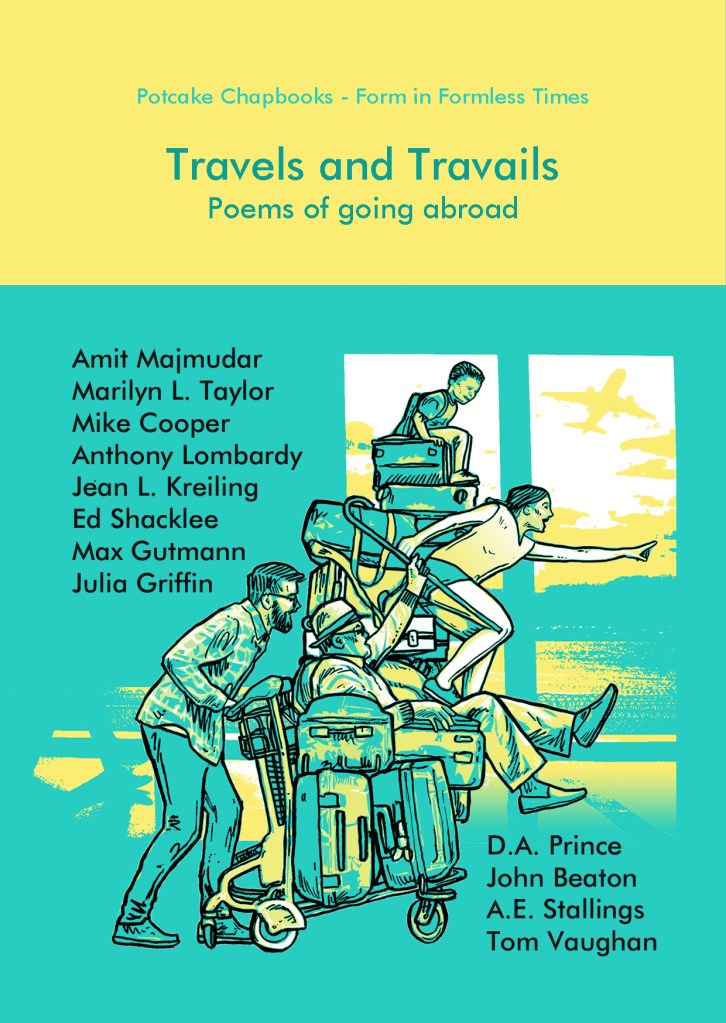
Launch: Potcake Chapbook 10, ‘Travels and Travails’

Maybe it’s just wishful thinking, but surely we’re going to get back to casual international travel again some day soon? The 10th chapbook in the Potcake series is now being mailed out from London, and I trust it augurs well for the happily peripatetic. As usual, the chapbook contains an assortment of the bright (D.A. Prince), the dark (Tom Vaughan) and the flippant (Max Gutmann), with everything in between, and all in rhythm and rhyme–and illustrated of course by Alban Low!

Returning poets are A.E. Stallings, John Beaton, Julia Griffin, Anthony Lombardy, Marilyn L. Taylor, D.A. Prince and Tom Vaughan; joining them are Amit Majmudar, Mike Cooper, Jean L. Kreiling, Ed Shacklee and Max Gutmann. (The links in the names are a mixture of websites, bios, and places to buy their books.) Most, but not all, of the poets are listed on Sampson Low’s webpage of Potcake Poets.

Let’s get everyone vaccinated so we can all start travelling again!

Short Poem: ‘Cultural Field Trip’

Properly stroppily,
Off to Thermopylae
Busloads of schoolchildren
Grudgingly go;
Hoovered, manoeuvred
Off into the Louvre’d
Be better for profs who are
Trudgingly slow.

No, I agree, that’s not a true Double Dactyl because it doesn’t have a single-word double dactyl line. It’s just one of those poems I’ve written for no other purpose than to play with rhymes. The poem was published in this month’s Snakeskin, editor George Simmers privately commenting: “As an ex-teacher I empathise with the trudging profs.”

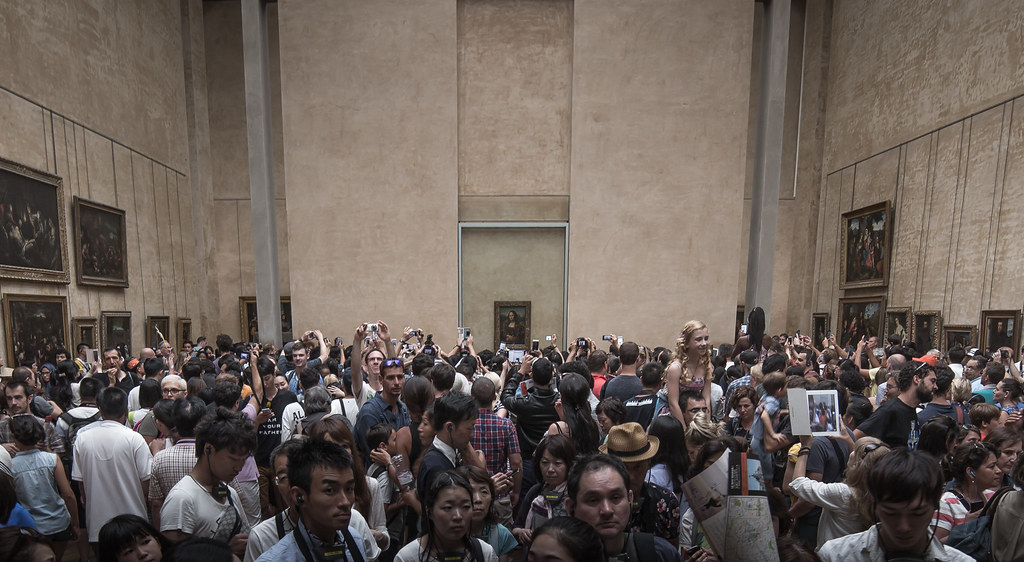
“Mona Lisa Madness” by Joe Parks is licensed under CC BY-NC 2.0

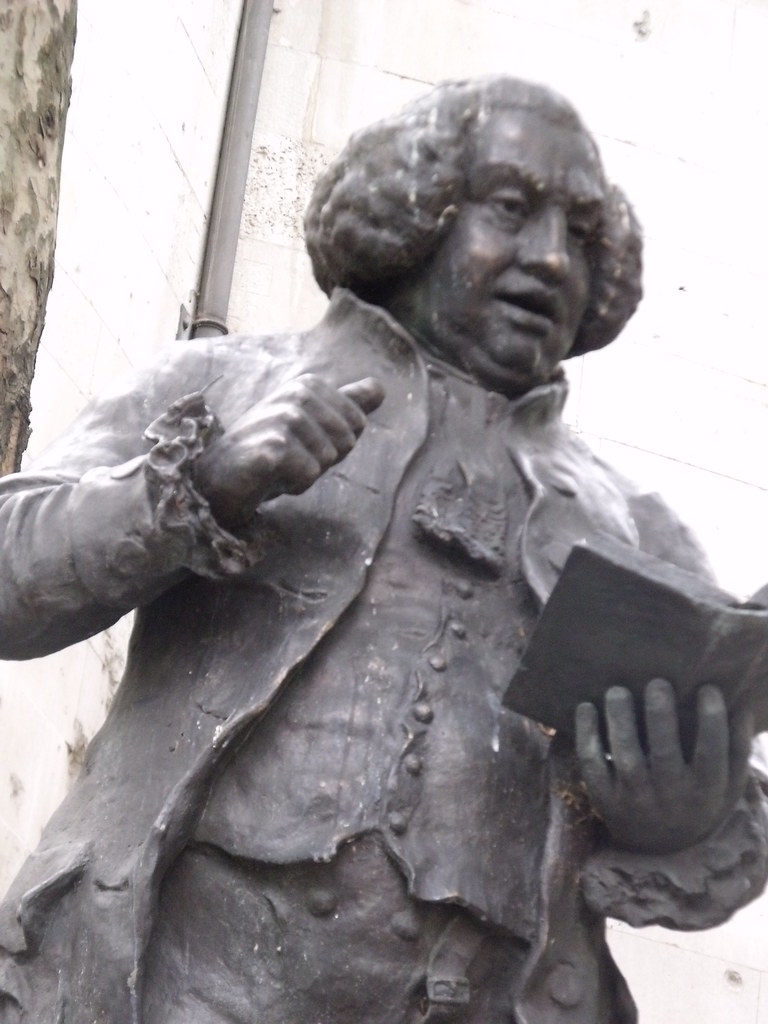
Odd poem: Samuel Johnson on wordplay

If I were to be punishèd
For every pun I shed
There would be no puny shed
For my punnish head.

Strictly speaking, of course, this isn’t a poem–it was merely an apparently spontaneous reply (but how many “spontaneous” remarks have been thought of and prepared in advance?)

The story was told in the following way:– “Sir,” said Johnson, “I hate a pun. A man who would perpetrate a pun would have little hesitation in picking a pocket.” Upon this Boswell hinted that his “illustrious” friend’s dislike to this species of small wit might arise from his inability to play upon words. “Sir,” roared Johnson, “if I were punishèd for every pun I shed, there would not be left a puny shed of my punnish head.”

The moral of the story was presumably for Boswell and others to guard their possessions when Doctor Johnson was around…

“statue of Samuel Johnson outside St Clement Danes Church” by ell brown is licensed under CC BY 2.0

Short Poem: ‘Old Soldiers’

Sitting blowing bubbles
Each one a tiny world
Of monumental troubles
And how they all unfurled.

“The desert, Cairo, jaunty,
A blue room and whore –
And so I said to Monty –
And so we won the War!”

Bernard Law Montgomery, afterwards Viscount Montgomery of Alamein, was Britain’s star commander of the Second World War. “Unbeatable and unbearable” from North Africa to northwest Europe where he had control of all Allied land forces under Eisenhower, he was the figure that British veterans tended to suggest that they had had some useful contact with.

Always arrogant, opinionated and outspoken, he later opposed American tactics in the Vietnam War, as in the New York Times in 1968: “The United States has broken the second rule of war. That is: don’t go fighting with your land army on the mainland in Asia. Rule one is, don’t march on Moscow. I developed those two rules myself.” Familiar enough to fans of Risk and Civilization and The Princess Bride…

“Two Old Soldiers” by jf01350 is licensed under CC BY-NC-SA 2.0

Sonnet: ‘One True Religions’

No vision brings the whole world to its knees.
Jains, Hindus, Buddhists, Mithraists, Parsees,
Moses, Muhammad, Jesus or St. Paul,
One True Religions never conquer all.
Humans are simply too cantankerous
for any one belief to anchor us.

Success at once leads into sects and schisms:
the One Pure Ray of Light hits human prisms,
and egos, power grabs, love of dispute,
traditions, curiosity, all loot
the intellectual wealth of strong belief.
This year’s great guru’s merely last year’s thief.

Control’s maintained by sword and flame, not thought.
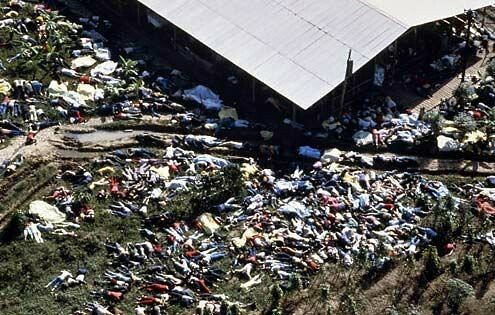
In failure, drink the Kool Aid or get shot.

Well, maybe 14 lines rhymed in pairs isn’t really a sonnet, even if it’s in iambic pentameter. But when you’ve got a structure that works for a poem, I don’t think it’s worth trying to hammer it into a different shape just to try to reach a “higher” standard. Anyway, sonnet or not this poem was published in Rat’s Ass Review – as you could guess from the journal’s name, editor Roderick Bates publishes whatever appeals to him, with no apologies for treading on other people’s sensibilities, religious, poetic or anything else. It’s a good place to submit a poem that other journals might be squeamish about, and a good place to read a wide range of outspoken poetry.

“Jonestown massacre” by johndavison883 is marked with CC PDM 1.0

Evocative Fragments: Edward Lear

When awful darkness and silence reign
Over the great Gromboolian plain,
Through the long, long wintry nights; —
When the angry breakers roar
As they beat on the rocky shore; —
When Storm-clouds brood on the towering heights
Of the Hills of the Chankly Bore: —

Then, through the vast and gloomy dark,
There moves what seems a fiery spark,
A lonely spark with silvery rays
Piercing the coal-black night, —
A Meteor strange and bright: —
Hither and thither the vision strays,
A single lurid light.

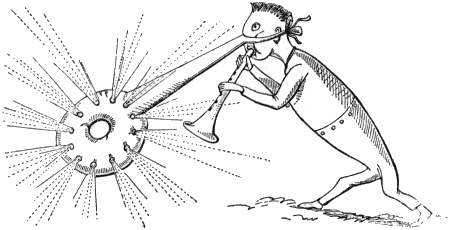
It is, of course, the Dong With a Luminous Nose, wandering crazed through the forests seeking the Jumblie Girl he fell in love with. Edward Lear’s verse is known for its frivolous characters, actions and names, and his scribbly little drawings. But ignore the drawing and note the skill and control, the emotional pull, of the two stanzas above (even if he does sabotage them with words like “Gromboolian”). Similarly he was a remarkable artist when he wanted to be: one of the world’s great ornithological painters, a wonderful landscape artist, and well-enough respected to have given Queen Victoria a dozen lessons in drawing and watercolours in 1846.

Nonsense poetry in itself is a wonderful way to introduce children to literature, if it is handled as skilfully and, yes, emotionally as Lear does with his nonsense poems of travel, romance, heartbreak, and finding (or failing to find) lasting happiness.

Poem: ‘The Future as CDG Terminal 1’

The future is a long low passage,
Whitewashed, undulating,
A moving forward-flowing track,
No chance of going back.

The future has no message,
Its ads are guides only to the past,
Misleaders, redesignposts,
Echoes, undefined ghosts.

The future is travelled without presage,
Always onward, none comes back.
Predestination without destination.
Stationary or walking, you’ve no final station.

The future goes on until you get off.
I won’t. I will not to get off.

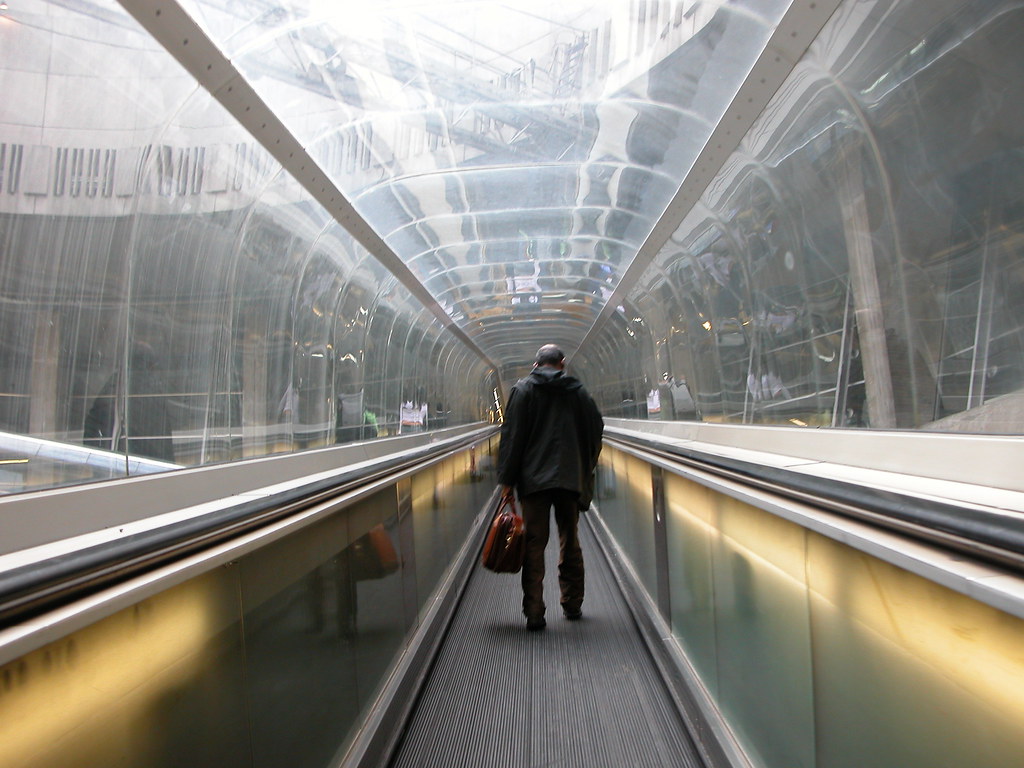
This poem (set in Charles de Gaulle airport’s people-mover) is halfway to being a sonnet: it has three sets of four lines and a final couplet, and its lines are not far from being tetrameters or pentameters. But the rhyme scheme is idiosyncratic: abcc adee afgg hh. But even that is being kind: the last couplet doesn’t rhyme, it just repeats its end words.

And yet, mishmash though it is, it was published in The Rotary Dial, Canada’s leading formal poetry publication for the few years of its incandescent life. So perhaps it is at least semi-formal poetry.

“sba-cdg85” by dsearls is licensed under CC BY 2.0

Sonnet: ‘Maya’

When God took Time to spin a length of Matter,
And, nothing at each end, tied the ends together,
He held between his fingers and surveyed
The first cat’s-cradle, and since then has played.

Flames flicker, flare, re-form as a friend’s face;
Dogs mime all features of the human race;
The willow weaves a walker from the air;
All Nature helps us see things that aren’t there.

To read Life’s Meanings, we must write the text:
What’s Right one day is often Wrong the next –
I’m rich or poor only as I profess,
Must ask your love or hate, for you can’t guess.

If love’s illusion, so are hate and fear…
Why not choose love?, when it’s so great, and near?!

Reareading this poem after a number of years, I have my doubts about it. It seems to start strong, and ends weak. What to do about a poem like that? The stuff about Maya, the illusory nature of the universe, is OK; but maybe cut it off after eight lines, before it starts preaching. But then maybe it would be lacking an ending, and I’d have to come up with something better than what’s there now.

As it is, it was first published in the defunct ‘Rubies in the Darkness’, and republished in India’s ‘Metverse Muse’. But I’m not happy with the poem…

“Cat’s Cradle by N.O. Bonzo” by wiredforlego is licensed under CC BY-NC 2.0

Short Poem: ‘Young Men Go Off To War’

Young men go off to war
And score
Deaths, rapes, across an alien nation
Which they chimp-like can revel in –
Which they in later years regret,
Never discuss, never forget.

The one thing that Donald Trump and Joe Biden could agree on: get out of the trillion-dollar waste of Afghanistan. Trump had Pompeo negotiate with the Taliban–the US would leave in 2021 so long as the Taliban didn’t kill any more US personnel; he presumably wanted to wait until the 2020 election was over, because the withdrawal might be chaotic and would look bad anyway. Biden stuck with the Trump agreement, and his calculation must be that, messy or not, hopefully it will be ancient history by the 2024 election.

You can’t fault the US for wanting to go after Osama Bin Laden after 9/11… but that’s separate from trying to stay and nation-build a supremely difficult and corrupt country. And it was probably not criminal under international law, whereas the subsequent Iraq invasion *was* illegal and breached the UN Charter, as Secretary-General Kofi Annan said. Bush, Cheney, Rumsfeld, Wolfowitz (and Tony Blair)… many people see them all as war criminals, unpunished, and leaving their front-line pawns (if they survived) to live with guilt and PTSD.

The American defeat in Vietnam turned out to be very good for the Vietnamese. Let’s just hope things turn out well for the Afghans. And congratulations to Joe Biden for getting the US out – you can’t impose human rights on a corrupt tribal society by invasion. It doesn’t work like that. There are far more constructive ways to approach international human rights issues… like cleaning your own house first.

This poem was published by Visions International, a poetry journal with perhaps a brighter past than present.

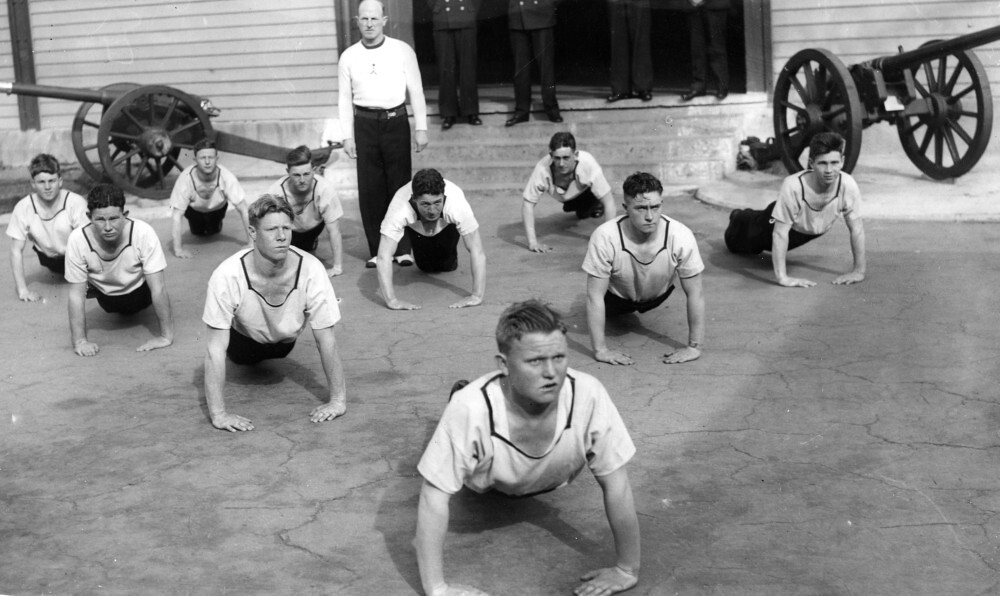
“New recruits at physical jerks – Flinders” by State Library Victoria Collections is licensed under CC BY-NC 2.0